Introduction
Many small to mid-size businesses face the same challenge: how do you train employees effectively while managing tight budgets and avoiding productivity disruptions?
Traditional classroom training pulls your team away from work for hours or days at a time. Purely online courses often suffer from low completion rates and limited engagement.
Corporate blended learning offers a practical middle ground. This article defines blended learning and explains why it works for growing businesses. It also covers proven models, practical steps to get started, and how to handle common obstacles small businesses face.
Key Takeaways
- Blended learning combines self-paced digital content with live instructor-led sessions
- Improves training completion rates while cutting travel and venue costs
- Growing organizations increasingly treat blended learning as standard training practice
- Four core models give you flexibility to match training format to your specific business needs
- Starting with a pilot program lets you refine your approach before committing to full-scale implementation
What Is Corporate Blended Learning?
Corporate blended learning is an instructional approach that combines self-paced digital learning with instructor-led training, delivered either in person or virtually. According to the Association for Talent Development (ATD), it's the combination of formal and informal learning events designed to achieve specific training objectives.
Many employers struggle to keep training consistent when teams are busy, remote, or split across locations. The key distinction: you assign each topic to the format that best supports the objective—foundational content online, live time for practice, discussion, and feedback.
How It Differs from Other Training Approaches
Blended learning vs. pure e-learning:
- Pure e-learning is 100% digital with no live interaction
- Blended learning adds scheduled live sessions for discussion, practice, and feedback
- The live component creates accountability that improves completion rates
Blended learning vs. traditional classroom training:
- Traditional training is all in-person with no digital component
- Blended learning moves foundational content online, freeing live time for application and problem-solving
- Employees can revisit digital materials anytime instead of relying only on what they remember from class
Typical Structure
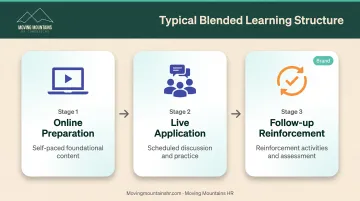
The most common structure follows this pattern:
- Online preparation - Employees complete foundational content at their own pace (videos, readings, interactive modules)
- Live application - Teams participate in scheduled sessions for discussion, case studies, and hands-on practice
- Follow-up reinforcement - Additional online activities reinforce concepts and measure retention
Simple example: Employees watch compliance training videos covering company policies and regulations online. They then attend a workshop to discuss real workplace scenarios, ask questions, and practice applying the rules to situations they encounter in their roles.
Why Blended Learning Works for Small to Mid-Size Businesses
Flexibility and Scale Across Locations
Blended learning fits different employee schedules, learning styles, and locations without gathering everyone in one place at once. Your sales team in one city, operations staff in another, and remote employees can complete the same online content. They then join live sessions virtually or attend local in-person sessions built around their needs.
The same model scales as you grow. Small businesses can train teams across multiple sites with one core online curriculum while customizing live sessions locally—and add participants without a matching jump in cost or logistics.
Cost Advantages That Add Up Quickly
The format reduces or eliminates several major training expenses:
- Cuts travel costs when employees complete foundational content locally
- Shrinks venue needs because live sessions run shorter
- Replaces most printed handouts with digital materials
Online modules spread development costs across many learners and training cycles. Once you build solid digital content, you can reuse it across departments and update it more cheaply than reprinting materials.
Better Retention and Engagement
Research shows that adding live group sessions to web-based training improves completion. In a 2023 workplace study, employees using blended learning had a 34.2% dropout rate compared to 46.0% for web-only training, with compliance rates of 99.3% versus 89.1%.
The mix works because:
- Self-paced theory lets employees learn at their own speed
- Spaced repetition reinforces concepts over time
- Hands-on practice in live sessions moves knowledge into application
Varied formats also hold attention better than single-format training:
- Videos break up dense written content
- Interactive exercises give immediate feedback
- Live discussions create peer learning opportunities
- Gamification adds competition and achievement
Those results help explain why the format keeps spreading. According to ATD's 2024 survey of 360 talent-development professionals, 71% reported that at least half of organizational learning was blended, and about 75% said use had increased over the previous two years.

The Four Main Blended Learning Models for Corporate Training
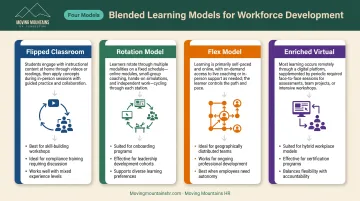
Corporate training typically uses one of four blended learning models. Each mixes online and live elements differently based on team structure, content complexity, and business goals.
Flipped Classroom Model
How it works: Employees complete online content before live sessions to build foundational knowledge. Videos, readings, and modules introduce concepts, definitions, and procedures. Live sessions then focus on application—discussion, case studies, and problem-solving.
Best applications:
- Leadership training that requires guided practice
- Complex technical skills needing hands-on work
- Scenarios requiring discussion and group problem-solving
Example: Before a management training session, new supervisors watch videos covering performance review frameworks and documentation requirements. The live workshop devotes all its time to practicing difficult conversations, reviewing sample scenarios, and role-playing feedback discussions.
Rotation Model
How it works: Employees move between online activities, instructor-led sessions, and collaborative work on a structured schedule. Two variations exist:
- Station rotation - Everyone follows the same sequence through different learning activities
- Individual rotation - Each learner follows a path personalized by role, skill level, or progress
Best applications:
- Comprehensive onboarding programs covering multiple topics
- Structured skills development with clear progression
- Training that benefits from peer collaboration and individual practice
Example: New hires spend week one completing online modules about company culture, policies, and systems. Week two includes daily rotations between department shadowing, hands-on system training, and collaborative project work with their onboarding cohort.
Flex Model
How it works: Learning happens primarily through self-paced online content with instructors available for support, coaching, and scheduled check-ins when needed. Regular checkpoints keep it from turning into passive e-learning and hold people accountable for progress.
Best applications:
- Distributed teams across multiple time zones
- Certification programs with defined learning outcomes
- Continuous professional development that employees complete alongside daily work
Example: Employees working toward professional certification complete online courses at their own pace. They schedule one-on-one coaching sessions with subject-matter experts when they need clarification, and attend monthly group check-ins to discuss progress and share challenges.
Enriched Virtual Model
How it works: Most learning happens online, but required live sessions keep cohorts aligned and give facilitators time to coach. Between those scheduled meetings, employees work independently, then reconvene for discussion and collaborative problem-solving.
Best applications:
- Remote teams requiring consistent connection
- Leadership development programs across multiple locations
- Training that combines technical content with strategic discussion
Example: A leadership development program assigns monthly online modules covering strategic planning, team dynamics, and change management. Participants join bi-weekly virtual sessions with a facilitator and their cohort to discuss real challenges they're facing and apply concepts to their specific situations.
How to Implement Blended Learning in Your Organization
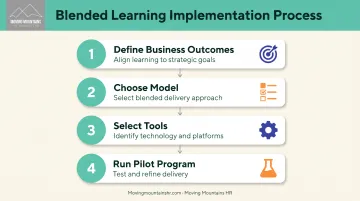
Blended learning works when you design around business results, not content volume. Use the four steps below to set outcomes, pick a model and tools, then prove the mix with a small pilot.
Start with Clear Business Outcomes
Identify the business outcomes and skills you need, then work backward to decide what belongs online versus live.
Questions to answer:
- What performance gaps are you trying to close?
- What specific behaviors or skills should change?
- How will you measure success?
Format decision framework:
- Online: Foundational concepts, compliance rules, product specifications, definitions
- Live: Application practice, difficult scenarios, coaching, group problem-solving
Choose the Right Model
Pick the blended model that fits your goals, team structure, and resources. Not every topic needs the same design.
Quick selection guide:
- Flipped Classroom: Rich discussion and hands-on practice after self-paced prep
- Rotation: Onboarding or skill-building that needs several learning modes
- Flex: Maximum scheduling flexibility for distributed or shift-based teams
- Enriched Virtual: Mostly online learning with scheduled live touchpoints for structure
Select Essential Tools
Learning Management System (LMS):
You need an LMS to deliver and track online content. Look for:
- Easy content upload and organization
- Progress tracking and reporting
- Mobile access for employees
- User-friendly interface for administrators and learners
- Integration with your existing systems
Don't over-invest in expensive authoring tools at the start. Many strong blended programs begin with simple video recordings, PDF resources, and basic quizzes.
Video Conferencing:
For virtual live sessions, choose a platform that supports:
- Screen sharing and breakout rooms
- Recording capabilities
- Chat and Q&A features
- Stable connections for your typical group size
Plan a Pilot Program
Test the design with a small group before you scale:
- Choose 10–20 employees who represent your target audience
- Track completion rates, time invested, knowledge gains, and participant feedback
- Survey participants and run a short debrief discussion
- Adjust the online-to-live mix based on what the pilot shows
Common adjustments after pilots:
- Breaking long videos into shorter segments
- Adding more interactive elements to online content
- Increasing or decreasing live session frequency
- Changing the sequence of topics
Common Challenges Small Businesses Face with Blended Learning
Limited Technology Budgets
The challenge: Many small businesses worry they can't afford LMS platforms and content development tools.
Solutions:
- Start with cost-effective LMS options designed for small businesses (many offer tiered pricing based on user count)
- Use free or low-cost tools you already have (Google Workspace, Microsoft 365, Zoom)
- Begin with simple content formats (screen recordings, slide presentations with voiceover, PDF guides)
- Build your content library gradually rather than creating everything at once
Blended learning can start simple. You don't need expensive custom courseware to see results. Clear content and consistent structure matter more than production value.
Employee Resistance to Digital Learning
The challenge: In industries accustomed to traditional training, employees may resist digital components or feel uncomfortable with technology.
Solutions:
- Communicate benefits clearly from the start (flexibility, less time away from work, ability to review content)
- Provide technical orientation before launching training
- Start with short, simple digital activities to build confidence
- Maintain strong live components so training doesn't feel impersonal
- Collect and share positive feedback from early adopters
Gradual adoption works better than sudden transformation. Introduce digital elements alongside familiar formats, then increase the digital ratio as comfort grows.
Time Management and Completion Issues
The challenge: Employees struggle to complete self-paced content when daily work demands take priority, and module completion can decline significantly over time.
Solutions:
- Block specific calendar hours for protected online training time
- Have supervisors check in on progress during one-on-ones
- Design content in 10-15 minute segments that fit busy schedules
- Require prerequisite completion before employees can join live workshops
- Use LMS reporting to identify who's falling behind and reach out early
Self-paced completion often drops as employees move through a program. Structure, accountability, and regular touchpoints help keep momentum going.
Real-World Applications for Small to Mid-Size Businesses
<small and mid-size teams rarely need blended learning everywhere at once. They get the most value when they apply it to a few high-stakes moments—compliance, onboarding, and customer-facing skills.
Regulatory Compliance Training
How it works: Employees complete online modules covering regulations, policies, and procedures at their own pace. They then attend live workshops to discuss real workplace scenarios and practice applying the rules.
Example structure:
- Online: OSHA safety regulations, anti-harassment policies, data privacy requirements
- Live: Scenario-based discussions, Q&A about gray areas, department-specific application
Everyone gets the same baseline on the rules. Live time is reserved for the gray areas that actually create liability—edge cases, department quirks, and “what would you do?” calls.
New Hire Onboarding
How it works: New hires complete company culture, policy, and system training online during their first days. They then participate in live welcome sessions, hands-on job shadowing, and structured introductions to their teams.
Example structure:
- Week 1 online: Company history and values, benefits enrollment, system access and navigation, department overviews
- Week 1-2 live: Welcome meeting with leadership, team introductions, job shadowing, hands-on practice with guidance
- Ongoing: Monthly check-ins with cohort and assigned mentor
Self-paced modules clear the admin and systems load early. Live touchpoints—shadowing, mentor check-ins, leadership welcomes—shorten time-to-productivity and keep new hires from feeling parked in a content queue.
Customer Service Training
Product specs, service policies, and de-escalation frameworks move online so people arrive prepared. Live sessions then focus on rehearsal: role-playing tough interactions, testing script variations, reviewing recorded calls, and swapping what actually works on the floor.
That split matters. Knowledge transfer scales in modules; tone, timing, and recovery under pressure only stick when people practice with a facilitator and peers.
If you want these models built around your policies—not off-the-shelf courses—Moving Mountains HR designs blended programs for leadership development, California employment compliance, performance management, and workplace communication. Delivery can be virtual or in person, matched to how your team actually works.
Frequently Asked Questions
What is an example of corporate blended learning?
A common example is compliance training: employees complete online modules on regulations and company policies, then join a live workshop to discuss workplace scenarios and practice applying the rules. Online delivery keeps knowledge consistent; the live session adds discussion and hands-on application.
What are the four models of corporate blended learning?
The four main models are: Flipped Classroom (online content before live practice), Rotation Model (structured movement between online, live, and collaborative formats), Flex Model (primarily self-paced with on-demand instructor support), and Enriched Virtual Model (online learning with scheduled live sessions for connection and guidance).
What is the 70-20-10 rule for learning?
The 70-20-10 framework from the Center for Creative Leadership holds that about 70% of learning comes from on-the-job experience, 20% from coaching and mentoring, and 10% from formal courses. Blended programs can support all three by pairing formal instruction with collaboration and work-based application.
What is the best LMS for corporate blended learning?
There isn’t one best LMS—it depends on your size, budget, and must-have features. Prioritize easy content upload, progress tracking, video-conferencing integrations, mobile access, and a simple admin/learner interface, then compare tools in your price range rather than by brand alone.
How is blended learning different from hybrid learning?
Blended learning is an instructional design choice: you mix online and live formats based on what each objective needs. Hybrid learning is a delivery mode where some people attend in person and others join the same session remotely. In short, blended is about what format fits the content; hybrid is about where learners sit during delivery.
What types of corporate training work best with blended learning?
Programs that pair foundational knowledge with practice work best in a blended format. Strong fits include compliance and regulatory training, new-hire onboarding, leadership development, technical skills, and customer service—anywhere employees must both learn information and apply it in realistic scenarios.
Need training that fits how your team actually works? Moving Mountains HR builds customized programs—compliance, leadership, and onboarding—around your goals, budget, and team structure. Schedule a free consultation to talk through your training challenges.