
Introduction
Small-business owners face a tough hiring market. 35% report job openings they cannot fill, and 49% of those hiring find few or no qualified applicants. Keeping the people you already have engaged and productive is essential to survival.
Many owners know feedback matters. Delivering it consistently is harder when operational demands, client deadlines, and day-to-day crises fill every hour.
This article covers the measurable outcomes regular feedback delivers: stronger performance, lower turnover costs, better retention, and cultures that attract and keep talent. If you run a small or mid-size business without a dedicated HR department, you'll get practical guidance that doesn't require heavy infrastructure or time you don't have.
Key Takeaways
- Regular feedback boosts engagement and cuts costly turnover in tight talent markets
- Clear expectations and faster development follow when managers give feedback well
- Delayed or missing feedback raises errors, slows work, and makes scaling harder
- Small teams can run strong feedback loops without a full HR staff—keep talks frequent and forward-looking
What Is Workplace Feedback (Brief Context)
Workplace feedback is structured or informal communication between managers and employees—or peers—about job performance, behaviors, and development opportunities. Effective feedback isn't limited to annual performance reviews. It's an ongoing, conversational tool that recognizes what's working and provides course correction when needed.
When delivered consistently, feedback:
- Aligns individual effort with business goals
- Clarifies expectations in real time
- Gives employees the information they need to improve
Key Advantages of Workplace Feedback
The advantages below focus on measurable business impacts that small to mid-size businesses typically track: productivity, cost control, employee retention, and organizational growth. Each advantage translates directly to outcomes you can monitor through concrete metrics.
Improved Performance and Productivity
Regular feedback shows employees what's working, what isn't, and how to adjust in real time. They don't wait weeks or months to learn they've been heading the wrong way.
Timely input lets people course-correct, cut wasted effort on misaligned tasks, and focus on high-impact work. Employees who receive daily feedback are 3.6 times more likely to be strongly motivated to do outstanding work than those who only hear from managers once a year.
That speed shows up in decision-making, work quality, and operational efficiency. In lean small-business teams, every person's contribution counts, so fewer repeated mistakes matter.
A field study of multiple organizations found that employees averaged 3.8 feedback conversations over three weeks, and more frequent feedback was positively related to both performance and job satisfaction, with no observed downturn even at the highest frequencies.
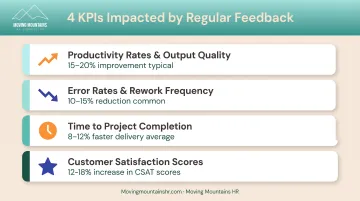
KPIs impacted:
- Productivity rates and output quality
- Error rates and rework frequency
- Time to project completion
- Customer satisfaction scores
When this advantage matters most:
- Rapid growth or lean teams that can't absorb repeated mistakes
- New product or service launches
- Process refinement and quality standard resets
Enhanced Employee Engagement and Retention
Feedback fulfills employees' fundamental need to know how they're doing, feel valued, and see a path forward in their careers. Consistent feedback demonstrates that leadership is invested in employees' success, creating psychological safety and a sense of belonging that keeps talented people from looking elsewhere.
Eighty percent of employees who reported receiving meaningful feedback in the previous week were fully engaged. By contrast, 4 in 10 workers become actively disengaged when they get little or no feedback.
Disengagement feeds turnover. Organizations using continuous feedback see 14.9% lower turnover rates, and Gallup estimates replacing an employee costs one-half to two times their annual salary.
For small to mid-size businesses, keeping institutional knowledge and avoiding constant retraining protects continuity, customer relationships, and margins. When someone leaves, you lose more than labor: expertise, client rapport, and momentum go with them.
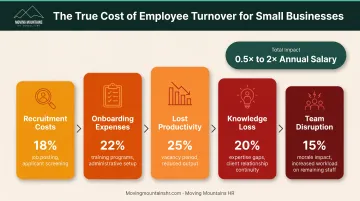
KPIs impacted:
- Employee turnover rate and retention rate
- Time-to-productivity for new hires
- Recruitment and onboarding costs
- Employee satisfaction and engagement scores
When this advantage matters most:
- Competitive labor markets where retention is hard-won
- Teams with millennial and Gen Z employees who expect ongoing development
- Organizational change that creates uncertainty
- Efforts to build long-term team stability for sustainable growth
Stronger Trust and Workplace Culture
Feedback creates transparency and two-way communication that strengthen manager-employee relationships and peer collaboration.
When feedback flows freely, conflict drops, psychological safety rises, and people feel heard. Those conditions shape how employees show up each day.
Trust lets people raise concerns early, share ideas without fear of criticism, and collaborate across departments. In small businesses where every relationship affects the customer experience, trust is a competitive differentiator you can't buy or fake.
However, trust can also be damaged: a 2024 peer-reviewed study found that frequent negative supervisory feedback can reduce learning performance by eroding trust in the supervisor. This underscores that feedback must be constructive and future-focused, not just frequent.
KPIs impacted:
- Employee satisfaction and engagement scores
- Absenteeism rates and unplanned leave
- Workplace conflict incidents
- Cross-team collaboration effectiveness
- Innovation and idea generation volume
When this advantage matters most:
- Building culture from the ground up
- Change or uncertainty that tests commitment
- Remote or hybrid teams where communication is harder
- Interpersonal conflict that needs resolution before it escalates
What Happens When Feedback Is Missing or Ignored
The absence of feedback creates hidden costs and operational friction that compound over time. These problems often stay invisible until a valued employee resigns or a preventable mistake becomes a client crisis.
Fifty-one percent of voluntary leavers reported that during their final three months, no manager or leader discussed their job satisfaction or future with them. Another 52% said their departure could have been prevented.
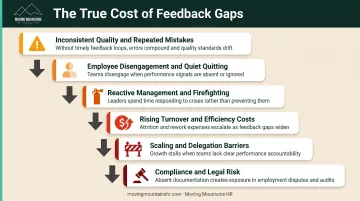
Common consequences of feedback gaps include:
- Inconsistent quality and repeated mistakes that drive rework, client complaints, and wasted labor hours
- Employees who feel undervalued or directionless, fueling quiet quitting, disengagement, or sudden resignations
- Managers stuck in reactive firefighting instead of proactive performance development
- Rising costs from turnover, inefficiencies, and preventable errors that never show up on one line item
- Harder delegation and scaling when expectations and standards stay unclear
- Higher compliance and legal risk when performance issues go undocumented or unaddressed
Only 26% of employees strongly agreed that the feedback they received helped them do better work. Even when feedback exists, it often fails to deliver value because it's vague, delayed, or poorly framed.
How to Get the Most Value from Workplace Feedback
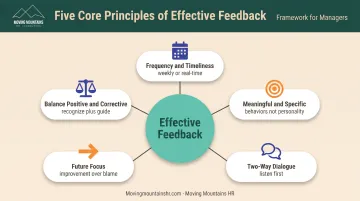
Feedback works best when it becomes a consistent practice embedded in daily operations, not a once-a-year formality that managers dread and employees dismiss. To maximize the business impact of feedback, focus on these principles:
Frequency and timeliness:
Aim for weekly check-ins or real-time feedback immediately after key events, projects, or client interactions. Gallup recommends feedback a few times per week, delivered close to the observed action so employees can connect input to specific behaviors while the context is still fresh.
Meaningful, not just frequent:
Quantity doesn't equal quality. Gallup finds that only 26% of employees say the feedback they receive helps them improve. Make every conversation specific, tied to clear examples, and focused on behaviors or outcomes—not personality.
Two-way dialogue:
Encourage employees to share their perspective and self-assess before managers provide input. Listen first and ask for their view. That shift turns feedback into a joint problem-solving conversation and builds real ownership.
Future focus:
Frame feedback around what can be improved going forward and how to build on strengths, rather than dwelling on past failures. Research published in PLOS ONE found that future-focused discussions were the strongest predictor of feedback acceptance and intention to change. That forward lens can also reduce the harm of mostly negative feedback.
Balance positive and corrective feedback:
Corrective feedback is necessary, but negative-only input erodes trust and hurts learning. Pair recognition of what's working with clear guidance on what to adjust.
For small businesses without a dedicated HR team, an HR consultant focused on performance management can help you build feedback habits and train managers without overloading your budget. Moving Mountains HR supports this through performance management and fractional CHRO services.
Conclusion
Workplace feedback is essential for high performance, talent retention, and trust. That matters most for small to mid-size businesses facing competitive labor markets and rising employee expectations.
When you apply it consistently and tie it to clear business goals and development plans, the gains show up fast. Productivity improves. Turnover costs fall. You build a culture that attracts and keeps the people you need to grow.
Treat feedback as a regular management practice baked into how you run the business. Frequent, future-focused, two-way conversations give employees the clarity and support to succeed—and shield your company from the hidden costs of disengagement and avoidable turnover.
Make those conversations routine, coach managers to deliver them well, and measure whether people leave clearer on expectations than they arrived.
Frequently Asked Questions
What is feedback and why is it important?
Feedback is communication about job performance and behaviors that clarifies expectations, supports development, and keeps employees aligned with business goals. It matters because it gives people real-time information to improve, feel valued, and see a clear path forward, which supports both performance and retention.
What are the 5 reasons why feedback is important?
Feedback improves performance through real-time course correction, boosts engagement by showing investment in people, strengthens retention, builds trust through transparent communication, and reduces costly mistakes by aligning expectations early.
How can I give effective feedback in the workplace?
Give feedback often, weekly or right after key events, instead of saving it for annual reviews. Stick to specific behaviors and outcomes, balance recognition with constructive guidance, and keep the conversation two-way and forward-looking so employees know what to do next.
What to avoid when giving feedback?
Avoid vague comments, delayed input, personal attacks instead of behavior focus, only calling out negatives, and public delivery of sensitive feedback. Private, timely, and specific input protects dignity and gives people something they can act on.
What are the five R's of feedback?
Common versions of the five R’s describe feedback as Relevant to the role and situation, Regular rather than annual-only, Respectful in tone, Reciprocal so employees can respond, and Results-focused on measurable improvement.