Introduction: Understanding Company Policies
Picture this: Your longest-tenured employee asks for bereavement leave, and you realize you've never documented how much time off the company provides.
Another team member wants to know your work-from-home policy, but you've been making decisions case-by-case. A third employee files a harassment complaint, and you scramble to figure out how to respond—because nothing is in writing.
Many small businesses run on informal, unwritten rules. They operate with good intentions, but when policies live only in managers' heads or scattered email threads, the result is confusion, inconsistent treatment, and real legal exposure.
In California, businesses with as few as 5 employees face state-level harassment and discrimination liability. Federal protections under Title VII and the ADA kick in at 15 employees.
This guide will walk you through what company policies are, why they matter for growing businesses, the 10 essential policies every small business needs, and how to create and implement documentation that protects your organization while preserving operational flexibility.
Key Takeaways:
- Written policies reduce legal liability and demonstrate good-faith compliance efforts
- Policies set the "what" and "why," while procedures detail the "how"
- California businesses with 5+ employees must comply with state-level harassment and discrimination rules
- Small businesses should prioritize 10 foundational policies covering conduct, leave, safety, and wage-and-hour compliance
- Effective policy systems combine clear language, consistent enforcement, and annual reviews
What Are Company Policies?
Company policies are formal, written guidelines that establish standards for employee conduct, workplace operations, and organizational expectations. They communicate what your organization requires, prohibits, and permits, serving as the framework for daily decisions and long-term consistency.
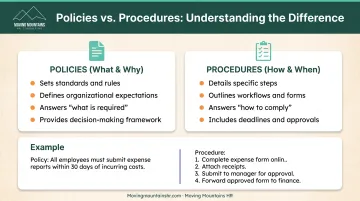
How Policies Differ from Procedures
- Policies answer "what" and "why": they state the rule, its purpose, and the standards employees must meet
- Procedures answer "how" and "when": they outline the specific steps, forms, deadlines, and approval paths required to comply
Example: A time-off policy establishes that employees accrue vacation at one day per month and must request leave in advance. A time-off procedure specifies the request form, manager-approval workflow, payroll-notification steps, and documentation required.
Who Uses Company Policies?
Policies serve multiple stakeholders:
- Employees receive clear expectations and understand their rights
- Managers get consistent decision-making guidelines
- Payroll and HR know documentation and record-keeping requirements
- Regulators and courts can review your communication and enforcement practices during audits or disputes
To be effective, policies must be written, accessible, and applied consistently. An unwritten "policy" is simply a practice—and practices that vary by manager or tenure create the exact risks policies are designed to prevent.
Why Company Policies Matter for Small Businesses
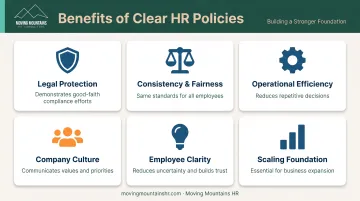
Even businesses without dedicated HR departments face the same employment laws as larger organizations. Written policies deliver measurable value across six dimensions:
Protection against legal liability. Documented policies demonstrate good-faith efforts to comply with federal and state employment laws. The EEOC settled a harassment and retaliation case against Del Taco for $1.25 million in 2020, underscoring enforcement risk. Written anti-harassment policies with clear reporting procedures, prompt investigation protocols, and anti-retaliation language help defend against wrongful termination and discrimination claims.
Consistency and fairness. Policies ensure employees are held to the same standards regardless of their manager, hire date, or personal relationships. When attendance expectations or disciplinary responses vary from person to person, documentation gaps become evidence in retaliation and discrimination disputes.
Operational efficiency. Clear guidelines reduce the hours managers spend answering repeated questions and making ad hoc decisions. Instead of reinventing the wheel for every time-off request or technology question, managers apply documented standards.
Company culture and values. Policies communicate what the organization stands for beyond legal minimums. A respectful-workplace policy, volunteer-time-off benefit, or professional-development commitment signals priorities and shapes how employees experience the culture.
Employee clarity and confidence. Workers perform better when they understand expectations, know their rights, and can access resources. Clear documentation reduces uncertainty and builds trust.
Foundation for scaling. As your business grows, informal practices break down. Written policies become essential when you add a second location, hire your first remote worker, or cross the threshold that triggers federal FMLA coverage at 50 employees.
10 Essential Company Policies Every Small Business Needs
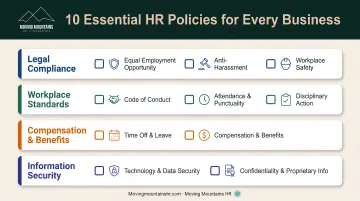
These 10 policies form the compliance and operational foundation for most small businesses. Prioritize them based on your headcount, state, industry, and workforce structure.
1. Equal Employment Opportunity and Anti-Discrimination Policy
What it covers: This policy prohibits discrimination in hiring, promotion, compensation, and termination based on protected classes under federal and state law, including race, color, religion, sex, national origin, age, disability, and genetic information.
Legal foundation:
- Federal Title VII and ADA protections generally apply at 15+ employees
- Federal ADEA age-discrimination protections start at 20+ employees
- California FEHA applies at 5+ employees for discrimination and extends harassment protections below five
Key elements:
- List all protected classes under federal and applicable state law
- Describe complaint and accommodation procedures
- Emphasize objective, job-related criteria for all employment decisions
- Prohibit retaliation against employees who report concerns
2. Code of Conduct and Ethics Policy
What it covers: Expected behaviors, professional standards, conflicts of interest, honesty, respect, and appropriate workplace interactions for all employees.
Key elements:
- Define respectful conduct and prohibit bullying or intimidation
- Address conflicts of interest and outside employment
- Clarify reporting channels for ethics concerns
- Outline consequences for violations
Important limitation: Your policy cannot prohibit employees from discussing wages or working conditions—these are protected activities under the National Labor Relations Act.
3. Attendance and Punctuality Policy
What it covers: Work schedules, expectations for on-time arrival, procedures for reporting absences, and consequences for excessive tardiness or unexcused absences.
Compliance note: Under the Fair Labor Standards Act, work the employer "suffers or permits" is compensable. You must pay for all time worked, even if it's unauthorized or violates your attendance policy. Employers must maintain accurate daily and weekly time records for at least three years.
Key elements:
- Define standard work hours and schedules
- Explain notification procedures for planned and unplanned absences
- Clarify how tardiness and absences are tracked
- Address progressive discipline for policy violations
4. Time Off and Leave Policy
What it covers: Vacation, sick leave, holidays, bereavement, jury duty, and legally mandated leaves such as FMLA, state-paid family leave, and California-specific sick leave.
Legal foundation:
- Federal FMLA applies at 50+ employees and provides 12 weeks of unpaid, job-protected leave
- California CFRA applies at 5+ employees
- California paid sick leave requires at least 5 days or 40 hours annually
- California treats accrued vacation as earned wages that cannot be forfeited
Key elements:
- State accrual rates, carryover limits, and eligibility requirements
- Explain request and approval procedures
- Clarify blackout periods and staffing-based denials
- Reference all applicable statutory leaves and eligibility thresholds
- Note that California requires immediate payment of accrued vacation upon termination
5. Workplace Safety and Health Policy
What it covers: Hazard identification and prevention, emergency procedures, incident reporting, and OSHA compliance obligations.
Legal foundation: OSHA's General Duty Clause and industry-specific standards apply regardless of size. Small employers with 10 or fewer employees are partially exempt from OSHA injury-recordkeeping requirements, but they still must maintain safe workplaces and report severe incidents.
Key elements:
- Assign safety responsibilities to specific roles
- Describe hazard identification and reporting procedures
- Provide emergency response protocols
- Outline training requirements and evaluation methods
- Tailor the policy to your industry (office, construction, healthcare, manufacturing)
6. Anti-Harassment and Non-Retaliation Policy
What it covers: Definitions of harassment (including sexual harassment), prohibited conduct, multiple reporting channels, investigation procedures, and protections for employees who report concerns.
Legal foundation: The EEOC requires employers to establish effective prevention, complaint, investigation, and correction processes. California mandates harassment-prevention training for employers with 5+ employees.
Key elements:
- Define harassment with specific examples
- Provide at least two reporting options, including a bypass route around the employee's direct supervisor
- Commit to prompt, thorough, and impartial investigations
- Prohibit retaliation in all forms
- Explain confidentiality limits and interim measures during investigations
7. Compensation and Benefits Policy
What it covers: Pay structures, overtime eligibility, pay schedules, timekeeping requirements, deductions, benefits eligibility, and compliance with wage-and-hour laws.
Legal foundation: Nonexempt employees must receive 1.5× their regular rate for hours over 40 in a workweek. Workweeks cannot be averaged. State laws add complexity. California requires daily overtime, meal and rest breaks, and immediate payment of final wages including accrued vacation.
Key elements:
- Define the workweek and standard schedules
- Clarify exempt vs. nonexempt classifications
- State payday frequency and method
- List permissible and prohibited deductions
- Reference benefits-plan documents for detailed eligibility and coverage
8. Technology and Data Security Policy
What it covers: Acceptable use of company email, internet, devices, and systems; personal-device policies; monitoring practices; data protection; and remote-work technology expectations.
Key compliance areas:
- Transparent notice of monitoring reduces privacy-invasion claims
- Data breach notification laws vary by state
- California's CCPA applies when annual revenue exceeds $26.625 million (2025 threshold) or other tests are met
Key elements:
- Define acceptable and prohibited uses
- Disclose monitoring scope and methods
- Address personal use and privacy expectations
- Require password protection and device security
- Specify data retention and disposal procedures
9. Disciplinary Action and Termination Policy
What it covers: Progressive discipline framework, investigation procedures, documentation requirements, and at-will employment disclaimers.
Legal foundation: At-will employment permits termination for any lawful reason, but it does not allow discrimination, retaliation, breach of contract, or public-policy violations. Progressive discipline (graduated warnings and consequences) creates consistency and fairness.
Key elements:
- Reserve discretion for serious misconduct (violence, theft, harassment)
- Define typical discipline steps (verbal warning, written warning, suspension, termination)
- Require investigation and employee response before final decisions
- Document all actions and decisions
- Comply with state final-paycheck timing rules
10. Confidentiality and Proprietary Information Policy
What it covers: Protection of trade secrets, customer data, business strategies, and sensitive information during and after employment.
Legal foundation: Federal law (18 U.S.C. § 1833(b)) requires employers to include whistleblower-immunity language in trade-secret agreements. Omitting this notice can bar you from recovering exemplary damages and attorney fees in trade-secret litigation.
Key elements:
- Define what constitutes confidential information
- Explain handling, storage, and sharing restrictions
- Clarify obligations upon termination or resignation
- Include the federally required whistleblower notice
- Preserve employee rights to report violations to government agencies and discuss wages
How to Create and Implement Effective Policies
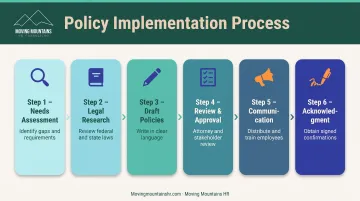
Building a compliant, practical policy system requires more than downloading a template. Follow these steps:
1. Start with a Needs Assessment
Identify:
- Federal, state, and local laws that apply to your industry, headcount, and locations
- Common employee questions or recurring issues
- Gaps revealed by manager confusion or inconsistent decisions
2. Research Applicable Laws and Regulations
Consult:
- U.S. Department of Labor guidance on wage-and-hour and FMLA requirements
- EEOC resources on discrimination, harassment, and accommodation
- State labor agencies (California's DIR, New York's DOL, etc.)
- Industry-specific regulations (OSHA standards, healthcare licensing boards)
3. Draft Policies in Clear, Accessible Language
- Avoid legal jargon that confuses readers
- Use headers, bullet points, and short paragraphs for scannability
- Include concrete examples where helpful
- Define key terms in plain language
4. Build in a Review and Approval Process
Have policies reviewed by:
- Employment-law attorneys or HR consultants specializing in compliance
- Internal stakeholders (finance for pay policies, IT for technology policies)
- Leadership to confirm alignment with business goals
Moving Mountains HR supports this step through HR Document Audit and Fresh Compliance Docs services, which review existing materials or create new compliant policies tailored to your state, industry, and company size.
5. Communicate Policies Effectively
- Distribute the employee handbook during onboarding
- Provide training on high-stakes policies (harassment prevention, safety, confidentiality)
- Make policies easily accessible online or in print
- Notify employees of updates and changes
6. Require Acknowledgment
Have employees sign that they:
- Received the handbook or policy
- Read and understood the content
- Agree to comply
Retain signed acknowledgments in personnel files for documentation and accountability.
Common Company Policy Mistakes to Avoid
Even well-intentioned businesses stumble. Watch for these pitfalls:
Creating Policies That Are Too Rigid
Policies need reasonable flexibility. Absolute language like "always" or "never" locks you into impractical positions. Build in manager discretion for accommodations, protected leave, and case-by-case decisions where appropriate.
Inconsistent Enforcement
Enforcing a policy strictly for some employees while making exceptions for others without legitimate reasons undermines the entire system. It also creates evidence for retaliation and discrimination claims. Apply policies consistently and document any justified exceptions.
Failing to Update Policies Regularly
Laws change. Business models evolve. Review and update policies at least annually, and immediately when:
- Employment laws are amended
- You cross a coverage threshold (5, 15, 20, or 50 employees)
- You expand into a new state or locality
- You introduce new benefits, technology, or work arrangements
Frequently Asked Questions
What is a company policy?
A company policy is a formal, written guideline that establishes rules, standards, expectations, rights, and responsibilities for workplace conduct and operations. Policies communicate what employees must do, what they're prohibited from doing, and how the organization makes decisions.
What are common company policies?
The most common small-business policies include code of conduct, attendance and punctuality, time off and leave, anti-harassment, equal employment opportunity, workplace safety, compensation and benefits, technology use, disciplinary action, and confidentiality.
Do small businesses need the same policies as large corporations?
Small businesses need many of the same policies because employment laws apply based on headcount thresholds, not company revenue. While smaller organizations may use simplified language and shorter handbooks, core policies covering discrimination, harassment, wages, safety, and leave remain essential.
What's the difference between a policy and a procedure?
Policies define the rules, principles, purpose, and decision standards (the "what" and "why"). Procedures outline the specific steps, forms, deadlines, and workflows required to apply those rules (the "how" and "when").
How often should company policies be reviewed and updated?
At minimum, review policies annually. Update immediately when laws change, you cross an employee-count threshold, expand into a new jurisdiction, or introduce new technology, benefits, or work models. Scheduled reviews help catch outdated language and compliance gaps before they create risk.
What happens if an employee violates a company policy?
Consequences depend on severity and should follow your disciplinary-action policy. Most issues use progressive discipline (verbal warning, written warning, suspension, termination); serious misconduct such as violence, theft, or harassment may mean immediate termination. Investigate, document, and apply standards consistently.
Final Thought:
Written company policies protect your business, support employees, and scale with growth. Whether you're formalizing practices for the first time or updating an outdated handbook, clear and consistently enforced guidelines reduce risk and set expectations.
Need help auditing your current policies or building compliant documentation from scratch? Moving Mountains HR offers tailored HR Document Audits, Fresh Compliance Docs packages, and ongoing support to help small businesses across California and the U.S. stay compliant and confident. Contact us today to schedule a free consultation.