
This guide walks you through when to counsel an employee, how to prepare thoroughly, the step-by-step conversation process, and what to do when counseling doesn't resolve the issue.
Key Takeaways
- Performance counseling is a structured, problem-solving conversation that corrects substandard work and sets clear expectations
- Act promptly when issues arise; delaying confuses employees about standards and allows poor performance to continue
- Prepare with specific, dated examples, relevant performance standards, and complete documentation before the meeting
- Focus on observable behaviors and business impact, never personal judgments or character assessments
- Follow up consistently and document every step to protect both employee and employer
How to Counsel an Employee on Poor Performance: The 4-Step Process
Step 1: Prepare for the Conversation
Effective counseling depends on thorough preparation. Walking into the meeting unprepared undermines your credibility and the entire process.
Gather specific, documented examples:
- Compile dates, times, and measurable impacts (for example, "On March 15, the Johnson report was submitted five days late, delaying the client presentation")
- Collect supporting evidence: emails, work samples, customer complaints, or attendance records
- Link each example to relevant job expectations, performance standards, or company policies
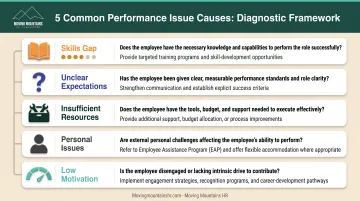
Diagnose the root cause:
Before the meeting, consider whether the problem stems from:
- Lack of necessary skills or training
- Unclear expectations or role confusion
- Insufficient resources, tools, or support
- Personal or health issues affecting focus
- Motivation or engagement problems
Don't assume the cause. You'll explore it during the conversation.
Review legal and policy requirements:
- Check your employee handbook for performance-management and progressive-discipline policies
- Understand your obligations under California employment law if applicable (at-will employment, protected classes, disability accommodations)
- Know when union representation or HR involvement is required
Plan meeting logistics:
- Schedule 30-60 minutes in a private location
- Hold the meeting shortly after the performance issue while it's fresh and correctable
- Prepare to offer specific support: training, mentoring, tools, or workload adjustments
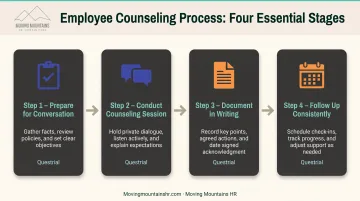
Step 2: Conduct the Counseling Session
Open directly and professionally:
State the purpose immediately without small talk: "I need to discuss some performance concerns." Then keep the discussion forward-looking. Research shows future-focused feedback predicts acceptance and intention to change better than dwelling on past failures.
Present specific examples:
- Link each instance of substandard performance to relevant job expectations or standards
- Use objective, factual language: "Your last three reports contained calculation errors that required correction" rather than "You're careless with numbers"
- Avoid personal attacks or character judgments. Focus exclusively on observable behaviors and measurable results
Listen actively to the employee's perspective:
- Ask open-ended questions: "What's making it difficult to meet these deadlines?"
- Let the employee explain their view without interrupting
- Consider whether accommodations, resources, or support are needed
Collaborate on solutions:
Ask "What do you think would help you meet these expectations?" and genuinely consider their input. Studies link goal-setting participation with proactive behavior, and employees who help create their improvement plan show stronger ownership.
State expectations clearly:
- Set specific, measurable goals with a realistic timeframe (typically 30-90 days depending on severity)
- Example: "Submit all client reports by the agreed deadline, with no more than one late submission requiring prior approval in the next 60 days"
- Explain what support you'll provide: training, adjusted priorities, weekly check-ins
- Communicate consequences if performance doesn't improve, including potential termination if warranted
Step 3: Document the Conversation in Writing
Prepare a written summary within 24-48 hours. Well-documented counseling creates a clear record that protects both employee and employer.
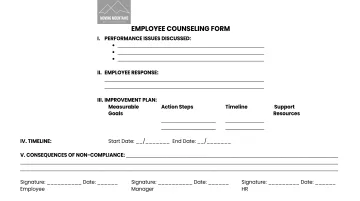
Your documentation should include:
- Date, time, and participants
- Specific performance issues discussed with examples
- Employee's response and explanation
- Agreed-upon improvement plan with measurable goals
- Timeline and follow-up schedule
- Support or resources you committed to provide
- Consequences if performance doesn't improve
Documentation best practices:
- Use factual, objective language without emotional or judgmental phrasing
- Write as if a third party (arbitrator, lawyer, investigator) will read it
- Provide the employee with a copy and place the original in their personnel file
- Avoid vague statements like "needs to improve attitude"—instead, describe the observable behavior that must change
Step 4: Follow Up Consistently
Failing to follow up undermines your message and destroys your credibility for future performance conversations.
Schedule regular check-ins:
- Meet weekly or biweekly to review progress, provide feedback, and adjust the plan if needed
- Tie your cadence to the employee's task cycle and improvement deadline
- Document each follow-up conversation with brief notes on progress or continued concerns
Recognize and reinforce improvement immediately:
When you see progress, acknowledge it right away and be specific: "Your last two reports were on time and error-free. That's exactly what we need."
Escalate if performance doesn't improve:
If the employee doesn't meet expectations after the counseling period, escalate to a formal Performance Improvement Plan (PIP) or disciplinary action. Continuing informal counseling indefinitely sends mixed messages about the seriousness of the problem.
When Should You Counsel an Employee on Poor Performance?
Address patterns of substandard work:
Counsel when you observe repeated issues such as:
- Consistent missed deadlines across multiple projects
- Ongoing quality problems requiring frequent correction
- Persistent attendance issues (tardiness, unexcused absences)
- Repeated interpersonal conflicts affecting team dynamics
Act immediately on serious single incidents:
A single serious incident may warrant immediate counseling if it significantly impacts:
- Operations or project delivery
- Customer relationships or satisfaction
- Team morale or safety
- Company reputation or legal compliance
Consider the employee's work history:
A sudden drop from a typically strong performer may point to personal issues that need different support—such as an Employee Assistance Program referral—rather than formal counseling for ongoing poor performance.
According to Gallup, employees who receive frequent feedback are 3.6 times more likely to feel motivated to do outstanding work. Regular conversations help keep counseling from becoming a surprise.
What You Need Before Counseling an Employee on Poor Performance
Clear Documentation and Evidence
Compile specific examples with dates, times, and measurable impacts. Vague complaints like "you're not a team player" aren't actionable.
Use concrete detail instead: "During the March 10 planning meeting, you interrupted colleagues four times and dismissed their suggestions without offering alternatives, which prevented the team from reaching consensus."
Gather relevant evidence:
- Emails or work samples demonstrating the performance gap
- Customer complaints or internal feedback
- Attendance or punctuality records
- Previous informal feedback you've already provided
Understanding of Legal and Company Requirements
California employment law considerations:
California Labor Code Section 2922 establishes at-will employment. You can generally terminate without cause or prior counseling—but at-will status is not a safe harbor from:
- FEHA discrimination protections for race, religion, disability, sex, age 40+, sexual orientation, gender identity, and other protected classes
- Retaliation claims for protected activities
- Disability accommodation obligations under ADA and FEHA
- Union representation rights (Weingarten rights for investigatory interviews)
- Contract or collective bargaining agreement terms
Company policy compliance:
Review your employee handbook for progressive discipline procedures. Inconsistent application of your own policies creates legal risk.
Support Resources to Offer
Identify specific help you can provide:
- Training programs or skill development
- Tools, software, or equipment upgrades
- Mentoring or coaching support
- Workload adjustments or reprioritization
- Employee Assistance Program (EAP) referral when personal issues may be affecting performance
Counsel observable job performance only—not suspected diagnoses.
Key Factors That Determine Counseling Success
Not all counseling sessions lead to improved performance. Success hinges on a few practical factors.
Timing and Consistency
Address issues promptly (within days, not weeks or months) while the situation is fresh and correctable. Delaying makes the problem worse and confuses employees about what's acceptable.
Ensure you've provided regular feedback throughout the year. Surprise poor-performance discussions at annual review time signal inconsistent management and undermine your credibility.
Specificity and Clarity
Vague feedback like "you need to be more professional" fails because it's not actionable. What does "professional" mean? What specific behavior should change?
Effective counseling includes:
- Concrete examples of the gap between expected and actual performance
- Measurable improvement targets the employee can track
- Clear deadlines tied to business needs
Example: "Submit weekly status reports every Friday by 3 p.m., with all sections complete and formatted per the template. No late submissions in the next 30 days."
Your Tone and Approach
Adopt a problem-solving, coaching mindset rather than an accusatory or punitive tone. Frame the conversation as "I want to help you succeed" while being direct about the seriousness of the issues.
Remain calm and professional even if the employee becomes defensive or emotional. Your composure sets the tone for a productive conversation.
Employee Buy-In and Accountability
Ask the employee to suggest solutions and commit to specific actions. Ownership increases follow-through and creates shared accountability for the improvement plan.
Clearly communicate consequences of non-improvement (up to and including termination if warranted) so the stakes are understood. Employees deserve to know where they stand.
Quality of Documentation
Poor or missing documentation makes further action nearly impossible if performance doesn't improve. It also creates legal risk if the employee files a claim.
Your documentation should be factual, specific, and written for a third-party audience. Avoid emotional language, speculation about motives, or character judgments.
Common Mistakes When Counseling Employees—And What to Do If It Doesn't Work
Common Counseling Mistakes to Avoid
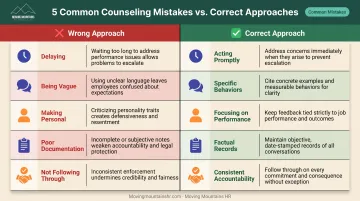
Even experienced managers slip into habits that weaken counseling. Watch for these:
- Delaying the conversation: Hoping the problem fixes itself confuses expectations and lets poor performance hurt morale and productivity.
- Being too vague: "Improve your attitude" or "be more professional" doesn't say what to change. Use specific behaviors and measurable expectations.
- Making it personal: Attacking character, intelligence, or value damages the relationship and pulls the talk off job performance.
- Documenting poorly: Emotional labels ("lazy," "bad attitude," "doesn't care") instead of objective facts weaken your record and raise legal risk.
- Not following through: Skipping promised support, check-ins, or consequences erodes your credibility and weakens future counseling with the whole team.
What to Do When Performance Counseling Doesn't Work
If informal counseling and documented follow-ups still don't move the needle, take these next steps:
- Escalate to a formal PIP: Use specific metrics, a clear timeline (typically 30–90 days), and explicit consequences so expectations and stakes are unmistakable.
- Reassess role fit: Reassignment to a role that matches their strengths can beat more counseling for a poor fit. Check with HR first so you don't create accommodation or discrimination issues.
- Bring in HR or legal counsel: Work with internal HR or an external consultant (including fractional CHRO support) to confirm documentation, legal compliance, and readiness if termination becomes necessary.
- Separate inability from unwillingness: If someone is trying but still can't meet standards after support and a fair timeline, ending employment can be clearer—and kinder—than endless counseling. Not every role fits every person.
- Terminate when appropriate: After multiple counseling sessions, a PIP, and all reasonable support efforts fail, work with HR or legal counsel and follow proper procedures. In California, all wages, including accrued vacation, are due immediately upon termination.
Small and mid-size businesses without in-house HR can use an outside partner to keep performance management compliant and consistent. Moving Mountains HR provides performance management support, HR document audits, and fractional CHRO services for California employers working through these situations.
Frequently Asked Questions
How do I deal with employees with poor performance?
Address issues promptly in a private counseling session with specific, behavior-based feedback. Document the talk, agree on an improvement plan with clear expectations and a timeline, then follow up with support and accountability.
What are 5 common reasons for poor work performance?
Common causes include lack of skills or training, unclear expectations or role confusion, personal issues that drain focus, low motivation or engagement, and inadequate resources or management support.
What are five signs an employee is struggling?
Watch for declining work quality or quantity, more absenteeism or tardiness, withdrawal from the team, emotional shifts like irritability or sadness, and trouble following through on commitments.
How do I deal with an employee who challenges everything?
Counsel on the specific disruptive behavior and how it hurts team effectiveness. Separate respectful disagreement from undermining authority, and check whether the employee feels unheard, distrusts leadership, or is misaligned with company values.
How do I let an employee go due to poor performance?
Terminate only after documented counseling, a formal Performance Improvement Plan, reasonable time and support to improve, and guidance from HR or legal counsel. Then follow your company's process for the final meeting, paperwork, benefits, and final pay.