Introduction
The right employee training program depends on what you need to achieve. Onboarding new hires, meeting mandatory compliance requirements, developing future leaders, and closing performance gaps each call for a different approach.
For HR leaders, business owners, and managers, knowing the main types of employee training programs matters. It helps you match training to your workforce needs, budget, and goals—and avoid wasting time and money on programs that look impressive but miss your actual challenges.
Key Takeaways
- Training types map to distinct needs: onboarding new hires, meeting compliance rules, building skills, and developing leaders
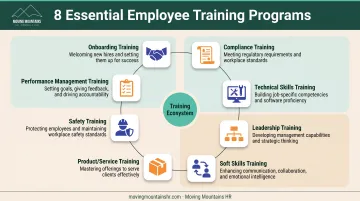
- Core programs span the employee lifecycle: onboarding, compliance, technical and soft skills, leadership, product, safety, performance, and DEI
- Small to mid-size businesses should start with compliance and onboarding, then add skills training as they grow
- Choose programs by naming the real problem first, then weighing legal must-haves against budget and capacity
What Is Employee Training?
Employee training is a structured effort to build employees' knowledge and skills so they can perform their current roles effectively. Training is generally short-term and task-focused, designed to improve specific job performance or meet compliance requirements.
Training takes many forms: formal classroom sessions, on-the-job learning, and online courses. It typically focuses on:
- Job-specific skills (how to use your CRM or operate equipment)
- Regulatory requirements (harassment prevention or safety protocols)
- Organizational competencies (communication or problem-solving)
Employee training differs from employee development. Training addresses current job performance and immediate skill needs. Development focuses on long-term career growth and preparing people for roles they do not yet hold.
Why Is Employee Training Important?
Effective training directly impacts business outcomes. Done well, it:
- Reduces costly errors and improves productivity
- Supports regulatory compliance and lowers legal risk
- Helps organizations avoid employment-law violations
Federal OSHA penalties alone can reach $165,514 per willful or repeated violation.
Training is also a key driver of employee retention. In a 2022 SHRM survey, 76% of employees who received employer training said continuous learning made them more likely to stay. Separately, Pew Research found that 63% of workers who quit in 2021 cited lack of advancement opportunities—and training is foundational to advancement.
For small to mid-size businesses especially, training maximizes the capabilities of existing staff. It reduces the need for expensive external hires, builds institutional knowledge, and protects the business as it grows. That investment shows up in faster execution, fewer costly mistakes, and a team that can grow with the business.
Types of Employee Training Programs
Employee training programs typically fall into several categories based on their purpose, audience, and timing. Some are legally required. Others are essential for operational effectiveness. Still others focus on long-term capability building that prepares your organization for growth.
Below are the most common types of employee training programs and when each one makes sense for your business.
Onboarding Training
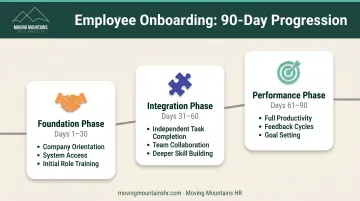
Onboarding training integrates new hires into the organization, covering everything from company culture and policies to role-specific responsibilities and systems. Effective onboarding extends beyond the first week and can last 30-90 days or more, progressively building the employee's capability and confidence.
Orientation is only a brief introduction. Onboarding is ongoing and comprehensive, and it matters for every new hire—especially in small to mid-size businesses that need people productive fast.
Onboarding duration varies by role and may span 30, 90, or 150 days, or longer for complex positions. It also applies when employees transition to new roles, functions, or locations within the company.
Key strengths:
- Faster time-to-productivity
- Better cultural integration
- Significantly higher retention rates
- Clearer expectations that reduce early confusion
Limitations:
- Requires significant time investment from managers and team members
- Needs structured content that must be kept current as roles and systems evolve
- One-time delivery isn't enough; ongoing check-ins and support are essential
Compliance Training
Compliance training is legally mandated or policy-required education that ensures employees understand and follow laws, regulations, and organizational policies. This includes topics like anti-harassment, workplace safety (OSHA), data privacy, anti-discrimination, and industry-specific regulations.
Requirements vary significantly by state. California requires employers with 5+ employees to provide 1 hour of harassment-prevention training to nonsupervisors and 2 hours to supervisors every two years. New employees and supervisors have six months to complete training; short-term workers have 30 days or 100 hours of work, whichever comes first.
This training is non-negotiable. Every employee needs it, with role-specific modules where regulations demand them. Skipping it exposes the business to penalties, lawsuits, and reputational damage.
Key strengths:
- Legal protection and clear documentation of due diligence
- Creates a safer, more respectful workplace
- Reduces risk of costly violations and lawsuits
Limitations:
- Can feel like "check-the-box" training if not done well
- Requires regular updates as laws change
- Needs reinforcement over time to change behavior, not just meet requirements
Technical Skills Training
Technical skills training provides instruction on the specific tools, systems, software, and technical processes employees need to do their jobs. This ranges from learning your CRM or ERP system to mastering industry-specific equipment or software applications.
It includes both initial training when tools are introduced and ongoing training as systems are updated or employees take on new responsibilities. The World Economic Forum projects that 39% of core skills will change by 2030, driven largely by technological change.
The focus is practical: how to use the tool, not why the tool exists. Prioritize it for anyone on specialized systems, and treat it as essential during system rollouts or digital transformation.
Key strengths:
- Immediate performance improvement
- Reduced errors and better utilization of technology investments
- Employees who feel confident rather than frustrated with their tools
Limitations:
- Training can quickly become outdated as systems change
- One-time sessions rarely create proficiency; plan for practice and ongoing support
- Requires dedicated time and resources to keep content current
Leadership Training
Leadership training builds management capabilities, strategic thinking, decision-making skills, and people leadership competencies. This includes training for new managers learning to lead for the first time, experienced managers advancing their skills, and high-potential employees being prepared for future leadership roles.
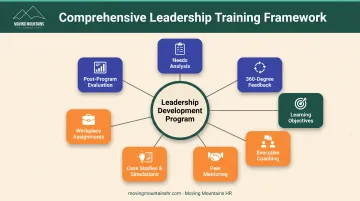
Typical components include needs analysis, outcome goals, 360-degree feedback, coaching, mentoring, case analysis, simulations, workplace assignments, peer communities, and post-program evaluation.
Unlike general skills training, the emphasis is leading others, strategy, and business acumen rather than individual-contributor tasks. Target current managers, aspiring leaders, and high performers in your succession plan.
Key strengths:
- Builds a leadership pipeline from within
- Improves team performance through better management
- Develops organizational capacity for growth
Limitations:
- Significant time and resource investment required
- Difficulty measuring immediate ROI
- Some programs fail: 10% of interventions in a 72-study dataset produced no benefit or negative outcomes
- Trained leaders may leave for opportunities elsewhere if career paths aren't clear
Soft Skills Training
Soft skills training develops interpersonal and professional competencies like communication, collaboration, problem-solving, emotional intelligence, time management, and conflict resolution. These skills are essential across all roles but often overlooked because they're harder to measure than technical skills.
It addresses behaviors and interactions rather than tools or processes. Everyone benefits, with the highest payoff in customer-facing roles, team leads, and cross-functional work.
A 12-month program at Shahi Exports factories returned about 250% ROI within eight months, primarily through productivity gains, with attendance and retention improvements during training.
Key strengths:
- Improved team dynamics and better customer service
- Enhanced communication across departments
- Employees who adapt more easily to change
Limitations:
- Harder to teach and measure than technical skills
- Improvement requires practice and feedback over time
- ROI can be difficult to quantify even though the impact is real
Product or Service Training
Product or service training educates employees on what your organization offers—features, benefits, use cases, competitive advantages, and common customer questions. This goes beyond basic awareness to deep knowledge that enables employees to represent your offerings accurately and confidently.
Sales, support, marketing, and new-product teams need it most. Extending a lighter version company-wide, including during onboarding, keeps messaging consistent.
Key strengths:
- More effective sales conversations
- Better customer support and consistent messaging across the organization
- Employees who can act as brand ambassadors
Limitations:
- Content must be continuously updated as products evolve
- Detailed product facts fade without regular reinforcement and real-world use
Safety Training
Safety training provides instruction on workplace hazards, safe work practices, emergency procedures, and proper use of safety equipment. Some safety training is OSHA-mandated depending on industry and hazards, while other training is a best practice to protect employees and reduce liability.
This applies beyond obviously dangerous industries. It includes office ergonomics, workplace violence prevention, and emergency preparedness.
The Bureau of Labor Statistics reported 2,488,400 private-industry recordable injury and illness cases in 2024, with an incidence rate of 2.3 per 100 full-time-equivalent workers. The National Safety Council estimated 2024 work-injury costs at $181.4 billion.
It often carries legal requirements and directly protects physical wellbeing. Give every employee a baseline, then add role-specific modules for higher-risk work in manufacturing, construction, healthcare, retail, and similar settings.
Key strengths:
- Reduced workplace injuries and illnesses
- Lower workers' compensation costs
- Legal compliance and demonstrating genuine care for employee wellbeing
Limitations:
- Requires regular refreshers to remain top-of-mind
- Training alone doesn't create safety without leadership example, enforcement, and culture
Performance Management Training
Performance management training instructs managers on how to set clear expectations, provide ongoing feedback, conduct effective performance reviews, address performance issues, and coach employees to higher performance. It also includes training employees on how performance management works in your organization, what's expected of them, and how they can advocate for their own development.
Managers and supervisors are the primary audience. A shorter version for all employees helps everyone understand how performance is measured and managed.
In a 2024 Gallup survey, only 2% of 135 Fortune 500 CHROs strongly agreed their system inspires improvement. Among 18,665 U.S. employees, only 47% strongly agreed they knew what was expected, and just 22% strongly agreed reviews were fair and transparent.
Key strengths:
- More consistent and fair performance evaluations
- Managers better equipped to have difficult conversations
- Clearer expectations that reduce confusion and conflict
- Stronger documentation if performance issues escalate
Limitations:
- Managers often resist or avoid performance management even after training
- Requires ongoing practice and support to build confidence
- Poorly designed performance systems can't be fixed by training alone
Diversity, Equity, and Inclusion (DEI) Training
DEI training builds awareness of bias, promotes inclusive behaviors, and creates a workplace where employees of all backgrounds feel valued and can contribute fully. This includes unconscious bias training, cultural competency, inclusive leadership, and creating psychologically safe teams.
While some DEI training is compliance-related (like California harassment prevention), the most effective programs go beyond legal minimums to genuinely shift culture.
The subject is culture and interpersonal dynamics, not individual job skills. Roll it out to all employees, with deeper modules for leaders who hire, promote, and set team norms.
McKinsey research across 1,265 companies found that top-quartile executive teams for gender diversity and ethnic representation each had a 39% greater likelihood of financial outperformance than bottom-quartile peers. This is correlation, not causation—but it demonstrates the business relevance of diversity.
Key strengths:
- Builds more inclusive and innovative teams
- Reduces discrimination and harassment risks
- Improves employee engagement across diverse populations
- Supports recruitment of top talent who prioritize inclusive workplaces
Limitations:
- Training alone doesn't change culture without leadership commitment, policy, and accountability
- Poorly designed programs can trigger backlash or feel performative.
How to Choose the Right Type of Employee Training Program
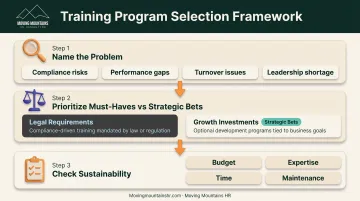
Match the program to a real gap, not a trend. Work through these three steps before you buy or build anything.
Name the problem. Pin the training to a concrete need. Common triggers include:
- Compliance risks
- Performance issues in specific roles or teams
- High turnover among new hires
- Weak leadership bench strength
Separate legal must-haves from strategic bets. Put required compliance training first, especially in highly regulated states like California. Then fund programs that remove your biggest constraints, such as technical skills gaps that slow projects or leadership gaps that block growth.
Check what you can actually sustain. Weigh budget, internal expertise, available time, and whether you can maintain the program after launch. Small to mid-size businesses often get more from an HR consultant who assesses needs and prioritizes spend than from building every program in-house.
Moving Mountains HR builds customized training around your industry, workforce, culture, and goals, including leadership development, California employment compliance, performance management, and workplace investigations. Delivery can be virtual or in person through workshops, coaching, or tailored learning resources.
What to Check Before Finalizing a Type of Employee Training Program
Don't choose training based on popularity or polish. The most sophisticated program is useless if it doesn't solve a real need in your workplace.
Before you finalize a type, check these points:
- You can state what will be different after training and how you'll measure success
- Someone has time to administer the program, keep content current, and reinforce learning after the session
- Required compliance training is covered first—skipping it for "more interesting" programs creates legal risk
Compliance training often sets the professional baseline other development builds on. Many programs fail not from poor design, but because no one owns ongoing management—plan for that before you launch.
Conclusion
Employee training programs come in many types, each serving different purposes, from legally required compliance training to strategic investments in leadership and skills development. There's no universal "best" program; the right choice depends on your organization's specific needs, industry requirements, and stage of growth.
Starting with compliance and onboarding makes sense for most businesses, then expanding to technical, soft skills, and leadership development as your business matures and your workforce needs evolve.
Treat training as an ongoing strategic priority, not a one-time initiative. Investing in employee capabilities is one of the most effective ways to improve retention, productivity, and performance.
Map your current gaps first, then build a simple roadmap that sequences compliance, role skills, and leadership development as you grow. If you need help prioritizing programs or staying aligned with employment requirements, an experienced HR partner can make that plan practical and sustainable.
Frequently Asked Questions
What are the different types of employee training programs?
The main categories include onboarding, compliance, technical skills, leadership, soft skills, product/service, safety, performance management, and DEI. Organizations typically use multiple types depending on their industry, size, and strategic priorities.
What should be included in employee training programs?
Effective programs include clear learning objectives, job-relevant content, practice opportunities, assessment or feedback, and post-training reinforcement. Training should tie directly to real workplace application—not theory alone.
Which training is best for employees?
There's no single best type. It depends on role requirements, skill gaps, and growth goals. Employees consistently value training that's immediately applicable, improves performance, and opens career paths.
What are the 5 steps for developing a training program?
The core steps are: (1) identify the specific need or gap, (2) define clear learning objectives, (3) design or select training content and delivery method, (4) deliver the training with opportunities for practice, and (5) evaluate effectiveness and reinforce learning over time.
What are some effective onboarding programs for new hires?
Effective onboarding typically includes 30-60-90 day plans, company orientation plus role-specific training, a buddy or mentor, regular manager check-ins, and progressive responsibility as confidence builds. The best programs extend well beyond the first week.
What is the 70-20-10 rule for training and development?
The 70-20-10 rule from the Center for Creative Leadership holds that 70% of learning comes from on-the-job experience, 20% from coaching and feedback, and 10% from formal training. Classroom training alone isn't enough; it needs practice and ongoing support.