
Introduction
Small and mid-size businesses are hiring against the same labor pool as national chains and Fortune 500 companies, usually without a recruiter, an HR generalist, or a learning budget to match. That gap shows up fast in turnover.
Gallup's 2026 workforce data puts replacement costs at roughly 40% of salary for a frontline employee, 80% for a technical professional, and 200% for a manager or leader who walks out the door. For a business running lean, one bad exit can eat up a quarter's profit.
Here's what most owners miss: hiring and developing people get treated as separate jobs. One person fills the seat. Nobody owns what happens after the offer letter is signed.
The result? Companies hire well and still lose people fast, or they keep average performers because nobody attracted stronger candidates.
This guide covers the full picture — what talent acquisition and development actually mean, the five elements of an acquisition strategy, and how the two connect — with the practical emphasis on the development side, where a business without a dedicated recruiting function has the most direct control.
Key Takeaways
- Talent acquisition and development are most often described as one continuous strategy rather than two disconnected functions
- Turnover costs scale sharply with role level — up to 200% of salary for a departing manager
- Five building blocks (planning, branding, sourcing, selection, onboarding) create a repeatable hiring engine
- Career pathing and manager quality drive retention more reliably than pay increases alone
- A fractional CHRO model can give smaller businesses executive-level HR strategy — particularly on the development, retention, and compliance side — without a full-time salary
What Is Talent Acquisition and Development?
Talent acquisition is the ongoing, strategic process of identifying, attracting, and hiring people who fit both the role and where your business is headed. It goes well beyond posting a job and hiring the first qualified applicant.
Talent development picks up where acquisition leaves off. It's how you grow, engage, and advance employees after they're hired, through training, mentoring, and clear career paths.
The two are generally described as one continuous strategy rather than two separate jobs. SHRM frames talent acquisition as a long-term workforce strategy—attracting, hiring, and retaining people aligned with business goals—not reactive vacancy-filling.
When acquisition and development run on separate tracks, the gap shows up in the numbers. Gallup found that 42% of voluntary leavers said their manager or organization could have done something to prevent the departure. Most turnover is preventable through better hiring alignment or a real development plan.
How this differs from recruitment and HR administration:
- Recruitment is tactical: filling one open req, usually fast and reactive
- Talent acquisition is strategic: building a pipeline aligned to where the business is going
- HR administration covers payroll, benefits, and compliance—necessary work, separate from growing your workforce
Why It Matters More for Small and Mid-Size Businesses
A 500-person company can absorb a bad hire in one department without much disruption. A 15-person team can't. One wrong fit in a key role hits payroll, morale, and client relationships all at once, and there's rarely a backup plan.
Regulated industries add another layer of difficulty. Healthcare employers, for example, must verify credentials, document competency, and reassess staff when duties change—on top of standard hiring and development steps.
Skip that diligence and you carry risk a larger organization's compliance team would normally catch before it became a problem.
The 5 Key Elements of Talent Acquisition, Explained
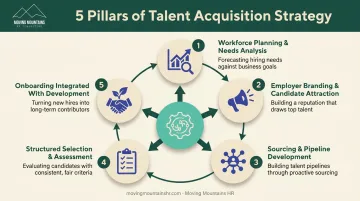
A strong talent acquisition strategy rests on five interconnected pieces. Skip one, and the others weaken. A great sourcing pipeline doesn't matter if interviews are inconsistent, and a strong employer brand won't help if onboarding drops new hires into a sink-or-swim first week.
Workforce Planning and Needs Analysis
Workforce planning means forecasting who a business will need to hire, and when, based on growth goals rather than gut feel. It typically looks 12 to 36 months ahead, maps expected roles against revenue or growth targets, and accounts for skills gaps on the existing team before they turn urgent.
Employer Branding and Candidate Attraction
Your reputation online does more work than most owners realize. Glassdoor's 2025 employer branding data found that employers who raised their company rating by at least half a point averaged 20% more job clicks and 16% more application starts.
Candidates check reviews and ask current employees long before they ever hit "apply."
Sourcing and Candidate Pipeline Development
Reactive job postings reach whoever happens to be looking that week; proactive sourcing builds a bench over time. Employee referrals, continued contact with strong candidates from past openings, and industry relationships formed before a vacancy exists are the components most often described.
Structured Selection and Assessment
Unstructured interviews are where bias creeps in and quality drops. Structured selection refers to making hiring decisions comparable across candidates — consistent questions within a role, work-relevant assessments, and the same reference process for every finalist.
Onboarding Integrated With Development
Onboarding that ends after orientation week leaves most of its value unrealized. Many organizations extend it across a new hire's first 90 days — role clarity and key relationships early on, independent work in the middle, and a first development conversation by the end. That final step is where acquisition hands off to development.
Building an Integrated Talent Acquisition and Development Strategy
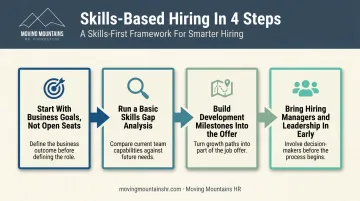
Connecting acquisition and development doesn't require a big HR department. It requires a sequence.
- Start with business goals, not open seats. Map hiring to where the business needs to be in 12 to 36 months—not only the vacancy in front of you.
- Run a basic skills gap analysis. Compare what your team knows today with what upcoming projects will require. Fill some gaps by hiring; close others faster and cheaper by developing people already on staff.
- Build development milestones into the offer, not the exit interview. Show new hires a rough growth path before they accept—not six months in, when they're already wondering what's next.
- Bring hiring managers and leadership in early. Have the people who will manage new hires define success before the posting goes live. That keeps the plan business-driven, not purely administrative.
In practice: Dynamic Automotive, a Maryland auto services company with roughly 60 employees, was named the U.S. Chamber's 2025 CO-100 Top Small Business. It runs apprenticeships for high schoolers and recent graduates to build a pipeline, then pairs new hires with growth plans tied to one-, three-, and five-year milestones.
The Chamber's coverage doesn't cite a specific turnover figure, but the owner credits long-term retention to employees who were developed on the job. For small teams without a full HR bench, the development half of this sequence — skills gap analysis, growth paths, and manager coaching — is often where outside support gets brought in, without adding headcount.
Retaining Talent Through Development Best Practices
Once someone's hired, development is what keeps them.
Build a career path, even an informal one. Employees don't need a corporate ladder with ten rungs. They need to see a next step — a promotion, a new responsibility, or a skill they'll gain in the next year. Without that visibility, good employees start looking elsewhere.
Use mentorship as a low-cost engagement tool. Peer mentoring, manager-led coaching, and informal check-ins transfer institutional knowledge and build loyalty without adding to a training budget.
Train your managers, not just your employees. A manager's quality often determines whether development efforts stick. Someone can have a great career path on paper and still leave if their supervisor lacks feedback skills, conflict resolution training, or basic coaching ability.
Investing in manager development is often the smartest retention move a small business can make.
Measuring What Matters: Key Metrics to Track
You can't fix what you don't measure. A handful of metrics tell you whether acquisition and development are actually working together.
| Metric | What it tells you | Benchmark |
|---|---|---|
| Time-to-fill | Days from opening a role to accepted offer | SHRM's 2026 median: 39 days for nonexecutive roles, 45 for executive roles |
| Time-to-hire | Days from candidate identification to accepted offer | No universal benchmark; track your own trend over time |
| Offer acceptance rate | Whether the right candidates are saying yes | Define your own target; compare against your industry when possible |
| Quality of hire | Whether new hires actually perform well post-hire | Only 20% of organizations formally measure this; define criteria and track your own trend |
| Retention rate | Whether development efforts are keeping people | Define your cohort and time period before comparing year over year |
| Internal promotion rate | Whether employees see real advancement | Track internally; no universal SMB target exists |
Time-to-fill and time-to-hire show whether your acquisition process runs efficiently. Offer acceptance rate and quality of hire reveal whether you're landing the right people—and quality of hire is still underused, so measuring it is an easy way to stand out.
Retention rate and internal promotion rate show whether development is doing its job. Track all six and you'll see exactly where the acquisition-to-development handoff breaks down.
When Businesses Bring In Outside HR Expertise
Some warning signs are hard to ignore once you know what to look for:
- Turnover is climbing and you can't pinpoint why
- Strong performers leave before they reach their second year
- Compliance gaps keep surfacing in handbooks, policies, or documentation
- You're growing fast enough that "figuring it out as we go" no longer works
One model that has emerged in response is the fractional CHRO — part-time, senior-level HR leadership without the cost of a full-time executive hire. In this arrangement someone sets strategy, oversees compliance, and guides retention and employee development decisions on an ongoing basis rather than project by project.
The model shows up most often where added complexity sits on top of everyday people decisions — healthcare organizations handling credentialing and competency requirements, for example. In those cases the value is executive-level input on employee development, retention, and compensation, without an owner having to become an HR expert to get it.

Frequently Asked Questions
What is talent acquisition and development?
Talent acquisition and development is a continuous strategy that combines attracting and hiring the right people with growing, engaging, and advancing them after they join. It supports long-term business goals, not just filling open roles.
What are the 5 elements of talent acquisition?
The five elements are workforce planning, employer branding, sourcing and pipeline development, structured selection, and onboarding integrated with development. Each builds on the one before it.
What is the difference between talent acquisition and recruitment?
Recruitment is short-term and vacancy-driven, focused on filling one open role quickly. Talent acquisition is a long-term, strategic approach aimed at building a workforce aligned with where the business is going.
Is talent acquisition part of HR?
Yes, it typically sits within the HR function. Larger organizations sometimes have a dedicated talent acquisition team, but it still reports up to HR leadership.
How can a small business build an effective talent acquisition strategy without a dedicated HR team?
Start by prioritizing basic workforce planning and standardizing your core hiring steps, like consistent interview questions and reference checks. From there, the businesses that handle this well without dedicated HR tend to revisit their workforce plan on a set cadence — quarterly, for many — instead of only when someone resigns.
What is a fractional CHRO, and when should a business consider one?
A fractional CHRO is a part-time executive HR leader who provides strategic guidance without the cost of a full-time hire. Businesses typically consider one when growth outpaces internal HR capacity, compliance gaps start surfacing, or leadership needs ongoing executive-level input on employee development and retention rather than project-by-project help.