Introduction: What Are Management Development Services?
A small business owner promotes their top salesperson into a supervisory role—only to watch them struggle six months later. The new manager hasn't learned how to delegate, coach, or handle conflict.
Productivity drops. Morale suffers. The promotion that was supposed to solve a problem created a new one.
This scenario is common: companies select the right managerial talent only 18% of the time, according to Gallup. Technical excellence doesn't guarantee leadership effectiveness. That's where management development services come in.
Management development services are structured programs and consulting support designed to build leadership capabilities, management skills, and organizational effectiveness across all levels. These services encompass training, coaching, assessments, and strategic HR guidance that help organizations close the gap between technical performance and leadership readiness.
This article explains what management development services include, the business results they drive, how programs are delivered, and how to choose the right provider.
Key Takeaways
- Structured programs, coaching, and consulting build stronger leadership and day-to-day management effectiveness
- Strong manager development drives up to 18% higher engagement and 21%–28% lower turnover
- Offerings span assessment through strategic leadership, via external, in-house, or hybrid delivery
- Lasting results need strategy fit, clear metrics, executive buy-in, and culture and compliance alignment
Understanding Management Development Services: Core Definition and Scope
Management development services are professional consulting and training solutions that build managers' and leaders' capabilities. They help organizations drive performance, manage teams effectively, stay compliant, and hit strategic objectives.
Federal guidance such as 5 CFR Part 412 shows how formal programs are often scoped: development for current and prospective supervisors, managers, and executives, tied to succession plans. Common methods include training, coaching, mentoring, learning groups, and action projects.
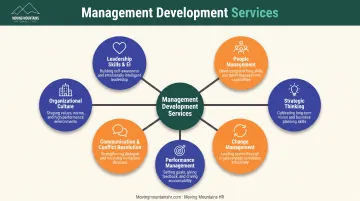
These services address multiple dimensions:
- Leadership skills and emotional intelligence
- People management and team effectiveness
- Strategic thinking and decision-making
- Change management and adaptability
- Performance management and accountability
- Communication and conflict resolution
- Organizational culture development
How Management Development Differs from General Training
Management development is not a one-time class. It is a multi-method, succession-linked effort delivered over an extended period. General employee training focuses on job-specific skills, often delivered once and checked off. Management development emphasizes leadership competencies, aligns with organizational goals, and needs ongoing reinforcement and application.
Internal, External, or Hybrid Delivery
Organizations can deliver management development:
- Internally: Through HR departments or learning and development teams
- Externally: Via specialized consultants, coaching firms, or fractional HR executives
- Hybrid: Combining external expertise with internal cultural knowledge
Many small to mid-size businesses lack dedicated HR resources and benefit from external partners who provide strategic guidance, program design, and facilitation expertise. Moving Mountains HR, for example, offers customized Training & Development Programs covering leadership and supervisor development, delivered virtually or in person.
Why One-Size-Fits-All Doesn't Work
Effective management development must fit industry context, organizational culture, business strategy, and specific capability gaps. A healthcare organization faces unique regulatory and ethical considerations; a startup needs different competencies than a mature enterprise.
Customization starts with assessment. Teams identify current capabilities, gaps, and future needs through 360-degree feedback, competency frameworks, performance data, and leadership assessments.
Key Benefits of Management Development Services for Organizations
Improved Retention and Succession Planning
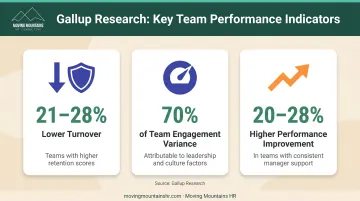
Organizations with strong manager-development programs experience 21%-28% lower turnover and stronger internal promotion pipelines. Gallup found that 42% of voluntary leavers said their manager or organization could have prevented their departure.
Developing managers creates clear career paths and reduces costly external hiring. A 2012 Wharton study found that external hires received lower evaluations, exited more often, and earned 18%-20% more than comparable internal promotions.
Enhanced Productivity and Performance
Gallup research shows that managers account for at least 70% of variance in team-level engagement. Skilled managers drive that engagement when they:
- Set clear expectations
- Give timely, useful feedback
- Remove obstacles that slow the team down
- Build psychologically safe working conditions
Employees receiving daily manager feedback were three times as likely to be engaged as those receiving feedback annually or less.
Trained managers achieved a 20%-28% higher likelihood of performance improvement compared to nonparticipants in manager-development programs.
Reduced Compliance and Legal Risks
Well-trained managers understand employment law, fair treatment practices, and documentation requirements. In California, employers with five or more employees must give supervisors at least two hours of interactive sexual-harassment training within six months of assuming the role, repeated every two years.
Beyond mandated compliance training, management development helps leaders handle sensitive situations such as harassment claims, performance issues, and terminations. That preparation reduces exposure to lawsuits and regulatory violations.
Moving Mountains HR integrates compliance training with leadership development, covering documentation, employee relations, conflict resolution, and respectful workplace practices.
Stronger Organizational Culture and Employee Engagement
Managers are the primary interface between leadership vision and employee experience. Developing their people skills directly impacts workplace culture. McKinsey research found that senior-leader role modeling was associated with 5.3 times greater transformation success, and open senior-manager communication with 8.0 times greater success. When managers model the culture leaders describe, employees experience it consistently—not only in all-hands meetings.
Better Change Management and Adaptability
Developed managers can lead teams through organizational change, industry disruptions, and strategic pivots more effectively. McKinsey found 3% transformation success when line managers were not engaged versus 26% when they were. While this is an association, not proof of a training effect, it underscores the critical role managers play in executing change.
How Management Development Differs from Training, Coaching, and Mentoring
These terms often get used interchangeably, but each plays a different role in building leadership capability.
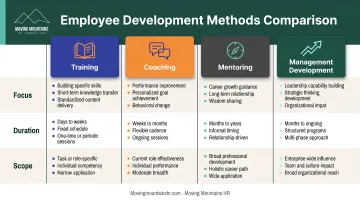
Employee Training
- Focus: Short-term, skill-specific job tasks
- Duration: Often one-time events
- Scope: Narrow technical or procedural skills
Management Development
- Focus: Leadership capabilities and strategic thinking
- Duration: Ongoing over extended periods
- Scope: Competency-based programs with organizational impact
Coaching
- Format: One-on-one
- Purpose: Individual goals, current performance, or specific obstacles
- Role: A component within broader management development
Mentoring
- Format: Relationship-based, often informal
- Purpose: Knowledge transfer from experienced to less experienced people
- Role: Career navigation, organizational context, and future capability
According to the Center for Creative Leadership, coaching provides individualized challenge and support focused on current performance, while mentoring is career-path focused. Mentors use experience to advise, transfer knowledge, and expand networks.
Management development can include coaching and mentoring as components, but it goes further. It uses formalized, competency-based programs with measurable outcomes and organizational accountability.
Types and Components of Management Development Services
Needs Assessment and Competency Modeling
Strong programs start with a clear organizational assessment:
- Identifying current management capabilities and gaps
- Analyzing future needs based on business strategy
- Using tools like 360-degree feedback, competency frameworks, performance data, and employee engagement surveys
CCL's Benchmarks® 360 assessment measures 16 competencies and five possible derailers, identifying strengths, improvement areas, and development goals.
Skill-Building Components
Assessment findings drive what managers actually practice. Most programs concentrate on a few high-leverage skill clusters rather than a generic curriculum.
Leadership skills usually cover emotional intelligence, communication and active listening, delegation, conflict resolution, decision-making, strategic thinking, and team collaboration. Delivery mixes workshops, simulations, role-playing, case studies, and experiential activities. A 2017 meta-analysis of 335 independent samples found stronger outcomes when programs used needs analysis, feedback, multi-method practice, spaced sessions, and face-to-face delivery.
Performance management training equips managers to:
- Set clear expectations and SMART goals
- Run effective performance reviews
- Give constructive feedback on a regular cadence
- Document performance issues properly
- Handle difficult conversations with confidence
Training on fair evaluations, bias awareness, and solid documentation also reduces legal risk for the organization.
Change leadership helps managers guide teams through transitions, explain the vision and rationale, work through resistance, and build buy-in for continuous improvement.
Strategic and business acumen deepens fluency in budgeting and finances, market dynamics, competitive trends, and how day-to-day decisions affect broader results.
Coaching and Ongoing Support
Skill workshops alone rarely stick. One-on-one executive or management coaching adds personalized guidance and accountability so new behaviors show up on the job.
Coaching works best inside a fuller program that includes workplace practice, feedback, and reinforcement—not as a standalone session.
Implementing Management Development in Your Organization
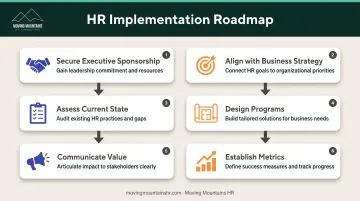
Rolling out management development works best when you treat it as a business initiative, not a one-off training event. Use the steps below to build sponsorship, focus effort, and prove impact.
Key Implementation Steps
- Secure executive sponsorship - Leadership buy-in is critical for resource allocation and cultural support
- Align development objectives with business strategy - Only 43% of talent-development professionals report alignment between business and learning goals
- Assess current state and identify priorities - Use baseline data to target high-impact areas
- Design or select appropriate programs - Customize to organizational culture and industry context
- Communicate value to stakeholders - Help managers understand the benefits and expectations
- Establish metrics to measure impact - Track behavior, transfer, and business results—not just satisfaction
Critical Success Factors
Create a learning culture:
- Protect development as valued time on the calendar
- Give managers real work opportunities to apply new skills
- Reinforce learning with coaching and follow-up after training ends
- Hold managers accountable for showing new capabilities on the job
Practices that improve results:
- Run a needs analysis and collect feedback before you design content
- Build practice through role-plays, projects, and peer learning
- Space sessions over time and blend live learning with on-the-job application
- Tie every module to real workplace challenges managers face
- Use individual assessments and tools so development fits each leader
Common Implementation Challenges and Solutions
Budget constraints:
- Start with high-impact areas (supervisor-to-manager transitions, performance management)
- Use phased rollout
- Consider hybrid models with external expertise for design and internal delivery for scale
Time limitations:
- Integrate development into workflow
- Use microlearning and on-the-job application
- Schedule regular touchpoints rather than long, infrequent sessions
Skepticism from managers:
- Demonstrate ROI with baseline and follow-up metrics
- Get testimonials from early adopters
- Make development relevant to real challenges managers face
Maintaining momentum:
- Celebrate progress publicly so wins stay visible
- Tie development to promotion criteria and performance evaluations
- Assign owners for follow-up so reinforcement does not fade after launch
If you do not have dedicated HR capacity, an external partner can help with strategy, program design, and facilitation. Moving Mountains HR works with small to mid-size businesses on leadership and supervisor development through workshops, coaching, and ongoing HR support—virtual or in person.
Choosing the Right Management Development Partner
Not every provider fits every organization. Use the criteria below to compare options, then match provider type to the scope and depth of development you need.
Evaluation Criteria
Provider's industry expertise:
- Understanding of your business context and challenges
- Experience with similar-sized organizations
- Track record with measurable outcomes
Customization capability:
- Ability to tailor programs rather than deliver off-the-shelf content
- Willingness to conduct needs assessment and align with your strategy
- Flexibility to adapt delivery methods to your culture
Measurement and ROI:
- Clear metrics to demonstrate impact
- Baseline and follow-up assessment processes
- Transparency about what success looks like
Cultural fit:
- Alignment with your organization's values and tone
- Credibility with your management team
- Chemistry during initial consultations
Different Provider Types and When Each Makes Sense
| Provider Type | Best For | Considerations |
|---|---|---|
| Large training companies | Broad, multi-level program coverage; standardized frameworks | Brand presence doesn't prove outcomes; verify customization |
| Specialized boutique consultancies | Deep expertise in specific methodologies or industries | Higher cost per participant; match specialization to your need |
| Individual executive coaches | Personalized one-on-one development for senior leaders | Verify ICF credentials, references, and coaching philosophy; not scalable for groups |
| Fractional or outsourced HR executives | Strategic HR guidance plus management development as part of broader HR function | Best when you need integrated people strategy, compliance support, and performance systems |

Questions to Ask Potential Providers
Needs assessment:
- What is your approach to identifying our specific capability gaps?
- How do you involve our leadership and managers in the assessment process?
Customization:
- How do you customize content for our industry and organizational culture?
- Can you provide examples of how you've adapted programs for similar clients?
Measurement:
- What metrics do you use to measure success?
- How do you establish baseline and follow-up data?
- What does your reporting process look like?
Experience and references:
- What experience do you have in our industry?
- Can you provide references from similar-sized organizations?
- What client outcomes can you document?
Ongoing support:
- What support do you provide beyond initial program delivery?
- How do you reinforce learning and ensure skill application?
- Do you offer coaching or follow-up consultation?
For small to mid-size businesses, a strategic HR partner can often fold management development into broader people strategy, compliance support, and performance systems—so leadership training doesn’t sit apart from day-to-day HR.
Moving Mountains HR takes that route through Training & Development Programs, HR outsourcing, and fractional CHRO services, so you build manager capability alongside compliant HR systems.
Frequently Asked Questions
What does MDS stand for in the business context?
MDS stands for Management Development Services: professional programs and consulting that strengthen leadership and management capability. That usually includes training, coaching, assessments, and strategic guidance for supervisors and executives.
How much do management development services typically cost?
Costs vary by scope and delivery model. Group workshops may run several hundred dollars per participant; full leadership programs or executive coaching often cost $5,000–$15,000+ per person. Weigh that against turnover costs (often 50%–200% of annual salary) and stronger team performance.
How long does it take to see results from management development programs?
Managers often show early behavior changes within weeks of applying new skills. Measurable gains in engagement, retention, and productivity usually show up over 6–12 months of consistent practice. A 2021 small-business study found four of five leadership practices improved at three-month follow-up.
Should we develop managers internally or hire external consultants?
Many organizations use a hybrid model. External partners add specialized expertise and outside perspective; internal programs keep culture alignment and lower per-person cost. Choice depends on size, HR capacity, budget, and needs—small businesses without dedicated HR often gain the most from external support.
What's the difference between management development and leadership development?
The terms overlap, but management development focuses on supervising teams and executing strategy (delegation, performance management, operations). Leadership development targets vision-setting, strategic thinking, and organizational influence. Strong programs usually cover both.
Do small businesses really need formal management development services?
Yes. In smaller organizations, manager mistakes hit harder, and many owners promote strong individual contributors without leadership training. Targeted development supports growth and lowers people-risk. Gallup found companies select the right managerial talent only 18% of the time.
Ready to strengthen your management team? Moving Mountains HR provides customized leadership and supervisor development programs tailored to your industry, workforce, and business goals. Schedule a 30-minute consultation to discuss how we can help your organization build stronger, more effective leaders.