
The bridge between survey insights and actual workplace improvements is action planning — the structured process of translating employee feedback into tangible changes. Without it, surveys can actually damage trust and engagement. This guide provides a practical 7-step framework specifically designed for small to mid-size businesses that want to turn survey data into meaningful results.
Key Takeaways
- Failing to act on survey results can decrease engagement by 3% and break organizational trust
- Leadership commitment, employee involvement, and clear accountability make action planning work
- Prioritizing 2–3 issues beats trying to fix everything at once
- Regular progress tracking and transparent communication sustain momentum and prove follow-through
Why Action Planning Matters After Employee Surveys
Conducting an engagement survey without acting on the results is worse than not surveying at all. When employees take time to provide honest feedback and see no response, it signals that their opinions don't matter. Deloitte research confirms that failure to act after feedback can break organizational trust—and once that trust is gone, future surveys lose credibility.
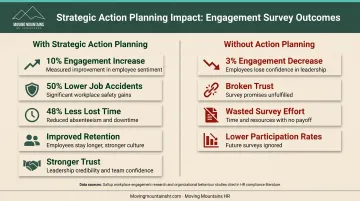
The contrast in outcomes is measurable. Research ties follow-through after surveys to clear business results:
- Gallup found top-quartile workgroups on action planning raised engagement by an average of 10%, while lowest-quartile groups saw engagement drop 3%
- Organizations that shared and acted on survey results saw 50% lower job-accident incidence and 48% less lost time
For small businesses, those gaps show up in retention, productivity, and day-to-day culture.
Done well, action planning shows employees their input changes decisions and creates accountability leaders can track over time. With limited resources, the priority is acting strategically on a few high-impact issues—not trying to fix everything at once.
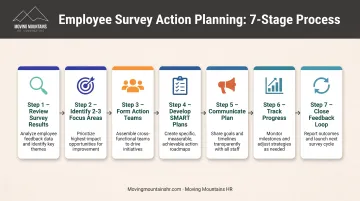
7-Step Action Planning Process for Employee Engagement
Step 1: Review and Analyze Survey Results with Key Stakeholders
Start by convening the right people to examine results while feedback is still fresh. Include leadership, department managers, and HR in your initial review. The goal is to identify patterns, recurring themes, and priority areas that cut across teams.
How to approach the review:
- Look for survey items where scores are lowest or have declined since the last measurement
- Segment data by department, tenure, or role to identify localized issues
- Note where multiple related questions point to the same underlying problem
- Distinguish between issues within your control and those requiring longer-term strategy
Return results quickly. Employees remember their survey experience best when feedback is recent. Gallup recommends analyzing results within days or weeks, not months.
Step 2: Identify 2-3 Focus Areas for Action
Once you understand the data, resist the urge to fix everything at once. Gallup's foundational action-planning process recommends selecting 2-3 key issues to address over the next 12 months. For small businesses with limited HR capacity, this focus is essential.
Prioritization criteria:
- Impact: Will addressing this issue significantly improve engagement or business outcomes?
- Feasibility: Can you realistically implement solutions with current resources?
- Alignment: Does it support broader organizational goals and values?
- Employee voice: Did employees indicate both high importance and low satisfaction in this area?
Avoid the trap of choosing priorities based solely on leadership assumptions. The issues that matter most to employees should drive your selection, not what seems easiest to fix.
Step 3: Form Action Planning Teams
Effective action planning involves the people who will live with the changes. Assemble small, cross-functional teams for each priority area, ensuring representation from different levels and departments.
Team structure:
- Team leader: A manager or senior employee who can champion the initiative and report progress
- Action item owners: Individuals responsible for specific tasks within the plan
- Team members: Employees from the affected areas who bring diverse perspectives
In smaller organizations, teams may be 3-5 people rather than 8-10. What matters is diverse input and genuine participation. When employees help shape solutions, buy-in and accountability increase naturally.
Step 4: Develop SMART Action Plans
Translate priority areas into concrete, measurable plans. SMART goals are Specific, Measurable, Achievable, Relevant, and Time-bound. The framework turns good intentions into trackable initiatives.
Components of a strong action plan:
- Specific goal: Clear description of what success looks like
- Measurable criteria: How you'll track progress and know when you've succeeded
- Action steps: Concrete tasks required to achieve the goal
- Owners: Named individuals responsible for each action
- Timeline: Realistic deadlines with interim milestones
- Resources needed: Budget, time, tools, or support required
For small businesses, keep timelines realistic. A 3-6 month horizon for most initiatives allows meaningful progress without overextending your team.
Step 5: Communicate the Action Plan to All Employees
Transparency is critical. Share what you heard in the survey, what you're doing about it, and when employees can expect to see changes. This "closing the loop" step demonstrates that feedback led directly to action.
Communication best practices:
- Use the framing: "We heard you, therefore we are..." to connect feedback explicitly to planned actions
- Share through multiple channels — all-hands meetings, email updates, team huddles, or internal collaboration tools
- Invite questions and input, creating two-way dialogue rather than one-way announcements
- Acknowledge areas where you cannot take immediate action and explain why
CIPD research emphasizes that genuine two-way communication requires managers to listen and act on feedback, not simply broadcast decisions. Employees should understand how their voices influenced the plan.
Step 6: Implement and Track Progress
Action plans fail when they sit in a drawer. Establish regular check-ins (monthly or quarterly, depending on your company's pace) to review progress, address obstacles, and adjust as needed.
Tracking essentials:
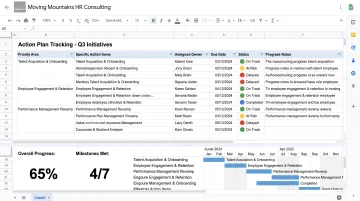
- Create a simple tracking tool with columns for priority area, action item, owner, due date, status, and notes
- Hold brief standing meetings to review progress and remove blockers
- Celebrate quick wins publicly to build momentum and reinforce the value of participation
- Be transparent about delays or challenges rather than letting them quietly derail the plan
Even small businesses can use basic spreadsheets or shared documents to maintain visibility. The format matters less than the discipline of regular review.
Step 7: Close the Feedback Loop and Prepare for the Next Cycle
Before launching your next engagement survey, communicate what you accomplished, what's still in progress, and what you learned. Acknowledge both successes and ongoing challenges honestly.
Closing the loop effectively:
- Share progress updates at regular intervals, not just at the end
- Highlight specific changes employees will notice as a result of their feedback
- Ask employees whether the organization "hit the mark" on commitments
- Use the momentum from completed actions to set the stage for continuous engagement measurement
Treat this step as preparation for the next engagement cycle, not a finish line. Research supports reviewing action plans for effectiveness and sustainability, then adjusting where needed and carrying those lessons into future feedback efforts.
Common Mistakes to Avoid in Action Planning
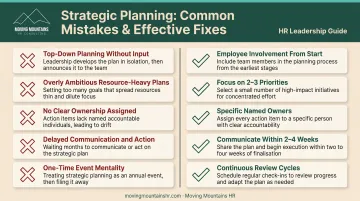
Mistake 1: Leadership Announces the Plan Without Employee Involvement
When leaders dictate solutions without input, employees don't own the outcomes. Gallup emphasizes that priority setting must be fair and originate with the team, not handed down from above. Top-down planning reduces buy-in and misses valuable insights from those closest to the problems.
The fix: Involve employees in diagnosing issues and developing solutions from the start.
Mistake 2: Creating Overly Ambitious Plans That Exceed Available Resources
Small businesses often lack the time, budget, and HR capacity of larger organizations. Committing to more than you can deliver sets everyone up for failure and disappointment.
The fix: Start small, focus on 2-3 priorities, and build on early successes rather than launching a dozen initiatives simultaneously.
Mistake 3: Failing to Assign Clear Ownership and Accountability
Vague responsibility means nothing gets done. When "the team" is responsible, no one is responsible.
The fix: Designate specific action item owners with authority and resources to execute, and hold regular check-ins to track their progress.
Mistake 4: Waiting Too Long to Communicate or Take Action
Delay erodes trust and momentum. Employees interpret silence as indifference. Gallup recommends analyzing results within days or weeks. Stretch that window much further and people conclude their feedback didn't matter.
The fix: Share initial results and next steps within 2-4 weeks of closing the survey, even if your full action plan takes longer to develop.
Mistake 5: Treating Action Planning as a One-Time Event
Engagement is continuous, not a "set it and forget it" initiative. Per research on workplace engagement interventions, plans should be reviewed for effectiveness and sustainability, adjusted when needed, and used to inform the next feedback cycle.
The fix: Build ongoing review and iteration into your engagement strategy from day one.
Action Plan Examples for Small Businesses
Concrete examples make action planning easier to copy and adapt. Each plan below turns a common engagement survey finding into a SMART goal, named owners, and a realistic timeline.
Example 1: Addressing Communication Gaps
Survey findings: Employees reported low satisfaction with internal communication, particularly regarding company decisions and project updates.
SMART Goal: Establish consistent communication channels and practices that increase employee awareness of company decisions and project status within 90 days.
Action plan:
- Launch weekly 15-minute team huddles every Monday to share updates and answer questions (Owner: Department Managers, Start: Week 1)
- Implement monthly all-staff meetings with Q&A to discuss company direction and performance (Owner: CEO, Start: Week 2)
- Create brief communication guidelines outlining when and how to share information (Owner: HR, Deadline: Week 4)
- Survey employees at 90 days to measure improvement in communication satisfaction
Timeline: 3 months with milestone check-ins at 30 and 60 days
Example 2: Improving Professional Development Opportunities
Survey findings: Employees indicated strong interest in growth opportunities but felt the company provided limited support for professional development.
SMART Goal: Launch three low-cost professional development initiatives within six months that increase employee access to learning and skill-building.
Action plan:
- Establish a peer mentorship program pairing junior and senior employees (Owner: HR, Launch: Month 2)
- Create cross-training opportunities allowing employees to learn adjacent roles (Owner: Operations Manager, Start: Month 1)
- Introduce a $500 annual tuition assistance policy for job-relevant courses (Owner: Finance/HR, Effective: Month 4)
- Track participation rates and employee feedback quarterly
Timeline: 6 months with staggered rollouts
Example 3: Enhancing Recognition and Appreciation in a Remote Team
Survey findings: Remote employees felt underappreciated and disconnected, with low scores on recognition-related questions.
SMART Goal: Implement formal and informal recognition practices that increase employees' sense of appreciation within four months.
Action plan:
- Launch a peer recognition platform where team members can publicly acknowledge each other's contributions (Owner: HR, Launch: Month 1)
- Host monthly virtual appreciation events celebrating wins and milestones (Owner: Leadership Team, Start: Month 2)
- Train managers on giving specific, timely, and meaningful feedback (Owner: HR, Completion: Month 3)
- Measure recognition frequency and employee satisfaction at the 4-month mark
That investment is hard to beat on cost: well-recognized employees are 45% less likely to leave after two years.
When to Seek External HR Support for Action Planning
The plans above assume you can run the process in-house. Bring in an HR consultant when:
- Limited internal capacity: Your team lacks time or HR expertise to facilitate the action-planning process effectively
- Need for neutral facilitation: Sensitive issues or low trust require an objective third party to guide discussions
- Complex or systemic issues: Survey results reveal challenges requiring strategic HR intervention beyond basic fixes
Moving Mountains HR's Fractional CHRO services give small businesses senior HR leadership without a full-time executive hire. Support can include interpreting survey data, facilitating action-planning sessions, and tracking implementation so plans stay on course.
How to Maintain Momentum After Your Action Plan
An action plan only works if you keep it moving after the survey buzz fades. Build these three habits into your calendar so gains stick.
Schedule Regular Progress Reviews and Update Employees
Set a predictable cadence for reviewing action items: monthly for fast-moving initiatives, quarterly for longer-term plans. Share progress transparently, including both wins and obstacles.
Continue Measuring Engagement Through Pulse Surveys
Pulse surveys are short, frequent checks that monitor changes over time. Use them between annual surveys to see whether your actions are lifting engagement in real time.
Recognize and Celebrate Action Plan Wins Publicly
Acknowledge progress and reinforce positive changes. Recognition doesn't need an elaborate program. Simple, public gestures work:
- Thanks in team meetings
- Email shout-outs for specific contributions
- Callouts of measurable improvements in all-hands updates
Keep reviewing, measuring, and celebrating so employees see that engagement work continues long after the survey closes.
Frequently Asked Questions
What are the 5 C's of employee engagement?
The 5 C's — Care, Connect, Coach, Contribute, and Congratulate — are a practitioner framework for organizing engagement activities. They emphasize building relationships, developing employees, enabling meaningful work, and recognizing contributions.
What are the 7 steps of an action plan?
The seven steps are: review survey results with stakeholders, pick 2–3 focus areas, form action teams, build SMART plans, communicate the plan, implement and track progress, then close the feedback loop. The same sequence works for teams of any size.
What is a good action plan example?
A strong plan names the issue (such as low communication scores), a SMART goal (weekly huddles and monthly meetings within 90 days), owners and deadlines for each action, and a success metric (resurvey communication scores at 90 days).
How long should an action plan take to implement?
Most initiatives fit a 3–6 month window with regular milestone check-ins. Simple changes may take weeks; larger strategic work can run 6–12 months, depending on complexity and resources.
What if employees don't participate in action planning sessions?
Raise participation by protecting psychological safety, showing how input shapes decisions, and offering more than one channel—meetings, short surveys, or anonymous suggestions. Leadership modeling and visible follow-through on feedback usually bring more people in.
Need help turning engagement survey results into a workable plan? Moving Mountains HR helps small and mid-size businesses design practical engagement strategies that fit their resources and culture. From survey analysis and action-planning facilitation to progress tracking, our Fractional CHRO services offer senior HR guidance without a full-time executive hire. Contact us today to talk through your next steps.