Introduction
Strong leadership has become a make-or-break factor for small to mid-size businesses facing real talent shortages. In October alone, 32% of small-business owners reported unfilled job openings despite active recruiting efforts, reflecting the mounting pressure to attract and retain skilled people.
Managers are struggling with core leadership skills at the same time. Setting strategy and managing change rank among their biggest gaps, yet many HR teams still deprioritize closing them.
Many business owners recognize that leadership matters, but question whether formal development programs justify the investment. Research shows effective leadership training delivers measurable returns through higher profitability, lower turnover, and reduced compliance risk. This article explores the practical, data-backed benefits of leadership development and shows why small to mid-size companies stand to gain the most.
Key Takeaways
- Programs improve learning, skill transfer, and business results—backed by 335 independent studies
- Effective managers reduce turnover by 21%-28% and explain 70% of team engagement differences
- Trained leaders prevent costly compliance violations, workplace conflicts, and employment claims
- Lasting gains come from coaching, mentoring, workshops, and ongoing practice—not one-time events
What Is Leadership Development (Brief Context)
Leadership development is the systematic process of building the skills, knowledge, and capabilities leaders need to guide teams and achieve organizational goals. It applies to every leadership level, from frontline supervisors to mid-level managers and senior executives. It covers soft skills such as communication and emotional intelligence, and hard skills such as strategic planning and performance management.
Modern leadership development takes many forms beyond traditional classroom training. Common approaches include:
- Executive coaching for real-time challenges
- Mentorship programs that transfer institutional knowledge
- Workshops focused on targeted skill-building
- Self-directed learning for schedule flexibility
- Stretch assignments and other on-the-job experiences
The strongest programs blend several of these over time so leaders can practice, get feedback, and refine skills in the flow of work.
Key Benefits of Leadership Development in Organizations
The benefits outlined below are supported by peer-reviewed research and measurable in real-world organizational outcomes. A 2017 meta-analysis of 335 independent samples found leadership training improved reactions, learning, transfer, and business results, with effect sizes ranging from 0.63 to 0.82. Those gains show up as stronger financial performance, higher retention, and lower organizational risk.
Improved Business Performance & Profitability
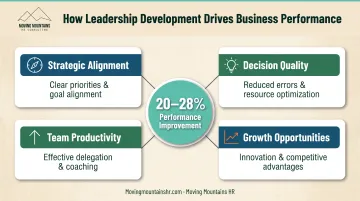
Leadership development directly impacts your bottom line by building leaders who drive productivity, make better decisions, and execute strategy effectively. Developed leaders build higher-performing teams, cut costly mistakes, allocate resources more wisely, and spot innovation that drives revenue growth.
How it works:
- Trained leaders set clear priorities and align team efforts with organizational goals
- Better decision-making reduces expensive errors and wasted resources
- Effective delegation and coaching multiply productivity across the team
- Strategic thinking enables leaders to identify growth opportunities and competitive advantages
The research: The 2017 meta-analysis covering 335 studies found leadership training delivered an effect size of 0.72 for business results. A separate Gallup analysis found teams led by trained managers showed a 20%-28% higher likelihood of performance improvement compared to teams whose managers didn't participate in development programs.
KPIs impacted:
- Revenue growth and profit margins
- Productivity metrics and output per employee
- Cost reduction and resource efficiency
- Innovation pipeline and new product launches
- Customer satisfaction and retention scores
This benefit matters most during growth phases, market expansion, organizational change, or when you need better operational efficiency and competitive positioning. Small to mid-size businesses often see outsized impact because each manager’s performance touches a larger share of the workforce.
Higher Employee Retention & Engagement
Performance gains only stick if people stay. Leadership development reduces turnover and raises engagement by building managers who support, coach, and motivate their teams.
Train leaders to communicate clearly, give regular feedback, recognize contributions, and grow their people, and employees feel valued and see a future with you.
What drives retention:
When leaders know how to hold meaningful conversations, give constructive feedback, resolve conflicts early, and create development opportunities, employees stay longer and perform better. Gallup research shows managers account for at least 70% of the variance in team engagement, making manager capability the single biggest engagement lever organizations control.
Proof points: Teams led by trained managers had 21%-28% less turnover than teams whose managers didn't participate in development programs.
Among 717 employees who voluntarily left their jobs, 42% said the manager or organization could have prevented the departure. Yet 45% received no proactive conversation about job satisfaction, performance, or their future in the three months before leaving.
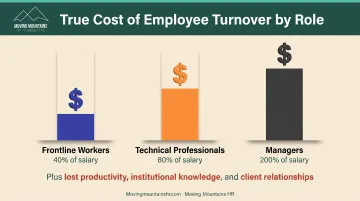
The financial impact is significant. Gallup estimates replacement costs at roughly 200% of salary for managers, 80% for technical professionals, and 40% for frontline workers (not counting lost productivity, institutional knowledge, or client relationships).
KPIs impacted:
- Employee turnover and retention rates
- Time-to-fill open positions
- Employee engagement and satisfaction scores
- Internal promotion rate
- Voluntary vs. involuntary turnover ratio
- Cost per hire and total turnover cost
When this benefit matters most: In tight labor markets, for roles requiring specialized skills, during periods of high turnover, or when building strong organizational culture is a strategic priority.
Better Risk Management & Compliance
Keeping talent is only half the equation; untrained managers also create legal exposure. Leadership development lowers organizational risk by teaching leaders to handle sensitive situations correctly, stay aligned with employment law, and stop workplace issues before they escalate.
Untrained managers make costly mistakes: harassment claims, discrimination lawsuits, wage violations, and regulatory penalties.
How trained leaders reduce risk:
- Understand harassment prevention, discrimination laws, wage and hour rules, and documentation requirements
- Recognize warning signs of workplace problems before they escalate
- Respond to employee relations issues following proper procedures
- Create records that protect the organization and support fair, consistent decisions
Legal context: California employers with 5+ employees must provide supervisors at least 2 hours of harassment-prevention training every two years. That requirement is a legal minimum, not a complete risk strategy.
Leaders still need skills to manage performance fairly, handle terminations correctly, maintain workplace safety, and resolve conflicts before they become formal complaints.
KPIs impacted:
- Number of HR complaints and grievances
- Legal fees and settlement costs
- EEOC charges and regulatory violations
- Workplace safety incidents and OSHA citations
- Employee relations issues requiring investigation
- Time spent resolving conflicts and conducting investigations
When this benefit matters most: In regulated industries, companies with distributed teams or multiple locations, during rapid growth when new managers are promoted quickly, or after previous workplace incidents have exposed gaps in leadership capability.
What Happens When Leadership Development Is Missing or Ignored
Organizations that skip leadership development face predictable, costly consequences. These are measurable patterns that show up across industries and company sizes.
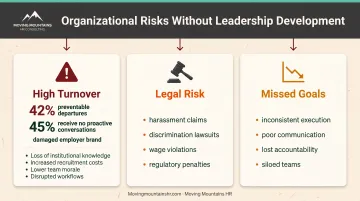
High turnover and difficulty attracting talent: Employees leave bad managers, not companies. When managers lack basic skills like giving feedback, recognizing good work, and resolving conflicts, turnover spikes.
42% of voluntary leavers say their departure could have been prevented, yet 45% received no proactive conversation about their job satisfaction or future before they quit. Word spreads, your employer brand suffers, and qualified candidates get harder to attract.
Increased compliance and legal risk: Untrained managers violate employment laws, often without realizing it. Common mistakes include:
- Misclassifying employees
- Handling harassment complaints incorrectly
- Retaliating unintentionally
- Failing to accommodate disabilities properly
- Terminating people without proper documentation
Each mistake exposes the organization to lawsuits, regulatory investigations, and financial penalties that basic training could have prevented.
Inconsistent execution and missed goals: Without developed leaders, strategic initiatives stall because teams execute unevenly. Managers interpret priorities differently, communicate poorly, and avoid hard conversations.
Accountability slips, silos form, and culture loses clear direction. Business results then fall short of targets.
How to Get the Most Value from Leadership Development
Leadership development pays off most when you treat it as a system, not a one-off event. Use these principles to get stronger results.
Start early and develop at all levels
Don't wait until someone is promoted to start developing them. High-potential employees benefit from early exposure to leadership concepts, and each level needs different skills:
- Frontline supervisors: coaching and conflict resolution
- Mid-level managers: strategic planning and change management
- Executives: vision-setting and organizational design
Make it ongoing, not one-time
Leadership development works best as a continuous process, not a single workshop. Research shows that spaced sessions, practice, feedback, and multiple delivery methods strengthen outcomes. Pair formal training with coaching, peer learning groups, and on-the-job application over months—not days.
Tie development to business outcomes
Connect leadership training to goals your organization already tracks, such as lower turnover, higher customer satisfaction, or revenue growth. Leaders need to see why the skills matter and how they show up in results.
Set clear KPIs before launch. Only 43% of talent-development professionals report aligned business and learning goals, and 90% say isolating training impact is difficult.
Consider external support when needed
Small to mid-size businesses often lack the internal HR capacity to design and sustain leadership programs. An experienced HR partner can supply coaching, customized training, and ongoing guidance.
Moving Mountains HR delivers leadership and supervisor training virtually or in person, with fractional CHRO support for organizations that want executive-level HR help without a full-time hire.
Frequently Asked Questions
What are the benefits of leadership development in organizations?
Leadership development improves profitability through stronger decision-making and execution, raises retention by creating managers people want to work for, and lowers risk by training leaders on compliance and workplace issues.
What are the main goals of leadership development programs in organizations?
Programs build competencies like communication, strategic thinking, and performance management; align leaders with company strategy; and create consistent management practices that strengthen culture and drive results.
What are examples of leadership development in organizations?
Common formats include executive coaching, mentorship programs, leadership workshops, stretch assignments, peer learning groups, and formal development tracks for high-potential employees.
What is a leadership development company?
A leadership development company is an external firm that provides training, coaching, assessments, and programs to build skills organizations may lack in-house. They add expertise and an objective perspective alongside internal HR.
What are the key qualities of a good leader?
Strong leaders show self-awareness and emotional intelligence, communicate clearly, develop others through coaching, think strategically, adapt to change, and own results and decisions.
When does leadership development matter most for small businesses?
It matters most during growth when you need new managers fast, when promoting first-time managers, during major change, in tight labor markets, or when turnover and employee-relations issues signal leadership gaps.
Conclusion
Leadership development is a strategic investment with measurable returns: improved profitability, higher retention, reduced risk, and stronger organizational performance. Research shows leadership training improves learning, transfer, and business results, while trained managers reduce turnover by 21%–28% and lift team performance.
The benefits compound over time. Organizations that consistently develop leaders build a competitive advantage through stronger culture, better decision-making, and more effective execution. Each trained manager multiplies impact across their team, and those gains spread through the rest of the organization.
Small to mid-size businesses often see the greatest impact, because effective managers have outsized influence on team success. When every manager leads a large share of your workforce, investing in their capability protects and accelerates growth. Moving Mountains HR delivers leadership training built for growing organizations that need practical, executive-level support without a full-time HR bench.