
Introduction: Why Core Values Training Matters More Than Ever
Picture this: Your employee handbook lists "integrity" as a core value. Yet when a deadline looms, leadership quietly approves corner-cutting to deliver on time. That disconnect creates real tension for employees, and it drives turnover and disengagement.
Research analyzing over 1.2 million employee reviews found that published company values showed no meaningful correlation with employees' actual workplace experience. When 562 organizations claimed "integrity" as a core value, employees in those same companies reported no difference in ethical culture compared to organizations that never mentioned it.
For small businesses without dedicated HR teams, this gap hits especially hard. When employees can't reconcile their personal principles with daily workplace decisions, productivity drops, compliance risks multiply, and retention suffers. You can't afford constant rehiring or the regulatory penalties that follow inconsistent practices. Core values training closes that gap when values show up in daily decisions, not only in the handbook. This guide covers what effective training looks like, where programs fall short, and practical steps small and mid-size teams can use right away.
Key Takeaways
- Core values training reduces the gap between stated principles and observed workplace behavior
- Authentic values emerge from what your organization actually rewards, not aspirational statements
- Small businesses gain the most when values guide hiring, performance reviews, and daily decisions
- Scenario-based learning and storytelling make abstract values actionable for employees
- Effective training requires ongoing reinforcement through recognition, accountability, and leadership modeling
What is Core Values Training and Why It Matters
Core values training is a structured process that helps employees understand, internalize, and apply an organization's guiding principles to real-world decisions and behaviors. It transforms abstract statements like integrity, collaboration, and customer focus into daily actions employees can recognize, practice, and be held accountable for.
For small businesses, this framework becomes especially critical. You likely don't have formal policies covering every situation. Values fill that gap, giving employees decision-making guardrails when no handbook section applies.
The Business Case for Values Training
Research on person-organization fit shows that when employees' personal values align with organizational values, they report higher job satisfaction and stronger commitment. While the data doesn't prove direct productivity gains, it consistently predicts positive work attitudes and contributes to retention.
The negative case is clearer. A 2022 MIT analysis of 1.3 million employee reviews found toxic culture (disrespectful, non-inclusive, unethical, cutthroat, or abusive behavior) was 10 times more predictive of attrition than compensation in the early months of the Great Resignation.
Values training alone won't fix a toxic culture. It is, however, a necessary foundation for defining and addressing the behaviors that create it.
Compliance and Risk Considerations
Even small employers face significant compliance exposure. The EEOC notes that businesses with 15–19 employees are covered by federal prohibitions on discrimination based on race, color, religion, sex, national origin, age, disability, and genetic information.
Values training isn't a legal defense. Clear behavioral expectations rooted in respect, fairness, and accountability still reduce the conditions that lead to harassment claims, retaliation complaints, and workplace investigations.
The U.S. Department of Justice's 2024 compliance framework sets a higher bar than posting values on a wall or sending an annual email. Effective programs:
- Use tailored training with real-life scenarios
- Check whether employees actually learned the material
- Follow up when people fail those checks
- Evaluate whether training changed behavior on the job
Why Most Values Training Fails
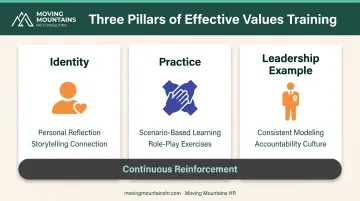
Values posted on walls don't change behavior. The MIT study compared 562 published values statements with employee reviews and found near-zero, and sometimes negative, correlations between what companies claimed and what employees experienced. Training works when it does three things:
- Helps employees identify with values through stories
- Lets them practice those values on realistic dilemmas
- Shows leaders modeling the same standards consistently
Without that loop of identity, practice, and leadership example, values stay words on a wall.
How to Identify Your Organization's Core Values
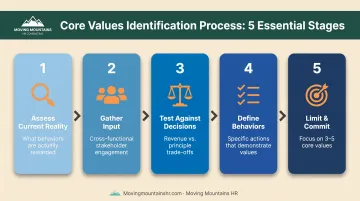
Start With Reality, Not Aspiration
Most organizations get this backward. They brainstorm aspirational values in a conference room, then wonder why employees don't live them. Instead, start with what you already reward.
Ask leadership and employees separately: What behaviors does this company actually recognize, promote, and tolerate? Compare the two lists. The gap between them reveals whether your stated values reflect reality or wishful thinking.
Gather Diverse Input
SHRM recommends assembling a cross-section of departments, locations, roles, and tenure levels. Collect 20–25 ideas, then group them into 5–7 themes using affinity mapping. Label each theme using participants' own language, not corporate jargon.
Long-tenured employees bring institutional memory; recent hires bring fresh perspective. Both matter. Harvard Business School research stresses testing draft values through employee feedback and reassessing them as conditions change.
Test Values Against Real Decisions
For each proposed core value, ask: "Would we sacrifice revenue, time, or a client relationship to uphold this principle?" If the answer is no, it's a preference, not a core value.
Real-world examples make the standard clearer:
- Southwest Airlines reportedly cut executive bonuses, closed routes, and reduced discretionary spending rather than lay off employees during downturns
- Adidas built its values into town halls, management conversations, and compensation decisions
Once a value survives that test, keep the list short. Fewer, deeply held values beat exhaustive lists—employees can't remember or consistently apply ten competing principles. Three to five gives people clarity they can actually use.
Document Specific Behaviors
For each core value, define:
- 3–4 behaviors that show the value in daily work
- 2–3 behaviors that cross the line and violate it
This specificity becomes the foundation for training content, performance feedback, and accountability. "Integrity" means little until you define it as "admitting mistakes to clients before they discover them" and "never misrepresenting project status in status meetings."
Effective Core Values Training Activities
Start by helping employees reflect on their own values. In the "peak experience" exercise, participants recall a time they felt most fulfilled at work, then name which personal values showed up in that moment. Overlap between personal principles and company values makes buy-in real—not a poster on the wall.
Scenario-Based Learning and Role-Play
Build realistic workplace dilemmas that force a values-based choice, then debrief the trade-offs and consequences of each option.
A 2009 meta-analysis of ethics instruction covering 20 studies and 3,041 participants found a moderate overall effect (d=.42). Case-based, interactive programs with real-world practice consistently outperformed lectures. The research wasn't limited to "core values training," but the principle holds: people learn values by practicing decisions, not hearing definitions.
Example scenario:
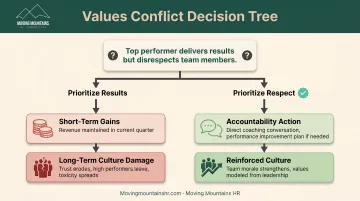
A top-performing salesperson consistently closes deals but frequently dismisses support staff requests and makes demeaning comments to junior team members. The company values both "results" and "respect." What do you do?
Follow-up discussion should explore trade-offs, consequences of each choice, and how leadership's response signals which value truly governs behavior.
Layer in role-play when two values pull in different directions—for example, "customer service excellence" versus "employee well-being." Staff rehearse the tension in a low-stakes setting so real conflicts feel familiar, not improvised.
Storytelling and Real Employee Case Studies
Have team members share specific stories of colleagues living the values, especially under pressure. Notre Dame's ethics research notes that stories engage episodic memory and let people see and feel ethical behavior in context. Narrative builds an emotional link that definitions alone never will.
One caution: negative stories can normalize misconduct. Use examples that show the right path—not cautionary tales that accidentally model bad behavior.
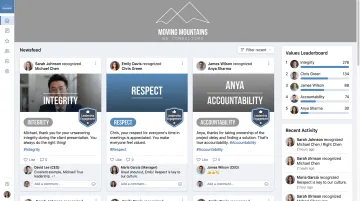
Recognition Systems Linked to Values
SHRM's 2016 survey found that among organizations linking recognition to values, 88% said it helped reinforce values, compared to 57% without that linkage. The survey covered larger organizations (500+ employees) and measured perceptions, not hard outcomes—but public recognition of specific values still tells people what leadership will reward.
Create physical or digital spaces where employees can:
- Recognize colleagues for demonstrating specific values
- Share customer stories that reflect values in action
- Post examples of values-based decisions
Connect bonuses, promotions, and formal awards to observed values behavior so the principles show up in career decisions, not only in training decks.
Building a Values-Based Culture Beyond Training
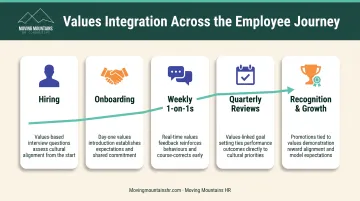
Integrate Values Into Hiring From Day One
Build values-based interview questions that ask candidates to describe past behavior, not hypothetical responses. SHRM warns that subjective "culture fit" questions invite bias. Instead, define required values clearly, use standardized questions, and score answers with anchored examples.
Example question for "accountability":
"Tell me about a time you made a mistake that affected your team. What did you do, and what was the result?"
A values-aligned candidate will describe owning the error, communicating quickly, and taking corrective action, even when that answer reflects poorly on them.
Hiring for values only sticks if onboarding reinforces them before new hires pick up contradictory habits. From day one, make clear what the organization rewards and what it will not tolerate.
Align Performance Management With Values
Core values belong in everyday management, not only annual training. SHRM frames performance management as clear goals plus ongoing feedback, not a once-a-year event.
Build values into:
- Weekly one-on-ones and real-time feedback
- Quarterly reviews and goal-setting
- Recognition and coaching conversations
When managers reference values in these moments, employees treat them as relevant, not ceremonial.
Consider Fractional CHRO Support
Organizations without dedicated HR leadership can use fractional CHRO support to build values frameworks, design training, and keep hiring, performance management, and compliance aligned. Moving Mountains HR provides this executive-level guidance so small businesses can put values into daily practice without the cost of a full-time hire.
Aligning Values With HR Policies and Compliance
Develop Policies Rooted in Values
Core values should directly inform your code of conduct, ethics policies, and behavioral expectations. Citigroup's code of conduct shows how this works in practice. It requires judgment consistent with the company's mission and values, and it:
- Applies three decision tests to ethical dilemmas
- Mandates reporting of violations
- Prohibits retaliation
- Links breaches to investigation and potential termination
This creates consistency: "who we say we are" matches "what we require."
Apply Values in Investigations and Conflict Resolution
Workplace investigations should assess whether behavior violated organizational values, not just legal standards. A neutral third-party investigation protects the integrity of your culture by evaluating conduct against the principles employees were trained to uphold.
Moving Mountains HR's workplace investigation services cover harassment, discrimination, retaliation, hostile work environment, and code-of-conduct violations. These are the areas where values alignment is tested most directly.
Conduct Compliance Audits Through a Values Lens
The DOJ's 2024 compliance framework evaluates several culture-related factors:
- Leadership commitment and tailored training
- Incentive structures and consistency of discipline
- Reporting channels and investigation quality
- Employee surveys and continuous improvement
HR compliance audits can check whether your policies and practices reinforce stated values or contradict them. Moving Mountains HR uses this lens to identify gaps before they become legal risks.
Measuring the Impact of Values Training
Track Leading and Lagging Indicators
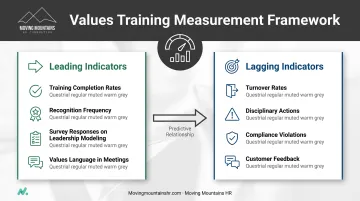
Effective measurement combines perception (what employees believe) and behavior (what actually changes).
Leading indicators:
- Training completion and engagement rates
- Values-specific recognition frequency
- Employee survey responses on leadership modeling
- Values language used in meetings and decisions
Lagging indicators:
- Turnover rates, especially values-related exits
- Disciplinary actions and investigation findings
- Compliance violations and regulatory issues
- Customer feedback reflecting values in service delivery
Implement Regular Feedback Mechanisms
Use pulse surveys or focus groups to ask:
- Do you see leaders consistently model our core values?
- Can you describe a recent example of a colleague demonstrating a specific value?
- Do you feel empowered to make values-based decisions, even when it's difficult?
Gallup research found that only 27% of employees strongly agreed that leaders were committed to cultural values. Use this as a credibility benchmark, not a target: higher scores suggest employees believe the stated culture is real.
Watch for Day-to-Day Behavioral Signals
Look for evidence that values language and thinking have become embedded:
- Do employees reference values when explaining decisions in meetings?
- Are customer interactions reflecting stated principles?
- How are conflicts being resolved: through power dynamics or shared values?
- Do performance conversations cite specific values demonstrations?
These qualitative signals often reveal culture change before quantitative metrics shift.
Core Values Training Tools and Resources
Learning Management Systems for Scalable Delivery
Small businesses can deliver, track, and reinforce values training digitally using platforms like:
- TalentLMS: Course creation, assignments, progress tracking, reports, and automation. Free plan available for up to 5 users and 10 courses.
- MoodleCloud: Course delivery, assessments, progress monitoring, and reports for small organizations.
These platforms provide functionality, not proof that values change. You still need strong content, real scenarios, and leadership follow-through.
Values Assessment and Clarification Tools
Before you roll values into training, it helps to surface what people already believe and how they make ethical calls.
- Barrett Personal Values Assessment: $19.95 survey with report, interpretation, and exercises in 22 languages. Helps employees name personal values before comparing them with company principles.
- Ethics Unwrapped: Free university videos, cases, and decision concepts on behavioral ethics. Facilitators can map cases to company-specific values.
If you need programs built around your own values, Moving Mountains HR designs virtual or in-person training on leadership, compliance, and workplace culture tied to your business goals.
Frequently Asked Questions
What are the 5 main core values?
Core values vary by organization. Common ones include integrity, respect, excellence, innovation, and accountability. In 562 large-company values statements, integrity appeared in 65%, collaboration in 53%, and customer focus in 48%. The right values are the ones that truly match your identity, not a generic list copied from competitors.
What are the 5 steps of training?
A typical process has five steps: define values with stakeholder input, build content from real workplace scenarios, deliver it through workshops or digital modules, reinforce it with recognition and leadership accountability, then measure results and refine the program.
How long does core values training take?
Initial training usually takes 2–4 hours for the basics. Real impact comes from ongoing reinforcement: quarterly team discussions, recognition tied to values, and inclusion in performance reviews. Values training is a continuous cultural process, not a one-time event.
How do you measure the success of values training?
Track hard metrics such as engagement scores, retention, and fewer workplace conflicts or investigation cases. Also watch for employees citing values in decisions and leaders modeling them consistently. The DOJ's compliance framework stresses observable behavior change in operations, not just completion rates.
What's the difference between company values and personal values?
Personal values are individual principles shaped by life experience, family, and culture. Company values guide business decisions, workplace behavior, and culture. Strong workplaces hire for meaningful overlap between the two, which cuts the friction that drives disengagement and turnover.
How often should values training be refreshed?
Refresh formal training annually and reinforce it quarterly through team discussions, recognition, and leadership messages. Revisit values during mergers, leadership changes, strategy shifts, or major growth. The DOJ framework calls for periodic, audience-specific training updated after incidents, policy changes, and new risks.
Ready to build a values-driven culture employees actually believe in? Moving Mountains HR helps small and mid-size businesses define authentic core values, design practical training, and weave those principles into hiring, performance management, and compliance.
Schedule a consultation to see how fractional CHRO support turns abstract values into daily behaviors that improve retention and reduce risk.