
Leave policies are the written frameworks that define when, why, and how employees may take time away from work while protecting their jobs, benefits, and pay. They're legally essential because federal laws (FMLA, ADA, PWFA) and state-specific rules impose mandatory minimums, documentation standards, and employee protections that vary by business size, location, and circumstance. Operationally, clear leave policies prevent the chaos Sarah faced—reducing legal exposure, supporting retention, and building trust.
This guide covers the categories every small business must understand: federal requirements that set the floor, California-specific rules that often exceed federal minimums, the full spectrum of leave types you should address, and best practices for building compliant, practical policies that work.
Key Takeaways
- Federal laws (FMLA, ADA, PWFA) set minimums; states often require broader protections
- California covers employers with 5+ employees and mandates paid sick leave and vacation payout
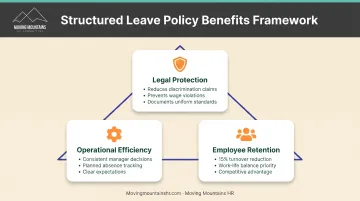
- Structured leave policies cut discrimination claims, wage violations, and turnover
- Concurrent leave types create overlapping entitlements that need separate tracking
- Ignoring PWFA 2023 and state paid-leave expansions risks penalties and back pay
Why Leave Policies Matter for Small Businesses
Legal protection is the first business case. The U.S. Department of Labor reported 301 FMLA violations affecting 342 employees in FY2025, producing over $1 million in back wages. Leading findings included denial of leave (116 cases), discrimination (106), failure to reinstate (84), and termination (65).
These are recurring enforcement actions against employers who lacked clear, consistently applied leave policies. Written policies create documented procedures that reduce discrimination exposure and wage-hour violations by setting uniform standards for every employee.
The retention case is equally strong. A 2023 working paper found that paid-family-leave adoption reduced employee turnover by 1.2 percentage points—a 15% reduction from the sample baseline.
Separately, SHRM reported that employees need at least 15 annual PTO days to consider a new job. EBRI's 2025 survey showed 53% placed work-life balance among their top three non-compensation benefits. Employees value family benefits enough to switch employers; structured leave policies reduce that risk.
Small businesses face a unique reality. Even if your company has fewer than 50 employees and is not required to offer FMLA, you still need clear leave policies. Employees will request time off for illness, family emergencies, and personal needs regardless of legal mandates. Without documented procedures, you face:
- Inconsistent manager decisions that create discrimination liability
- Operational chaos when absences aren't planned or tracked
- Employee dissatisfaction when expectations are unclear
- Exposure under the ADA, PWFA, and state laws that apply regardless of FMLA coverage
A written policy framework prevents these problems and gives managers a consistent playbook when leave requests come in.
Understanding Federal Leave Laws
Federal law establishes three overlapping leave frameworks that apply differently based on employer size, employee eligibility, and the reason for leave.
FMLA: The Core Job-Protected Leave Entitlement
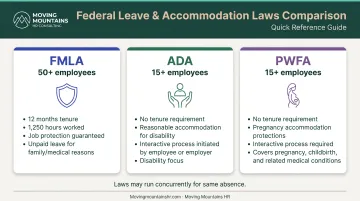
The Family and Medical Leave Act (FMLA) covers private employers with 50 or more employees in 20 workweeks. An employee becomes eligible after:
- 12 months of employment
- 1,250 hours worked in the prior year
- Working at a location with at least 50 employees within 75 miles
Eligible employees receive up to 12 workweeks of unpaid, job-protected leave annually for:
- Serious health conditions affecting the employee
- Birth or adoption of a child
- Care for a spouse, child, or parent with a serious health condition
- Qualifying military-family exigencies
A separate 26-week entitlement applies for military-caregiver leave. During FMLA leave, group health coverage continues, and the employee must be restored to the same or an equivalent position.
Documentation requirements:
- Employees don't need to say "FMLA" when requesting leave
- Medical certification is generally due within 15 calendar days; incomplete certifications get a 7-day cure period
- Certification records must stay confidential and separate from personnel files
ADA: Reasonable Accommodation Beyond FMLA
The Americans with Disabilities Act (ADA) applies independently of FMLA. Additional unpaid leave can be a reasonable accommodation for a qualified employee unless it creates undue hardship. The EEOC has clarified that employers cannot automatically terminate employees at an FMLA or policy maximum. An ADA analysis is still required.
Example: An employee with a qualifying disability needs 13 weeks of leave when your FMLA entitlement provides 12. The additional week requires an ADA interactive process to determine whether the extension is reasonable or creates undue hardship.
Key differences:
- Lower employer-size threshold (15+ employees, not 50+)
- No hours-worked or tenure requirement
- Unpaid leave is one potential accommodation; return-to-work accommodations may also be required
- Medical documentation standards differ; obvious disabilities may not require supporting documentation
PWFA: Pregnancy-Related Accommodations
The Pregnant Workers Fairness Act (PWFA) became effective June 27, 2023; the EEOC's final rule took effect June 18, 2024. The law requires reasonable accommodation for known pregnancy-, childbirth-, or related-medical limitations absent undue hardship.
How it differs from FMLA:
- Covers employers with 15+ employees (not 50)
- No tenure or hours-worked requirement
- Leave may be an accommodation, but employers may not force leave if another effective accommodation permits continued work
- The regulation restricts when supporting documentation may be sought; documentation isn't automatically required for every request
Interactive process: Employers must engage promptly and cannot delay accommodations while waiting for medical documentation in all cases.
How These Laws Run Concurrently
An employee may simultaneously be:
- On FMLA leave for a serious health condition
- Receiving ADA accommodation in the form of additional unpaid leave beyond FMLA
- Using employer-paid sick leave that runs concurrently with FMLA
Each law has separate documentation, notice, and tracking requirements. Businesses must evaluate each absence against all applicable frameworks and maintain clear records of which entitlements are being used.
Types of Leave Policies Explained
Leave policies typically fall into three broad categories: family/caregiving, health, and personal. Within each category, you need both mandatory leave (required by law) and discretionary leave (offered by choice).
Use the breakdowns below to see what belongs in a written policy and what California or federal rules may already require.
Paid vs. Unpaid Leave
Paid leave replaces wages during an absence; it may be required by state law (California paid sick leave) or voluntarily offered (PTO, bereavement). Unpaid leave protects the job and may continue benefits but does not pay wages; FMLA is the most common unpaid framework.
Family and Caregiving Leave
- Parental leave: Time off for birth, adoption, or foster placement
- Bereavement leave: Time off after a family member’s death (not federally mandated; usually employer-provided)
- Compassionate/family-care leave: Broader caregiving for seriously ill relatives
Health Leave
- Sick leave: Short-term absence for illness or injury; often state-mandated with accrual minimums
- Medical leave: Extended leave for serious health conditions, typically covered by FMLA or state equivalents
- Mental health leave: Time off for mental-health needs; 47% of leave requests in a 2025 SHRM survey involved mental-health challenges
Personal and Vacation Leave
- Vacation/PTO: Discretionary time off for rest, travel, or personal needs
- Floating holidays: Flexible days that employees may use for religious observance, personal events, or other purposes
Specialized and Mandated Leave Types
Beyond core PTO and medical leave, several mandated categories need explicit policy language:
- Military leave (USERRA): Reemployment rights generally apply when cumulative service absence stays within 5 years. You must reinstate returning service members to the same or an equivalent role.
- Jury duty leave: California does not require paid jury-duty leave, but you must allow employees to serve. Many states use a similar unpaid model.
- Voting leave: California allows up to 2 hours of paid time off to vote, with notice and timing rules you should spell out in policy.
Emerging Leave Categories
Some employers also add optional categories that go beyond legal minimums:
- Volunteer time off (VTO): 28% of employers offered paid volunteer time in 2024; another 12% offered unpaid volunteer leave.
- Sabbaticals: Extended leave for development, rest, or personal projects; 6% of employers offered paid sabbaticals in 2024.
- Religious observance: Floating holidays help, but Title VII still requires case-by-case religious accommodation.
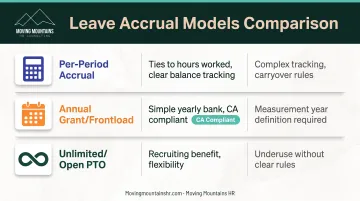
Leave Accrual Models: Pros and Cons
| Model | Advantage | Limitation |
|---|---|---|
| Per-period accrual | Ties leave to hours worked; clear earned balance (CA sick leave: 1 hour per 30 worked) | Needs tight tracking for balances, carryover, caps, and reinstatement |
| Annual grant/frontload | Simple yearly bank; CA allows frontloading full statutory sick leave | Must define the measurement year and meet new-hire minimums on time |
| Unlimited/open PTO | Strong recruiting signal; SHRM: ~16 days taken vs. 14 under fixed PTO | Vague approval rules drive underuse; define eligibility, exclusions, and expectations |
Carryover and Use-It-or-Lose-It Provisions
Under accrual plans, unused time often carries into the next year. You can still set reasonable caps on the total bank (for example, 80 hours) and on how much may be used in a year (for example, 40 hours).
California prohibits forfeiture of accrued vacation time. You may not run a use-it-or-lose-it rule on earned vacation, though reasonable caps remain allowed.
California-Specific Leave Requirements
California's leave framework is among the most protective in the nation, with obligations well beyond federal minimums.
Paid Sick Leave: 40 Hours Minimum
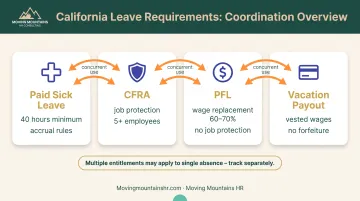
Effective January 1, 2024, California requires at least 40 hours or 5 days of paid sick leave annually, whichever is greater. Employees may begin using accrued sick leave after 90 days.
Key rules for employers:
- Accrual: At least 1 hour per 30 hours worked
- Carryover and caps: Unused accrued time carries over; employers may cap the bank at 80 hours or 10 days and annual use at 40 hours or 5 days
- Front-load option: Providing the full annual amount up front can avoid the statutory carryover requirement
- Records: Keep earned- and used-leave records for 3 years
- No use-it-or-lose-it: Accrued sick time cannot be forfeited, though reasonable caps are allowed
California Family Rights Act (CFRA)
CFRA mirrors FMLA but applies to employers with 5 or more employees (versus 50 for FMLA). Eligible employees generally need 1 year of service and 1,250 hours worked.
Entitlement: Up to 12 weeks of unpaid, job-protected leave annually for:
- Serious health conditions
- Bonding with a new child
- Care for a spouse, domestic partner, child, parent, grandparent, grandchild, or sibling with a serious health condition
Job protection: Employees must be reinstated to the same or a comparable job. CFRA's covered-family list is broader than FMLA's.
Paid Family Leave (PFL): Wage Replacement, Not Job Protection
California's Paid Family Leave program provides wage replacement through State Disability Insurance for:
- Bonding with a new child (birth, adoption, foster placement)
- Caring for a seriously ill family member
2026 benefits: Approximately 70%-90% of base-period wages for up to 8 weeks; weekly benefit ranges from $50 to $1,765.
Critical distinction: PFL provides pay, not job protection. CFRA, FMLA, or another law must supply job protection. Employees may use PFL concurrently with CFRA/FMLA.
Final Pay and Vacation Payout
California requires immediate payment of all wages, including accrued vacation, when an employee is terminated. Earned vacation is considered vested wages and may not be forfeited under a use-it-or-lose-it policy, though reasonable accrual caps are permitted.
Penalties: Willful failure to pay final wages can produce waiting-time penalties for up to 30 calendar days of the employee's daily wage rate.
Together, these rules mean California employers need leave policies that coordinate sick leave, CFRA job protection, PFL wage replacement, and vacation payout—not standalone practices copied from federal baselines.
Best Practices for Creating Compliant Leave Policies
Building a compliant leave policy framework requires understanding which laws apply, documenting clear procedures, and training managers to recognize and handle leave requests properly.
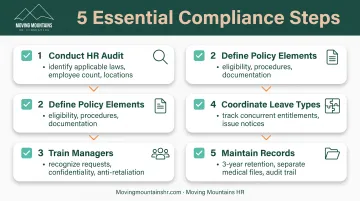
Conduct an HR Audit
Start by identifying which federal and state leave laws apply to your organization:
- Employee count: Do you have 5, 15, or 50+ employees? This determines CFRA, ADA, PWFA, and FMLA coverage.
- Locations: Which states do your employees work in? Multi-state employers must comply with each state's leave laws.
- Industry: Certain industries face additional leave requirements (such as healthcare and the public sector).
Use the audit to identify gaps between your current policies and legal requirements. Moving Mountains HR's HR Document Audit, for example, reviews your policies and handbooks, compares them to current legal requirements, and delivers a gap analysis with clear next steps.
Define Essential Policy Elements
Every compliant leave policy should include:
- Clear definitions of each leave type, including paid vs. unpaid status, duration, and qualifying reasons
- Eligibility criteria covering tenure, hours worked, and employee classification (full-time, part-time)
- Application procedures that explain how to request leave, notice periods (foreseeable vs. unforeseeable), and whom to contact
- Documentation rules for medical certification, deadlines, cure periods, and confidentiality protections
- Pay and benefits continuation details, including how accrued PTO interacts and whether health coverage continues
- Return-to-work processes covering reinstatement rights, fitness-for-duty certification (where permitted), and accommodation review
Train Managers to Recognize and Handle Leave Requests
Employees don't need to say "FMLA" or cite a specific law when requesting leave. Managers must recognize potentially protected absences—such as "I need time off for a medical procedure" or "My parent is seriously ill"—and route them to HR promptly.
Training should cover:
- How to identify qualifying leave requests
- Proper documentation and confidentiality requirements
- Job-protection obligations and anti-retaliation rules
- When to engage the interactive process for ADA or PWFA accommodations
- Avoiding automatic termination at policy or FMLA limits
Maintain Detailed Records
Strong recordkeeping protects you in audits and disputes:
- Keep FMLA medical records separate and confidential
- Retain California sick-leave accrual and use records for at least 3 years
- Document which leave entitlements run concurrently
- Issue required FMLA eligibility and designation notices on time
- Track each absence against separate entitlement limits
Common Leave Policy Mistakes to Avoid
Treating Leave Types as Completely Separate
Federal and state leave laws often run concurrently for the same absence. An employee on FMLA for a serious health condition may simultaneously use:
- California PFL for wage replacement
- CFRA for job protection
- Employer-paid sick leave
Each entitlement has separate tracking, notice, and documentation requirements. Failing to coordinate them leads to incorrect benefit calculations, missed deadlines, and compliance violations.
Inconsistent Application Across Departments
When managers apply leave policies differently across departments, discrimination claims and employee distrust follow. Approving one request while denying another for the same reason creates legal and cultural risk.
Written policies and centralized HR review help ensure uniform treatment.
Automatic Termination at FMLA or Policy Limits
FMLA exhaustion does not end the ADA accommodation analysis. An employee who has used 12 weeks of FMLA leave and needs additional time may be entitled to unpaid leave as an ADA accommodation. Automatic termination policies violate the ADA's reasonable-accommodation requirement.
Outdated Policies
Leave laws change frequently. The PWFA became effective in 2023, and many states have expanded paid-leave programs in recent years. Policies that haven't been reviewed since 2020 or earlier likely miss critical protections.
Multi-state employers face particular risk when a headquarters-state policy is applied uniformly without state-specific addenda.
Overbroad Documentation Demands
FMLA, ADA, and PWFA have different standards for medical information. One generic medical-information form isn't a safe substitute.
The PWFA regulation restricts when employers may seek supporting documentation. The ADA limits requests to disability- and accommodation-related information. Overly broad or premature documentation demands can violate these laws.
Frequently Asked Questions
What is the difference between FMLA and paid sick leave?
FMLA is federal job-protected unpaid leave for serious health conditions, birth or adoption, and military-family needs. Paid sick leave is employer-provided or state-mandated paid time off for shorter-term illness or injury. They can run together when the same absence qualifies under both (for example, California paid sick leave during an FMLA absence).
Does California require paid family leave?
Yes, but pay and job protection are separate. California's Paid Family Leave (PFL) replaces about 60–70% of wages (up to a weekly cap) via state disability insurance for bonding or caring for a seriously ill family member. PFL does not protect the job; employees typically run it with CFRA or FMLA for job protection.
How do I handle employees who request multiple types of leave at once?
Run leaves concurrently when the law allows. FMLA, CFRA, and PFL may all apply to the same absence. Document which laws apply, track each entitlement separately, issue the required notices, and keep clear written communication with the employee.
What are the penalties for not having a compliant leave policy?
FMLA violations can mean back pay, lost benefits, liquidated damages, reinstatement, and attorney fees. ADA, PWFA, and California sick-leave violations can add discrimination claims, compensatory damages, administrative fines, and related relief. In 2024, DOL recovered $438,625 in back wages, unpaid bonuses, and liquidated damages for two Mercedes-Benz workers in a single FMLA case.
Can small businesses with fewer than 50 employees offer FMLA?
FMLA only covers employers with 50 or more employees, but smaller employers can offer equivalent policies voluntarily. California employers with 5 or more employees must still comply with CFRA. Structured leave policies, even when optional, reduce operational chaos and support retention.
How should leave policies address remote employees in multiple states?
Cover employees under the leave laws of their work location with state-specific addendums or clear location-based provisions. Review policies regularly as state rules change (SHRM calls multi-state paid leave a compliance maze). Do not apply one state's rules everywhere; eligibility, duration, funding, and job protection differ significantly.
Build a leave policy framework that protects your business and supports your people. Moving Mountains HR helps small and mid-size businesses across California and the U.S. with compliance audits, policy documentation, and practical HR systems, including HR Document Audits and Fractional CHRO support for complex leave coordination. Contact us at 866-474-3575 or questions@movingmountainshr.com for a complimentary consultation.