
Introduction
The small-business talent shortage is intensifying. In June 2026, 32% of NFIB members reported job openings they could not fill, and 51% of hiring businesses found few or no qualified applicants. For small and mid-sized companies, that shortage means external recruiting alone will not build capable teams. You need to develop the talent already inside your organization.
A learning and development (L&D) strategy is a structured plan to grow employee skills in line with business goals. Unlike one-off training sessions, it ties assessment, planning, implementation, and measurement together so you can close skills gaps, strengthen leadership, and support growth.
In 2026, rapid AI adoption, evolving California employment law, hybrid work, and rising customer expectations make that kind of plan harder to put off.
This guide covers what an L&D strategy is, why it matters in 2026, and the core parts of an effective plan. You will also get a step-by-step approach to build, measure, and improve your strategy—even without a full HR department.
What Is a Learning and Development Strategy?
A learning and development strategy is a structured plan to develop employee skills and capabilities in alignment with your business objectives. According to the Chartered Institute of Personnel and Development (CIPD), an L&D strategy defines how an organization develops workforce capabilities, skills, and competencies as part of overall business strategy.
L&D differs from one-off training. Ad-hoc workshops or courses address immediate needs but don't build long-term capability. A systematic L&D strategy connects individual development to organizational goals, creates consistent learning pathways, and continuously improves based on results.
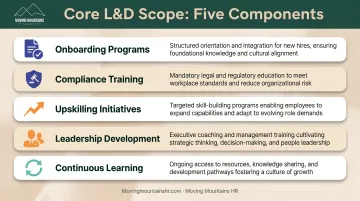
The scope of L&D includes:
- Onboarding programs that help new hires become productive quickly
- Compliance training that meets regulatory requirements and reduces legal risk
- Upskilling initiatives that build new capabilities for changing roles
- Leadership development that prepares supervisors and managers for greater responsibility
- Continuous learning opportunities that keep skills current as technology and markets evolve
An effective L&D strategy supports goals like retention, productivity, and innovation. It ties development spend to measurable capability gains instead of one-off courses with no follow-through. In 2026, rapid tech change and rising employee expectations push employers to build skills systematically rather than reactively.
Why Your Business Needs an L&D Strategy in 2026
L&D strategies address talent shortages by developing internal capability instead of relying solely on external hiring. When qualified applicants are scarce and turnover costs are high, growing your existing team becomes a practical necessity.
Several forces make a formal L&D plan especially urgent in 2026.
AI adoption pressure
Nearly 45% of U.S. workers used AI at work, and 51% named enhanced training as their top priority for improving AI outcomes.
In a 2026 Deloitte survey of business leaders, insufficient worker skills were the leading barrier to integrating AI. Another 53% emphasized broader AI fluency, and 48% prioritized upskilling and reskilling. Skip task-specific AI training, and you risk falling behind competitors who invest in it.
California compliance requirements
California employers with five or more employees must provide at least one hour of harassment-prevention training to nonsupervisors and two hours to supervisors every two years. California Labor Code 6401.9 also requires a workplace-violence prevention plan that includes effective employee training.
For covered employers, a recurring compliance training calendar is a legal requirement.
Other capability gaps are quieter but just as real:
- Remote collaboration, digital communication, and self-directed productivity now require skills many employees never needed in a traditional office
- Competitive markets and shifting buyer demands require continuous development so teams can deliver the service, innovation, and expertise customers expect
Those same investments show up in the budget—and on the balance sheet.
The cost case for L&D
Effective L&D reduces turnover cost and lifts productivity while sharpening competitive advantage. No recent study pins a universal small-business ROI on learning spend, yet the Association for Talent Development (ATD) reported that organizations averaged $1,054 per employee in direct learning expenditure in 2024. That figure reflects strategic prioritization: employers who fund learning treat it as a differentiator, not overhead to trim.
Key Components of an Effective L&D Strategy
An effective L&D strategy rests on six connected components. Skip one, and the others lose impact.
Strategic Alignment
L&D goals must connect directly to business objectives. If you're expanding into new markets, L&D should focus on relevant skills for that expansion. If customer satisfaction is slipping, training should address service, communication, or technical knowledge gaps. The CIPD treats L&D strategy as part of overall business strategy, not a standalone HR initiative.
Needs Assessment
Conduct a skills gap analysis to identify what employees need to learn. SHRM's 2026 guide to conducting a skills gap analysis emphasizes comparing required capabilities with current capabilities, not job titles or course histories. Review performance data, survey employees and managers, and analyze business goals to pinpoint priority areas.
Clear Learning Objectives
Set SMART goals (Specific, Measurable, Achievable, Relevant, and Time-bound) for training outcomes. A strong objective defines target behavior, success criteria, available resources, and deadlines. For example: "80% of managers will complete conflict-resolution training and demonstrate the feedback framework in documented performance conversations by Q2 2026."
Stakeholder Involvement
Engage leadership, managers, and employees in the L&D process:
- Leaders provide strategic direction and allocate resources
- Managers identify skill gaps and reinforce learning on the job
- Employees share what they need to succeed and apply training to real work
Without buy-in from all three groups, even well-designed programs struggle to deliver results.
Resource Allocation
Budget for learning, choose appropriate methods, and dedicate time for training. ATD reported an average of $1,054 per employee and 2.9% of revenue in 2024, though these are broad benchmarks, not prescriptive minimums. Small businesses should allocate based on specific needs and expected impact, not industry averages.
Measurement Framework
Establish KPIs and evaluation methods to track success. Completion rates alone don't prove value. ATD recommends combining usage and completion data with business-impact data, including:
- Skill acquisition and workplace application
- Time to competency
- Productivity and quality gains
- Compliance outcomes
Step-by-Step Guide to Building Your L&D Strategy
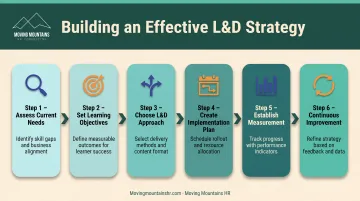
Assessing Your Current L&D Needs
Start by identifying business-critical capabilities. Document the process, role, or compliance outcome that requires improvement. Then conduct a skills-gap analysis by comparing required capabilities with current capabilities.
How to conduct a skills gap analysis:
- Review performance data, quality metrics, and customer feedback
- Survey employees and managers about skill needs and development priorities
- Analyze business goals to identify capabilities required for growth
- Examine compliance requirements and regulatory deadlines
Prioritize areas based on business impact and urgency. Compliance training that avoids fines takes precedence over optional leadership development. Skills that directly affect revenue, customer satisfaction, or safety rank higher than nice-to-have competencies.
Small businesses without internal HR expertise can work with external consultants to conduct thorough assessments. Moving Mountains HR, for example, helps clients identify training gaps through HR compliance audits, document reviews, and discussions with management. From there, the team designs customized programs tailored to the organization's industry, workforce, and goals.
Setting Clear Learning Objectives
Define what success looks like before you design training. A well-written objective includes the target behavior, the success criterion, the resources available, and the deadline.
Examples of strong learning objectives:
- "All supervisors will complete California harassment-prevention training and pass the assessment with 90% or higher by March 31, 2026."
- "Customer service representatives will demonstrate the three-step de-escalation framework in role-play scenarios and achieve an average customer satisfaction score of 4.5 or higher within 60 days of training."
- "New hires will complete onboarding modules, shadow an experienced team member, and independently process five transactions with zero errors within their first two weeks."
Align objectives with measurable business outcomes: improved customer satisfaction, reduced compliance violations, faster time to productivity, or higher quality scores. That link keeps training tied to results your business can track.
Choosing Your L&D Approach
Match learning methods to content type, audience size, budget, and learning objectives.
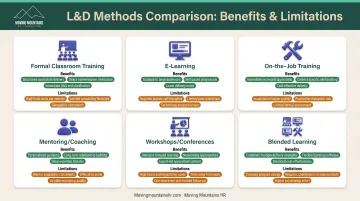
Formal classroom training suits group instruction, practice, and compliance topics. It provides structure and immediate feedback but requires scheduling coordination and dedicated time away from work.
E-learning platforms scale easily, accommodate flexible schedules, and reduce travel costs. A rapid review of synchronous e-learning found it can build knowledge or skills as effectively as face-to-face instruction when design is comparable—though evidence is sparse for hands-on work requiring physical practice.
On-the-job training builds capability through real work assignments. It provides immediate application and context but requires supervision and carries performance risk if employees aren't ready.
Mentoring and coaching offer personalized guidance and relationship-based learning. These methods fit leadership development and role-specific skills but depend on mentor capacity and consistency.
Workshops and conferences deliver concentrated learning and networking opportunities. They're effective for exposing employees to new ideas and industry trends but require travel budgets and time away.
Blended approaches combine formal instruction, relationships, and application. The Center for Creative Leadership describes the 70/20/10 guideline—70% challenging assignments, 20% developmental relationships, 10% coursework—as a leadership-development framework, not a rigid budget formula. Formal learning can amplify the other components when designed intentionally.
Creating Your Implementation Plan
Develop a timeline, assign responsibilities, and communicate the plan to stakeholders. Be specific about who delivers training, who participates, when sessions occur, and what resources are required.
Build a rollout schedule that keeps daily operations running:
- Stagger training across teams to protect business continuity
- Offer multiple session times for different schedules
- Use microlearning (short, focused modules) when a full-day workshop isn't needed
Communicate why the training matters, what employees will gain, and how it connects to business goals. Employees engage more deeply when they understand the purpose and relevance of learning.
Establishing Measurement and Evaluation
Select appropriate KPIs based on your learning objectives:
- Completion rates show participation but not capability
- Pre/post assessments measure knowledge or skill acquisition
- Manager observations and work samples reveal whether employees apply learning on the job
- Performance improvements, retention rates, quality metrics, and customer satisfaction demonstrate business impact
Set up feedback loops and regular review cycles:
- Survey participants after training on relevance and confidence
- Observe behavior change over the following weeks
- Compare performance metrics before and after training
- Adjust content, methods, or timing based on what you learn
The Kirkpatrick Model defines four evaluation levels: Reaction (experience and relevance), Learning (knowledge or skill gained), Behavior (transfer to work), and Results (business impact). Measure at all four levels to understand whether training delivers value.
Choosing the Right L&D Methods and Resources
No single delivery method fits every skill gap. Match the format to the outcome you need—compliance, hands-on skill, or leadership growth—then add tools that keep training consistent and measurable.
| Method | Best For | Limitations |
|---|---|---|
| Formal classroom training | Group instruction, compliance, practice, immediate feedback | Requires scheduling, dedicated time away from work |
| E-learning platforms | Scalable delivery, flexible schedules, reduced travel costs | Limited for hands-on skills requiring physical practice |
| On-the-job training | Real-world application, immediate context, building capability | Performance risk, requires supervision and feedback |
| Mentoring/coaching | Personalized guidance, leadership development, relationship-based learning | Mentor capacity and consistency can constrain scale |
| Workshops/conferences | Concentrated learning, networking, exposure to new ideas | Travel budget, time away, variable quality |
| Blended learning | Combines formal instruction, relationships, and application | No universal best mix; requires intentional design |
Technology and LMS decisions
Once you know which methods you will use, decide how you will deliver and track them. Learning management systems (LMS) centralize content, track completion, automate reminders, and generate reports. Common options include TalentLMS, MoodleCloud, LearnUpon, Litmos, Docebo, and 360Learning.
Before you commit, check:
- Learner minimums and implementation fees
- Content libraries and accessibility
- Integrations and reporting capabilities
An LMS pays off when you have recurring training, compliance deadlines, multiple locations, or distributed teams. Smaller programs with limited participants often do fine with shared documents, video conferencing, and manual tracking.
ATD reported an average of $165 per learning hour in 2024, but that figure is a broad benchmark, not a per-method cost comparison. Build your budget from specific needs, provider quotes, and expected outcomes rather than industry averages alone.
Measuring and Optimizing Your L&D Strategy
Track both operational and outcome KPIs. Operational metrics such as enrollment, completion, time spent, attendance, and cost per learner show program activity. Outcome metrics tell you whether learning changed the business: skill-assessment gains, time to competency, observed application, error reduction, compliance completion, and incident rates.
Key metrics to track:
- Training completion rates: Percentage of assigned employees who finish required training
- Employee performance improvements: Pre/post skill assessments, quality scores, productivity gains
- Retention rates: Voluntary turnover before and after L&D implementation
- Time-to-productivity for new hires: Days or weeks until new employees independently perform core tasks
- Compliance audit results: Violations, incidents, or fines before and after training
Gather feedback through post-training surveys, follow-up assessments, manager observations, and performance reviews. Ask participants what was relevant, what they'll apply, and what could improve. Observe whether employees use new skills in real work. Compare business results to pre-training baselines.
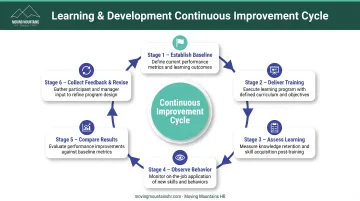
Create a continuous improvement cycle:
- Establish a baseline before training starts
- Deliver the training
- Assess learning with post-training checks
- Observe on-the-job behavior
- Compare results to the baseline
- Collect feedback and revise the program
ATD specifically supports before/after snapshots and linking learning analytics to impact data.
Don't claim ROI unless you can isolate benefits and monetize them against full program costs. Publish specific, evidence-based outcomes instead: "Manager conflict-resolution training reduced employee-relations complaints by 40% over six months" carries more weight than a generic ROI percentage.
Common L&D Challenges for Small Businesses (and How to Overcome Them)
Small businesses rarely lack the will to train. They run into tight budgets, no dedicated HR owner, and teams that cannot leave the floor for long sessions. Each barrier has practical workarounds.
Limited Budget
You do not need a large L&D budget to cover critical skills and compliance. Put spend where risk and business impact are highest.
What helps:
- Prioritize high-impact training tied to critical business needs or compliance requirements
- Use free or low-cost resources, such as the California Civil Rights Department's harassment-prevention training
- Tap internal experts as trainers instead of hiring outside vendors for every topic
- Start with one or two priority programs, then expand once you see results
Lack of Dedicated HR Staff
Without an HR lead, L&D often stalls at good intentions. You can still build a solid program without a full-time hire.
What helps:
- Work with fractional HR consultants for strategy and program design without full-time overhead
- Outsource L&D planning to specialists who assess needs, design programs, and manage rollout
- Use turnkey training solutions that bundle content, delivery, and tracking
- Partner with firms like Moving Mountains HR for customized leadership, compliance, performance, and workplace-risk training (virtual or in person)
Employee Time Constraints
Gallup found that time away from responsibilities was the leading barrier for 89% of CHROs, 37% of managers, and 41% of employees. Training Magazine reported that 41% of organizations named lack of resources and personnel as their largest training challenge.
Time pressure is real. Design learning so it fits the workday instead of competing with it.
What helps:
- Use microlearning (short, focused modules) employees can finish in 10–15 minutes
- Offer flexible scheduling with multiple session times or on-demand options
- Integrate learning into workflows so training supports daily work
- Focus on skills employees will use that same week
- Stagger training across teams so operations keep running
Frequently Asked Questions
How do you create a learning and development strategy?
Run a skills-gap analysis, then set SMART objectives tied to business outcomes. Pick delivery methods that fit your content, audience, and budget, and assign owners and timelines. Track completion, skill gains, behavior change, and business impact—and refine the program from feedback and data.
Can you provide an example of a learning and development strategy?
A mid-sized California manufacturer finds that 30% of supervisors lack current harassment-prevention and OSHA safety certifications. Leadership sets a year-end 100% certification goal and pairs quarterly workshops with e-learning, tracking completion monthly. Within six months, certification hits 95%, related incidents fall, and managers report more confidence handling workplace issues.
What is the 70/20/10 rule for learning and development?
The 70/20/10 framework holds that development comes roughly 70% from challenging job experiences, 20% from coaching and mentoring, and 10% from formal coursework. The Center for Creative Leadership treats it as a guideline, not a rigid budget—so balance training with real work and strong developmental relationships.