
These costs split into two categories: direct expenses you can track on a balance sheet, and indirect costs that often go unnoticed. Hardware, software, and training materials appear in budgets. Manager time, team disruption, and the productivity gap during the first 90 days rarely do. For small and mid-size businesses, these hidden soft costs can represent 60% or more of total onboarding spend, yet many organizations lack systems to measure them.
This article breaks down the true cost of onboarding in 2026, covering direct and indirect expenses, the factors that drive costs up or down, and how to budget strategically for sustainable, effective hiring.
Key Takeaways
- Onboarding expenses vary widely by role, but professional positions typically require $3,000–$7,000 in direct and indirect investment
- Soft costs like manager time, productivity loss, and team involvement usually make up most of the onboarding budget—and often go untracked
- Structured onboarding improves retention enough that the upfront cost typically pays for itself
- Small businesses often blow the budget by undercounting compliance training, mentor time, and longer ramp-up periods
How Much Does Onboarding a New Employee Cost?
Onboarding costs vary widely based on role complexity, company size, and program structure. Unlike hiring costs, which have published benchmarks, onboarding expenses depend on your systems, industry requirements, and how much manager and team time the role demands.
Many businesses budget only for visible line items such as equipment, software, and training courses. They miss the larger expenses: manager and peer hours, plus the months before a new hire reaches full productivity.
Common budgeting mistakes that inflate costs include:
- Underestimating manager and team time on orientation, check-ins, work review, and day-to-day questions
- Skipping structured programs to "save money," which prolongs ramp-up and raises early turnover costs
- Ignoring soft costs when new hires run at 25–50% capacity in month one and lost output hits the bottom line
Typical onboarding spend by role level breaks down like this:
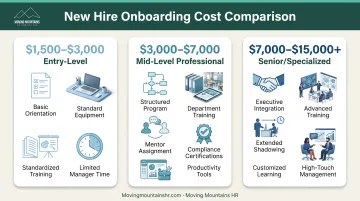
Entry-Level / High-Turnover Positions: $1,500–$3,000
What's Typically Included:
- Basic orientation covering company policies and workplace expectations
- Standard equipment (computer, phone, access credentials)
- Standardized training modules with minimal customization
- Limited manager involvement beyond initial setup
Best For: Retail, food service, entry-level administrative roles with shorter ramp-up periods and high employee volume
Mid-Level Professional Roles: $3,000–$7,000
What's Typically Included:
- Structured onboarding program with clear milestones and checkpoints
- Department-specific training tailored to role responsibilities
- Assigned mentor or buddy for cultural integration and daily questions
- Compliance certifications required by industry or state regulations
- Productivity tools, software licenses, and role-specific resources
Best For: Professional roles requiring 3–6 month ramp-up, skilled trades, specialized support positions
Senior / Specialized Positions: $7,000–$15,000+
What's Typically Included:
- Executive integration with strategic alignment sessions
- Advanced training programs or external certifications
- Extended shadowing with senior leadership and key stakeholders
- Customized learning paths addressing specific technical or leadership competencies
- High-touch manager and executive time investment
Best For: Management positions, highly technical roles, senior professionals requiring 6–12 month productivity ramp-up
Key Factors That Affect the Cost of Onboarding
Onboarding costs depend on role complexity, company infrastructure, regulatory requirements, and how well the organization has systematized the process. Map these variables early and you can budget realistically—and put money where it shortens time-to-productivity.
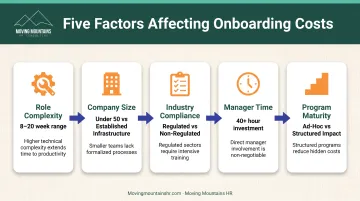
Role Complexity and Specialization
Technical roles in engineering, healthcare, and finance require more extensive training, industry-specific certifications, and longer ramp-up periods than general administrative positions. A software engineer may need weeks learning your codebase and development workflows, while a compliance officer must master internal policies plus regulatory frameworks before contributing independently.
APQC reports a median time-to-productivity of 35.5 calendar days across 300 companies, though this varies significantly by role. Clerical positions may reach full productivity within eight weeks, while senior professional roles can take 20 weeks or more according to older research from Mellon Financial.
Company Size and Existing Infrastructure
Established companies with existing onboarding systems, learning management platforms, and documented processes spend less per hire than startups building programs from scratch. When you already have training modules, automated workflows, and clear role expectations documented, new hires move through orientation more efficiently with less manager involvement.
Companies under 50 employees often lack dedicated HR staff, placing the entire onboarding burden on managers and inflating soft costs. Without systems to guide the process, managers recreate onboarding each time, wasting hours and producing inconsistent results.
Industry and Compliance Requirements
Highly regulated industries face mandatory training costs for HIPAA compliance, SOX requirements, state licensing, and comprehensive background checks.
California requires harassment-prevention training for employers with five or more employees: one hour for non-supervisory staff and two hours for supervisors, repeated every two years. Free state courses exist, but employers still pay for the time employees spend in training.
California also mandates injury and illness prevention training for every new employee and new job assignment, plus workplace violence prevention training for most covered employers.
Healthcare organizations must train every workforce member on PHI policies within a reasonable period after hire. These requirements add hours of paid training time that general business-services companies don't face.
Manager and Team Time Investment
The hidden cost of onboarding sits in manager and team calendars. If a manager spends 40 hours onboarding a new hire (orientation meetings, check-ins, work review, and feedback), that is roughly $1,860 in labor cost alone at the average private-industry compensation rate of $46.60 per hour reported by the Bureau of Labor Statistics for March 2026—about $2,000 when you round for planning.
Team time adds another layer: peers spend 20–30 hours in the first month answering questions, conducting shadowing sessions, and reviewing early work. At a blended rate of $40–$50 per hour, team involvement adds $800–$1,500 in soft costs for each new hire.
Onboarding Program Maturity
Ad-hoc onboarding—where managers build the process on the fly—eats manager hours and leaves quality uneven from hire to hire. Structured programs with checklists, automated workflows, and clear milestones reduce manager burden by 50% or more, but require upfront investment in documentation, systems, and potentially technology platforms.
Organizations with technology-enabled onboarding are 33% more likely to improve time to proficiency according to Brandon Hall Group research, though detailed methodology was not disclosed. The initial cost of building a structured program pays for itself through reduced manager time and faster employee productivity.
Equipment, Tools, and Technology Costs
Physical and digital infrastructure adds up quickly:
- Hardware: Laptop, monitor, keyboard, mouse ($1,000–$2,500)
- Software licenses: Email, communication tools, role-specific applications ($500–$2,000 annually)
- Phone and communication: Mobile device or stipend, conferencing licenses ($200–$500)
- Office supplies or home office stipend: Desk accessories, ergonomic equipment ($100–$300)
Remote employees may require additional technology setup and shipping costs, potentially adding 15–20% to baseline equipment expenses.
Cost Breakdown of Onboarding
Total onboarding cost extends well beyond the welcome email. It spans recruitment handoff, administrative setup, training delivery, and productivity ramp-up over three to six months. Here's how the expenses break down.
Pre-Arrival Preparation and Administrative Setup
Type: One-time
What's Included:
- HR paperwork processing and employment verification
- Background checks ($50–$200 per candidate)
- Drug screening when required ($50–$100)
- System access setup: email, network permissions, software provisioning
- IT account creation and security protocols
- Workspace preparation or remote-equipment coordination
Typical Cost: $300–$800 per hire for small businesses handling administrative setup internally
Equipment and Technology Provisioning
Type: One-time (with periodic replacement)
What's Included:
- Computer hardware: laptop, desktop, or tablet
- Peripherals: monitor, keyboard, mouse, webcam, headset
- Mobile phone or communication device
- Software licenses (mix of one-time and recurring annual subscriptions)
- Communication and collaboration tools
- Security equipment for remote workers (VPN, encrypted storage)
Typical Cost: $1,500–$4,000 per hire for standard hardware, peripherals, and core software (higher for specialized roles)
Remote hires may cost 15–20% more due to shipping, setup assistance, and home-office stipends.
Training and Development Programs
Type: One-time with ongoing elements
What's Included:
- Onboarding curriculum delivery: company orientation, mission and values, organizational structure
- Department-specific training: role responsibilities, team workflows, internal systems
- Role-specific skills development: technical training, process documentation, software proficiency
- External courses or professional certifications
- Compliance training modules required by industry or state
Professional roles typically require $1,000–$1,500 in initial training investment, though this varies widely by industry and role complexity.
Manager and Mentor Time Investment
Type: One-time (concentrated in first 90 days)
What's Included:
- Manager time: Orientation meetings, regular one-on-ones, work review, feedback sessions, performance coaching
- Peer mentor time: Shadowing, answering questions, cultural integration, informal guidance
Cost Example:
40 manager hours + 30 peer hours at a blended rate of $50 per hour = $3,500 in labor cost
This represents one of the largest onboarding expenses, yet most organizations don't track these hours or include them in onboarding budgets.
Productivity Ramp-Up and Opportunity Cost
Type: One-time (first 3–6 months)
What's Included:
New hires operate at reduced productivity while learning:
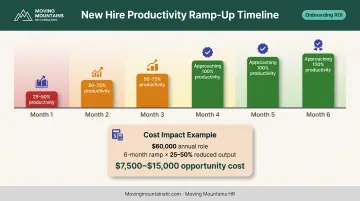
- Month 1: 25–50% of full productivity
- Months 2–3: 50–75% of full productivity
- Months 4–6: Approaching full productivity (varies by role complexity)
Example Calculation:
For a $60,000 role, a six-month ramp-up represents roughly $7,500–$15,000 in reduced output value, depending on how you measure the productivity gap.
That gap between a fully productive employee and a new hire rarely shows up in budgets, but it directly cuts organizational capacity.
Low-Cost vs High-Investment Onboarding—What's the Difference?
Onboarding investment level should match role complexity and organizational needs. Overspending on entry-level roles wastes resources, while under-investing in senior hires increases turnover risk and delays productivity.
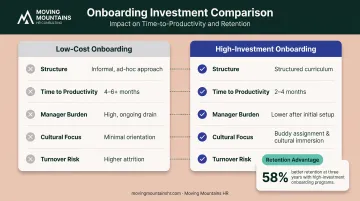
| Dimension | Low-Cost Onboarding | High-Investment Onboarding |
|---|---|---|
| Program Structure | Informal, manager-led, and rebuilt ad hoc for each hire | Structured curriculum with documented milestones and shared ownership across stakeholders |
| Time to Productivity | 4–6+ months with inconsistent results | 2–4 months with predictable ramp-up and clear benchmarks |
| Manager Involvement | High ongoing burden as manager answers the same questions repeatedly | Lower ongoing burden after setup; docs and systems handle routine questions |
| Cultural Integration | Minimal focus; new hire figures out norms independently | Buddy assignment, team intros, and planned cultural immersion |
| Long-Term Value | Higher turnover risk in first year; inconsistent performance across hires | 58% greater retention likelihood at three years; faster competency and stronger cultural fit |
Employees in structured onboarding programs show a 58% greater likelihood of remaining after three years, per SHRM reporting of Click Boarding data. Study methodology was not disclosed, but the gap is large enough that under-investing in complex or senior roles is rarely a real savings.
How to Estimate the Right Budget for Onboarding
The right onboarding investment balances thoroughness with efficiency. Spending too little increases turnover costs; spending too much on the wrong elements wastes resources without improving outcomes.
Factors to Consider When Building Your Onboarding Budget
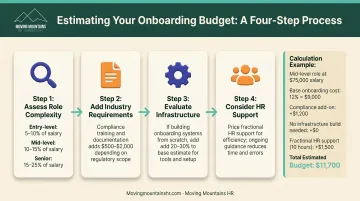
Start with role complexity:
Use these baseline ranges for initial budgeting. Treat them as internal benchmarks, not published industry standards:
- Entry-level roles: 5–10% of annual salary
- Mid-level roles: 10–15% of annual salary
- Senior/specialized positions: 15–25% of annual salary
Factor in your industry's compliance requirements:
Healthcare, finance, and legal sectors require additional investment in mandatory training, certifications, background checks, and regulatory documentation. Budget an extra $500–$2,000 for roles in heavily regulated industries compared with general business roles.
Assess your current infrastructure:
Companies with mature HR systems (documented processes, learning management platforms, automated workflows) onboard more efficiently than startups building systems from scratch. If you lack established infrastructure, budget 20–30% more until systems are built and tested.
If you lack in-house HR, price fractional support into the plan:
Small businesses without full-time HR staff often spend less overall by using fractional HR or fractional CHRO support to build the onboarding system once. A structured program from an experienced consultant cuts repeated manager time on each hire and improves retention—usually for less than the cost of a full-time HR seat.
What Most People Miss When It Comes to Onboarding Costs
Direct expenses like laptops and software are easy to spot. Manager time, team disruption, and long productivity ramp-ups usually aren't—and they drive most of the real cost.
Common blind spots include:
- Hidden labor: A $1,200 laptop shows up in expense reports; 60 hours of manager time often doesn't, even though soft costs dominate the onboarding budget.
- No ROI metrics: Without tracking days to first meaningful contribution, 90-day retention, and new-hire satisfaction, you can't tell whether your investment reduces turnover or shortens ramp-up.
- Ad-hoc process: Unstructured onboarding burns manager hours and creates inconsistent results that raise early turnover. Checklists, templates, and clear ownership deliver better outcomes at lower total cost.
- Turnover multiplier: When weak onboarding contributes to first-year exits, you pay recruitment and onboarding costs again for the same role.
Research indicates more than one-third of new hires leave within the first year, though the share tied directly to onboarding quality is hard to isolate. Even modest improvements can prevent repeated hiring cycles that compound costs.
Conclusion
Onboarding a new employee costs $3,000–$5,000 on average for professional roles, but specialized positions can reach $10,000 or more when you include all direct and indirect expenses. The largest costs (manager time, peer involvement, and months of reduced productivity) often go untracked, leaving businesses without a complete picture of their hiring investment.
Understanding the full cost breakdown enables smarter budgeting and better ROI measurement. By tracking both visible line items and hidden soft costs, you can see where to invest for maximum impact and where inefficiencies waste resources.
Structured onboarding pays for itself when it shortens time-to-productivity and reduces early turnover. Companies that run systematic programs recover the upfront cost through higher retention and faster ramp-up. For small and mid-size businesses, match spend to role complexity, document the process once, and track ramp time and 90-day retention so you can improve each hire cycle.
Frequently Asked Questions
What is the cost of onboarding a new employee?
Average onboarding costs run $3,000–$5,000 per employee for professional roles. Entry-level roles typically cost $1,500–$3,000, while senior or specialized hires can reach $7,000–$15,000+ once you include equipment, training, manager time, and ramp-up.
How much do soft costs add to onboarding expenses?
Soft costs (manager time, productivity loss during ramp-up, and team involvement) usually make up most of the total onboarding bill. Manager and peer time alone can add $2,000–$4,000, and reduced output over the first three to six months adds thousands more.
What's the ROI of investing in structured onboarding?
Employees with structured onboarding are 58% more likely to stay after three years, per SHRM-cited Click Boarding data. Structured programs also help new hires reach full productivity one to two months sooner, offsetting upfront cost through faster contribution and lower turnover.
How can small businesses reduce onboarding costs without sacrificing quality?
Use templates, checklists, and documented workflows to cut manager burden, and automate paperwork and access setup. Build reusable role-specific training modules, and consider fractional HR support if you need efficient systems without a full-time HR hire.
What are the hidden costs most companies overlook?
Manager and mentor time often totals $2,000–$4,000 but rarely hits the budget line. New hires working at 25–75% capacity for three to six months create major lost output, and poor onboarding drives early turnover that forces you to re-hire and re-onboard the same role.
Does onboarding cost vary by industry?
Yes. Highly regulated industries including healthcare, finance, and legal sectors face higher onboarding costs due to mandatory compliance training, professional certifications, comprehensive background checks, and state licensing requirements. These additions can add $500–$2,000 to baseline onboarding costs compared to less regulated sectors like general business services or retail.