Get onboarding right, and new hires ramp up faster, stick around longer, and stay out of compliance trouble. Get it wrong, and the cost shows up fast. A Paychex survey found that 80% of new hires who felt undertrained during onboarding planned to quit within their first year, compared to half of hires overall (Paychex, 2023).
This guide breaks down the top onboarding training solutions for 2026, from standalone LMS platforms to full-service HR consulting, so you can pick the one that actually fits your business.
Key Takeaways
- 2026 onboarding options: standalone LMS, all-in-one HR software, or specialized HR consulting
- Choose by company size, regulatory exposure (healthcare, California), and gap type—logistics, content, or compliance
- Software tracks completion; it does not verify training meets current legal requirements
- Pair a platform with periodic HR expert review to close gaps for regulated or growing companies
Overview of Employee Onboarding Training Solutions in 2026
An employee onboarding training solution is any software, content library, or consulting service that prepares new hires for their role, company culture, and compliance requirements.
Some businesses need a course builder. Others need help making sure harassment-prevention training actually satisfies state law.
Demand has climbed as hybrid work makes in-person orientation harder to standardize and state employment mandates keep stacking up. Many small teams struggle to deliver a consistent first week and still prove required training was completed. A 2025 OnPay survey of small businesses found that 62% already use HR software for onboarding, and 51% use it for certification or training tracking.
That adoption curve is why the market now includes everything from budget LMS tools to fractional HR consulting. Below, we compare the top options available in 2026, spanning software platforms and specialized compliance support.
Top Employee Onboarding Training Solutions for 2026
We evaluated each option on five criteria:
- Ease of use
- Compliance capability
- Scalability
- Integration with existing HR systems
- Fit for specific industries or company sizes
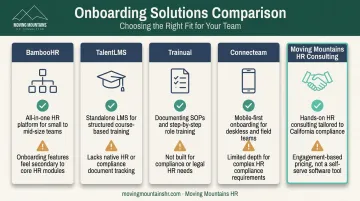
BambooHR
BambooHR is an all-in-one HR platform that bundles onboarding, payroll, and compliance tracking into a single system built for growing small and mid-size businesses (typically 1 to 1,000 employees).
It stands out for centralizing hire-to-retire workflows. New hires get automated checklists, e-signature collection, and I-9/E-Verify processing without HR chasing down paperwork.
It wasn't built as a deep training content platform, though. Its compliance course libraries (ranging from 1 to over 300 courses depending on plan) are powered by a third-party partner, not native course authoring tools.
| Factor | Details |
|---|---|
| Best For | Small to mid-size businesses wanting onboarding bundled with core HR and payroll |
| Key Limitation | Not a dedicated training/LMS tool; pricing isn't fully public |
| Ideal Company Size | 25+ employees (pricing starts at $10/employee/month for Core, plus a $250/month flat rate for teams of 25 or fewer) |
TalentLMS
TalentLMS is a cloud-based learning management system used by thousands of teams to build structured onboarding courses without an enterprise price tag.
Course customization is its real strength. Drag-and-drop builders, custom branding, and interactive content make it easy to create engaging training paths on a budget. What it doesn't do is manage the HR side of onboarding. Its own onboarding guide recommends pairing it with a separate e-signature app and task-management tool.
| Factor | Details |
|---|---|
| Best For | Businesses needing a standalone, cost-effective course delivery system |
| Key Limitation | No native HR onboarding workflow (e-signatures, task tracking) |
| Pricing Model | Tiered by active users; Core starts at $119/month annually for up to 40 users |
Trainual
Trainual turns tribal knowledge into structured, trackable training. It's built for companies that need to document processes as much as they need to train people on them.
This is the tool for growing companies where "ask Sarah how we do it" is still the onboarding process. Role-based training paths, embedded video, and e-signatures make it easy to formalize SOPs. Trainual doesn't disclose flat subscription pricing publicly, though it does charge a $1,000 one-time implementation fee.
| Factor | Details |
|---|---|
| Best For | Teams that need to document and scale internal processes alongside training |
| Key Limitation | No built-in HR document collection; pricing is custom and not fully transparent |
| Pricing Model | Custom subscription plus $1,000 setup fee |
Connecteam
Connecteam is built for frontline and deskless teams: retail, hospitality, field services, and multi-location businesses where employees rarely sit at a desk.
Mobile accessibility is the draw here. New hires can complete training modules from a phone on day one, no company laptop required. It's also one of the few tools on this list with a genuinely useful free tier for up to 10 users. E-signature functionality exists, but it's capped by plan (2 documents on Advanced, 10 on Expert).
| Factor | Details |
|---|---|
| Best For | Frontline, deskless, or multi-location teams needing mobile training delivery |
| Key Limitation | E-signature limits by plan tier may not suit desk-based HR documentation needs |
| Pricing Model | Free for up to 10 users; paid plans start at $29/month, plus per-user fees |
Moving Mountains HR Consulting
Moving Mountains HR takes a different approach entirely. Rather than selling software, it's an executive-level HR consulting firm. It offers fractional CHRO support, compliance audits, and custom onboarding program design, with deep expertise in healthcare and California employment law.
Its HR Document Audit reviews existing policies, procedures, and employee-facing documents, then delivers a formal gap analysis against current regulatory requirements and best practices. For businesses that already have onboarding software but aren't sure the content running through it is compliant, that's a gap most platforms leave open.
| Factor | Details |
|---|---|
| Service Model | Fractional HR consulting engagement, not a software subscription |
| Best For | Healthcare organizations and California-based SMBs needing compliant, customized onboarding content |
| Key Deliverable | Compliance audit, policy gap analysis, and tailored training program design |
Software vs. Expert HR Guidance: What Compliance-Heavy Businesses Actually Need
Onboarding software is good at logistics: tracking completion rates, sending reminders, storing signed documents. What it can't do is confirm whether the training content itself meets the law.
That distinction matters more than most business owners realize. A generic harassment-prevention module might satisfy your LMS's completion tracker while still missing state-specific mandates.
In California, employers with five or more employees must provide sexual harassment prevention training every two years, with 2 hours for supervisors and 1 hour for everyone else, delivered to new hires within six months of starting (California Civil Rights Department, 2025).
Healthcare adds another layer. California's workplace violence prevention regulations require site-specific training covering the employer's actual hazards and procedures, not a generic template. A course library that checks the compliance box without addressing your specific site puts you at risk even if every employee shows "100% complete."
A compliance gap doesn't show up until it's expensive:
- A failed audit that triggers penalties
- A harassment claim where the training on file doesn't meet the legal standard
- A workers' comp case where the workplace violence plan wasn't site-specific
Software and consulting work best together, not as an either-or choice. Platforms like BambooHR or TalentLMS handle delivery and tracking well. Pairing that with periodic HR expert review, whether a one-time compliance audit or an ongoing fractional CHRO relationship, ensures the content running through your system actually holds up.
For regulated industries and companies scaling fast, that hybrid model is the realistic 2026 standard. Moving Mountains HR supports it with compliance audits, training programs, and fractional CHRO services built for California employers and other compliance-heavy businesses.
How We Chose the Best Onboarding Training Solutions
The most common mistake we see: business owners pick a tool based on price or brand recognition, then discover months later it doesn't handle compliance documentation or doesn't scale past 50 employees.
We weighted five factors instead:
- Ease of implementation — A tool your team abandons after two weeks doesn't reduce turnover; it just wastes budget.
- Integration with existing HR systems — Duplicate data entry across five platforms increases the odds of an error slipping through.
- Compliance and documentation support — Weak tracking here shows up later as missing forms, incomplete records, and avoidable audit or litigation risk.
- Customer feedback — Verified user reviews surface adoption problems and support gaps that vendor demos rarely mention.
- Fit for company size — A 15-person retail shop and a 400-person healthcare network need different tools entirely.
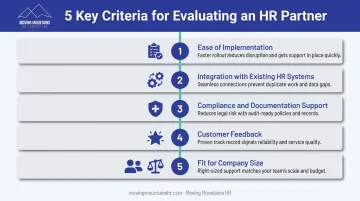
Each factor connects back to a business outcome: fewer compliance headaches, faster time-to-productivity, or lower new-hire attrition.
Conclusion
There isn't one "best" onboarding training solution in 2026. There's the one that matches your company's size, your industry's regulatory exposure, and where you're headed in the next two years. A 12-person retail team and a 150-person healthcare group shouldn't be shopping from the same checklist.
Before committing to any platform, weigh scalability, total cost of ownership, and whether it actually covers your compliance obligations—not just task completion.
If you're a healthcare organization or a California-based business, check whether your onboarding content still holds up under current law. Moving Mountains HR offers a free consultation to map your compliance gaps before you invest in or customize any training solution.
Frequently Asked Questions
Are employees paid during onboarding training?
Generally, yes. Under federal labor law, required training time counts as compensable work hours. California treats mandatory training the same way, so confirm your state's rules before assuming otherwise.
What is an onboarding training program?
It's a structured set of activities and content that prepares new hires for role expectations, company culture, and compliance requirements, typically spanning their first days through several months on the job.
What are the five C's of onboarding?
The five C's are Compliance, Clarification, Culture, Connection, and Confidence. Together they cover the legal, practical, cultural, and relational sides of a new hire's transition—including building the self-assurance to perform independently.
How much do onboarding training solutions cost for small businesses?
Most businesses with 10–50 employees spend $30 to $150 per month on LMS tools, while integrated HR platforms like BambooHR start around $250/month for teams of 25 or fewer. Custom HR consulting is usually quoted based on scope.
Do small businesses need a full LMS or an integrated onboarding platform?
Most businesses with 5 to 50 employees are better served by an integrated platform unless they need SCORM-based courses or have a dedicated learning and development administrator on staff.
What is the difference between onboarding software and HR consulting for onboarding?
Software handles delivery and tracking: courses, checklists, and completion records. HR consulting ensures the training content itself is legally compliant and tailored to your industry and state, which software alone can't verify.