

Introduction
When people hear "executive compensation," they picture proxy statements and eight-figure CEO packages. That's a Fortune 500 story. The reality for most business owners looks different.
Small and mid-size businesses, plus healthcare organizations of every size, face the same core challenge. They need a leadership pay package competitive enough to attract and keep good executives—without the benchmarking tools public companies use.
Most executive compensation data comes from SEC filings, proxy statements, and large-firm salary surveys built for public corporations. If you're privately held, that data doesn't apply to you. Pay decisions often become guesswork.
This article breaks down what actually makes up an executive pay package, how to benchmark that pay without SEC filings, and how to structure it so it holds up to compliance scrutiny.
Key Takeaways
- Executive pay covers far more than salary, including bonuses, long-term incentives, benefits, and severance terms
- Private companies can benchmark effectively using industry surveys and consulting data instead of public filings
- Choosing a market position (50th vs. 75th percentile) shapes both retention and cost control
- State pay transparency laws now reach companies well below the Fortune 500 threshold
Understanding Executive Compensation and Why It Matters Beyond Public Companies
Executive compensation is the total pay package for CEOs, CFOs, COOs, and senior leadership—the leaders whose decisions shape company performance. That definition doesn't change based on whether you're publicly traded, privately held, a nonprofit, or a regional healthcare system. The stakes, however, look different for smaller organizations.
Getting it wrong is expensive. According to SHRM, replacing an employee can cost between 50% and 200% of that person's annual salary, depending on their level within the organization (SHRM, 2025). For a senior leader, that math gets ugly fast once you factor in lost institutional knowledge, disrupted client relationships, and the months it takes to onboard a replacement.
Private and mid-size organizations also face a structural data gap:
- Public companies must disclose executive pay through 10-Ks, 8-Ks, and proxy statements
- Private and mid-size organizations have no equivalent mandatory disclosure
- Without public filings, informed benchmarking—not guesswork—is the only reliable path to competitive, defensible pay
Skip that discipline, and pay decisions get made reactively—usually after a resignation threat or a competitor's offer. That isn't a compensation strategy.
Key Components of a Competitive Executive Compensation Package
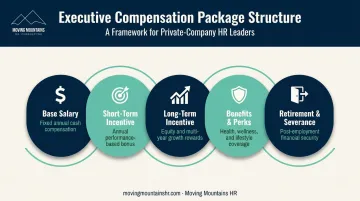
A common mistake: negotiating salary and treating everything else as an afterthought. Executive pay works better as a designed package, where each element serves a different purpose.
| Component | What It Is | Private-Company Consideration |
|---|---|---|
| Base salary | Fixed cash pay, the foundation | Should reflect role scope, industry, and geography (California cost-of-living pushes base pay higher than many other states) |
| Short-term incentive | Annual bonus tied to performance | Motivates near-term results against company or individual KPIs |
| Long-term incentive | Multi-year performance pay | Private companies substitute phantom equity, profit-sharing, or deferred compensation since public stock isn't available |
| Benefits & perks | Health coverage, wellness, allowances | Should be documented and proportionate to company size, not ad hoc |
| Retirement & severance | Exit and post-employment terms | Structure carefully; disproportionate severance clauses create outsized financial risk for smaller companies |
Long-Term Incentives Without Public Stock
Private companies can't hand out stock options the way a public corporation can, but that doesn't mean long-term incentives are off the table. Common alternatives include:
- Phantom equity or stock appreciation rights: mirrors the value of real equity without an actual ownership transfer
- Profit-sharing plans: discretionary employer contributions tied to a set allocation formula
- Deferred compensation: pay pushed to a later date, often tied to growth milestones or a future liquidity event
Evaluate Total Compensation, Not Isolated Pieces
Negotiating each component separately misses the bigger picture. The mix between fixed pay (salary, benefits) and variable pay (bonuses, incentives) signals your company's risk/reward philosophy.
A heavy bonus weighting says "we reward performance." A heavy salary weighting says "we value stability." Set that mix on purpose so the package matches the behavior and risk profile you want from the role.
How to Benchmark Executive Pay Without Public Company Data
Without 10-Ks or proxy statements to reference, private companies need a different benchmarking approach entirely.
Build Your Own Peer Group
Instead of pulling comparable public companies, define your peer group using:
- Industry and sub-industry classification
- Revenue size and employee count
- Geographic location and labor market
- Growth stage (early-stage vs. established)
Use Alternative Data Sources
Several sources exist specifically to fill the gap public filings leave behind:
- Compensation consulting firms with private-market survey data
- Published salary surveys covering executive roles across industries
- Industry association benchmarking reports
- Custom compensation studies built around your specific peer group
Choose Your Market Position
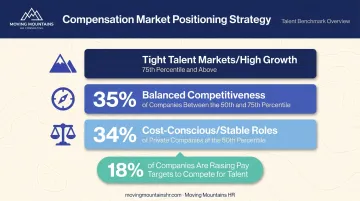
Not every company should target the same pay level. Pearl Meyer's research on private for-profit organizations found 34% target executive total direct compensation at the median (50th percentile), while 35% target between the 50th and 75th percentile (Pearl Meyer, 2022).
Another 18% had recently raised their target positioning specifically to compete for talent. Common stances include:
- 50th percentile for cost-conscious organizations with stable, lower-turnover roles
- 50th to 75th percentile when balancing competitiveness with budget discipline
- 75th percentile or above in tight talent markets or high-growth stages
Healthcare Organizations Need Specialized Data
Some industries need more than a percentile target. Healthcare executive roles carry regulatory scrutiny that generic compensation surveys rarely capture well.
Nonprofit and tax-exempt healthcare organizations, in particular, face IRS review under the rebuttable presumption standard. That standard calls for:
- Independent approval of the compensation decision
- Comparability data from appropriate peers
- Concurrent documentation of the decision-making process
Industry-specific healthcare compensation data—not general executive surveys—better reflects the scope of hospital and health-system leadership roles.
Adjust the Data, Don't Just Apply It
Survey numbers are a starting point, not a final answer. Adjust for:
- Executive tenure and experience level
- Company financial performance
- Strategic priorities unique to your organization
Re-benchmark every 1 to 2 years, or sooner after a leadership transition, rapid growth, or expansion into a new state.
Best Practices for Structuring Compliant and Strategic Executive Pay
Getting the numbers right is only half the job. How you document and communicate those numbers determines whether the structure holds up under scrutiny.
Start with performance. Build incentives around measurable outcomes, not automatic annual increases. That keeps pay defensible and keeps leadership focused on the metrics that matter.
Stay ahead of pay transparency rules
Pay transparency and equal pay laws increasingly apply well below the public-company threshold:
- California's SB 1162 requires salary ranges in job postings for employers with 15 or more employees, and current employees can request their position's pay scale
- Violations can carry penalties of $100 to $10,000 per violation (California Department of Industrial Relations)
- Similar posting laws now exist in New York, Illinois, and Massachusetts, each with different employee-count thresholds
Even without a formal compensation committee, keep written records of how pay decisions were made. Documentation protects the company in an audit or dispute.
Avoid common pitfalls
- Undocumented perks with no clear business rationale
- Severance clauses disproportionate to company size
- Pay decisions made without market data to back them up
Finally, explain the package. Executives who understand how their pay was set trust the process more. They are also less likely to leave over a competing offer they cannot fairly compare to their current deal.
When Executive Compensation Missteps Create Risk — And When to Bring in Expert Support
Poorly designed executive pay doesn't just cost money. It creates a cascade:
- Leadership turnover, with the replacement costs outlined earlier
- Morale issues among broader staff who notice inequities or undocumented perks
- Compliance violations and litigation exposure under equal pay laws that cover bonuses, equity, and profit-sharing—not just base pay
Signs your business has outgrown DIY compensation decisions:
- Rapid growth outpacing your current pay structure
- A leadership transition or new executive hire on the horizon
- Expansion into a state with different pay transparency requirements
- Pay decisions currently being made without any benchmarking data at all
That is the gap fractional HR leadership fills. Moving Mountains HR was founded by Michelle Schwanhauser to bring executive-level HR experience, including deep healthcare HR background, to businesses that need senior expertise without a full-time HR executive.
Through our Fractional CHRO services, we help small and mid-size businesses build compensation strategy, review compliance exposure, and make defensible pay decisions based on real data.

If your organization is navigating a leadership transition, entering a new state, or making pay decisions without a clear strategy, bring in outside support before a costly mistake happens.
Frequently Asked Questions
How is executive compensation determined for private or small businesses?
Private companies rely on peer benchmarking, industry surveys, and consulting data instead of public filings. This approach lets them set competitive, defensible pay without access to SEC disclosures.
What is included in a typical executive compensation package?
A typical package includes base salary, short-term bonuses, long-term incentives, benefits, and retirement or severance provisions. Each component serves a different retention and performance purpose.
How often should a company benchmark executive pay?
Most organizations benchmark every 1 to 2 years, or sooner after major changes like rapid growth, a leadership transition, or expansion into a new state.
What data sources can private companies use since they don't file with the SEC?
Compensation consulting firms, published salary surveys, and industry association benchmarking reports all serve as reliable alternatives to public filings for private organizations.
Is executive compensation regulated for private companies?
SEC disclosure rules don't apply to private companies, but state-level pay transparency and equal pay laws increasingly do. California, New York, Illinois, and Massachusetts all have posting or reporting requirements.
How can a fractional CHRO or HR consultant help with executive pay strategy?
A fractional CHRO brings executive-level compensation expertise and compliance knowledge without the cost of a full-time hire. Moving Mountains HR's Fractional CHRO service provides this strategic pay guidance for growing organizations.