The right training method doesn't just close skills gaps. Gallup's 2022 manager-development research found that trained managers improved engagement by up to 22% and reduced turnover by 21%-28% compared to non-participants. The challenge? Selecting the delivery approach that fits your budget, workforce size, and business goals while delivering measurable results.
This article covers 10 proven employee training methods for 2026, when to use each, and how to choose the right mix for your organization.
Key Takeaways
- Blend several training methods so delivery fits the content, budget, and workforce—not a single default format
- Small businesses can run effective training without enterprise budgets by picking scalable, lower-cost methods
- Prioritize flexibility, tech-enabled delivery, and measurable outcomes when planning training for 2026
- Training methods (how you deliver) are not the same as training types (what you teach)
- Match the method to the learning objective instead of defaulting to personal preference
Why Training Methods Matter in 2026
Training methods are the delivery mechanisms you use to teach employees: classroom instruction, online modules, hands-on practice, or coaching. They differ from training types, which describe the content itself: compliance, leadership development, technical skills, or onboarding.
Gallup reports that 51% of remote-capable U.S. employees now work hybrid schedules, so training has to reach distributed and on-site teams equally well. Other pressures make delivery method as important as content:
- Generational diversity across the workforce
- Accelerating skills gaps
- The shift from one-time events to continuous learning
Training Methods Drive ROI
A 2022 Department of Labor study of 68 registered-apprenticeship employers found 68% achieved a positive five-year net return, with median benefits of $144 per $100 invested. That figure is specific to structured apprenticeships, not every training program, but it still shows well-designed learning investments can pay off.
Match Methods to Learning Objectives
Employees retain more when delivery matches the task: visual aids, discussion, hands-on practice, and written reinforcement each have a role. Fixed "learning styles" are overstated (a 2024 meta-analysis found only a small matching effect, g=0.32), so vary formats by objective rather than by preferred style labels.
Small Business Reality
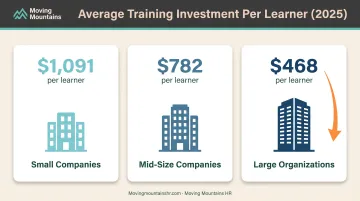
Small and mid-size businesses face unique constraints. Training Magazine's 2025 Industry Report found that small companies spent an average of $1,091 per learner, compared to $782 at mid-size companies and $468 at large organizations. The takeaway: smaller employers need strategic, reusable programs that deliver ROI without dedicated L&D teams.
10 Employee Training Methods for 2026
No single method works for every situation. The most successful organizations mix and match based on content, workforce, budget, and business goals. Here are the 10 most effective training methods for 2026.
1. Instructor-Led Training (ILT)
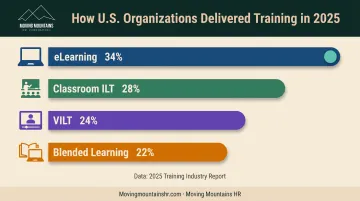
Instructor-led training is live, in-person classroom instruction delivered by an expert facilitator. It remains a cornerstone of corporate training, accounting for 28% of all U.S. training hours in 2025.
Key Benefits:
- High engagement through real-time discussion
- Immediate feedback and question-and-answer opportunities
- Adaptable content based on participant needs
- Strong for interpersonal skills and complex topics
Challenges:
- Resource-intensive (requires facilitator, space, scheduling)
- Less scalable than digital methods
- Scheduling constraints for distributed teams
When to Use ILT:
Use instructor-led training for complex topics requiring discussion, leadership development, compliance training with nuance, or major organizational change initiatives. ATD's 2024 survey found that one-third of workers still prefer traditional classroom settings, especially for management, interpersonal skills, and executive development.
2. Virtual Instructor-Led Training (VILT)
VILT delivers live training remotely through video conferencing platforms like Zoom, Microsoft Teams, or Google Meet. It combines the engagement of instructor-led training with the flexibility of remote delivery.
Key Benefits:
- Scalable to multiple locations without travel costs
- Reaches distributed and hybrid teams equally
- Flexible scheduling across time zones
- Lower overhead than in-person classroom training
Challenges:
- Requires strong facilitation skills to maintain engagement
- Depends on reliable technology and internet access
- Potential for lower engagement than in-person sessions
When to Use VILT:
VILT represented 24% of U.S. training hours in 2025 and is ideal for hybrid workforces, distributed teams, software rollouts, and organizations with multiple locations. It works well when live interaction matters but geography is a barrier. Moving Mountains HR delivers leadership, California employment compliance, and performance management training in both virtual and in-person formats, matched to each client's industry and workforce.
3. On-the-Job Training (OJT)
On-the-job training is experiential learning where employees learn by doing real work under supervision. It's one of the oldest and most effective methods for building practical skills quickly.
Key Benefits:
- Immediate application in the actual work environment
- Contextual learning with real tools and processes
- Accelerates time-to-productivity for new hires
- Builds muscle memory for operational tasks
Challenges:
- Quality varies depending on the mentor or supervisor
- Requires experienced trainers who can teach effectively
- Potential for customer-facing mistakes during learning
When to Use OJT:
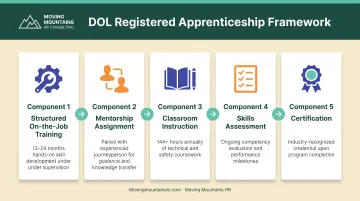
On-the-job training is best for operational roles, technical skills, apprenticeships, and frontline positions. The DOL's registered-apprenticeship model combines structured OJT with mentorship and classroom instruction, creating a formal framework that delivers measurable returns.
4. eLearning and Online Courses
eLearning is self-paced digital learning delivered through a learning management system (LMS). Employees complete modules, quizzes, and assessments on their own schedule.
Key Benefits:
- Highly scalable across locations and time zones
- Cost-effective for standardized content
- Consistent delivery regardless of location
- Tracks progress, completion, and assessment scores
Challenges:
- Potential for low engagement without accountability
- Requires self-discipline and time management
- Limited real-time interaction and feedback
When to Use eLearning:
eLearning accounted for 34% of U.S. training hours in 2025, making it the single largest delivery method. It's ideal for standardized content, compliance training, onboarding basics, and global workforces. 92% of organizations put at least some compliance training online, and 45% deliver it entirely online.
5. Microlearning
Microlearning delivers focused, bite-sized lessons, typically just a few minutes long, designed for quick consumption and immediate application.
Key Benefits:
- Higher completion rates due to short format
- Just-in-time learning for performance support
- Mobile-friendly for on-the-go access
- Better retention through focused, repetitive reinforcement
Challenges:
- Not suitable for complex or nuanced topics
- Requires thoughtful content design to avoid oversimplification
- No agreed optimal duration (studies range from 1-15 minutes)
When to Use Microlearning:
A 2025 systematic review of 40 studies found positive outcomes for acquisition, retention, recall, transfer, engagement, and motivation. Use microlearning for product updates, safety reminders, compliance refreshers, and performance support where employees need quick answers at the moment of need.
6. Coaching and Mentoring
Coaching and mentoring provide one-on-one or small-group guidance from experienced employees, managers, or external coaches. It's personalized development focused on individual growth.
Key Benefits:
- Personalized to individual needs and goals
- Transfers institutional knowledge and culture
- Builds relationships and strengthens engagement
- Addresses specific performance or development gaps
Challenges:
- Time-intensive for both coach and participant
- Difficult to scale across large organizations
- Depends heavily on coach quality and availability
When to Use Coaching and Mentoring:
A 2023 meta-analysis of 11 coaching studies found a moderate overall effect (g=0.44), with both face-to-face and virtual coaching producing significant results. Use coaching for leadership development, high-potential employees, succession planning, and addressing individual performance issues.
7. Simulation and Scenario-Based Training
Simulation training creates realistic, risk-free environments where employees practice decisions and skills. It increasingly includes virtual reality (VR) and augmented reality (AR) technology.
Key Benefits:
- Safe practice environment for high-risk situations
- Hands-on experience without real-world consequences
- Builds confidence and decision-making skills
- Realistic scenarios improve transfer to the job
Challenges:
- Expensive to develop, especially VR/AR solutions
- Requires technology investment and maintenance
- May need specialized equipment or space
When to Use Simulation Training:
A 2024 review of 52 VR safety-training studies found strong effects for knowledge acquisition (g=0.640) and retention (g=0.838) compared to conventional methods. Use simulation for high-risk roles, customer service scenarios, technical skills practice, and crisis management training.
8. Gamification
Gamification incorporates game elements such as points, badges, leaderboards, challenges, and rewards into training content.
Key Benefits:
- Increases engagement and motivation
- Makes learning fun and interactive
- Encourages friendly competition and goal achievement
- Provides immediate feedback through game mechanics
Challenges:
- Requires careful design to avoid trivializing content
- May not suit all topics, audiences, or learning preferences
- Competition can create stress for some learners
- Novelty can fade without ongoing updates
When to Use Gamification:
A 2025 review of 49 empirical studies linked well-designed gamification to engagement, motivation, retention, and performance. Use gamification for sales training, compliance courses, onboarding, and situations requiring frequent practice or repetition.
9. Job Rotation and Cross-Training
Job rotation moves employees between roles or departments, while cross-training teaches multiple job functions. Both build workforce flexibility and uncover hidden talents.
Key Benefits:
- Builds a flexible, multi-skilled workforce
- Reduces burnout through variety and new challenges
- Uncovers hidden talents and career interests
- Supports succession planning and continuity
Challenges:
- Requires coordination across teams and managers
- Potential short-term productivity dips during transitions
- Needs structured planning and clear expectations
When to Use Job Rotation and Cross-Training:
A 2025 study of 540 employees linked well-designed rotation to greater sense of gain, less emotional exhaustion, and better well-being. Use rotation for organizations with diverse operations, preparing employees for promotions, managing seasonal fluctuations, and building bench strength.
10. Blended Learning
Blended learning strategically combines multiple training methods, such as instructor-led sessions, eLearning, and hands-on practice, to draw on the strengths of each.
Key Benefits:
- Draws on the strengths of multiple methods
- Accommodates different learning preferences and schedules
- Maximizes retention through varied reinforcement
- Increases engagement by avoiding monotony
Challenges:
- Requires thoughtful design and coordination
- More complex to manage than single-method programs
- May need multiple platforms and resources
When to Use Blended Learning:
ATD's 2024 survey of 360 talent-development professionals found that about 75% reported increased blended-learning use over two years, and 71% said at least half their organization's learning was blended. Use blended learning for enterprise-wide initiatives, complex skill development, and comprehensive training programs where one method isn't enough.
In 2025, U.S. organizations delivered training through a portfolio: 34% online, 28% classroom ILT, 24% VILT, and 22% blended, demonstrating that most successful programs use multiple methods.
How to Choose the Right Training Method for Your Organization
Selecting the right training method starts with understanding your specific needs: business goals, workforce demographics, budget, timeline, and the nature of the content. Use those factors to filter the methods covered above.
Match Method to Content Type
Different content requires different delivery:
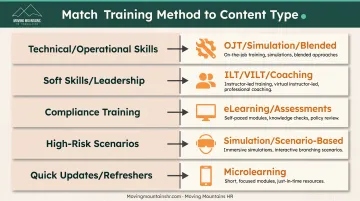
- Technical or operational skills: On-the-job training, simulation, or blended learning with hands-on practice
- Soft skills and leadership: Instructor-led training, VILT with role-play, or coaching
- Compliance training: eLearning for standardized content, with assessments to verify understanding
- High-risk scenarios: Simulation or scenario-based training in a safe environment
- Quick updates or refreshers: Microlearning delivered just-in-time
Content type is only half the decision. Budget, staffing, and where people work matter just as much.
Fit the Method to Your Business Reality
When resources are tight, favor methods that stay affordable as you grow. eLearning and microlearning scale without adding per-session costs and usually need less technology, space, and facilitator time than traditional classroom training.
Match delivery to your workforce structure:
- Fully remote teams: VILT, eLearning, virtual coaching
- Hybrid teams: Blended learning combining virtual and in-person elements
- In-person teams: ILT, on-the-job training, hands-on simulation
Measure Effectiveness
The CDC identifies behavioral modeling, realistic practice, error management, feedback, supervisor support, and opportunity to perform as the strongest predictors of training transfer. Measure results through:
- Knowledge assessments: Pre- and post-tests to measure learning
- Behavior observation: Manager or peer feedback on skill application
- Performance metrics: Track changes in quality, speed, errors, or customer satisfaction
- Feedback loops: Gather employee input to refine content and delivery
Moving Mountains HR helps small and mid-size businesses assess training needs, select the right methods, and implement programs tailored to their industry and workforce.

Implementing Your Training Strategy Successfully
Turn the methods above into results with a focused rollout:
- Start small. Pilot one or two methods with a single department or role before a company-wide rollout. Use pre- and post-assessments to measure knowledge gains, then run delayed follow-ups to verify skill transfer.
- Get leadership buy-in. Secure time, budget, and personnel up front. Managers should reinforce learning by giving people real chances to practice new skills on the job.
- Use the right tools. Per the 2025 Training Industry Report, 89% of organizations used an LMS, 77% used virtual classrooms or video, 41% used mobile apps, and 37% used AI for delivery and tracking.
- Gather feedback and adjust. Collect employee input on what works and what doesn't. ATD research found only 43% of talent-development professionals said learning and business goals were aligned, and just 30% said their organizations used learning data well for decisions. Define business measures before delivery, then adjust programs based on results.
Conclusion
Choosing the right employee training methods builds a skilled, high-performing workforce in 2026. The most effective approach combines multiple methods strategically, matching how you deliver training to the content and your team's real constraints.
Small business owners should start with one or two methods aligned with immediate priorities and budget. That might mean eLearning for compliance, on-the-job training for operational roles, or coaching for leadership development. Expand from there as needs and resources grow.
If your business needs help implementing training programs, HR consulting partners like Moving Mountains HR provide strategic support. That can include HR audits and performance management systems that integrate training with your organization's goals.
Frequently Asked Questions
What are some effective methods for training employees?
The most versatile methods include instructor-led training, eLearning, on-the-job training, coaching and mentoring, and blended learning. Effectiveness depends on matching the method to your goals, content type, and employee needs—not on finding one universal approach.
What are the five types of training methods?
Five core methods are instructor-led training, eLearning, on-the-job training, coaching and mentoring, and simulation-based training. Combine them when you need both knowledge transfer and hands-on practice.
What are the four types of training methods for employees?
Four fundamental categories are classroom/instructor-led, experiential/hands-on, digital/technology-based, and social/collaborative learning. Most organizations mix these based on the skill and the audience.
What are techniques of training and development?
Training techniques are specific approaches used within a method, such as role-playing, case studies, demonstrations, discussions, assessments, and simulations. Training builds immediate job skills; development supports longer-term career growth.
What are the three types of TNA?
Training Needs Analysis (TNA) works at three levels: organizational (company-wide skill gaps), task (job-specific competencies), and individual (person-specific performance gaps). All three should guide which training methods you choose.
How do I choose the best training method for my small business?
Assess your budget, workforce size, training content, available technology, and employee preferences. Start with cost-effective, scalable methods like eLearning or blended approaches that combine online modules with manager coaching. If the choice still feels unclear, an HR consultant can help align training spend with compliance needs and business outcomes.