This scenario plays out daily across small and mid-size businesses. The culprit? A lack of structured employee development. Individual Development Plans (IDPs) offer a practical, low-cost solution that keeps talented employees engaged, reduces costly turnover, and builds the leadership pipeline your business needs to grow—without requiring a massive HR department or expensive software.
Key Takeaways
- IDPs align employee career goals with business objectives through structured, collaborative planning
- Strong development cultures cut turnover and build stronger internal talent pipelines
- Effective IDPs need regular conversations, clear goals, and manager commitment, not expensive technology
- Focus on 2–4 development goals per employee and schedule quarterly check-ins
What Is an Individual Development Plan?
Definition and Core Purpose
An Individual Development Plan is a personalized, employee-driven document that outlines specific career goals, skills to develop, and actionable steps to achieve them. According to the U.S. Office of Personnel Management, IDPs serve as tools that help employees achieve personal and professional development goals while supporting organizational needs.
The key word is collaborative. The employee proposes goals based on their interests and aspirations, while the manager provides guidance, resources, and organizational context. Both parties commit to supporting the plan through regular check-ins and concrete actions.
IDPs differ from Performance Improvement Plans (PIPs):
- PIPs address performance deficiencies through corrective action
- IDPs are forward-looking and growth-focused
- The aim is building capability before problems take root
How IDPs Differ from Performance Reviews
Performance reviews assess past performance: what you accomplished, where you fell short, and how you measured against expectations. IDPs focus on future development: where you want to go and how you'll build the skills to get there.
The two processes complement each other. Effective performance reviews identify strengths to leverage and gaps to address; IDPs translate that feedback into concrete development opportunities. For example, if a performance review notes that an employee needs stronger delegation skills, the IDP might include:
- Leadership training tied to real team decisions
- Mentorship from a senior manager
- A stretch assignment leading a small project
IDPs work best when integrated into regular performance conversations, not treated as separate annual exercises. Gallup recommends managers hold brief check-ins at least weekly, with formal progress reviews at least every six months, far more frequent than the traditional annual review cycle.
Why IDPs Matter for Your Business
Structured employee development pays off even if you run a small business without a dedicated HR team.
The Retention Connection
Research from Pew Research Center found that 63% of U.S. workers who quit in 2021 cited lack of advancement opportunities as a key reason. Development planning directly addresses this documented driver of turnover. When employees see a clear path forward and receive support to grow their skills, they're far more likely to stay.
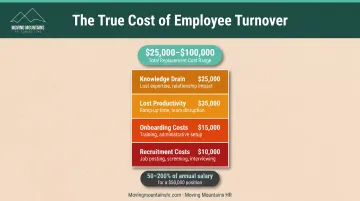
Organizations with highly engaged teams also see 21% lower turnover in high-turnover industries and 51% lower turnover in low-turnover sectors, according to Gallup. That retention gap shows up fast in your budget: replacing an employee costs roughly 50% to 200% of their annual salary, depending on role complexity.
For a $50,000-per-year employee, that is $25,000 to $100,000 in recruiting, onboarding, lost productivity, and knowledge drain.
Building Your Talent Pipeline
Keeping people is only half the payoff. IDPs also build a stronger internal talent pipeline by preparing employees for expanded responsibilities. Instead of scrambling to fill leadership roles externally, you develop candidates from within who already understand your culture, customers, and operations.
The Small Business Advantage
You don't need a massive HR department to put IDPs in place. Small businesses often hold the edge:
- Closer manager-employee relationships
- Faster decision-making
- Flexible development opportunities you can shape quickly
What you need is commitment to employee growth and structured conversations, not sophisticated software or lengthy processes.
Demonstrating Investment in People
That same commitment shows up in how candidates and current staff judge your workplace. Gartner research from 2024 found that only 46% of employees felt supported in trying to grow their careers. When you invest in development planning, you stand out as an employer who backs employee growth—a real recruiting and retention edge.
Compliance and Risk Management
IDPs help on the risk side too. Well-documented development plans support fair promotion decisions and help protect against discrimination claims. The EEOC requires covered employers to retain personnel records for one year and prohibits promotion decisions based on protected-class stereotypes. Structured IDPs create a transparent, merit-based framework for advancement that reduces legal risk.
Types of Individual Development Plans (With Examples)
Different employees need different development approaches depending on their goals, current role, and organizational needs.
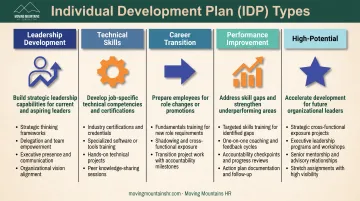
Leadership Development IDPs
Purpose: Prepare employees for or help them grow into leadership roles.
Example: Alex, a team lead in operations, wants to move into a department manager position within 18 months. His IDP focuses on:
- Strategic thinking: Completing a strategic planning course and shadowing the COO during quarterly planning sessions
- Delegation: Working with a mentor to practice assigning work, setting expectations, and holding team members accountable
- Executive presence: Joining Toastmasters and presenting quarterly department updates to senior leadership
Common development activities:
- Leadership training programs and executive coaching
- Cross-functional project leadership
- Mentorship from senior leaders
- Rotational assignments across the business
Technical Skills Development IDPs
Purpose: Build specific job-related competencies or learn new technologies.
Example: Maria, a marketing coordinator, wants to become a digital marketing specialist. Her IDP includes:
- SEO expertise: Completing Google Analytics and SEO fundamentals certifications
- Content strategy: Shadowing the content marketing manager and taking ownership of the company blog editorial calendar
- Analytics: Attending monthly analytics training webinars and creating monthly performance dashboards
Common development activities:
- Industry certifications and workshops
- Online courses (Coursera, LinkedIn Learning, Udemy)
- Shadowing specialists in your organization
- Hands-on project work
New Employee Onboarding IDPs
Purpose: Help new hires ramp up quickly and shape their early career path.
Example: Jordan, a new sales representative, has a 90-day IDP focusing on:
- Product knowledge: Completing product training modules and shadowing customer success calls
- Sales process: Role-playing discovery calls with the sales manager and observing three full sales cycles
- First wins: Closing two new accounts by day 90 with manager support
Setting development goals early—even during onboarding—improves long-term retention by signaling your investment in the employee's future.
Career Transition IDPs
Purpose: Support employees seeking to move into different roles or departments (internal mobility).
Example: Taylor, an administrative professional, wants to transition to an HR coordinator role. Her IDP includes:
- HR fundamentals: Completing a SHRM Essentials of HR Management course
- Exposure: Shadowing the HR manager during new employee orientations and assisting with open enrollment
- Project work: Leading the employee handbook update project under HR guidance
Retention benefit: Employees don't have to leave your company to grow their careers. Supporting internal moves keeps institutional knowledge in-house and reduces external recruiting costs.
Performance Improvement IDPs
Purpose: Address skill gaps or performance issues in a constructive, growth-oriented way.
Important distinction: These are collaborative, supportive plans—not formal Performance Improvement Plans (PIPs), which are disciplinary measures. Performance improvement IDPs focus on building capability, not documenting deficiencies.
Example: Sam, a project coordinator, struggles with time management and missed several deadlines. His IDP focuses on:
- Organization systems: Working with his manager to implement project management software and weekly planning sessions
- Prioritization: Attending a time management workshop and using daily priority matrices
- Accountability: Weekly 15-minute check-ins to review progress and remove obstacles
High-Potential Employee IDPs
Purpose: Accelerate development of employees identified as future organizational leaders.
Succession planning connection: High-potential IDPs build your bench strength by systematically preparing employees to fill critical roles.
Example: Chris, a high-performing senior analyst, is being prepared for a director-level role. Her IDP includes:
- Strategic exposure: Leading a cross-functional cost-reduction initiative with executive visibility
- Leadership development: Participating in an external executive leadership program
- Mentorship: Monthly meetings with the CFO to discuss business strategy and decision-making
Gartner recommends aligning high-potential development with evolving business needs and assessing business-driven competencies, not just past performance.
How to Create an Effective Individual Development Plan
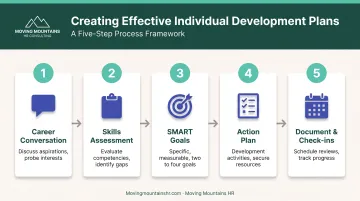
Step 1: Start with a Career Conversation
Effective IDPs begin with genuine dialogue about the employee's aspirations and motivations. The U.S. Office of Personnel Management emphasizes that employees and supervisors should jointly craft IDPs to clarify aspirations and organizational career paths.
Sample questions to ask:
- Where do you see yourself in 2-3 years: in this role, in our organization, or in your career generally?
- What skills or knowledge would you most like to develop?
- What work energizes you? What tasks do you find most engaging?
- What would make you feel more challenged or fulfilled in your current role?
- Are there responsibilities you'd like to take on or areas of the business you'd like to learn more about?
This should be a real conversation, not a form-filling exercise. Listen actively and probe for specific interests beyond generic responses like "I want to grow."
Step 2: Assess Current Skills and Identify Gaps
Once you understand the employee's goals, evaluate their current competencies against the skills needed to achieve those goals.
Practical assessment methods:
- Self-assessment: Ask the employee to rate their proficiency in key skill areas
- Manager observation: Document specific examples of demonstrated capabilities and areas for improvement
- 360-degree feedback: Gather input from peers, direct reports (if applicable), and other stakeholders
- Skills inventories: Use simple checklists of technical and soft skills relevant to the target role
Focus on concrete skill gaps rather than vague observations. Instead of "needs better communication," identify "needs to develop executive presentation skills" or "needs to improve written documentation clarity."
Step 3: Set SMART Development Goals
OPM defines SMART goals as Specific, Measurable, Achievable, Relevant, and Time-bound.
Examples of well-written IDP goals:
- ✅ "Complete Google Analytics certification and create monthly website performance dashboards by Q3"
- ✅ "Shadow three client discovery calls, then independently lead two discovery calls with manager observation by June 30"
- ✅ "Develop delegation skills by assigning and managing completion of four project tasks to team members over the next quarter"
Examples of poorly written IDP goals:
- ❌ "Improve leadership skills"
- ❌ "Learn more about finance"
- ❌ "Become a better communicator"
Balance and prioritization: Focus on 2-4 key development goals rather than overwhelming employees with a long list. Consider the employee's current workload and ensure development activities are realistic given their day-to-day responsibilities.
Step 4: Create an Action Plan with Resources
Translate goals into specific development activities and identify the resources needed to support them.
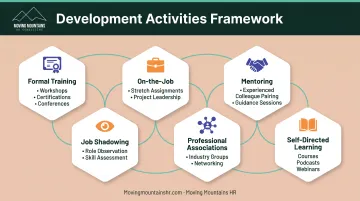
Range of development options:
- Formal training: Workshops, courses, certifications, conferences
- On-the-job experiences: Stretch assignments, project leadership, new responsibilities
- Mentoring: Pairing with a more experienced colleague for guidance and advice
- Job shadowing: Observing colleagues in target roles to understand responsibilities and required skills
- Professional associations: Joining industry groups for networking and learning opportunities
- Self-directed learning: Books, podcasts, online courses, webinars
OPM lists low-cost options including web training, job rotations, shadowing, on-the-job training, self-study, informal mentoring, and coaching. These options work well for small businesses with limited training budgets.
Secure resources upfront: Before finalizing the IDP, confirm you can provide the necessary time, budget, and manager support. Development plans fail when employees can't access promised resources.
Step 5: Document the Plan and Schedule Check-ins
Writing down the IDP creates accountability and provides a reference for tracking progress. Documentation doesn't need to be elaborate. A simple template covering goals, action steps, resources, timelines, and success criteria is sufficient.
Schedule regular check-ins: Gallup recommends short manager conversations at least weekly—about 1-10 minutes on expectations, workload, goals, and needs. Pair those with formal progress reviews at least every six months.
Effective check-ins include:
- Reviewing progress against goals and timelines
- Discussing obstacles or resource gaps
- Adjusting plans based on changing priorities or new opportunities
- Celebrating completed milestones and applied skills
That written record does more than track progress. It shows fair, consistent development opportunities across employees, which supports compliance and helps reduce discrimination risk.
Common IDP Mistakes to Avoid
Even a well-written IDP falls flat when common process mistakes get in the way. Watch for these three patterns—and fix them early.
Mistake #1: Making IDPs a One-Time Annual Event
Treating IDPs as "set it and forget it" documents guarantees failure. Only 14% of employees strongly agreed their performance reviews inspired improvement. Infrequent, formal reviews alone don't drive meaningful development.
Solution: Integrate IDP discussions into regular one-on-ones. Brief weekly or biweekly conversations about development progress keep goals top-of-mind and allow for real-time adjustments.
Mistake #2: Creating Manager-Driven Plans Without Employee Buy-In
Top-down development plans reduce employee ownership and motivation. When managers dictate what employees "should" work on without considering genuine interests, engagement suffers and goals go unmet.
Solution: Let the employee lead IDP creation while you guide and connect goals to business needs. Look for overlap between what they want to learn and what the organization requires.
Mistake #3: Setting Vague Goals Without Accountability
Vague goals like "improve reporting accuracy" or "develop better leadership skills" don't drive action because success is undefined.
Solution: Use the SMART framework. Instead of "improve reporting accuracy," write "reduce reporting errors to less than 2% by implementing a three-step review process by end of Q2." Spell out success criteria, a timeline, and how you'll measure progress.
How to Measure IDP Success
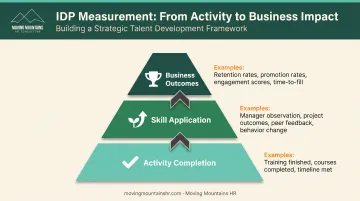
IDP success shows up at three levels: activities finished, skills used on the job, and business results that move. Track all three so you know development is more than a completed checklist.
Track Completion of Development Activities
Monitor whether employees complete planned training, courses, and development experiences on schedule.
Simple tracking methods:
- Shared documents (Google Sheets or Excel) with activities, deadlines, and status
- Calendar reviews during regular check-ins
- Brief progress updates in one-on-one meetings
Monitor Skill Acquisition and Application
Completing a course doesn't guarantee learning or workplace application. Assess whether employees are actually building and applying new skills.
Assessment methods:
- Manager observation: Watch for new skills in daily work
- Project outcomes: Evaluate stretch assignments and new responsibilities
- Employee self-assessment: Ask how they've applied what they learned
- Peer feedback: Gather input from close colleagues
Kirkpatrick's evaluation model is a useful frame. Measure Reaction (did they like the training?), Learning (did they gain knowledge?), Behavior (are they using it?), and Results (what's the business impact?).
Measure Organizational Outcomes
Tie individual development to broader business metrics with a few clear indicators:
- Employee retention rates: Compare turnover before and after IDPs. The U.S. average quits rate was 2.1% per month in 2024.
- Internal promotion rates: Track leadership roles filled internally versus externally
- Engagement survey scores: Watch career-development and growth items. In 2024, only 31% of U.S. employees were engaged.
- Time-to-fill for open positions: Check whether a stronger internal pipeline shortens recruiting
Development results take time. Most organizations see meaningful impact over 6–12 months of consistent work, not overnight. Measure progress against your own baseline, not universal benchmarks.
When to Seek HR Expertise for Development Planning
Many small businesses can implement basic IDPs using the framework outlined above. However, certain scenarios benefit from external HR consulting:
When to consider professional support:
- Build an IDP program from scratch, including templates, policies, manager training, and performance management integration
- Train managers to run career discussions, set SMART goals, and coach development over time
- Connect IDPs to performance reviews, compensation decisions, and succession planning
- Close skill gaps at scale (Gartner research found 41% of HR leaders say their workforce lacks needed skills, and 50% say existing skills go underused)
How fractional HR support helps:
Moving Mountains HR helps small and mid-size businesses put sustainable employee development processes in place. Support often includes:
- Customized training on leadership, performance management, and coaching
- Strategic HR guidance that aligns development with business goals
- Compliance help so development and promotion practices meet legal requirements
Fractional HR services deliver executive-level expertise without the overhead of a full-time hire. That fit works well for growing businesses that need professional guidance but not a dedicated HR department.
Frequently Asked Questions
What is an example of an individual development plan for employees?
A customer service rep aiming for a supervisory role in 18 months might plan to finish frontline leadership training by Q2, shadow two supervisors for a week each, and lead two small projects to build delegation skills. She and her manager review progress monthly.
How long should an IDP be?
Most effective IDPs run 1–2 pages and focus on 2–4 development goals. A one-page template with goals, action steps, resources, timelines, and success measures is enough for most teams.
Who is responsible for creating an IDP—the employee or the manager?
Both. The employee leads on career goals and desired skills; the manager adds organizational context, suggests opportunities, and helps secure resources. They share ownership of check-ins and updates.
How often should we update IDPs?
Review IDPs at least quarterly, and more often for new hires or people in career transitions. Treat the plan as a living document so goals can shift as skills grow and business needs change.
Do small businesses really need formal IDPs?
Formal does not mean complicated. A basic template and regular development conversations can improve retention and engagement. In small businesses, closer manager-employee relationships often make planning simpler—and follow-through matters more than fancy software.
What if an employee's development goals don't align with what the business needs?
Be honest about business realities and look for overlap. An operations employee interested in marketing might lead a customer communication project that serves both sides. Sometimes supporting a path that leads elsewhere is still right—it builds goodwill and protects your employer brand.