Workplace conflict is inevitable—but how you respond as a leader determines whether it destroys your team or drives growth. According to SHRM's Q4 2024 survey, workers experienced an average of 0.49 acts of workplace incivility per day, with affected employees reporting nearly 37 minutes of lost productivity per incident. The cumulative cost? An estimated $2.71 billion daily in combined productivity and absenteeism losses.
This article covers 10 essential conflict resolution skills every leader needs—from active listening to knowing when to bring in outside help. Whether you're a small business owner without an HR department or a manager navigating interpersonal disputes, these skills will help you protect team morale, reduce legal risk, and transform conflict into opportunity.
Key Takeaways
- Strong resolution blends people skills (listening, empathy) with process (documentation, escalation)
- Mastering these 10 skills builds psychologically safe teams where people feel heard
- 42% of voluntary exits are preventable—unresolved conflict drives lost productivity, turnover, and legal risk
- Without in-house HR, small-business leaders need these skills to stay compliant and cut risk
Why Conflict Resolution Is Essential for Leaders
Unresolved workplace conflict rarely fades on its own. It spreads through teams, eroding trust and productivity along the way. SHRM's 2024 data shows that even low-level incivility costs organizations billions in lost productivity and absenteeism. The hidden costs run deeper.
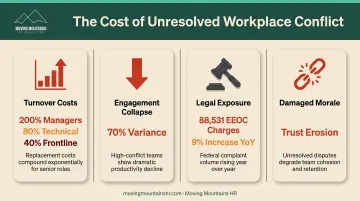
The Real Costs of Ignored Conflict:
- Turnover and replacement expenses – Gallup estimates replacement costs at roughly 200% of salary for managers, 80% for technical staff, and 40% for frontline employees
- Engagement collapse – Gallup attributes 70% of variance in team engagement to the manager; disengaged teams show lower productivity, profitability, and quality
- Legal exposure – The EEOC received 88,531 discrimination charges in FY2024, a 9% increase over the prior year; many allegations stem from unresolved workplace disputes
- Damaged morale and trust – Employees who feel unheard pull back, spread frustration, and often leave
Why Resolution Matters:
Effective conflict resolution builds trust and sharpens how teams communicate. Disagreements stop feeling like threats and start surfacing better ideas.
For small to mid-size businesses without dedicated HR departments, these skills matter even more. They help leaders catch disputes early, limit compliance exposure, and reduce legal risk before a conflict turns into a claim.
10 Leadership Conflict Resolution Skills
Skill 1: Active Listening
Active listening means fully concentrating on what's being said rather than planning your response or making assumptions. The University of Iowa defines active listening as techniques for hearing and understanding a speaker while helping them express their message clearly.
Core Techniques:
- Maintain eye contact and use open body language
- Paraphrase to confirm understanding ("What I'm hearing is...")
- Ask open-ended clarifying questions
- Avoid interrupting or rushing to judgment
- Reflect feelings and summarize key points
Active listening makes employees feel heard and valued, which de-escalates tension and opens the door to resolution. A 2020 study of 548 Icelandic employees found that supervisor active-empathetic listening was positively associated with engagement, vigor, dedication, and absorption.
Example: A manager listens to an employee's frustration about workload distribution without immediately defending the current system. Instead, she asks, "Can you walk me through what a typical week looks like for you?" This surfaces the real issue (unclear priorities) and shifts the conversation from complaint to problem-solving.
Skill 2: Emotional Intelligence
Emotional intelligence (EI) is recognizing and managing your own emotions while reading and responding appropriately to others' emotional states. Leaders with high EI remain calm under pressure, recognize when emotions are escalating, and respond with empathy rather than defensiveness.
Why EI Matters in Conflict:
A 2023 review of 104 peer-reviewed studies found EI associated with leadership effectiveness, team performance, and conflict-management competence. Meta-analytic research shows leader EI correlates positively with subordinate task performance (r=.48), though effects vary by cultural context.
How to Develop EI:
- Practice self-awareness: notice your triggers and emotional patterns
- Seek feedback on how you handle tense situations
- Learn to separate emotions from facts
- Validate feelings while addressing behaviors ("I understand you're frustrated, and we still need to meet the deadline")
- Maintain composure when conflicts become heated
High-EI leaders catch escalation early, keep respect intact, and steer the group back to workable solutions.
Skill 3: Clear and Respectful Communication
How leaders communicate during conflict sets the tone for resolution. Vague or accusatory language escalates disputes; clear, respectful communication invites collaboration.
Best Practices:
- Use "I" statements instead of "you" accusations
- ❌ "You never meet deadlines"
- ✅ "I'm concerned about the missed deadlines and how they impact the project timeline"
- Speak calmly and choose neutral language
- Be specific about the issue and its impact
- Focus on behaviors and outcomes, not personal attacks
- Emphasize finding solutions, not assigning blame
A 2023 systematic review defines workplace civility as respectful and courteous behavior and links it with improved individual, team, and organizational outcomes. Tone matters. Leaders who communicate with respect, even during difficult conversations, model the behavior they expect from their teams.
Skill 4: Remaining Neutral and Impartial
Leaders must approach conflicts as objective facilitators, not judges or advocates for one side. Showing favoritism or taking sides prematurely destroys trust and makes fair resolution impossible.
Techniques for Impartiality:
- Hear all perspectives before forming opinions
- Focus on facts over feelings (while acknowledging both)
- Acknowledge valid points from all parties
- Avoid letting personal relationships influence your judgment
- Use consistent criteria when evaluating behavior or outcomes
Research on organizational justice links fair procedures, clear information sharing, and respectful treatment with stronger team trust. When leaders stay neutral, employees are more likely to accept the process as fair, even when they dislike the outcome.
Important: Neutrality means process impartiality, not ignoring substantiated misconduct or splitting outcomes equally when evidence supports one party.
Skill 5: Problem-Solving and Root Cause Analysis
Effective conflict resolution addresses underlying issues, not just surface symptoms. Too often, leaders resolve the immediate complaint without uncovering the real source of tension: unclear roles, miscommunication, resource competition, or personality clashes.
Ask Probing Questions:
- What triggered this conflict?
- Is this the first time, or is it a recurring issue?
- Are expectations and roles clearly defined?
- Is there a resource or communication breakdown?
- What needs to change to prevent this from happening again?
Root Cause Tools:
- 5 Whys: ASQ describes this method as asking "why" repeatedly to move from a problem toward latent causes
- Fishbone diagrams: Ishikawa cause-and-effect diagrams help identify possible causes across categories like people, process, environment, and systems
Collaborative problem-solving empowers all parties to contribute solutions that address root causes, not just symptoms.
Skill 6: Setting and Enforcing Boundaries
Many conflicts stem from unclear expectations, roles, responsibilities, or acceptable workplace behaviors. Leaders who proactively establish boundaries prevent disputes before they start.
Establish Clear Boundaries:
- Define roles and decision-making authority
- Communicate policies and conduct expectations
- Clarify responsibilities and deliverables
- Set escalation routes for concerns and disputes
Enforce Consistently:
Boundaries only work if leaders enforce them uniformly. Inconsistent enforcement breeds resentment and confusion. A 2019 workplace study found that role clarity positively influenced basic psychological needs and vitality, while role conflict had the opposite effect.
Clear, evenly enforced boundaries reduce avoidable disputes because people know the rules before tension builds.
Skill 7: Facilitation and Mediation
Complex conflicts often require leaders to facilitate structured conversations between disputing parties. Mediation empowers employees to reach their own solutions rather than having leaders impose resolutions.
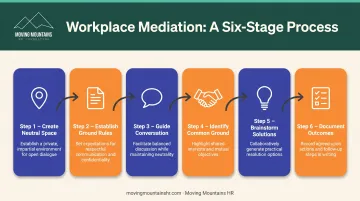
Mediation Techniques:
- Create a neutral meeting space – Choose a private, comfortable location
- Establish ground rules – No interruptions, respectful language, confidentiality
- Guide conversation without dominating it – Ask questions, clarify misunderstandings, summarize points
- Help parties identify common ground – Focus on shared goals and interests
- Facilitate solution brainstorming – Encourage creative options before evaluating feasibility
- Document agreed-upon outcomes – Write down commitments and follow-up dates
The EEOC defines mediation as an informal process in which a trained mediator helps parties negotiate resolution. In FY2024, the EEOC successfully resolved 8,543 private-sector mediations, producing $243.2 million in benefits.
Successful mediation leaves both parties feeling heard and invested in the solution.
Skill 8: Documentation and Record-Keeping
Documenting conflicts, conversations, and resolutions protects both the organization and employees. Proper documentation supports HR compliance, provides evidence if legal issues arise, and creates accountability for following through on resolutions.
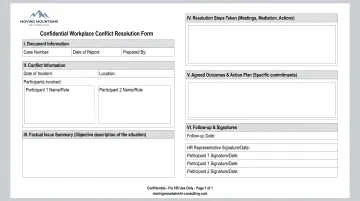
What to Document:
- Date and participants
- Summary of the issue (factual, not opinion-based)
- Steps taken toward resolution
- Agreed-upon outcomes and commitments
- Follow-up dates and checkpoints
Compliance Note:
Federal regulations generally require covered private employers to retain personnel or employment records for one year from creation or the personnel action, whichever is later. Once an EEOC charge is filed, relevant records must be kept until final disposition.
Documentation should be factual, objective, and stored securely according to company policies and legal requirements. The goal is transparency, consistency, and accountability, not a file built to punish people.
Skill 9: Cultural Awareness and Inclusivity
Diverse workplaces require leaders to recognize how cultural backgrounds, communication styles, and values influence conflict and resolution preferences. Cultural differences can lead to misunderstandings, such as direct versus indirect communication styles, individual versus collective decision-making, or different views of hierarchy and authority.
Cultural Competency in Conflict:
- Educate yourself on cultural norms and communication preferences
- Ask questions to understand different perspectives (don't assume)
- Adapt conflict resolution approaches to respect cultural differences
- Apply identical conduct standards while accommodating communication methods
A 2021 review of 108 studies found that cultural diversity can increase creativity while also increasing task conflict and reducing social integration under some conditions. Cross-cultural research also reports differences in conflict-handling preferences and leadership effectiveness.
Example: An employee from a culture that values indirect communication may express disagreement subtly. A leader who recognizes this can create space for that employee to share concerns in a way that feels comfortable, rather than interpreting silence as agreement.
Skill 10: Knowing When to Seek External Support
Some conflicts are beyond a leader's ability to resolve effectively. Recognizing when to bring in outside help is a responsible decision that protects the organization and its employees.
Signs You Need External Help:
- The conflict involves potential legal liability (harassment, discrimination, retaliation)
- Parties refuse to engage in good faith
- The leader is personally involved and cannot remain impartial
- The dispute involves senior leaders or executives
- Specialized expertise is required (workplace investigations, legal counsel)
- Internal resolution attempts have failed
External Resources:
- Neutral third-party workplace investigators
- HR consultants and compliance specialists
- Professional mediators
- Employment legal counsel
Moving Mountains HR provides neutral workplace investigations and HR consulting to help small and mid-size businesses navigate complex conflicts while maintaining compliance. When internal resources are insufficient or impartiality is impossible, external support ensures disputes are handled fairly, thoroughly, and professionally.
How to Develop These Skills as a Leader
Conflict resolution skills take intentional practice and ongoing learning. Treat development as a continuous process, not a one-time event.
Formal Training:
- Conflict resolution workshops and seminars
- Mediation certification programs, such as the Eckerd College/MTI Workplace Mediation Certification
- Emotional intelligence training
- Communication and leadership development courses, such as conflict-resolution training from the Center for Creative Leadership
A 2017 meta-analysis of 335 leadership-training studies found that structured programs improved learning, on-the-job transfer, performance, subordinate outcomes, and organizational results.

Experiential Learning:
- Practice with low-stakes conflicts first
- Seek mentorship from experienced leaders
- Request feedback after handling disputes
- Reflect on what worked and what didn't
Ongoing Development:
- Read books and articles on conflict management
- Attend HR and leadership conferences
- Stay current on employment law and compliance issues
- Build a network of HR professionals for guidance and support
Teams without internal L&D capacity often partner with an HR consulting firm for leadership and workplace conflict training delivered virtually or on-site.
When to Seek External Support for Workplace Conflicts
Even skilled leaders sometimes need outside help. Bringing in a third party when a conflict exceeds your role protects the organization and keeps the process fair.
Specific Scenarios Requiring External Support:
- Investigations into harassment or discrimination claims
- Conflicts involving executives, owners, or HR leaders
- Situations where company culture has broken down
- Disputes where the leader cannot remain impartial
- Allegations involving potential legal violations or criminal conduct
Third-party HR consultants bring objective investigations and compliance guidance internal leaders often cannot. For small businesses without a dedicated HR department, that outside support keeps disputes professional and aligned with employment law.
Moving Mountains HR conducts neutral workplace investigations for small and mid-size businesses. Confidential interviews, evidence collection, and a written findings report help organizations resolve disputes fairly and reduce legal risk.
Frequently Asked Questions
What are the 5 skills for conflict resolution?
Five core skills typically include active listening, emotional intelligence, clear communication, problem-solving, and impartiality. This article expands to 10 skills leaders use across interpersonal work and day-to-day team practices.
What are the 5 main conflict resolution strategies?
The Thomas-Kilmann framework identifies five modes based on assertiveness and cooperativeness: competing, collaborating, compromising, avoiding, and accommodating. No single mode fits every situation; context decides which approach works.
What are the 5 C's of conflict?
One common framework uses five C's: Communication, Curiosity, Commitment, Compromise, and Closure. Leaders pair open dialogue with a clear path to resolution so conflicts do not linger.
How can leaders develop conflict resolution skills?
Leaders build these skills through training, mentorship, real-world practice, and feedback. Programs that pair instruction with realistic practice and follow-up coaching produce the strongest results.
When should a leader seek outside help for conflict resolution?
Bring in outside help for legal risk, harassment or discrimination claims, cases where you cannot stay impartial, senior-leader allegations, or failed internal attempts. Third-party investigators and HR consultants add objectivity and compliance expertise.
What's the difference between conflict resolution and conflict management?
Conflict management is the ongoing process of handling disputes and building systems that prevent them. Conflict resolution is settling a specific dispute. Leaders need both sharp resolution skills and systems that keep workplace tension low.
Final Thought:
Conflict resolution channels disagreement productively instead of trying to erase it. Leaders who master these 10 skills settle disputes and build cultures where people speak up, disagree respectfully, and work toward shared goals. That culture is what resilient teams run on.