
Introduction: The Hidden Cost of Performance Management Done Wrong
Picture this: Your top performer, Sarah, who once stayed late to finish critical projects and volunteered for new initiatives, is now doing the bare minimum. She's updating her LinkedIn profile during lunch breaks and has already scheduled two "doctor's appointments" this month.
The problem isn't her salary; she's paid competitively. She can't remember the last time her manager acknowledged her contributions, clarified what success looks like, or discussed her career path.
Most small to mid-size businesses operate without structured performance management. They treat employee evaluations as an annual box-checking exercise, or skip them entirely. That oversight costs far more than lost productivity.
According to Gallup's analysis, replacing an employee typically costs between one-half to two times their annual salary once you factor in recruiting, onboarding, lost productivity, and institutional knowledge. For a $60,000-per-year employee, that's $30,000 to $120,000 walking out the door—often for reasons better performance management could have prevented.
This guide covers how performance management drives retention, where small and mid-size businesses go wrong, and the practical steps that keep your best people engaged.
Key Takeaways
- Structured performance management targets top exit drivers: weak recognition, unclear expectations, limited growth, and sparse feedback
- Small businesses improve retention without enterprise systems through consistent goals, feedback, and development planning
- Trained managers who hold regular, empathetic conversations beat any formal process as a retention tool
- Solid documentation protects against employment claims while building trust and clarity with employees
Why Performance Management Matters for Employee Retention
Performance management is more than an annual review ritual. It's a continuous cycle of goal-setting, coaching, real-time feedback, development planning, and recognition, all aligned with business objectives. Done well, that cycle keeps people engaged, productive, and committed to your organization.
For small businesses, voluntary turnover hits hard. Bureau of Labor Statistics data from June 2024 shows that establishments with 10-49 employees experienced a 2.7% monthly quit rate, while those with 50-249 employees saw 2.4%. On a small team, each departure creates outsized financial and operational disruption.
Why Employees Actually Leave
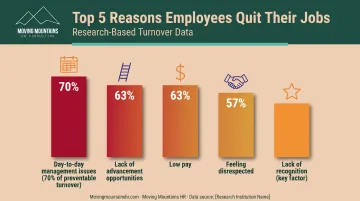
Understanding why people quit is the first step toward keeping them. Pew Research's 2022 survey of workers who left jobs in 2021 found the top drivers were:
- Lack of advancement opportunities (63%, tied with low pay)
- Feeling disrespected at work (57%)
Those gaps often point to management systems, not only compensation budgets.
Gallup's research into preventable turnover revealed that 70% of actions that could have retained departing employees fell into the category of day-to-day management. Among former employees who identified something that could have kept them, positive manager interactions accounted for 21% of those actions, and career advancement for 11%. Performance management directly addresses both.
The Recognition-Retention Connection
Gallup and Workhuman's two-year longitudinal study of nearly 3,500 employees found that well-recognized employees were 45% less likely to have turned over after two years. Recognition isn't expensive. It requires consistent attention and authentic acknowledgment.
Legal Protection Through Documentation
Performance management also serves a critical compliance function, especially for California employers. The Fair Employment and Housing Act (FEHA) covers businesses with five or more employees.
Contemporaneous records of expectations, feedback conversations, and performance improvement efforts support consistent, job-related decision-making if you face wrongful termination or discrimination claims. Documentation doesn't prevent claims or guarantee a legal defense, but it shows employment decisions rested on legitimate business reasons rather than protected characteristics.
Warning Signs Your Performance Management System Is Driving Turnover
Employees Feel Blindsided by Reviews
When employees report being surprised by feedback during formal evaluations, it signals a communication breakdown. A 2015 TriNet survey of 1,000 full-time U.S. workers born after 1980 found that 62% had felt blindsided by a performance review, and 28% had looked for a new job afterward.
While this data is older and focuses on one generation, the underlying issue persists: saving feedback for formal reviews instead of delivering it in real time breeds resentment and disengagement.
If your team members regularly express shock at review time—"I had no idea you were unhappy with my work"—you're likely losing people who would have course-corrected with earlier, clearer guidance.
High Performers Leave Unexpectedly
When your best employees resign without warning, it's a red flag that they're not receiving the recognition, challenge, or growth opportunities they need. High performers are often self-directed and don't complain openly, so managers mistakenly assume they're fine. Meanwhile, they're quietly interviewing elsewhere.
Gartner's September 2023 survey of 3,500 employees found that only 46% felt supported in career growth. Employees who did feel supported showed up to a 19-percentage-point increase in willingness to stay. Your high performers are exactly the people who need visible career paths and development plans.
Managers Avoid Difficult Conversations
Harvard Business Review research involving more than 7,600 respondents found that 44% found giving negative feedback stressful or difficult, and 21% admitted to avoiding it altogether. When managers delay feedback or skip reviews, employees disengage and assume the worst about their standing. Silence breeds anxiety, and anxious employees update their resumes.
Gallup found that 36% of recent leavers spoke to nobody before deciding to resign, and 44% of those who did speak to someone didn't speak to their direct manager. Proactive, regular performance conversations surface issues early, before they become resignation letters.
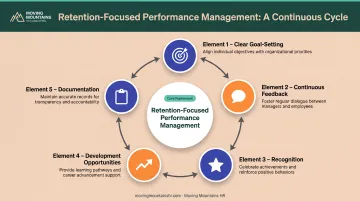
The 5 Core Elements of Retention-Focused Performance Management
These five building blocks work together as a system. Small businesses can start with one or two elements and build over time, but the greatest retention impact comes from integrating all five into your regular management rhythm.
Element 1: Clear, Collaborative Goal-Setting
Goals must be specific, measurable, and co-created with employees, not dictated from above. Gallup's research shows that employees whose managers involve them in goal-setting are 3.6 times more likely to be engaged. Participation creates ownership and commitment.
How to implement collaborative goal-setting:
- Link individual goals directly to team and company objectives so employees see their "line of sight" to organizational success
- Use SMART criteria (Specific, Measurable, Achievable, Relevant, Time-bound) to ensure clarity
- Schedule quarterly goal-setting conversations where employees propose their own objectives aligned with business priorities
- Document agreed-upon goals and revisit them monthly to track progress and adjust as conditions change
When employees understand how their daily work contributes to the bigger picture, they feel their work matters—a critical driver of engagement and retention.
Element 2: Continuous Feedback and Coaching
The shift from annual reviews to ongoing conversations represents one of the most important changes in modern performance management. Gallup found that employees receiving daily feedback rather than annual feedback were 3.6 times more likely to strongly agree they were motivated to do outstanding work.
Characteristics of effective feedback:
- Timely: Delivered within days of the observed behavior, not months later
- Specific: References concrete actions and outcomes, not vague impressions
- Behavior-focused: Addresses what someone did, not who they are
- Balanced: Acknowledges strengths while identifying growth areas
- Supportive: Always paired with resources, coaching, or development opportunities
Weekly or bi-weekly check-ins, even brief 15-minute conversations, create space for course correction, recognition, and support. These informal touchpoints prevent the "blindsided" experience that drives turnover.
Element 3: Recognition That Reinforces Desired Behaviors
Gallup's data shows that 80% of employees who received meaningful feedback in the previous week were fully engaged. Recognition is one of the most powerful forms of that feedback. To drive engagement and retention, it must be frequent, specific, and authentic.
Recognition best practices:
- Make it immediate: Acknowledge contributions within days, not at year-end reviews
- Be specific: "Your detailed analysis in yesterday's client presentation directly addressed their concerns about ROI" beats "Great job on the presentation"
- Balance formal and informal methods: Employee-of-the-month programs have their place, but spontaneous thank-you notes, public praise in team meetings, and Slack shout-outs often carry more emotional weight
- Connect recognition to values: Explicitly tie acknowledgment to company values or strategic priorities to reinforce desired behaviors
Non-monetary recognition (sincere appreciation, visibility to senior leaders, opportunities to present work) often motivates employees more powerfully than bonuses, especially when delivered consistently.
Element 4: Tailored Development and Growth Opportunities
Pew Research found that lack of advancement opportunities and low pay were among the top reasons people left their jobs. Performance management must explicitly connect current performance to future career paths, or you'll lose ambitious employees to organizations that do.
How to create meaningful development plans:
- Conduct annual career-development conversations separate from performance reviews to explore long-term goals without the pressure of evaluation
- Identify skill gaps between current capabilities and next-level roles, then create targeted development plans
- Offer stretch projects that build new competencies while delivering business value
- Provide access to training, mentorship, job shadowing, or cross-functional assignments
- Document clear paths to promotion or expanded responsibility, including specific milestones and timelines
Development doesn't always mean promotion. For small businesses with limited hierarchy, lateral moves, skill diversification, and increased autonomy can satisfy growth needs.

Element 5: Documentation That Protects and Informs
Documentation serves dual purposes: it creates fairness and consistency in evaluations while protecting the organization legally if termination becomes necessary.
What to document:
- Goal agreements and quarterly updates on progress
- Feedback conversations, both positive and constructive, with dates and specific examples
- Performance improvement plans, including agreed-upon actions, support provided, and deadlines
- Employee responses to coaching and whether performance improved
California employers should note that the California Civil Rights Department generally requires covered entities to retain relevant personnel or employment records for four years. For terminated employees, federal EEOC guidance requires one year of retention from the termination date, though California's longer period applies when relevant.
Proper documentation doesn't guarantee you'll win every legal dispute, but it demonstrates that your decisions were based on legitimate, job-related reasons rather than discrimination or retaliation.
Building a Supportive Performance Management Ecosystem
Individual managers can't execute performance management effectively without organizational support. The ecosystem of leadership commitment, training, data collection, and sometimes external expertise enables consistent execution.
Leadership Commitment Is Non-Negotiable
Senior leaders must visibly champion the process, model it with their own direct reports, and hold managers accountable for quality execution. This means:
- Reviewing performance-management data (conversation frequency, goal completion, development-plan progress) in leadership meetings
- Allocating time in managers' workloads for preparation, conversations, and documentation
- Recognizing and rewarding managers who execute performance management well
- Addressing managers who consistently skip or rush through the process
When leadership treats performance management as optional, the entire system collapses.
Invest in Manager Training
All people managers need ongoing training in giving feedback, conducting difficult conversations, setting SMART goals, and recognizing bias. Consider group coaching formats where managers practice conversations, discuss challenges, and learn from each other's experiences.
Training topics should include:
- How to deliver constructive feedback without triggering defensiveness
- Recognizing and interrupting unconscious bias in evaluations
- Documenting conversations and decisions appropriately
- Linking individual goals to business objectives
- Conducting career-development conversations
For small businesses without dedicated HR staff, fractional CHRO services or HR consultants (such as Moving Mountains HR's performance management consulting) provide structure, templates, manager training, and governance without a full-time HR hire.
Gather Multi-Source Performance Data
Collect input from project managers, peers, and internal customers, not just the direct supervisor. This provides a more objective view of contributions and reduces single-source bias.
Multi-source feedback is especially valuable in small businesses, where people collaborate across functions and reporting lines rarely capture the full scope of someone's impact.
Measure Manager Effectiveness
Use pulse surveys to evaluate whether employees feel they receive clear expectations, regular feedback, fair treatment, and development support from their managers. This data identifies which managers need coaching and which practices are working. Track metrics such as:
- Clear performance expectations reported by employees
- Meaningful feedback received in the past month
- Career-development support from managers
- Voluntary turnover rates by manager
Poor scores for a particular manager signal a coaching need; poor scores across the organization signal a systemic problem.
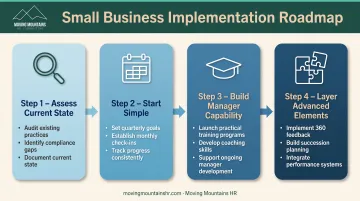
Getting Started: Implementation Roadmap for Small Businesses
Step 1: Assess Your Current State
Begin with an HR audit that identifies gaps in goal-setting practices, feedback frequency, documentation quality, and manager capabilities. Many HR consultancies offer compliance audits that include performance management assessment.
Moving Mountains HR's HR Document Audit, for example, reviews existing policies, procedures, and employee-facing documents—including evaluations—and delivers an HR Compliance Review Report with specific recommendations.
Your audit should answer:
- How often do managers currently meet one-on-one with direct reports?
- Are goals documented, or do they exist only in managers' heads?
- Do employees understand how their work connects to business objectives?
- Is feedback timely and specific, or vague and delayed?
- Are performance conversations documented consistently?
Step 2: Start Simple with Quarterly Goals and Monthly Check-Ins
Don't attempt a complex system overnight. Start with quarterly goal-setting conversations using a basic template that prompts managers to discuss:
- Progress toward current goals
- Obstacles preventing success
- Support or resources needed
- Recognition of recent contributions
Monthly check-ins should be brief—15 to 30 minutes—and focus on maintaining momentum, addressing roadblocks, and providing real-time feedback. Document key points from each conversation in a shared file accessible to both manager and employee.
Step 3: Build Manager Capability Through Practical Training
Prioritize skill-building over complex technology early on. Effective performance management depends more on manager competence than on software features. Focus training on:
- Conversation frameworks (how to structure a performance discussion)
- Feedback language (specific phrases and examples)
- Documentation practices (what to record and how)
- Handling difficult conversations (addressing underperformance or interpersonal conflict)
Role-playing exercises, peer feedback, and real-world scenario practice build confidence faster than lecture-style training.
Small businesses without internal HR expertise can bring in outside help for this work. Moving Mountains HR offers Training & Development Programs covering performance management, supervisor development, and documentation, delivered virtually or in person.
As your managers gain proficiency, layer in more sophisticated elements: 360-degree feedback, competency models, succession planning, or integrated performance and compensation reviews.
Frequently Asked Questions
What are the three R's of employee retention?
The three R's are Respect, Recognition, and Rewards. Respect means fair treatment; recognition means acknowledging good work often; rewards cover pay, benefits, and growth. All three tie directly into how you manage performance.
How often should performance reviews be conducted?
Formal reviews should happen at least quarterly, with informal check-ins weekly or bi-weekly. Gallup research shows employees who got meaningful feedback in the prior week were 80% more likely to be fully engaged than those limited to annual-only reviews.
What's the ROI of implementing a performance management system?
ROI comes mainly from lower turnover. Gallup estimates replacement costs at one-half to two times annual salary, so preventing one departure in a 20-person company can save $30,000 to $120,000. Clear goals and timely feedback also raise productivity and cut legal risk from weak documentation.
Can small businesses without HR departments implement effective performance management?
Yes. Start with quarterly goal-setting and monthly check-ins using shared documents and simple templates. When you need more structure, fractional HR support from Moving Mountains HR (passive, active, or premium packages) adds expertise without full-time overhead.
What are the most common performance management mistakes that drive employees away?
Common mistakes include annual-only reviews, goals set without employee input, focusing only on weaknesses, vague feedback, and skipping career conversations. Each signals that growth and contributions don't matter.
How do you measure if your performance management system is actually improving retention?
Track regrettable turnover, engagement scores on feedback and development items, internal promotion rate, new-hire time-to-productivity, and conversation coverage (share of employees getting documented discussions on schedule). Gains in these metrics show the system is working.