Introduction: The Foundation of Effective Leadership
A title or promotion does not automatically create leadership effectiveness. Many businesses learn this the hard way when a strong individual contributor struggles as a manager, or when a new executive fails to gain team buy-in despite an impressive résumé.
Effective leadership comes from deliberately building the qualities that drive steady performance in different situations. Those qualities, or leadership capabilities, are the foundation of lasting success—especially in small to mid-size businesses, where every leadership decision has immediate, visible impact.
According to Gallup's 2023 survey of 717 voluntary leavers, 42% said their manager or organization could have prevented their departure. Even more striking: 45% had no proactive discussion with a manager or leader in the three months before leaving. Leadership capability gaps hurt more than day-to-day performance; they drive turnover, weaken engagement, and slow organizational growth.
This guide breaks down 10 core leadership capabilities small and mid-size business leaders can develop to lead with more consistency, retain talent, and build stronger teams.
Key Takeaways
- Leadership capabilities are the qualities that make skilled leadership consistent—not one-off behaviors
- Ten core capabilities matter most: strategy, emotional intelligence, communication, adaptability, decision-making, people development, accountability, influence, resilience, and integrity
- Small businesses feel leadership gaps faster because of fewer management layers and tighter resources
- Capability growth needs experience, feedback, coaching, and practice—not one-time training
- Strong capabilities cut turnover costs (often 50–200% of salary), improve compliance, and strengthen culture
What Are Leadership Capabilities?
Leadership capabilities are the underlying capacities, qualities, and characteristics that enable leaders to perform leadership skills consistently and effectively over time. The U.S. Office of Personnel Management defines a competency as "a measurable pattern of knowledge, skills, abilities, behaviors, and other characteristics" needed for successful work. That same composite view applies to leadership capability.
The difference between skills and capabilities matters:
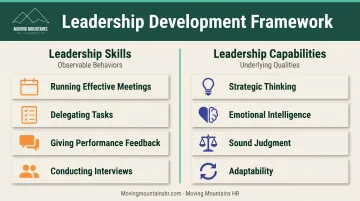
- Leadership skills are specific, observable behaviors: running effective meetings, delegating tasks, giving performance feedback
- Leadership capabilities are the underlying qualities that make those behaviors consistent across situations: strategic thinking, emotional intelligence, sound judgment
Two managers attend the same training on giving feedback. One returns and applies the techniques consistently, adapting for each employee and context. The other avoids hard conversations or delivers feedback inconsistently. Same knowledge; different capability.
Capabilities are harder to develop than skills because they often require changing mindsets, beliefs, and assumptions. Research by Kegan and Lahey on competing commitments shows that resistance to change often reflects hidden fears and protective commitments, not a lack of knowledge.
A leader may know how to delegate and still struggle because of beliefs about control, trust, or their own value to the organization.
The 10 Essential Leadership Capabilities
Strategic Thinking
Strategic thinking is the ability to see the big picture, understand how different parts of the organization connect, and make decisions aligned with long-term goals. A 2013 study of high-growth leaders identified seven components: conceptual, visionary, analytical, synthesizing, objective, creative, and learning abilities.
This capability helps leaders:
- Prioritize competing demands based on organizational impact
- Allocate limited resources wisely
- Navigate short-term pressures without losing sight of long-term direction
- Connect daily decisions to broader business objectives
Example: A small manufacturing business owner faces a decision: invest $50,000 in new equipment or hire two additional production staff. Strategic thinking enables the leader to analyze three-year growth projections, assess capacity constraints, evaluate competitive positioning, and determine which investment better supports the company's goal of expanding into new markets.
Emotional Intelligence
Emotional intelligence (EI) is the capacity to recognize, understand, and manage your own emotions and those of others. Harvard Business School identifies four core components: self-awareness, self-management, social awareness, and relationship management. The original Goleman model included five: self-awareness, self-regulation, motivation, empathy, and social skills.
Leaders with strong emotional intelligence:
- Build trust through authentic, empathetic interactions
- Navigate conflict without becoming defensive or reactive
- Create psychologically safe environments where people speak up
- Recognize when their own stress or frustration affects their behavior
A 2020 study of 393 U.S. employees found that supervisors' meaning-making, empathetic, and direction-giving communication each positively predicted employee trust.
Emotional intelligence helps leaders use those styles well: read the room, then adjust based on what people need.
Communication
Communication capability means articulating vision and expectations, delivering difficult messages, listening actively, and adapting messaging to different audiences. In small businesses where formal communication structures are often minimal, this skill matters even more.
Effective communication:
- Reduces misunderstandings and rework
- Improves alignment across teams
- Strengthens relationships through genuine listening
- Creates clarity during uncertainty
Small business environments rely heavily on informal communication, which can accelerate initiatives or derail them.
A leader who explains why a policy change matters, hears concerns without defensiveness, and adjusts based on feedback gets far better follow-through than one who announces changes and expects compliance.
Adaptability and Agility
Adaptability is the capacity to adjust approaches, strategies, and behaviors in response to changing circumstances, new information, or unexpected challenges. Validation research covering more than 3,300 respondents identified adaptive performance as an eight-dimension construct spanning multiple job contexts.
This capability is especially critical now:
- Rapid technological change reshapes how work gets done
- Employment laws evolve frequently, particularly in states like California
- Workforce expectations shift as generational demographics change
- Economic uncertainty requires quick strategic pivots
Leaders who model adaptability create organizational resilience.
When a leader responds to setbacks by exploring alternatives rather than assigning blame, teams learn to do the same. When leaders update their own thinking based on new information, they show that learning beats rigid adherence to the original plan.
Decision-Making and Judgment
Sound decision-making combines the ability to analyze information, weigh alternatives, consider implications, and reach conclusions—often with incomplete data. Research shows that data-driven firms had output and productivity 5-6% above what other investments predicted, supporting the value of analytical rigor.
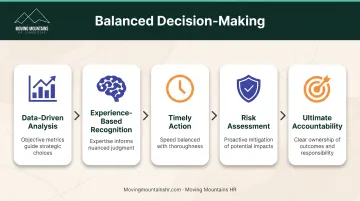
Yet analysis alone isn't sufficient. A 2024 study of 27 senior executives found intuition effective when grounded in domain experience and checked against evidence. The best decision-makers balance:
- Data-driven analysis with experience-based pattern recognition
- Thorough consideration with timely action
- Consultation with ultimate accountability
- Risk assessment with calculated courage
Leaders also need the courage to make difficult or unpopular decisions when necessary: closing an underperforming product line, addressing a valued employee's performance issues, or pivoting strategy despite earlier commitments.
People Development
People development is the capacity to recognize potential in others, provide growth opportunities, give meaningful feedback, and coach team members to higher performance. This capability directly impacts succession planning, employee engagement, and organizational capability building.
Gallup reports that employees involved by managers in goal setting were nearly four times as likely to be engaged, yet only 30% experienced it. This gap represents enormous untapped potential.
Research consistently shows employees are more likely to stay when organizations invest in their development. When leaders treat development as ongoing work (coaching, stretch assignments, and regular feedback, not only annual reviews), talented people stay and grow.
For small businesses, people development also builds capacity when you cannot hire senior talent for every role.
Accountability
Accountability is the capability to take ownership of decisions, outcomes, and responsibilities while holding others to agreed-upon standards. Research on 65 teams found that initial accountability correlated with trust (r=.67), commitment (.45), and efficacy (.55), and predicted later effort and team viability.
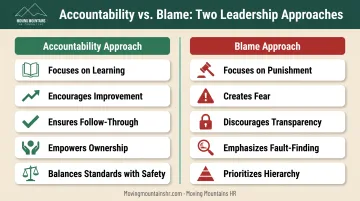
True accountability differs from blame:
- Accountability focuses on learning, improvement, and follow-through
- Blame focuses on punishment and fault-finding
Leaders with strong accountability capability:
- Own their mistakes and share what they learned
- Follow through on commitments consistently
- Address performance issues directly rather than hoping they resolve themselves
- Create environments where team members feel empowered to own their work
- Balance high standards with psychological safety
The challenge is holding people accountable without creating fear.
That means clear expectations, regular progress check-ins, support when obstacles show up, and direct conversations when standards slip. Deliver all of it in service of shared goals, not hierarchy.
Influence and Persuasion
Influence is the capacity to gain buy-in, build coalitions, and motivate action without relying solely on positional authority. A 2017 meta-analysis of 8,987 people found that rational persuasion was the only influence tactic with stable positive relationships to both task and relationship outcomes across contexts, while pressure related negatively to results.
This capability works through:
- Building credibility over time through consistent, reliable behavior
- Understanding what matters to different stakeholders
- Framing ideas in ways that connect to others' priorities and values
- Demonstrating how proposals address real problems
In small businesses, leaders often need to influence without formal authority. A project lead may coordinate across departments with no direct reports. A technical expert may push for process changes. Owners may need skeptical teams to try a new approach.
In those moments, influence skill matters more than title.
Resilience
Resilience is the capability to recover from setbacks, manage stress effectively, maintain perspective during challenges, and sustain energy over time. A 2025 meta-analysis covering 432,458 people found resilience components generally related positively to performance, job attitudes, psychological well-being, and physical health.
Leader resilience sets the tone for the whole organization. When a leader meets a lost contract with problem-solving instead of panic or blame, the team learns how to handle adversity. When a leader names stress and still focuses on solutions, they model a sustainable response to pressure.
Burnout prevention matters here. Leaders who push through exhaustion, skip time off, or answer every midnight email teach the wrong norms, and performance and retention suffer for it.
Resilient leaders know their limits, manage energy on purpose, and build sustainable rhythms for themselves and their teams.
Integrity and Ethics
Integrity is the capability to consistently act according to values, maintain ethical standards, and build trust through reliable, honest behavior. Research on ethical leadership found it predicted leader effectiveness, job satisfaction, dedication, and willingness to report problems.
Integrity creates the foundation for all other leadership capabilities. Without trust, influence disappears. Without consistency between words and actions, accountability becomes hollow. Without ethical behavior, even the most strategic thinking serves the wrong ends.
Leaders with strong integrity tend to build cultures where compliance and ethical behavior are the norm. Cut corners, ignore concerning behavior, or apply rules unevenly, and people learn that stated values are optional.
Address concerns directly, admit mistakes, and hold yourself to the same standards you set for others, and people do the right thing even when no one is watching.
Why Leadership Capabilities Matter for Small Business
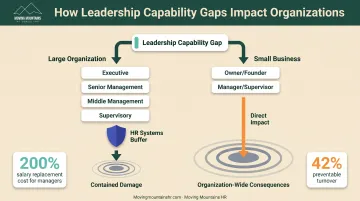
Small businesses operate with fewer management layers than large organizations. Leadership capability gaps hit harder and show up faster.
When a department head at a Fortune 500 company struggles with feedback conversations, HR systems and multiple reporting layers may contain the damage. When the owner of a 25-person company avoids difficult conversations, problems fester, good employees leave, and workplace culture deteriorates quickly.
The business case is clear:
Gallup's turnover research estimates replacement costs near 200% of salary for leaders and managers, 80% for technical professionals, and 40% for frontline employees. For a small business losing a $75,000 manager, that can mean $150,000 in recruiting, hiring, onboarding, lost productivity, and team disruption.
Strong leadership capabilities cut these costs by improving retention.
Among the 42% of employees who said their departure was preventable, 70% pointed to daily management actions: better manager interactions (21%), organizational problems (13%), advancement opportunities (11%), and staffing or workload issues (9%). Those exits trace back to specific gaps in communication, people development, strategic thinking, and decision-making.
The compliance angle matters too. Leaders with strong capabilities are better equipped to:
- Navigate complex employment law requirements
- Handle sensitive employee situations appropriately
- Recognize and address harassment or discrimination concerns early
- Create cultures where people report problems rather than hiding them
- Document performance issues properly
- Make defensible employment decisions
For California businesses navigating one of the most complex employment-law environments in the country, leadership capability directly affects legal risk.
How to Develop Leadership Capabilities in Your Organization
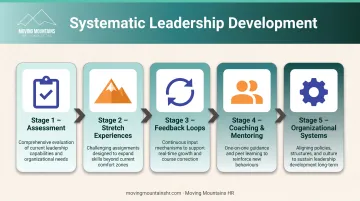
Leadership capabilities grow through experience, feedback, reflection, and sustained practice—not training alone. Build them systematically with the steps below.
Start with assessment. Gauge current capability levels before you design any program:
- 360-degree feedback from managers, peers, and direct reports
- Structured self-assessment against competency frameworks
- Performance data analysis identifying patterns of strength and struggle
- Conversations with leaders about their development goals
Create stretch experiences. Challenging assignments outside a leader's comfort zone drive the fastest growth:
- Lead a cross-functional project involving stakeholders from different departments
- Take ownership of a struggling initiative and turn it around
- Present strategy recommendations to senior leadership
- Manage a difficult employee-relations situation with coaching support
- Participate in strategic planning or organizational redesign
SHRM identifies job rotation, stretch assignments, cross-functional exposure, and on-the-job challenges as key capability-building experiences.
Establish feedback loops. A meta-analysis of 24 multisource-feedback studies found only small gains from feedback by itself. Paired with coaching and clear development actions, though, regular multi-source feedback still accelerates growth. It helps leaders:
- Identify blind spots in their self-perception
- Recognize patterns they might not see in isolated incidents
- Understand how their behavior affects different people
- Track progress on development goals over time
Provide coaching and mentoring. One-on-one coaching gives leaders space to reflect, gain perspective, and turn lessons into new behavior. A 2016 meta-analysis found workplace coaching had a moderate positive effect (δ=.36) on attitudes, skills, and business results.
Coaching works because it:
- Creates space for reflection that doesn't happen in day-to-day work
- Provides outside perspective without organizational politics
- Helps leaders connect current challenges to development goals
- Offers accountability for behavior change
Build organizational systems. Development shouldn't rest on individual initiative alone. Bake it into how the organization runs:
- Performance management processes that include development discussions
- Leadership competency frameworks that clarify expectations
- Succession planning that identifies and prepares future leaders
- Regular development check-ins, not just annual reviews
- Budget and time allocated for leadership development
Consider fractional HR support. If you lack internal HR capacity to run assessments, coaching structures, or competency frameworks, a fractional HR partner can design and run the program with you. That route suits small and mid-size businesses that want senior HR guidance—including leadership development and training—without hiring a full-time executive. Firms like Moving Mountains HR offer fractional CHRO and training support built for that gap.
Common Leadership Capability Gaps and How to Address Them
Certain capability gaps derail leaders repeatedly. DDI's 2025 research covering 10,796 leaders found 83% of HR leaders reported growing demand for new leadership skills, while Gallup identifies creating accountability as leaders' lowest-rated capability.
The most common gaps include:
Avoiding hard feedback: Many leaders skip performance conversations and hope problems resolve themselves. Fear of conflict, a desire to be liked, or simple lack of practice usually sits underneath.
Close the gap with:
- Feedback training paired with role-play
- Scripts prepared before tough conversations
- Coaching support on the first few real discussions
Avoiding conflict: Leaders who smooth over disagreements create environments where problems simmer. Many learned that conflict is destructive, or believe "good" teams don't disagree.
Build the muscle through conflict-resolution practice, reframing disagreement as normal and useful, and structured forums for productive debate.
Lack of strategic perspective: Leaders promoted for technical excellence often struggle to move from tactical execution to strategic thinking.
Give them exposure to enterprise-wide challenges, a seat in strategic planning, mentoring from senior leaders, and deliberate practice asking, "How does this connect to our three-year goals?"
Failure to delegate: Holding onto work instead of developing others usually traces to beliefs about speed ("it's faster if I do it"), quality ("no one else will do it right"), or worth ("my value comes from being indispensable").
Counter those beliefs by:
- Calculating the long-term cost of not delegating
- Matching tasks to team development goals
- Coaching leaders to release perfectionism
Inconsistent accountability: Research shows 47% of employees get manager feedback only a few times a year or less. When leaders set expectations but never follow up, commitments stop mattering.
Discomfort with confrontation and unclear standards often drive the pattern. Reset it with clearer goals, regular check-ins, and simple scripts for accountability conversations.
Most capability gaps come from mindsets, fears, or lack of practice—not missing knowledge. Skill training alone rarely sticks.
Pair learning with coaching, create safe practice reps, recognize progress, and tie development to business outcomes leaders already care about.
Frequently Asked Questions
What are leadership capabilities?
Leadership capabilities are underlying qualities, such as strategic thinking, emotional intelligence, and sound judgment, that enable leaders to apply skills consistently across situations—not just as isolated behaviors or technical knowledge.
What are examples of leadership capabilities?
Core examples include strategic thinking, emotional intelligence, adaptability, decision-making, and people development. Together they help leaders align decisions with long-term goals, manage emotions, adjust to change, decide with incomplete information, and coach others to higher performance.
What are the 7 leadership competencies?
Frameworks vary on the exact number. This article covers 10 essential capabilities: strategic thinking, emotional intelligence, communication, adaptability, decision-making, people development, accountability, influence, resilience, and integrity.
How can small business owners develop leadership capabilities?
Start with honest self-assessment and regular feedback from your team, peers, and mentors. Add stretch assignments, coaching, and leadership development or HR support tailored to small business contexts.
What's the difference between leadership skills and leadership capabilities?
Skills are specific, observable behaviors such as running meetings, delegating, or giving performance reviews. Capabilities are underlying qualities (emotional intelligence, judgment, strategic thinking) that enable those skills consistently. You can teach a skill in a workshop; a capability needs sustained practice and feedback.
How do leadership capabilities impact employee retention?
Employees stay with leaders who develop them, give clear direction, and act with integrity. Gallup found 42% of voluntary turnover was preventable, and 70% of those exits tied to daily management actions. Strong communication, people development, and integrity create workplaces people want to stay in.
Ready to strengthen leadership capabilities across your organization? Moving Mountains HR provides customized leadership development programs, strategic HR guidance, and fractional CHRO support tailored to small and mid-size businesses. Our approach combines practical skill-building with coaching and organizational systems that make development sustainable. Contact us for a consultation to discuss your leadership development needs.