For business owners, this creates a confusing gray area. Hire the wrong consultant, and you could end up with an outdated plan built around rules that no longer apply, or worse, a false sense of security while real state obligations go unmet. Hire the right one, and you get a defensible, fair hiring process that protects your business and your people.
This guide covers what affirmative action consulting actually involves today, the factors that separate a qualified consultant from a risky one, red flags to avoid, and how Moving Mountains HR supports small and mid-size businesses through this process.
Key Takeaways
- Affirmative action consulting now spans equity audits, policy reviews, and compliance monitoring—not only federal contractor plans
- EO 14173 revoked EO 11246 in January 2025, but Section 503, VEVRAA, and California pay data rules still apply
- The best consultant fit depends on industry expertise, regulatory fluency, and transparent pricing, not brand name recognition
- Vague credentials, hidden fees, and generic templates signal a consultant to avoid
- For small to mid-size employers, prioritize tailored executive-level guidance—especially partners with healthcare-specific insight like Moving Mountains HR
What Is Affirmative Action Consulting?
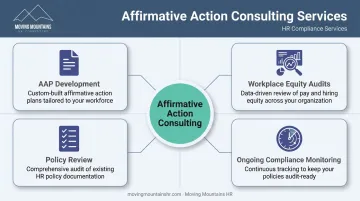
Affirmative action consulting is guidance and services that help organizations build, audit, and maintain programs promoting equal employment opportunity, including formal Affirmative Action Plans (AAPs) where legally required.
Typical services include:
- AAP development for federal contractors and subcontractors
- Workplace equity audits comparing hiring, pay, and promotion data against benchmarks
- Policy review to catch outdated or noncompliant language in handbooks and hiring procedures
- Ongoing compliance monitoring as regulations shift
Not every business needs every service. A consultant's real job is helping you figure out which pieces actually apply to your organization.
Who Actually Needs This Kind of Support Today
The rules changed significantly in 2025. Executive Order 14173, signed January 21, 2025, revoked EO 11246, the order that had required federal contractors with 50 or more employees and contracts of $50,000 or more to maintain race- and sex-based AAPs.
OFCCP stopped enforcing those requirements after a 90-day wind-down period that ended in April 2025.
That doesn't mean affirmative action obligations disappeared entirely. Contractors covered under Section 503 (disability) and VEVRAA (protected veterans) must still maintain separate written AAPs if they meet those specific thresholds.
OFCCP remains operational, just with a narrower scope than before.
Beyond federal contractors, many businesses still benefit from this guidance:
- Healthcare organizations face layered compliance requirements that make structured hiring and promotion tracking valuable regardless of contractor status
- California employers with 100+ employees must file separate pay data reports under state law, independent of any federal AAP rules
- Any employer building structured hiring and promotion practices can close representation gaps and reduce discrimination-claim exposure, even without a legal mandate
Where a formal AAP isn't required, proactive equity practices still strengthen retention and lower litigation risk—especially for California and healthcare employers navigating layered state and industry rules.
What to Consider When Choosing the Best Affirmative Action Consultant
Selecting a consultant isn't a one-size-fits-all decision. Your company's size, industry, contractor status, and internal HR bandwidth all shape what "the right fit" looks like. The factors below connect a consultant's capabilities to measurable compliance and workforce outcomes.
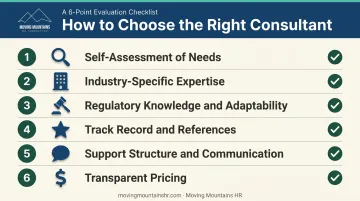
Conduct a Self-Assessment of Your Needs
Before contacting anyone, take stock of your current obligations, internal HR capacity, and existing data systems. That inventory shows whether outsourcing will improve compliance or simply add cost.
Your assessment should shape the scope you request:
- Full AAP development if you are a covered contractor
- Periodic audits when you lack a formal mandate but want risk checks
- Fractional HR support for ongoing questions and policy upkeep
Industry-Specific Expertise
A consultant who understands your industry's regulatory nuances produces more accurate, defensible plans. Healthcare, for example, involves layered compliance requirements a generalist consultant may miss entirely.
Industry fit also affects:
- Audit readiness when a real review begins
- Relevance of benchmarking data in your reports
- Speed at flagging industry-specific risks
Regulatory Knowledge and Adaptability
Affirmative action and equity regulations are changing quickly at both the federal and state level. A consultant needs to track new executive orders, OFCCP guidance, and state-specific rules as they happen, not after the fact.
This directly affects audit outcomes and how fast your company can adjust policies when the law shifts. Ask candidates how they monitor regulatory change and how recently they've updated their own materials.
Track Record, Reputation, and References
Check client references and ask about the consultant's history with organizations similar in size to yours. Ask what went wrong in past engagements and how they fixed it—theory-heavy consultants rarely have clear answers.
Prior work with peers in your size range is the best signal your plan will hold up under OFCCP or state review.
Support Structure and Communication Style
Responsiveness, a dedicated point of contact, and a collaborative data-gathering process determine how smoothly the engagement runs. Slow turnaround or unclear communication early on is often a preview of what's ahead.
Poor communication delays deliverables and leaves gaps in the data your plan depends on.
Transparent, Flexible Pricing
Understand the full pricing structure before signing anything: flat fee, tiered packages, or add-ons billed separately. Surprise costs mid-engagement are a common complaint among businesses that skipped this step.
Flexible service tiers matter too. As your business grows, you should be able to scale support up or down without renegotiating from scratch.
Red Flags to Watch for When Selecting a Consultant
Some warning signs show up before you even sign a contract. Watch for these patterns during initial conversations:
- Guaranteed outcomes: No legitimate consultant can promise a clean audit result. Compliance depends on your actual data and practices, not a sales pitch.
- Generic templates only: If a consultant skips a real self-assessment and jumps straight to a boilerplate plan, the result won't reflect your workforce or risks.
- Vague pricing answers: Hesitation around costs, unclear add-on fees, or reluctance to put pricing in writing usually means budget surprises later.
- Reluctance to share references: An established consultant should have past clients willing to speak about their experience.
- Outdated regulatory knowledge: Can't explain current OFCCP posture or your state's rules—especially changes since January 2025—means they aren't equipped to protect you.
Ask what changed in federal affirmative action enforcement over the past year. If the answer is vague, scripted, or stuck in pre-2025 rules, pause before you sign.
How a consultant handles tough questions in the sales process is usually how they'll handle your account once you're paying.
How Moving Mountains HR Can Help
Moving Mountains HR is an executive-level HR consulting partner built for small to mid-size businesses that need practical, compliant affirmative action and equity guidance, without the cost of hiring a full-time HR executive.
Founder and CEO Michelle Schwanhauser brings deep HR expertise from the healthcare industry, one of the more heavily regulated sectors in the country. That background helps when compliance requirements overlap with staffing, credentialing, or patient-facing workforce rules.
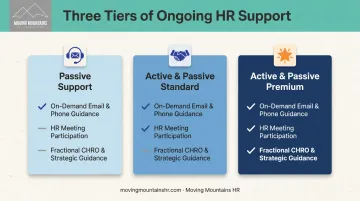
Flexible support tiers. Rather than a single package, Moving Mountains HR structures ongoing support across three levels:
- Passive Support: on-demand guidance by email or phone, bundled with a compliance package
- Active & Passive Support (Standard): adds direct participation in your internal HR meetings
- Active & Passive Support (Premium): includes fractional CHRO services and high-level strategic guidance on staffing, retention, compensation, and benefits
This tiered structure lets businesses choose the level of support that matches their current compliance needs and budget, then scale up as those needs grow.
For businesses just starting to assess their standing, Moving Mountains HR offers a complimentary California HR Compliance Checklist, a practical first step for identifying gaps before committing to a larger engagement.
Beyond affirmative action and equity guidance, the firm also provides:
- Neutral third-party investigations for harassment, discrimination, retaliation, and code-of-conduct concerns
- Fractional CHRO services when you need senior HR leadership without a full-time hire
Moving Mountains HR's services are not designed for HIPAA-, FISMA-, or GLBA-regulated compliance needs. For general employment law compliance and equity guidance, the flexible tiers and executive experience give small and mid-size businesses a clear path from gap assessment to ongoing support.
Conclusion
The right hire isn't the biggest name in affirmative action consulting. It's a consultant whose expertise, communication style, and pricing fit your company's size, industry, and actual compliance obligations.
Federal and state rules have already shifted since early 2025, and more changes may follow. This isn't a decision to make once and forget. Review your plan and your consultant relationship periodically—not only when a new regulation hits the news.
If you're evaluating your current compliance standing or trying to figure out which requirements still apply to your business, reach out to Moving Mountains HR for a consultation. A short conversation can clarify where you stand and what needs to change next.
Frequently Asked Questions
What is an example of affirmative action?
Targeted outreach recruiting, such as partnering with vocational rehabilitation agencies to reach qualified candidates with disabilities, is a common example. Structured promotion tracking that flags representation gaps is another. Neither involves quotas, which are prohibited.
How do employers deal with affirmative action in the workplace?
Employers document policies clearly, apply hiring and promotion practices consistently, and run periodic self-audits to catch disparities early. Written policy plus regular data review is what makes a program defensible.
What is an affirmative action plan in the workplace?
An affirmative action plan (AAP) is a written document outlining a federal contractor's efforts and goals for equal employment opportunity. Historically updated annually, it includes workforce analysis, benchmarking against labor availability, and placement goals.
Do all businesses need a formal affirmative action plan?
No. Formal AAPs are legally required only for federal contractors and subcontractors meeting specific employee and contract-value thresholds under Section 503 and VEVRAA. Other businesses may benefit from similar practices voluntarily.
How has the federal rollback affected affirmative action requirements?
Executive Order 14173 revoked EO 11246 in January 2025, ending the federal race- and sex-based AAP mandate. Section 503 and VEVRAA obligations remain active, and state rules like California's pay data reporting still apply independently.
How much does an affirmative action consultant typically cost?
Pricing varies by service tier, company size, and scope of work, so there's no universal rate. Request a transparent, itemized proposal before signing anything, and confirm what's included versus billed separately.