Introduction
When the NBA released its findings on Phoenix Suns owner Robert Sarver in 2022, the world watched a workplace investigation play out in headlines. High-profile cases like that one, and similar situations across professional sports leagues, put a spotlight on a question every employer eventually faces: was this investigation actually fair?
Most business owners never deal with national media attention. But the same standard applies whether you run a five-person dental office or a 500-person logistics company. Many small and mid-size employers still struggle with a basic question: who should investigate a complaint, and how do you keep that process legally defensible?
This post breaks down what impartiality really means, why it carries legal weight, the red flags that signal a biased process, and the practical steps that keep your investigation neutral.
Key Takeaways
- Impartiality means the investigator has no stake in the outcome and weighs facts, not loyalties.
- A biased or poorly documented investigation can undermine your defense in a harassment or discrimination claim.
- Watch for red flags: one-sided witness lists, no interview of the accused, or personal ties to either party.
- A neutral third-party investigator is often the safest way to protect fairness and the appearance of fairness.
What Does "Impartiality" Mean in a Workplace Investigation?
Impartiality doesn't mean the investigator walks in with a blank slate and zero opinions about anything. It means they set those opinions aside and let the evidence do the talking.
According to the Association of Workplace Investigators' Guiding Principles, an investigator should be impartial in fact and perceived as impartial by everyone involved. Both halves matter. An investigator who's genuinely fair but looks compromised, say, because they report to the accused, still creates a problem.
Investigators Aren't Judges of Company Risk
A common misconception: impartial investigators are somehow neutral robots. They're not. Like a judge or arbitrator, a trained investigator can hold personal views and still reach conclusions based purely on a preponderance of the evidence.
Their job stops at fact-finding. It doesn't extend to:
- Offering legal advice
- Predicting litigation risk
- Recommending discipline (in most models)
Being paid by the employer doesn't automatically taint the process, either. What matters is whether the investigator has a personal or professional interest in a particular outcome.
Federal Guidance Sets the Floor
The EEOC has long required employers to respond to harassment complaints with a prompt, thorough, and impartial investigation. Its 2024 enforcement guidance reinforces that standard.
An "adequate" investigation must be thorough enough to reach a reasonably fair estimate of the truth, and led by someone without a stake in the result. That applies whether your investigator is an internal HR manager or an outside consultant.
Why Impartiality Is Critical: The Legal and Business Stakes
Impartiality isn't a nice-to-have. In California, it's part of the legal bar employers must clear when defending a termination or disciplinary decision.
The Cotran Standard: What Courts Actually Look For
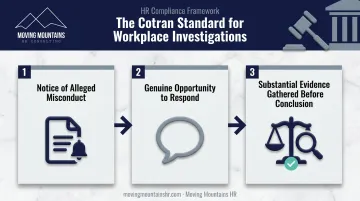
Under Cotran v. Rollins Hudig Hall, a jury doesn't decide whether the accused employee actually did what they were accused of. Instead, it asks whether the employer honestly reached its conclusion, on reasonable grounds, through an investigation that wasn't arbitrary or pretextual.
That standard requires, at minimum:
- Notice to the employee of the alleged misconduct
- A genuine opportunity for that employee to respond
- Substantial evidence gathered before any conclusion is drawn
There's no single fixed procedure. But skip these basics, and you're exposed.
When Internal Bias Creeps In
Courts have found problems where an internal investigator had a prior reporting relationship with, or personal connection to, one of the parties.
One California appellate case described an internal investigation as "a far cry" from an appropriate one after exculpatory witnesses were ignored while unrelated staff were interviewed instead. That kind of gap can, by itself, support a legal claim of pretext.
There's no clean industry-wide dollar figure for what a biased investigation costs an employer. What's well documented is the exposure it creates:
- Prolonged litigation
- Damaged credibility with a jury
- Compliance findings on top of legal ones in regulated sectors
Healthcare employers face an added regulatory layer. Joint Commission workplace-violence prevention standards, effective since January 2022, require accredited hospitals to document, investigate, and report incidents systematically. That backdrop makes a documented, impartial process essential, not optional.
Trust Produces Better Evidence
Impartiality also has a quieter, cultural payoff. When witnesses trust that an investigator is genuinely neutral, they share more complete and accurate information. When they suspect the process is rigged, they hold back. That directly affects the quality of your findings.
How to Spot an Unfair or Biased Workplace Investigation
An unfair investigation is one where the investigator has something riding on the outcome, ignores their own procedures, or lands on conclusions the evidence doesn't support.
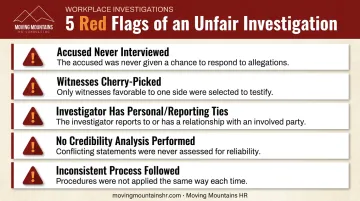
Watch for these red flags:
- The accused was never interviewed or given a real chance to respond to specific allegations
- Witnesses were cherry-picked to favor one side, while people with relevant, possibly exculpatory information were skipped
- The investigator has a personal or reporting relationship with one of the parties involved
- No credibility analysis was performed when accounts conflicted
- Inconsistent process — the employer didn't follow its own written investigation policy, or handled this case differently than past ones
Does an Employer Have to Explain the Allegations?
Best practice—and often company policy—is to tell the accused employee the allegations and give them a chance to respond. Exact requirements vary by jurisdiction and employment contract, so check your policy language. Skipping this step almost always weakens your legal position.
Beyond these core red flags, subtler signs of a flawed process include:
- Excessive surveillance of one party
- Forcing a complainant to repeat their account unnecessarily
- A report that states a conclusion without explaining how the investigator reached it
Internal vs. Third-Party Investigators: Who Can Truly Be Impartial?
Deciding who leads an investigation matters as much as how it's conducted.
The Trouble With Internal Staff
HR employees and managers often report to, or work alongside, one of the parties involved. Even with genuine effort to stay neutral, that structural relationship creates actual or perceived bias. Perception matters as much as reality here. Employees who suspect the process is rigged will trust it less, regardless of the outcome.
Why In-House Counsel Shouldn't Double as Investigator
Company attorneys generally shouldn't wear both hats. Their job is zealous advocacy for the employer, which sits in direct tension with neutral fact-finding. There's also a practical risk: an attorney who investigates may become a necessary witness later, complicating their ability to represent the company if the matter escalates.
Bringing in a Neutral Third Party
A neutral third party is often the strongest safeguard—especially for small and mid-size employers, and anytime internal relationships could cloud the process.
Outside investigators are a strong fit when:
- No dedicated HR team exists to run a formal process
- The complaint involves leadership, HR, or someone close to the investigator
- The matter carries legal, reputational, or cultural risk
- You need a clear record that will hold up if the dispute escalates
Moving Mountains HR provides neutral, third-party workplace investigations for employers who need a defensible, unbiased process without internal conflicts of interest.
Best Practices for Ensuring Impartiality in Your Investigation Process
A consistent, documented process protects you regardless of what the investigation ultimately finds.
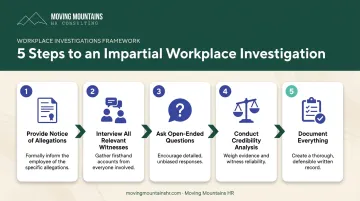
Follow these steps for every complaint, without exception:
- Provide notice of the specific allegations to the accused employee
- Interview all relevant witnesses, including the accused, not just the ones who support one narrative
- Ask open-ended, non-leading questions to get complete accounts rather than confirming assumptions
- Conduct a clear credibility analysis when accounts conflict, regardless of who the findings favor
- Document everything: the process, evidence gathered, and the reasoning behind conclusions
Training matters as much as the checklist. Investigators need to recognize their own biases and set them aside deliberately, the same discipline judges and arbitrators are trained to apply.
Before assigning an investigation internally, ask honestly: can this person remain neutral, and will employees perceive them that way? If the answer is no, bring in outside expertise.
Moving Mountains HR provides neutral third-party investigation support so business owners can protect process integrity without adding full-time headcount.
Frequently Asked Questions
What does impartial investigation mean?
It means the investigator has no personal or professional stake in the outcome and evaluates evidence purely on the facts. Just as important, all parties involved need to perceive the investigator as unbiased, not just the investigator believing they are.
Does my employer have to tell me why I am being investigated?
Best practice, and often company policy, requires informing you of the specific allegations and giving you a chance to respond. Exact requirements can vary by employer policy, contract terms, and jurisdiction.
What is an unfair workplace investigation?
One that lacks neutrality, skips its own written procedures, or denies a fair opportunity for all parties to be heard. Common signs include one-sided witness selection and an investigator with a personal connection to either party.
Who should conduct a workplace investigation to ensure impartiality?
Choose someone with no conflict of interest and no reporting relationship to either party. For sensitive claims, especially harassment or discrimination, a neutral third party is often the safest choice.
Can an internal HR employee conduct an impartial investigation?
Yes, if that employee has no conflict of interest or reporting relationship with either party. Many employers still choose an external investigator to avoid any appearance of bias.
What happens if a workplace investigation is found to be biased?
A biased investigation can weaken the employer’s legal defense in a wrongful termination or discrimination claim, raise litigation exposure, and erode employee trust in the HR process going forward.