Lack of training isn't just about missing skills. It's a cascading business problem that drives turnover, exposes companies to compliance violations, tanks morale, and erodes profitability. The financial impact is real: replacing a single employee costs between 50% and 200% of their annual salary, and workplace injuries tied to insufficient safety training cost businesses $54.9 billion in wage and productivity losses. Yet many small to mid-size businesses continue operating without structured onboarding, ongoing development, or compliance training—until a resignation, lawsuit, or safety incident forces the issue.
This article examines the warning signs, true costs, and legal risks of inadequate training, and provides actionable steps to close those gaps before they damage your business.
Key Takeaways
- Outdated content, thin onboarding, and no development path leave skill gaps that keep growing
- Costs compound fast: turnover at 50–200% of salary, plus compliance hits, safety incidents, and lost edge
- Repeated errors, low confidence, recruiting struggles, and early exits signal training failure
- Gaps in safety, harassment, or compliance training create real legal exposure and lawsuit risk
- Assess needs first, prioritize required training, use accessible formats, and bring in HR help when capacity is thin
What Is Lack of Training in the Workplace?
Lack of training means more than skipping orientation. It's the absence of proper instructional resources, outdated or irrelevant content, insufficient onboarding, and no ongoing development opportunities. It occurs when employees don't receive the information, practice, or support they need to perform their roles safely, effectively, and confidently.
Two types of training deficiencies show up most often:
- Missing or weak compliance and safety instruction (harassment prevention, workplace safety protocols, Cal/OSHA requirements, industry-specific rules)
- Missing skills and professional development (job-specific training, leadership development, performance management, career growth)
Compliance gaps create legal liability. Skills gaps create operational problems: slower work, higher error rates, lower customer satisfaction, and disengaged employees who leave for employers that invest in their growth.
Lack of training versus ineffective training
Lack of training means employees receive no instruction at all. Ineffective training means they sit through poorly designed programs that waste time without building real competency: lecture-only sessions with no practice, information dumps with no reinforcement, or generic content that doesn't match their actual work.
Either way, the symptoms look familiar in small and mid-size shops—repeated mistakes, low employee confidence, and early turnover.
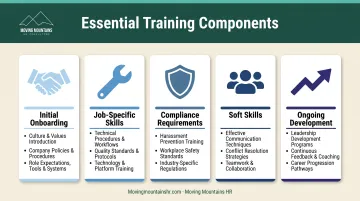
What adequate training should include
- Initial onboarding covering culture, policies, role expectations, and core tools
- Job-specific skills: task procedures, quality standards, and technology proficiency
- Compliance requirements such as harassment prevention, safety protocols, and industry regulations
- Soft skills including communication, conflict resolution, time management, and teamwork
- Ongoing development: leadership training, performance feedback, and career paths tied to business goals
Warning Signs Your Company Has a Training Problem
Performance and Quality Indicators
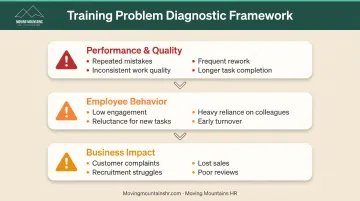
When employees repeat the same mistakes week after week, the cause is usually a training failure, not simple carelessness. Look for these patterns:
- Inconsistent work quality across team members doing the same job
- Tasks taking significantly longer than expected, even after months on the job
- Frequent rework, corrections, or quality-control escalations
The "competency confidence gap" is another red flag: employees express uncertainty about procedures, frequently ask the same questions, or hesitate when assigned routine tasks. If your team can't complete standard work without constant supervision, training didn't stick.
Employee Behavior and Morale Signals
Behavioral indicators reveal what employees won't say directly:
- Low engagement in meetings—silence when asked for input or feedback
- Reluctance to take on new responsibilities or stretch assignments
- Visible frustration, stress, or avoidance when assigned unfamiliar tasks
- Heavy reliance on a few "go-to" colleagues for answers instead of working independently
New hire turnover patterns are particularly telling. A controlled study at Wipro found that identity-focused onboarding reduced six-month turnover by more than 32% compared to traditional onboarding, demonstrating how effective early training directly influences retention. If your new hires are leaving within their first six months, inadequate onboarding and training are likely contributors.
Business Impact Indicators
External warning signs include:
- Customer complaints about service quality, employee knowledge, or inconsistent experiences
- Online reviews mentioning untrained or unhelpful staff
- Lost sales or contract renewals due to poor service delivery
Recruitment struggles are another indicator. LinkedIn's 2018 workplace learning research found that 94% of employees said they would stay longer at companies that invested in their development. When your company develops a reputation for poor training, attracting top talent becomes harder, and keeping that talent gets much harder too.
The True Cost of Inadequate Employee Training
Financial Impact: Turnover and Replacement Costs
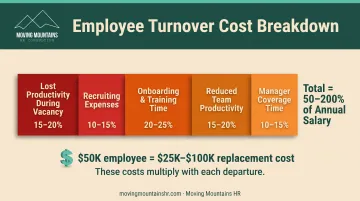
Gallup research shows that replacing an employee costs between 50% and 200% of their annual salary, depending on role complexity. For a $50,000-per-year employee, that's $25,000 to $100,000 per replacement. Work Institute's 2023 benchmark placed average turnover cost at approximately $18,000, or 33% of base pay.
Hidden costs buried in that total:
- Lost productivity during the vacancy period
- Recruiting expenses: job postings, recruiter fees, interview time
- Onboarding and training time for the replacement
- Reduced team productivity while new hires ramp up
- Manager time spent covering gaps and correcting mistakes
These costs multiply quickly. Lose three employees per year, and you're spending $54,000 to $300,000+ on turnover alone. That money could fund comprehensive training programs instead.
Productivity Loss and Quality Problems
Untrained employees work slower, make more mistakes, and ship lower-quality work that damages customer relationships.
Field research in a Dutch call center found that targeted training improved productivity by approximately 10% through faster call handling without sacrificing quality. A similar study in a Colombian agency showed trainees' goal achievement rose roughly 10%, while managers gained approximately 3% more capacity for strategic work because trained employees sent fewer help-seeking emails.
Training gaps create operational bottlenecks:
- Work stalls while employees wait for answers from supervisors or colleagues
- Over-reliance on a few knowledgeable employees who become overwhelmed
- Management time consumed correcting mistakes instead of focusing on strategy
- Opportunities missed because the team lacks capacity or capability to execute
Safety Incidents and Workplace Risk
Workplace injuries aren't limited to construction sites or factories. Every industry faces safety risks, and insufficient training increases incident frequency. The National Safety Council reports that work injuries cost businesses an estimated $54.9 billion in wage and productivity losses and $36.8 billion in medical expenses in 2024.
Beyond the immediate injury costs, incidents drive up workers' compensation premiums, trigger regulatory inspections, and expose companies to liability claims. A 2006 meta-analysis found that highly engaging safety training methods were approximately three times more effective than less engaging approaches. Training quality matters as much as offering training at all.
Competitive Disadvantage and Innovation Stagnation
Untrained teams fall behind on new tools, industry practices, and customer expectations. When people can't use the systems you already paid for—or apply emerging methods—the business moves slower than competitors who invest in development.
That gap compounds. Employees without training rarely surface improvement ideas or help the company pivot when the market shifts, while trained teams absorb change and execute on it.
Employee Morale and Engagement Decline
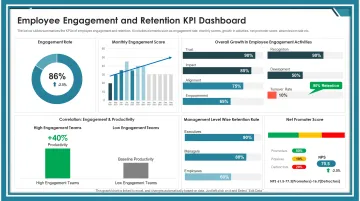
Skip training and employees feel undervalued and less confident in their roles. Disengagement follows. Gallup's 2024 data shows that 31% of U.S. employees were engaged and 17% actively disengaged, with the remaining 52% "not engaged."
The same research found that top-quartile engagement teams achieved 14% higher productivity in production roles and 18% higher in sales compared to bottom-quartile teams. Low morale feeds more turnover, cuts discretionary effort, and hurts your reputation on sites like Glassdoor, which makes hiring even harder.
Legal and Compliance Risks of Insufficient Training
Employers have a legal duty to provide a safe work environment and deliver required compliance training. Failing to meet those obligations creates liability exposure.
California-specific requirements:
- Harassment prevention (Gov. Code 12950.1): Employers with five or more employees must give interactive training every two years (two hours for supervisors, one hour for nonsupervisors), and new hires generally within six months.
- Cal/OSHA IIPP (8 CCR 3203): Every employer needs an effective written Injury and Illness Prevention Program, with training at setup, hire, reassignment, new hazards, and when supervisors take on safety duties.
- COVID-19: Standalone prevention rules ended February 3, 2025, but IIPP and Labor Code duties still apply when COVID is a workplace hazard.
California is only part of the picture. Federal rules add another layer of exposure.
- OSHA: Safety training is required under hazard-specific standards and in a language workers understand. As of January 15, 2025, maximum penalties were $16,550 per serious violation and $165,514 per willful or repeated violation.
- Title VII / ADA: Harassment and discrimination rules generally cover employers with 15 or more employees. Weak harassment-prevention training undercuts the Faragher-Ellerth defense when a supervisor is the harasser.
When training falls short, those duties turn into concrete legal and financial risk:
- Discrimination and harassment suits tied to weak prevention training
- OSHA citations and fines for safety training gaps
- Industry-specific compliance penalties
- Higher exposure in workplace injury claims
An OSHA release from December 26, 2024 linked a fatal worker electrocution to expired protective equipment and training failures. Gaps like these can cost lives and trigger serious regulatory action.
How to Address Training Gaps in Your Organization
Start with Assessment
Conduct a thorough needs assessment using SHRM's three-level framework: organization analysis, person/learner analysis, and task analysis.
Practical assessment steps:
- Review compliance requirements for your industry, location, and employee count
- Survey employees about training needs and confidence gaps
- Examine performance review patterns for recurring skill deficiencies
- Document required performance, observed gaps, affected roles, and legal triggers
Prioritize Based on Risk and Impact
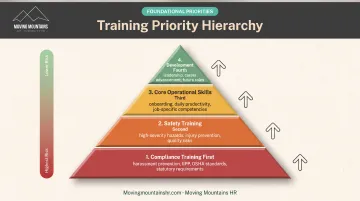
Not all training gaps carry equal weight. Apply this risk-based sequence:
- Compliance training first: Overdue statutory or hazard training (harassment prevention, IIPP, OSHA standards)
- Safety training second: High-severity safety or quality gaps that could cause injury or significant loss
- Core operational skills third: Recurring onboarding or productivity gaps affecting daily work
- Longer-term development fourth: Leadership training, career advancement, and future-role preparation
Leverage Accessible Training Solutions
Small to mid-size businesses don't need enterprise budgets to deliver effective training:
- Online platforms: Use web-based compliance training for harassment prevention, safety protocols, and required certifications
- Peer mentoring and job shadowing: Pair new hires with experienced employees for hands-on learning
- Microlearning: Deliver short, focused training sessions (10-15 minutes) for busy teams
- Industry association resources: Many trade groups offer free or low-cost training materials
- OSHA On-Site Consultation: Free, confidential small-business assistance on safety and health programs
- California CRD courses: Free harassment-prevention training that meets state requirements
Consider Expert Partnership
Sometimes building training infrastructure requires specialized HR expertise. Fractional HR support can help when you need to:
- Build a comprehensive training infrastructure from the ground up
- Conduct compliance audits that identify legal gaps and prioritize remediation
- Develop performance management systems that include employee development plans
- Create customized training programs tailored to your industry, workforce, and business goals
Moving Mountains HR designs training programs for California employment compliance, leadership development, performance management, and respectful workplace practices. Sessions run virtually or on-site and match the gaps your assessment surfaces.
Establish an Ongoing Training Culture
Build systems that reinforce learning and keep development visible:
- Schedule regular check-ins to review training effectiveness and employee confidence
- Connect training completion to career progression and performance evaluations
- Track training completion and measure outcomes (productivity, quality, retention, safety incidents)
- Celebrate learning milestones and recognize employees who pursue development
Strengthen retention with simple reinforcement habits:
- Space practice over time instead of one long session
- Use quick retrieval checks so people recall, not just re-read
- Apply new skills on the job the same day when possible
- Break complex topics into shorter sessions to avoid overload
Frequently Asked Questions
What is lack of training?
Lack of training means employees lack the onboarding, skills development, or compliance instruction they need to do their jobs safely and well. It covers missing programs, outdated content, and no ongoing development.
What does lack of training lead to?
Inadequate training drives lower productivity, more errors, safety incidents, compliance violations, and weak morale. Turnover alone can cost 50–200% of an employee’s salary, and talent becomes harder to attract and keep.
How much does lack of training cost companies?
Costs stack quickly: replacing one employee often runs 50–200% of salary, or about $25,000 to $100,000+ depending on the role. Nationally, workplace injuries alone account for roughly $54.9 billion a year in wage and productivity losses, on top of output and service gaps from undertrained teams.
What are the legal risks of inadequate training?
Legal exposure includes OSHA fines (up to $16,550 per serious violation and $165,514 per willful or repeated violation), harassment or discrimination claims when prevention training is weak, and higher liability after injuries. In California, employers with five or more employees must provide harassment-prevention training every two years, and every employer needs a Cal/OSHA IIPP with required safety training.
How do I know if my employees need more training?
Watch for repeated mistakes on the same tasks, constant questions about routine procedures, early turnover (especially within six months), customer complaints, and recurring skill gaps in reviews. Heavy reliance on a few “go-to” people is another clear sign training is falling short.
Why do employees struggle to retain training information?
People forget training when it is lecture-only, overloaded, or never applied on the job. Spacing sessions over time with practice, retrieval, and workplace application beats one-and-done sessions with no follow-up.