Introduction
Do you actually know every employment law your business is on the hook for right now? Most owners don't, and it's rarely for lack of trying.
HR compliance mistakes are among the most common and expensive risks small and mid-size employers face. A single misstep, like miscalculating overtime or skipping required harassment training, can trigger fines, lawsuits, back pay, or a formal agency investigation.
The problem is compounded by overlapping rules. Federal law sets a baseline, but state law (especially in California) and local ordinances often demand more. Without a dedicated HR or legal team, requirements across all three layers are easy to miss—and gaps often surface only after a complaint or audit.
This guide breaks down what workplace compliance actually means, the core areas every employer must manage, what non-compliance really costs, and the practical steps you can take to protect your business.
Key Takeaways
- Compliance spans wage/hour, safety, anti-discrimination, and classification laws at three levels at once
- Employment claims can cost tens of thousands in defense and settlements, even for small businesses
- Audits, updated policies, and training cost far less than reacting to a complaint
- Not every compliance vendor is credible; know the red flags before you hire one
- An experienced HR consultant gives small businesses senior-level protection without a full-time HR exec’s salary
What Is Workplace Compliance?
Workplace compliance means your organization follows every federal, state, and local law, regulation, and internal policy governing how you treat employees, from the job posting to the exit interview.
That definition sounds simple. In practice, it demands more than good intentions:
- Documented policies that spell out expectations in writing
- Consistent enforcement across every employee, every time
- Records that hold up if a regulator or plaintiff's attorney comes asking
A handbook sitting unused in a drawer doesn't protect you. Neither does a policy you enforce for some employees but not others. Compliance is the legal floor, not a strategy.
The strongest employers build culture, retention, and engagement on top of that foundation. Skip it, and everything above it is at risk.
Why Compliance Complexity Is Increasing
Federal law (the FLSA, OSHA, Title VII) sets the baseline. States then layer on their own rules, and California is famous for setting a higher bar on wages, leave, and harassment-prevention training. Cities add a third layer with their own minimum wage and paid sick leave ordinances.
Each layer has different employee-count thresholds, different deadlines, and different penalties. An employer who's compliant federally can still be in violation at the state or city level.
This landscape doesn't sit still, either. Littler's annual roundup identified 24 new California employment laws taking effect around January 1, 2026 alone—nearly two new or amended requirements every month, in one state.
Add federal rule changes and local ordinance updates, and "we didn't know" is not a defense regulators accept.
Core Areas of Workplace Compliance Every Employer Must Know
Wage and Hour Compliance
Wage and hour rules cover minimum wage, overtime, meal and rest breaks, and accurate timekeeping. Complexity shows up fast once you add exempt versus non-exempt classifications, split shifts, and rounding practices.
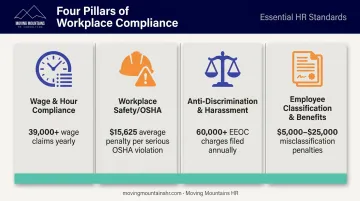
Misclassifying an employee as exempt from overtime is one of the most common—and costly—mistakes employers make. In California alone, the Labor Commissioner's Office fielded roughly 39,000 wage claims in a single fiscal year.
Between 2018 and late 2023, the average awarded claim was about $1,900, with some awards exceeding $507,000. Nearly 28% of employers ordered to pay simply didn't, which stacked collections and legal costs on top of the original award.
To stay compliant:
- Auditing exempt classifications against current duties tests, not job titles
- Tracking meal and rest breaks with time-stamped records
- Reviewing payroll systems for rounding or overtime calculation errors
Workplace Safety (OSHA)
Every employer must provide a workplace free from recognized hazards under OSHA's General Duty Clause, regardless of industry. In California, Cal/OSHA enforces even stricter standards.
Obligations include:
- Conducting and documenting hazard assessments
- Providing required safety training
- Reporting any work-related death within 8 hours, and hospitalizations, amputations, or eye loss within 24 hours
- Maintaining injury and illness records (Forms 300, 300A, and 301) if you have more than 10 employees
Penalties escalate quickly for repeat or willful violations, and Cal/OSHA's maximums run even higher than federal OSHA's. A single overlooked hazard assessment can turn into a citation during a routine inspection.
Anti-Discrimination, Harassment & Equal Employment
Federal EEO law protects employees from discrimination based on protected classes. California goes further, requiring employers with five or more employees to provide sexual-harassment prevention training every two years, two hours for supervisors, one hour for everyone else.
A written anti-harassment policy isn't enough on its own. You also need to show:
- Consistent enforcement across all levels of the organization
- Prompt, documented investigation of every complaint
- Training records retained for at least two years
One untrained supervisor or one unresolved complaint can wipe out the legal protection that policy was meant to create.
Employee Classification & Benefits
Classifying workers correctly—employee versus independent contractor, exempt versus non-exempt—isn't optional paperwork. California's ABC test presumes a worker is an employee unless the business proves all three prongs. Get it wrong, and Labor Code penalties run $5,000 to $25,000 per violation, plus back pay and benefits liability.
Leave laws add another layer employers often underestimate:
- California paid sick leave: at least 40 hours annually for most employees
- CFRA: job-protected leave for employers with five or more employees
- Federal FMLA: job-protected leave for employers with 50 or more employees
Each law has different eligibility rules, so a single leave request can trigger more than one statute at once.
The Real Cost of Non-Compliance
The direct costs are easy to imagine: government fines, back-pay awards, legal fees, and settlements. A 2017 Hiscox study of over 1,200 closed employment claims found that nearly a quarter of employment charges generated defense and settlement costs averaging $160,000, taking an average of 318 days to resolve.
For a small business, that kind of hit can threaten the business itself.
The indirect costs compound the damage:
- Reputational harm that follows a public complaint or lawsuit
- Reduced employee trust when policies are enforced inconsistently
- Higher turnover, with replacement costs often estimated at 40% to 200% of annual salary (Gallup, SHRM), depending on role
There's also an operational risk that catches employers off guard. Compliance gaps rarely surface on your schedule. They tend to appear during a funding application, an acquisition due diligence review, or a government audit, right when you can least afford the disruption.
Building a Proactive Compliance Strategy
Reacting to a complaint is always more expensive than preventing one. A proactive strategy starts with an honest look at where you currently stand.
- Start with a compliance audit. Benchmark your current policies, classifications, and documentation against today's law, not the law when you last updated your handbook.
- Keep your employee handbook current. A handbook written in 2022 likely doesn't reflect California's 2026 requirements.
- Train regularly, by role. Harassment prevention, safety protocols, and wage/hour rules all need recurring, documented training, not a one-time onboarding session.
- Build a neutral complaint process. Give employees a confidential way to raise concerns, and have someone without a stake in the outcome investigate. That reduces legal exposure and preserves trust.
- Monitor changes on an ongoing basis. Laws shift constantly, and "we'll update it next year" is how gaps form.
These five steps work best when someone runs them as a structured review. Moving Mountains HR's HR Document Audit is built around that process:
- Review existing policies against current law
- Discuss actual practices with management
- Examine employee-facing documents
- Run a gap analysis
- Deliver a compliance review report with specific recommendations
Need new documentation instead of a review? The Fresh Compliance Docs package builds policies from scratch. The combined Audit & Update package does both.
Not ready for a full audit? Moving Mountains HR's complimentary California HR Compliance Checklist helps you spot gaps on your own.
How to Choose a Legitimate Workplace Compliance Partner
Not every consultant claiming HR expertise can back it up. Before hiring outside help, look for these credibility signals:
- Verifiable credentials and industry experience, not just a polished website
- Transparent scope of services, so you know exactly what's included before you sign
- Client testimonials from real, named businesses
- Demonstrated knowledge of state-specific law, especially California's, if that's where you operate
Watch for red flags, too. Anyone guaranteeing "100% compliance" is overselling. No legitimate consultant can promise zero risk. Other warning signs include:
- High-pressure sales tactics
- No verifiable team or business address
- Generic policy templates that ignore your industry or state
A credible partner looks different. Moving Mountains HR, for example, is led by Michelle Schwanhauser, Founder and CEO, who brings executive-level HR experience concentrated in healthcare. The firm offers tiered service levels, from passive on-call support to a fractional CHRO, so businesses aren't locked into one-size-fits-all pricing.
It also runs neutral third-party workplace investigations with a clear process:
- Intake and complaint assessment
- Planning and interviews with anti-retaliation education
- Evidence collection
- A formal summary report with recommendations
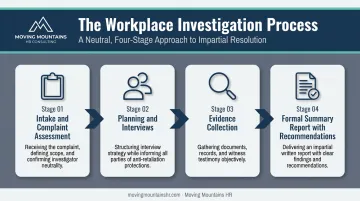
That structured, impartial process is what separates a real compliance partner from a template mill.
Frequently Asked Questions
What does workplace compliance mean?
Workplace compliance is your organization's adherence to the federal, state, and local laws, regulations, and internal policies that govern employment. It covers everything from wages and safety to anti-discrimination protections.
How can I tell if a workplace compliance service is legitimate?
Check for verifiable credentials, a transparent scope of services, and real client references. Be wary of anyone guaranteeing "100% compliance" or using high-pressure sales tactics.
What happens if a business fails a workplace compliance audit?
An audit typically flags gaps and provides a corrective action plan to fix them. If those gaps go unresolved and a complaint or government audit follows, unresolved gaps can lead to fines or legal exposure.
How often should employers review their compliance policies?
Review policies at least once a year, plus any time a relevant federal, state, or local law changes. In California, that can mean multiple updates annually.
Do small businesses need workplace compliance?
Yes. Most wage, safety, and anti-discrimination laws apply regardless of company size, though specific thresholds, like harassment training or leave mandates, vary based on employee count.
What is the difference between compliance and HR strategy?
Compliance is the legal minimum you must meet. HR strategy builds on that foundation with proactive practices that improve culture, retention, and overall performance.