
If you're a California employer, compliance isn't optional—it's the law. SB 553 requires a written workplace violence prevention plan and annual employee training, with Cal/OSHA penalties reaching up to $162,851 for willful violations. This article explains exactly what California employers must do to meet these requirements, how to implement compliant training programs, and how to build a culture of prevention that keeps your workplace safe and your business protected.
Key Takeaways
- SB 553 requires nearly all California employers to establish a workplace violence prevention plan and provide annual training by July 1, 2024
- Required topics include your prevention plan, statutory definitions, reporting procedures, job-specific hazards, response strategies, and employee rights
- Effective programs combine mandatory training with hazard assessments, clear reporting channels, and documented incident response
- Retain training records for 1 year; keep hazard assessments and incident logs for 5 years
Understanding Workplace Violence in California
What Constitutes Workplace Violence Under California Law
California Labor Code 6401.9 defines workplace violence as any act or threat of violence occurring at a worksite. This includes:
- Physical force that causes or is likely to cause injury
- Threatening behavior that creates psychological trauma or stress
- Incidents involving firearms, dangerous weapons, or common objects used as weapons
California groups these incidents into four types, which matter because your prevention plan and training must address the risks your worksite actually faces:
| Type | Definition | Example |
|---|---|---|
| Type I | Perpetrator has no legitimate business relationship with the worksite | Armed robbery by stranger |
| Type II | Customer, client, patient, student, or visitor targets employee | Patient assaults healthcare worker |
| Type III | Current or former employee, supervisor, or manager targets coworker | Terminated employee threatens former colleagues |
| Type IV | Someone with a personal relationship to an employee brings violence to the workplace | Domestic partner confronts employee at work |
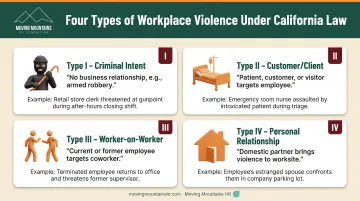
In practice, that can look like threatening emails or voicemails from a coworker, verbal threats during an argument, stalking by a former employee, or someone deliberately damaging company property to intimidate staff. Robbery, client assault, and domestic violence that spills into the worksite fall under the same law.
The Scope of the Problem: Why California Took Action
Those definitions exist because the problem is measurable. Bureau of Labor Statistics data for 2021–2022 recorded 57,610 nonfatal workplace violence cases that required days away from work, job restriction, or transfer, with a median of 7 days away per incident. Healthcare and social assistance alone accounted for 41,960 cases—73% of private-industry workplace violence.
Incident rates make the imbalance clearer:
- Healthcare and social assistance: 14.2 incidents per 10,000 full-time workers
- Educational services: 8.4 incidents per 10,000 full-time workers
- California hospitals: 10,280 violent incidents from October 2021 through September 2022
The business impact shows up in workers’ compensation, lost productivity, turnover after traumatic incidents, and liability when employers fail to maintain a safe workplace. A 2023 American Hospital Association study put the annual cost of workplace violence to U.S. hospitals at $4.2 billion. California passed SB 553 to push prevention upstream instead of treating violence as an unavoidable cost of doing business.
Who Must Comply with SB 553
SB 553 covers nearly every California employer. Only a few categories are carved out, and each carve-out is narrow:
| Exemption Category | Specific Requirements |
|---|---|
| Healthcare facilities | Already covered by 8 CCR 3342 violence prevention regulations |
| Law enforcement | POST-defined departments complying with 8 CCR 3203 |
| Corrections facilities | CDCR-operated facilities complying with 8 CCR 3203 |
| Telework locations | Employee-selected locations not controlled by the employer |
| Small worksites | Fewer than 10 employees at any time, not publicly accessible, and complying with 8 CCR 3203 |
A few details trip employers up. The small-worksite exemption applies only when all three conditions are true at once. Cal/OSHA can still order an otherwise exempt employer to comply if violence concerns arise. And if you miss any part of the small-worksite test, you need a workplace violence prevention plan—and the employee training that goes with it—though simplified templates may be enough for smaller operations.
California SB 553: Mandatory Training Requirements
What SB 553 Requires of California Employers
California Labor Code 6401.9 mandates two core compliance elements:
- Written workplace violence prevention plan — worksite-specific, readily accessible to all employees, and covering 13 required elements
- Employee training — when the plan is first established, annually thereafter, and when new hazards appear or the plan changes
The July 1, 2024 deadline means compliant employers should already have:
- A complete, written workplace violence prevention plan
- Initial training completed for all current employees
- An incident log in place (even if no incidents have occurred)
- Documentation systems for training and hazard assessments
- Scheduled annual retraining for all employees
Required Training Content Elements
California law specifies six mandatory training categories:
- Prevention plan access — How to get a free copy, how employees helped develop it, and how they can keep participating in implementation
- Definitions and legal requirements — What workplace violence means under California law and what SB 553 requires
- Reporting procedures — How to report incidents or concerns to your employer or law enforcement without retaliation
- Job-specific hazards — Violence risks in your workplace, corrections already made, and how employees get help and avoid harm
- Violent incident log — What gets recorded and how employees obtain required records
- Interactive Q&A — Time to ask questions of someone who knows the plan
Additional rules:
- Materials must match employees' education level, literacy, and language needs
- When hazards change or the plan is updated, follow-up training may cover only those updates
- The law does not set a minimum training length
Who Delivers Training, How Often, and In What Format
Trainers must know your workplace violence prevention plan well enough to answer employee questions. Common options include:
- HR professionals with workplace safety training
- External compliance consultants focused on California employment law
- Certified safety professionals with violence-prevention expertise
- Managers or supervisors trained on the plan who can run Q&A
Delivery formats that satisfy the interactive requirement:
- In-person sessions at your worksite
- Online platforms with live or scheduled Q&A
- Hybrid programs that pair self-paced modules with a knowledgeable facilitator
When to train:
- Initially, when the prevention plan is first established
- Annually for all employees
- Whenever new workplace violence hazards are identified
- Whenever the prevention plan is updated
- For new hires as a best practice (the statute does not say "upon hire," but early training closes the gap)
Scheduling practices that improve completion:
- Hold sessions during paid work hours
- Split large groups so people actually participate
- Offer multiple times for different shifts
- Record live sessions, then complete individual Q&A for anyone who missed them
Training also has to reach every employee:
- Deliver it in languages workers understand, with qualified interpreters or translated materials
- Confirm comprehension during interactive Q&A and document languages used
- Accommodate disabilities (captioning, sign language, accessible venues)
- Offer alternative formats (large print, audio, digital) and extra time when needed
Penalties for Non-Compliance
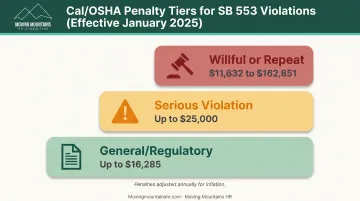
Cal/OSHA penalty amounts effective January 1, 2025:
| Violation Type | Penalty Range |
|---|---|
| General/regulatory (including posting and recordkeeping failures) | Up to $16,285 |
| Serious (substantial probability of death or serious harm) | Up to $25,000 |
| Willful or repeat | $11,632 to $162,851 |
How violations surface:
- Employee complaints filed with Cal/OSHA
- Scheduled or random Cal/OSHA inspections
- Investigations after a workplace violence incident
- Complaints from unions or employee representatives
Non-compliance also raises risk beyond fines:
- Civil liability if an employee is injured
- Weaker position on workers' compensation claims
- Harder defense against negligence lawsuits
- Reputation harm that makes hiring harder
Essential Components of Your Workplace Violence Prevention Training Program
A strong California workplace violence prevention training program does more than check a compliance box. It teaches people how to spot risk early, respond under pressure, report concerns safely, and recover after an incident—and it leaves a paper trail that stands up to Cal/OSHA review.
Build each session around the components below so employees leave with clear actions, not vague awareness.
Core Curriculum: What to Cover in Training Sessions
Start with the knowledge every employee needs before a situation escalates. Cover warning signs, active-threat response, and de-escalation in plain language tied to your worksite.
Recognizing warning signs of potential violence:
- Behavioral changes: increased conflicts, withdrawal, mood swings, declining performance
- Verbal threats or intimidating language directed at coworkers
- Obsession with weapons, violence, or violent media
- Concerning social media posts about the workplace or coworkers
- Bringing weapons to work or discussing plans to harm others
- Serious personal stress: financial crises, relationship problems, substance abuse
- Blame and persistent grievances against the organization
Note: One characteristic doesn't predict violence. Profiling is ineffective and potentially discriminatory. Actual threats require immediate response.
When a situation turns into an active threat, employees need a simple decision framework—not a long policy excerpt.
Active threat response protocols:
California's "Run, Hide, Fight" framework guides action when evacuation, concealment, or confrontation is necessary:
- Run (Evacuate): Leave immediately if a safe path exists; leave belongings behind and help others only if you can do so safely
- Hide (Conceal): If you can't evacuate, get out of sight; lock or barricade doors, silence phones, and stay quiet
- Fight (Take Action): Last resort only—if your life is in imminent danger, disrupt or incapacitate the attacker with whatever you have
Prevention still matters more often than an active-threat event. Train people to slow a tense moment down before it turns physical.
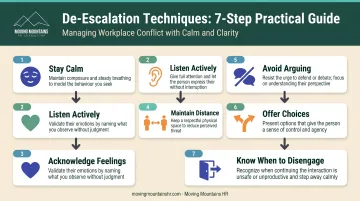
De-escalation techniques:
- Use calm, respectful tone and body language
- Listen actively without interrupting
- Acknowledge the person's feelings without agreeing or disagreeing
- Maintain safe distance and position yourself near an exit
- Avoid arguing, challenging, or making sudden movements
- Offer choices when possible to give the person a sense of control
- Know when to disengage and get help
Interactive Elements That Engage Employees
Lecture-only sessions rarely stick. Build in practice so employees rehearse decisions they may need to make under stress.
Scenario-based learning:
- Present realistic situations for your industry (such as an aggressive customer, a threatening coworker email, or domestic violence spillover)
- Ask employees how they would respond
- Discuss multiple approaches and likely outcomes
- Connect scenarios to your floor plan and written procedures
Q&A sessions:
- Reserve time for specific employee concerns
- Address "what if" situations people have already wondered about
- Clarify reporting steps and employee rights
- Log recurring questions so you can improve the next session
Role-playing exercises:
- Practice short de-escalation conversations with volunteers
- Walk through reporting steps (who to contact, what details to share)
- Rehearse evacuation or lockdown procedures
- Keep drills brief and supportive—not high-pressure performances
Reporting Procedures and Employee Rights
Once employees can recognize risk, they need a clear, low-friction way to speak up—and confidence that the company will protect them for doing it.
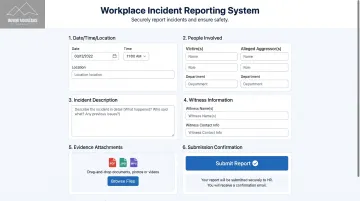
Teach employees exactly how to report:
- Who to contact: Name or title of the person who receives reports (HR manager, supervisor, safety officer, or hotline)
- What to include: Date, time, location, people involved, what happened, witnesses, and any evidence (emails, texts, recordings)
- When to report: Flag threats or concerning behavior immediately; report incidents as soon as it is safe
- Multiple channels: Offer options (supervisor, HR, anonymous hotline, online form) for anyone who fears retaliation
Employee rights and protections:
- Employees may report workplace violence concerns without fear of retaliation
- Employees may refuse work that violates safety standards and would create a real and apparent hazard
- Every report must be investigated, with findings and corrective actions shared with employees as appropriate
- Retaliation for reporting is illegal and can trigger penalties
Confidentiality protections:
- Handle reports confidentially to the extent possible
- Share information only with people who need it for investigation or safety
- Keep employee identities in the incident log confidential
Post-Incident Support and Resources
Training is incomplete if it stops at response. Employees also need to know what support looks like after something goes wrong.
Immediate support after a violent incident:
- On-site counseling or crisis intervention
- Employee Assistance Program (EAP) referrals for ongoing support
- Modified duties or temporary reassignment when needed
- Paid time off to recover or attend counseling
Workers' compensation rights:
- Employees hurt in a workplace violence incident may qualify for workers' compensation
- Benefits can include medical care, temporary disability pay, and permanent disability when applicable
- Psychological injuries may also be covered under California workers' compensation law
Community resources:
- Domestic violence hotlines and shelters for personal-relationship (Type IV) violence that spills into work
- Local victim assistance programs
- Legal aid for protective orders
- Law enforcement victim services units
Documentation and Record-Keeping Best Practices
Even a well-run session falls short on compliance if you can't prove who was trained, on what, and when. Close the loop with clean records.
Required training record contents:
- Date of training
- Contents or summary of topics covered
- Names and qualifications of trainers
- Names and job titles of all attendees
Retention requirements:
- Training records: minimum 1 year
- Hazard assessment, incident log, and investigation records: minimum 5 years
- Provide records free of charge to employees or their representatives within 15 calendar days of a request
Recommended record-keeping systems:
- Digital tracking with automated annual retraining reminders
- Individual training files with dates of every session attended
- Master calendar of scheduled sessions
- Signed attendance sheets for each session
- Copies of materials used
- Notes on training delivered in other languages or formats
Developing Your Workplace Violence Prevention Plan
Training is just one component of SB 553 compliance. Your written workplace violence prevention plan must cover 13 required elements. Grouping them by theme makes the checklist easier to build and audit.
Required Plan Elements
Accountability and coordination
- Designated person(s) responsible for implementing the plan
- Active employee and representative involvement in development and implementation
- Procedures for coordinating with other employers at shared worksites
- Procedures for ensuring plan compliance
Reporting, communication, and emergency response
- Procedures for accepting and responding to reports, with anti-retaliation protections
- Communication methods for workplace violence matters
- Emergency response procedures (alerting, evacuation or sheltering, and calling for help)
Hazard management
- Procedures for identifying and evaluating workplace violence hazards
- Procedures for timely correction of hazards
- Post-incident response and investigation procedures
Training and plan maintenance
- Training program details
- Procedures for reviewing and revising the plan at least annually
- Any other procedures Cal/OSHA requires
Hazard assessment is one of those required elements—and it drives much of the rest of the plan.
Conducting a Workplace Violence Hazard Assessment
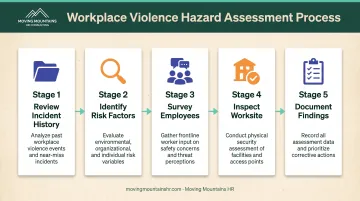
- Review your incident history. Analyze past reports, complaints, workers' compensation claims, and security logs for patterns.
- Identify risk factors. Flag customer or client contact, working alone, cash handling, late-night operations, access to medications, and high-stress roles.
- Survey employees. Ask frontline workers about safety concerns and near-miss incidents.
- Inspect the worksite. Check lighting, visibility, entry and exit points, security systems, and layout vulnerabilities.
- Document findings. Record each hazard and prioritize by likelihood and severity.
When to Inspect for Hazards
Run hazard inspections at these points:
- When the plan is first established
- On a regular scheduled basis
- After every workplace violence incident
- Whenever a new or previously unrecognized hazard is identified
Recognizing Warning Signs and Responding to Incidents
Effective workplace violence prevention training covers what to watch for and how to act when something goes wrong. Build warning signs, immediate response, and post-incident steps into every training cycle.
Behavioral Warning Signs
Train supervisors and employees to spot these red flags early:
- Increased conflicts with coworkers, supervisors, or customers
- Verbal threats, including vague or "joking" comments about violence
- Intimidating behavior such as standing too close, blocking exits, or aggressive posture
- Bringing weapons to work or discussing weapons frequently
- Obsession with workplace violence incidents in the news
- Dramatic changes in behavior, appearance, or performance
- Signs of substance abuse or a serious personal crisis
Immediate Response During a Violent Incident
When violence or an active threat occurs, act in this order:
- Ensure immediate safety — Move away from danger; use Run, Hide, Fight if facing an active threat
- Contact law enforcement — Call 911 for weapons, physical violence, or imminent danger
- Notify management — Alert your supervisor, HR, or designated safety officer once it is safe
- Render aid if safe — Provide first aid only if you are trained and it is safe to do so
- Preserve evidence — Do not disturb the scene if law enforcement is responding
Post-Incident Procedures
After the immediate threat ends, close the loop with documentation, support, and plan updates:
- Secure the scene and block unauthorized access if law enforcement instructs
- Document what happened as soon as possible: who, what, when, where, and how
- Record the incident in your violent incident log with required details
- Investigate root causes, including hazards and whether prevention measures were adequate
- Support affected employees through counseling, EAP, or modified duties
- Review and revise your prevention plan based on investigation findings
- Communicate corrective actions to all employees
How Moving Mountains HR Can Help You Achieve Compliance
California's SB 553 requirements can feel overwhelming, especially for small to mid-size businesses without dedicated HR staff. Moving Mountains HR provides compliance support designed specifically for California employers.
Our services include:
- HR compliance audits: Review policies, procedures, and handbooks against SB 553, then get a gap analysis with clear recommendations
- Customized training programs: Cover all six mandatory content categories and your industry-specific workplace violence risks
- Policy and procedure development: Build a compliant workplace violence prevention plan tailored to your worksite
Founded in 2023 by HR executive Michelle Schwanhauser, Moving Mountains HR brings executive-level expertise to businesses of all sizes. We focus on California employment law and practical support for employers without a full in-house HR team.
You can engage us for a one-time SB 553 compliance audit or ongoing HR support to keep your workplace violence prevention program current.
Ready to assess your SB 553 readiness? Contact us at questions@movingmountainshr.com or call 866-474-3575 for a complimentary consultation.
Frequently Asked Questions
What are the 7 elements of a workplace violence prevention program?
California Labor Code 6401.9 requires 13 elements in your written plan, not 7. Core components include designated responsible persons, employee involvement, hazard identification and correction, training, reporting and investigation procedures, emergency response, incident logging, annual review, and anti-retaliation protections.
What is the definition of workplace violence?
Under SB 553, workplace violence is any act or threat of physical violence, harassment, intimidation, or other threatening behavior that occurs at a worksite. This includes physical force, threats that create psychological trauma or stress, and incidents involving firearms, weapons, or common objects used as weapons.
What are the four types of workplace violence?
OSHA and California guidance group workplace violence into four types:
- Type I: Criminal intent — no legitimate business relationship with the workplace
- Type II: Customer/client — patient, customer, or visitor targets an employee
- Type III: Worker-on-worker — current or former employee targets a coworker
- Type IV: Personal relationship — domestic partner or acquaintance brings violence to the worksite
What are 5 examples of workplace violence?
Common examples include:
- Physical assault by a customer
- Threatening email or voicemail from a coworker
- Domestic partner arriving at the worksite with a weapon
- Armed robbery that injures an employee
- Intimidating or stalking behavior by a former employee
All require documentation, investigation, and corrective action under SB 553.
When does additional workplace violence training need to be provided?
Beyond initial and annual training, California law requires additional training whenever a new or previously unrecognized workplace violence hazard is identified, or whenever your workplace violence prevention plan is updated. This additional training may be limited to the specific new hazard or change rather than repeating all six content categories.
How long must California employers keep workplace violence training records?
Training records must be retained for at least 1 year. Other required records—including hazard identification and correction documentation, incident logs, and investigation records—must be kept for at least 5 years. Employers must provide these records free of charge to employees or their representatives within 15 calendar days of a request.