
Introduction
Imagine walking into Monday's leadership meeting and realizing your team doesn't trust a word you say—not because you lied, but because your actions contradict your stated values. This disconnect erodes engagement, drives turnover, and creates a workplace where employees keep their heads down instead of speaking up.
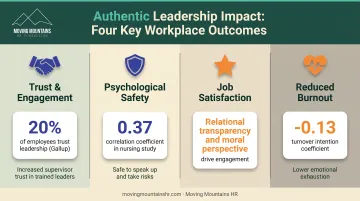
Only 20% of U.S. employees strongly agree they trust their organization's leadership, according to Gallup's current indicator. Meanwhile, just 32% are engaged at work. These numbers point to a credibility crisis that authentic leadership directly addresses—not through charisma or likability, but through values-driven behavior, self-awareness, and transparent relationships.
This article defines authentic leadership, explains its four research-backed components, explores why it matters in today's workplace, and provides practical steps to develop it. You'll also learn how authentic leadership applies in small to mid-size organizations, where leader visibility is high and cultural impact is immediate.
Key Takeaways
- Authentic leadership is values-based: self-awareness, ethical decisions, balanced processing, and transparency
- Research links it to higher trust, engagement, job satisfaction, and psychological safety
- The four components stick only when leaders develop them intentionally over time
- Small to mid-size organizations gain cultural impact when leaders balance transparency with authority
- Build it through self-reflection, feedback-seeking, values clarification, and genuine relationships
What Is Authentic Leadership?
Authentic leadership is a leadership approach where leaders act consistently with their core values, demonstrate self-awareness, process information objectively, and maintain transparent relationships.
Research by Walumbwa et al. defines it as "a pattern of leader behavior that draws upon and promotes both positive psychological capacities and a positive ethical climate."
The real standard is alignment between internal values and external behavior, not simply "being yourself." An authentic leader doesn't just act naturally; they act intentionally, grounded in moral principles and self-knowledge. This distinction matters: authenticity without ethical grounding can mean consistency with any trait, including toxic ones.
Origins and Purpose
Authentic leadership emerged in the early 2000s as a response to corporate scandals and the erosion of trust in business leadership. High-profile ethical failures at Enron, WorldCom, and other companies created demand for a new leadership model rooted in honesty, loyalty, responsibility, and integrity rather than short-term results or external approval.
The framework is values-based and morally grounded. Leaders don't simply remain consistent with their personality; they regulate their behavior through internal ethical standards, not external pressure.
Not Just Likability or Genuineness
Authentic leadership differs from being likable or genuine in casual conversation. The Center for Creative Leadership warns that authenticity does not authorize unfiltered behavior or abandoning professional judgment. It requires specific behaviors: self-awareness, moral courage, objective analysis, and appropriate transparency. Those skills must be developed intentionally.
The Four Components of Authentic Leadership
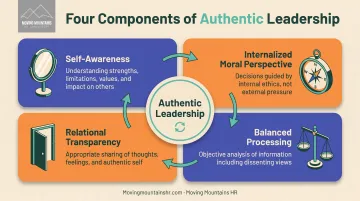
Walumbwa's research identified four components that define authentic leadership. Each is a distinct behavior requiring practice and refinement.
Self-Awareness
Self-awareness means understanding your strengths, limitations, values, emotions, and how your behavior affects others. Self-aware leaders actively seek feedback and use it to refine their approach.
Example: A founder recognizes that she becomes defensive when her strategy is questioned. She starts inviting dissent explicitly in leadership reviews, making space for her team to challenge assumptions without fear.
Internalized Moral Perspective
Internalized moral perspective means making decisions from your own ethical standards rather than external pressure or organizational convenience. Leaders with this stance do what's right even when it's difficult or costly.
Example: An owner rejects a profitable contract because the client's business practices conflict with the company's stated commitment to environmental responsibility. The decision is consistent with values, not just expedient.
Balanced Processing
Balanced processing means objectively analyzing relevant information before making decisions, including perspectives that challenge your own views. It requires acknowledging your biases and actively seeking diverse input.
Example: Before announcing a hiring freeze, the leader asks finance, operations, and frontline staff to test assumptions. She slows down the decision process to ensure all relevant data and viewpoints are considered.
Relational Transparency
Relational transparency is openly sharing information, expressing your true thoughts and feelings appropriately, and revealing your authentic self. Transparency has boundaries—it means genuine communication, not oversharing or removing all professional filters.
Example: The leader admits uncertainty about market conditions and explains the known rationale for a strategic pivot. She communicates openly while respecting legitimately confidential information, such as pending mergers or personnel matters.
Why Authentic Leadership Matters in the Workplace
Authentic leadership is associated with measurable workplace outcomes, though the evidence is observational and context-dependent.
Trust and Engagement
A 2025 hospital intervention study found that new direct reports of supervisors trained in authentic leadership reported increased authentic-leadership behavior and supervisor trust. The same randomized study found no significant overall effects on trust, job satisfaction, or organizational commitment—results still depend on context.
A cross-sectional study of 476 Dubai hotel employees found that relational transparency, moral perspective, and balanced processing positively linked with engagement. Self-awareness alone was not significant.
Psychological Safety
Psychological safety—the belief that you can speak up, take risks, and contribute ideas without fear—is strongly associated with authentic leadership.
A 2025 study of 504 U.S. nurses found authentic leadership tied to unit psychological safety (coefficient = 0.37, p < 0.001). That safety, in turn, mediated effects on missed care and intention to leave.
Reduced Burnout and Turnover Intention
Evidence also points to lower burnout and weaker intent to leave:
- A three-wave study of 628 German and Finnish employees linked authentic leadership with lower emotional exhaustion, with a negative indirect effect through procedural justice
- A study of 433 South Korean employees found authentic leadership predicted lower turnover intention (beta = -0.13, p < 0.01), fully mediated by perceived supervisor support
Context matters: These findings are cross-sectional and do not prove causation. Authentic leadership is associated with positive outcomes, not guaranteed to produce them.
How to Develop Authentic Leadership Skills
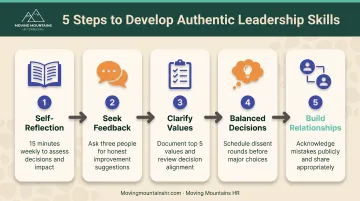
Authentic leadership requires intentional practice. Start with these five practices:
Start with Self-Reflection
Build self-awareness through journaling, personality assessments, or working with a mentor. A 2022 U.S. authentic-leadership program used autobiographical reflection, self-assessments, coaching, and simulations. Participants reported greater self-concept clarity and presence as leaders.
Action: Set aside 15 minutes weekly to reflect on decisions you made, emotions you felt, and how your behavior affected others.
Seek and Act on Feedback
Ask for honest feedback from colleagues, direct reports, and supervisors. Compare external perceptions with your self-view. The key is demonstrating willingness to change based on what you learn.
Action: Ask three people, "What's one thing I do that helps our team, and one thing I could improve?" Listen without defending, then implement one change.
Clarify and Communicate Your Values
Identify your core values and ensure your decisions align with those principles. This creates consistency between what you say matters and what you actually do.
Action: Write down your top five professional values. Review your last three major decisions and ask: Did I act consistently with these values?
Practice Balanced Decision-Making
Slow down important decisions. Seek dissenting opinions, question your assumptions, and document counterarguments before committing.
Action: Before your next significant decision, schedule a "dissent round" where you ask someone to argue the opposite view.
Build Authentic Relationships
Share appropriate personal experiences, admit mistakes, and communicate with openness while respecting boundaries. Authentic relationships are built on trust, not oversharing.
Action: The next time you make a mistake, acknowledge it publicly and explain what you'll do differently. That kind of openness builds trust faster than a polished image.
Authentic Leadership in Small to Mid-Size Organizations
Authentic leadership can be particularly valuable in smaller organizations, where leaders often have higher visibility and closer contact with employees. Cultural norms and trust dynamics spread quickly in tight-knit teams.
Common Challenges
Balancing authenticity with authority: Small-business owners may struggle to remain approachable while maintaining decision-making authority. Authentic leaders keep hierarchy in place and exercise authority transparently, in line with stated values.
Transparency while protecting confidential information: Not all information can or should be shared. Authentic leaders explain what they can share, why certain details remain confidential, and how decisions align with company values.
Staying true to values amid growth pressures: According to NFIB's November 2025 survey, 33% of small-business owners had job openings they could not fill, versus a 24% historical average.
Those growth pressures can push leaders toward short-term fixes that clash with their values. Authentic leaders still choose long-term principles over immediate convenience.
HR Consulting Support
Facing those pressures alone is hard when you also own compliance, performance, and culture. Outside HR support gives small and mid-size leaders structure so authenticity does not slip when the business is stretched.
Moving Mountains HR works with these organizations on practical supports such as:
- Performance management systems that match stated values
- Leadership training for approachable, accountable managers
- Fractional CHRO guidance for consistent, compliant decisions
That backing helps leaders stay transparent and values-led without dropping professionalism or legal requirements.
Frequently Asked Questions
What are the four components of authentic leadership?
The four components are self-awareness, internalized moral perspective, balanced processing, and relational transparency. That means knowing your strengths and impact, deciding from internal ethics, weighing input objectively, and sharing openly within appropriate boundaries.
Can you give me an example of authentic leadership?
A business owner admits an expansion call rested on incomplete assumptions, shares the nonconfidential facts, and invites finance and operations to challenge recovery options. She then chooses the path that matches commitments to employees and customers, even at higher short-term cost.
Is authentic leadership the same as being honest?
No. Honesty is one element, but authentic leadership also requires self-awareness, ethical grounding, objective decision-making, and appropriate transparency. You can be honest without being self-aware or values-driven.
How long does it take to develop authentic leadership skills?
Development is ongoing, not a fixed timeline. Some reflection-and-coaching programs report clarity gains within weeks, but consistent authentic leadership takes years of practice and feedback. Start with small, repeatable habits and build from there.
Does authentic leadership work in all industries?
The theory applies broadly, with documented associations in healthcare, hospitality, manufacturing, and public sectors. Context still matters, and research does not prove causation in every setting. It is promising and evidence-backed, not a guaranteed formula.
Can introverted leaders be authentic leaders?
Yes. Authentic leadership is about alignment between values and behavior, not personality style. Introverted leaders can show self-awareness, moral courage, balanced processing, and transparency in ways that fit how they communicate.