
Introduction
A harassment complaint lands on your desk on a Tuesday morning. You run a 22-person company. There's no HR department, no employee handbook update since 2021, and no idea who's supposed to investigate the claim—you or the accused employee's manager?
You're not alone. According to SHRM's Q4 2024 Civility Index, 76% of U.S. workers reported experiencing or witnessing workplace incivility, and 26% said they were likely to leave their jobs in 2025 because of it.
What many owners don't know: you can bring in outside expertise without hiring a full HR team. An Employee Relations Consultant is an external HR expert who steps in to manage these situations, resolve conflict, and build healthier workplace systems without adding to your permanent payroll.
This article covers what these consultants actually do, the four pillars their strategies are built on, how they differ from an in-house specialist, and when it's time to bring one in.
Key Takeaways
- Employee Relations Consultants are external HR experts who resolve conflict, manage compliance, and strengthen culture
- They bring a neutral third-party view without adding permanent headcount
- Four pillars guide the work: communication, fair treatment, conflict resolution, and engagement
- Best fit if you lack dedicated HR, face complaints, or are growing across multiple states
What Is an Employee Relations Consultant?
An Employee Relations Consultant is an independent HR professional (or firm) retained by a business to manage and resolve issues in the employer-employee relationship.
They're not on your payroll. They're brought in for a specific need, then they finish the engagement.
Their expertise usually comes from years of senior in-house HR leadership. That background typically covers:
- Employment law and regulatory compliance
- Workplace investigations
- HR policy development
- Conflict mediation and dispute resolution
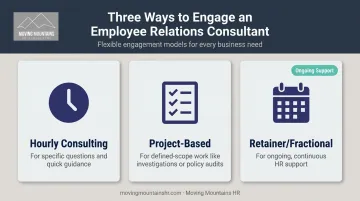
Flexible engagement is the defining feature. Rather than a fixed salaried position, consultants work through:
- Hourly consulting for specific questions
- Project-based work with a defined scope and deliverable
- Ongoing retainer or fractional arrangements for continued support
This flexibility matters most in sensitive situations. When a harassment complaint involves a manager, or when leadership itself is in conflict, internal staff often have a real or perceived conflict of interest.
A neutral outside consultant doesn't have that baggage. That objectivity is often why businesses seek outside help in the first place. With three-quarters of workers reporting they've witnessed incivility at work, the need for an unbiased referee is more common than most owners assume.
What Does an Employee Relations Consultant Do?
The role covers a wider range of work than most business owners expect. Handling complaints is only one piece. Core services typically include:
- Workplace investigations — Conducting neutral, documented inquiries into harassment, discrimination, or misconduct, then delivering findings and recommendations.
- Policy and handbook audits — Reviewing policies, handbooks, and grievance procedures to close compliance gaps before they become legal exposure.
- Labor law guidance — Advising leadership on federal rules like the FLSA and OSHA, plus state-specific requirements such as California's employment statutes.
- Dispute mediation — Stepping in between employees and managers before tension escalates into a formal complaint or lawsuit.
- Engagement and retention strategy — Designing feedback loops and recognition programs that keep strong performers from leaving.
- Fractional CHRO guidance — Providing senior-level HR strategy for companies that need executive thinking without an executive salary.
Moving Mountains HR, for example, runs its investigations process through intake, planning, neutral interviews, evidence collection, and a formal summary report, with anti-retaliation protections at every step. Related HR regulatory compliance work often includes a gap analysis against current federal and state requirements.
Why Neutrality Matters Here
Internal staff investigating their own colleagues (or worse, their own boss) creates an obvious credibility problem. A consultant with no stake in office politics can interview everyone involved, document evidence, and issue findings that both sides are more likely to trust.
The 4 Pillars of Employee Relations
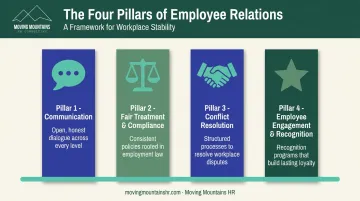
Every effective employee relations strategy rests on four pillars. Consultants use this framework as a diagnostic tool, figuring out which pillar is weakest before recommending fixes.
Communication
Transparent, two-way communication between management and staff builds trust. When employees feel heard, small frustrations stay small instead of snowballing into formal grievances. Consultants often start here because poor communication is usually the root cause behind bigger problems.
Fair Treatment and Compliance
Consistent policy enforcement protects everyone. When rules apply differently depending on who's asking, businesses expose themselves to favoritism and discrimination claims. Labor law compliance turns fair treatment from a stated value into an enforceable standard.
Conflict Resolution
A structured, impartial process for handling disputes keeps minor disagreements from turning into costly grievances or lawsuits. Without one, employees often have no clear path forward except escalation, which is expensive for everyone involved.
Employee Engagement and Recognition
Proactively supporting morale and recognition protects your bottom line. SHRM estimates that replacing an employee can cost 50% to 200% of their annual salary, depending on the role's seniority and skill level.
That range covers recruiting, onboarding, lost institutional knowledge, and the productivity gap while a replacement ramps up. Engagement strategies exist specifically to avoid paying that bill.
Employee Relations Consultant vs. In-House Employee Relations Specialist
The core difference is simple: a specialist is a full-time employee embedded in your culture. A consultant is an external, objective expert you bring in as needed.
| Factor | In-House Specialist | ER Consultant |
|---|---|---|
| Employment status | Full-time payroll employee | Project, hourly, or retainer engagement |
| Best fit | Larger organizations with steady ER case volume | Small to mid-size businesses without ongoing need for full-time HR |
| Objectivity | Can be shaped by internal relationships | Neutral third party |
| Cost structure | Continuous salary + benefits | Flexible, scoped to the engagement |
On cost: The U.S. Bureau of Labor Statistics reports a median annual wage of $72,910 for HR specialists and $140,030 for HR managers as of May 2024. Benefits typically add another 25–30% in employer costs—a fixed expense no matter how many ER issues come up in a given month.
A consultant converts that fixed cost into a flexible one. You pay for an investigation, a policy overhaul, or a fractional retainer, not a continuous salary. Whether that saves money depends on your caseload:
- Frequent, complex ER cases — a full-time hire may pay for itself
- Occasional needs — a consultant is usually the better fit
When Should Your Business Hire an Employee Relations Consultant?
Bring in a consultant when you see signs like these:
- Rising employee complaints with no formal process to address them
- No dedicated HR function at all
- A recent threat of legal action or an EEOC-style complaint
- Rapid hiring or growth that's outpacing your current policies
- Multi-state expansion or California growth that triggers rules such as harassment prevention training at five employees
The payoff shows up in three places:
- Lower compliance and legal risk
- Hours back each week that used to go to HR firefighting
- Stronger retention when issues get fixed before people leave
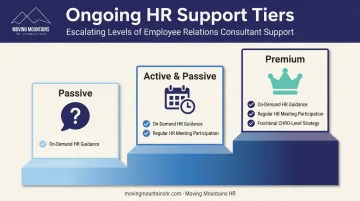
Moving Mountains HR built its ongoing support model around this exact need, with three tiers you can scale up or down:
- Passive — on-demand guidance when issues arise
- Active & Passive — regular participation in your HR meetings
- Premium — adds fractional CHRO-level strategy
Owners who want a starting point before committing can use the firm's complimentary California HR Compliance Checklist to spot gaps first.
Frequently Asked Questions
What is an employee relations consultant?
An employee relations consultant is an external HR expert hired to manage employer-employee relationships, resolve workplace conflict, and ensure compliance without a full-time hire. They typically work on a project, hourly, or retainer basis.
What are the 4 pillars of employee relations?
The four pillars are communication, fair treatment and compliance, conflict resolution, and employee engagement. Consultants use these areas as a framework to diagnose and fix workplace issues.
How is an employee relations consultant different from a general HR consultant?
ER consultants specialize in workplace relationships, conflict, and investigations. General HR consultants often cover broader functions such as payroll, benefits, or recruitment strategy.
How much does an employee relations consultant cost?
Costs vary by engagement type (hourly, project-based, or retainer), case complexity, and scope. Most firms provide a custom proposal based on your specific needs.
Can an employee relations consultant conduct workplace investigations?
Yes, this is a core service. Their value comes from neutrality and objectivity, which internal staff often can't provide in sensitive cases like harassment or leadership disputes.
When should a small business hire an employee relations consultant?
Watch for rising complaints, no in-house HR function, legal threats, rapid growth, or multi-state compliance complexity. Any of these signals is a good reason to bring in outside expertise.