
Yet many organizations still promote strong individual contributors into management roles without equipping them for people leadership. Technical excellence in a previous role doesn't automatically translate to the communication, conflict resolution, coaching, and decision-making skills required to lead teams effectively. The cost of this gap is measurable: higher turnover, weaker engagement, compliance exposures, and productivity losses.
This article explains the tangible business benefits management training delivers—from reduced turnover to stronger culture to lower legal risk—and how to maximize the return on training investments.
Key Takeaways
- Management training builds communication, conflict resolution, and decision-making skills promoted technical experts often lack
- Trained managers drive higher engagement, lower turnover, stronger productivity, and fewer compliance violations
- Development works best as ongoing support, not a one-time workshop, so managers keep pace with workforce change
- Small and mid-size businesses can get practical management training that fits their budget and closes real leadership gaps
What Is Management Training?
Management training refers to structured development programs that build the skills employees need to lead teams, manage performance, navigate conflict, and align team goals with organizational objectives.
Unlike technical or job-specific training, it focuses on people leadership: motivating, guiding, supporting, and holding accountable the people who do the organization's work.
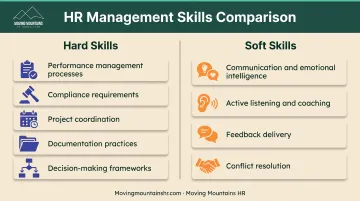
Effective programs address both hard skills and soft skills.
Hard skills include:
- Performance management processes
- Compliance requirements
- Project coordination
- Documentation practices
- Decision-making frameworks
Soft skills include:
- Communication and emotional intelligence
- Active listening and coaching
- Feedback delivery
- Conflict resolution
Management training is a strategic investment that prevents costly problems while creating competitive advantages. Organizations that develop strong managers reduce turnover, avoid lawsuits, maintain higher morale, and execute more effectively than those that leave leadership to chance. In competitive labor markets, especially high-regulation states like California, trained managers become a critical differentiator.
Key Benefits of Management Training Programs
The benefits outlined below are grounded in measurable business outcomes, not abstract leadership ideals. Each advantage directly impacts metrics business owners track daily: turnover rates, engagement scores, legal claims, productivity benchmarks, and operational efficiency. These benefits compound over time when organizations commit to continuous manager development rather than treating training as a one-time checkbox.
Reduces Employee Turnover and Improves Retention
Most voluntary exits trace back to the manager-employee relationship, not the company brand. Research consistently shows that relationship quality is the strongest predictor of turnover. According to Gallup's 2022 meta-analysis of manager development programs, participants experienced 21% to 28% lower team turnover compared to teams led by untrained managers.
Trained managers create better employee experiences through:
- Clear, consistent communication about expectations and priorities
- Regular, constructive feedback that helps employees improve
- Meaningful recognition that reinforces desired behaviors
- Career development conversations that demonstrate investment in growth
- Conflict resolution that addresses issues before they escalate
What turnover actually costs:
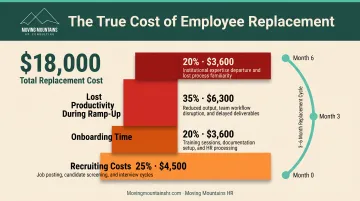
Replacing an employee costs approximately $18,000, or about 33% of base pay, according to Work Institute's 2023 retention report. Gallup's broader estimate places replacement cost between one-half to two times annual salary, depending on role complexity.
Those figures cover recruiting, onboarding time, lost productivity during ramp-up, and knowledge loss when experienced people leave.
In California and other competitive labor markets, retention has become a critical competitive advantage. Organizations that reduce voluntary turnover by even 10% through better management practices see substantial savings and operational stability.
KPIs impacted:
- Employee turnover rate
- Retention rate
- Cost per hire
- Time to fill open positions
- Employee satisfaction scores
When this advantage matters most:
- Organizations experiencing high voluntary turnover
- Competitive industries with talent shortages
- Companies with significant onboarding or training investments in each employee
- Businesses where institutional knowledge is critical to operations
Strengthens Organizational Culture and Employee Engagement
Managers are the primary translators of company culture. Senior leaders may define values and mission, but frontline and mid-level managers bring those ideals to life in day-to-day work experiences. They set tone, model behavior, and create the immediate environment where employees spend their time.
Management training equips leaders to foster inclusive, collaborative, accountable team cultures that align with broader organizational values. Trained managers understand how to:
- Set clear expectations and connect individual work to organizational goals
- Provide meaningful recognition that reinforces culture
- Facilitate team collaboration and psychological safety
- Address behaviors that undermine culture quickly and consistently
- Involve employees in goal setting and decision-making
What the engagement data shows:
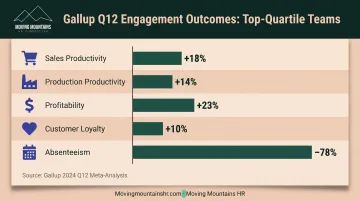
Gallup's 2024 Q12 meta-analysis, covering 736 studies across 347 organizations and more than 3.3 million employees, found that top-quartile engaged teams experienced:
- 18% higher sales productivity
- 14% higher production productivity
- 23% higher profitability
- 10% higher customer loyalty
- 78% lower absenteeism
These figures are engagement outcomes, not guaranteed training results. Still, Gallup reports that management relates to 70% of the variance in team engagement, so manager development remains a high-leverage lever for culture and performance.
Trained managers create environments where employees feel valued, heard, and supported. That reduces absenteeism, lifts morale, and builds resilience during organizational change.
KPIs impacted:
- Employee engagement scores
- Absenteeism rate
- Internal promotion rate
- Culture survey results
- Team collaboration metrics
When this advantage matters most:
- Organizations undergoing growth or change
- Companies with distributed or hybrid teams
- Businesses where culture is a differentiator in talent markets
- Industries with high customer-interaction roles where morale impacts service quality
Reduces Legal and Compliance Risk
Untrained managers are a significant source of compliance violations. Improper terminations, harassment issues, wage-and-hour mistakes, and documentation failures often stem from managers who don't understand their legal responsibilities or how to escalate issues appropriately.
Management training ensures leaders understand employment law basics, anti-discrimination policies, documentation requirements, meal and rest break rules, overtime exemptions, and when to involve HR or legal counsel. In high-regulation states like California, this knowledge is essential.
What noncompliance costs:
The EEOC received 88,531 charges and secured almost $700 million in monetary relief in fiscal year 2024. The U.S. Department of Labor secured more than $259 million in back wages for 176,957 workers in fiscal year 2025, averaging $1,465 per worker.
California's Division of Labor Standards Enforcement reported 47,000 backlogged wage claims at the end of fiscal year 2022-23, with the State Auditor noting a median 854-day decision time versus a 135-day statutory maximum.
California requires employers with at least five employees to provide two hours of harassment-prevention training to supervisors and one hour to nonsupervisors every two years. Proper training creates a documented record that the organization took reasonable steps to prevent violations. That record matters in legal defense, though documentation alone is not immunity.
KPIs impacted:
- Number of HR complaints
- Legal claims filed
- Settlement costs
- Workers' compensation claims
- Safety incident rates
When this advantage matters most:
- Organizations in highly regulated industries (healthcare, manufacturing, hospitality)
- Companies operating in California or other high-compliance states
- Businesses with distributed teams across multiple jurisdictions
- Organizations with recent compliance incidents or EEOC/DOL investigations
Improves Operational Performance and Productivity
Trained managers make better decisions, delegate more effectively, and keep teams focused on high-impact priorities. They remove obstacles, allocate resources well, and course-correct when problems arise.
Management training builds the systems that drive execution: goal-setting frameworks, performance management, project coordination, and clear accountability.
Performance gains you can track:
Gallup's manager development research found program participants had a 20% to 28% higher likelihood of manager performance improvement. Separately, Gallup's engagement research found top-quartile teams had 18% higher sales productivity, 14% higher production productivity, and 32% fewer quality defects—though these are engagement correlations, not direct training effects.
Employees involved by managers in goal setting were nearly four times as likely to be engaged. Employees receiving daily feedback were three times as likely to be engaged. Goal involvement and frequent feedback are core components of effective management training.
Well-trained managers shift from reactive firefighting to proactive strategic thinking. They anticipate challenges, communicate priorities clearly, and create accountability without micromanaging.
KPIs impacted:
- Revenue per employee
- Project completion rates
- Customer satisfaction scores
- Error or defect rates
- On-time delivery metrics
When this advantage matters most:
- Fast-growth organizations where execution gaps become bottlenecks
- Companies with tight margins where efficiency is critical
- Businesses launching new products or services
- Organizations with performance management challenges or missed deadlines
What Happens When Management Training Is Missing or Ignored
Skip management training and the costs show up quickly in turnover, culture, compliance risk, and stalled output. Left unaddressed, those problems compound.
High voluntary turnover becomes routine. People leave managers who fail to communicate, recognize contributions, support development, or build psychological safety. Gallup's meta-analysis shows a 21%–28% turnover difference between teams with trained versus untrained managers.
Toxic workplace cultures take hold when managers play favorites, avoid hard conversations, or leave conflict unresolved. MIT Sloan researchers analyzing 34 million employee profiles and more than 1.4 million Glassdoor reviews found that toxic culture was 10.4 times more predictive of attrition than compensation.
Legal and compliance exposures stack up next. Untrained managers mishandle terminations, ignore harassment complaints, violate wage-hour laws, or create discriminatory practices. With the EEOC securing nearly $700 million in relief in fiscal year 2024 and California's backlog of 47,000 wage claims, manager mistakes carry a real price.
Productivity drops when managers can't delegate, set priorities, hold people accountable, or decide on time. Missed deadlines, duplicated work, and frustrated teams follow. Gallup's engagement research shows 14%–18% productivity differences between high- and low-engagement teams.
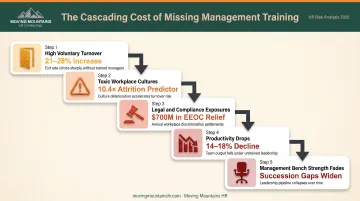
Management bench strength fades when nobody is developed for the next role. Succession gaps appear, and the business leans too hard on a few key people. A fall-2024 Gallup survey of 1,264 U.S. business owners found that one-third had no long-term succession plan or were unsure.
How to Get the Most Value from Management Training
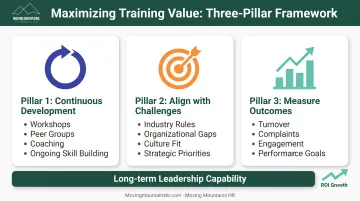
Treat management training as continuous development, not a one-time event. A single seminar rarely transforms leadership capability. Skills like conflict resolution, feedback delivery, and performance coaching need practice and reinforcement to stick.
Build that continuity through:
- Workshops and online courses
- Peer learning groups
- Ongoing coaching
Gallup research links the strongest leadership outcomes to development sustained over time.
Align training with your organization's challenges and culture. Generic courses often miss the industry rules, customer expectations, and operational constraints your managers face daily. Customize programs around your biggest gaps, such as compliance knowledge, delegation, or change management.
For California-based businesses, include state-specific requirements like meal breaks, overtime exemptions, and harassment prevention.
Measure effectiveness through business outcomes, not satisfaction surveys alone. Compare pre- and post-training baselines on metrics that affect the business:
- Voluntary turnover
- Time-to-productivity for new hires
- HR complaints and compliance incidents
- Team performance goal achievement
- Engagement scores
Those numbers justify continued investment and show where managers still need support.
Conclusion
Management training is one of the highest-ROI investments an organization can make. It directly impacts retention, culture, compliance, and operational performance. Gallup research shows 21%–28% lower turnover and up to 18% greater engagement among teams with trained managers—clear evidence that developing leadership capability pays off.
Those benefits compound when organizations commit to continuous manager development and tie training into broader talent strategies. Managers who get ongoing support adapt faster to shifting workforce expectations and business challenges than those who attend a single workshop.
Effective management training doesn't require massive budgets. Small to mid-size businesses can start with focused programs that address their biggest leadership gaps—communication, performance management, compliance, or conflict resolution—and scale from there.
The cost of training is modest next to turnover, legal claims, and lost productivity from untrained managers. If you're ready to close those gaps, Moving Mountains HR offers leadership, compliance, and workplace training built for small and mid-size teams.
Frequently Asked Questions
What are the benefits of management training programs?
Management training can cut turnover 21%–28%, lift engagement up to 18%, lower compliance risk, and raise productivity. It builds leadership skills—communication, conflict resolution, performance management, and decision-making—that many technical experts never develop on their own.
How much does management training cost for small businesses?
Costs range from free online resources to multi-thousand-dollar programs—for example, SHRM’s self-paced People Manager Qualification at $995 and AMA’s live courses at $2,595–$2,895. Small businesses often start with online courses, peer groups, or fractional HR training; reduced turnover alone usually covers the investment.
What skills should management training programs cover?
Core skills include communication, conflict resolution, performance management, delegation, coaching, emotional intelligence, and decision-making, plus compliance basics like harassment prevention and wage-hour rules. The right mix depends on industry, company size, manager experience, and your biggest organizational gaps.
How long does it take to see results from management training?
Some benefits like improved communication and clearer expectations appear within weeks, while others like reduced turnover and measurable culture change emerge over 6-12 months. Consistent reinforcement and practice accelerate results; one-time training rarely produces lasting behavior change without ongoing support and accountability.
Who should participate in management training?
Aspiring managers, newly promoted leaders moving out of individual-contributor roles, and seasoned managers who need a skills refresh all benefit. Each group needs a different focus—prep for the role, transition support, or updates on workforce expectations and regulations.
How can I measure the ROI of management training?
Track turnover, engagement scores, time-to-productivity for new hires, HR complaints, and performance goal achievement. Compare pre- and post-training baselines so you measure business outcomes—not just course satisfaction surveys.