Workforce planning is the strategic process that prevents exactly these situations. It ensures you have the right people with the right skills in the right roles at the right time—aligned with where your business is heading, not just where it is today. In this article, you'll learn what workforce planning really means, why it matters for your bottom line, how to execute the four-step process, and how to start even without dedicated HR staff or complex systems.
Key Takeaways
- Workforce planning aligns current and future staffing with your business objectives to prevent costly talent gaps
- Done well, it cuts labor costs, improves retention, and puts you in position to move when opportunities arise
- Four steps drive results: analyze your workforce, forecast future needs, identify gaps, and implement targeted solutions
- Small businesses can start with critical roles and existing data—you don't need a full HR team or perfect systems
- Treat planning as a continuous cycle you revisit as the business changes—not a once-a-year binder exercise
What Is Workforce Planning?
Workforce planning is the strategic process of ensuring the right people with the right skills are in the right roles at the right time. It's how you align your current and future talent with your business goals, proactively rather than reactively.
Unlike general HR management or scrambling to fill vacancies as they appear, workforce planning is forward-looking. The Chartered Institute of Personnel and Development (CIPD) defines it as balancing labor supply (the skills and people you have) against demand: the numbers and capabilities you'll need.
It connects directly to your broader business strategy, translating goals like revenue growth, new product launches, or market expansion into people requirements.
Two Dimensions of Workforce Planning:
- ** "Hard" planning:** Numbers, metrics, and headcount—how many people you need, in which roles, and when
- ** "Soft" planning:** Strategy, culture, and capabilities—what skills matter, how roles fit the organization, and whether your team is ready for what's ahead
Planning Horizons:
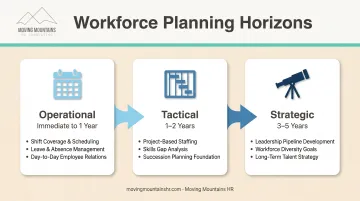
Workforce planning operates across three timeframes, though exact boundaries vary by organization:
- Operational (immediate to ~1 year): Covering shifts, managing seasonal demand, ensuring day-to-day capacity
- Tactical (1–2 years): Supporting specific projects, product launches, or growth milestones with the right team structure
- Strategic (3–5 years): Building future leadership, preserving critical capabilities, and preparing for long-term business changes
The process isn't one-size-fits-all. Your planning scope, role coverage, and timeline depend on your industry, size, and goals.
Why Workforce Planning Matters for Your Business
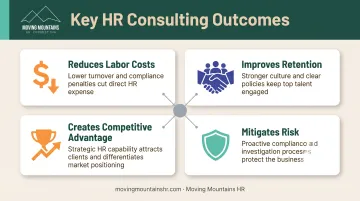
Reduces Labor Costs
Workforce planning helps you avoid the expensive mistakes of overstaffing, understaffing, and emergency hiring. When you know what you'll need in advance, you can recruit strategically, adjust schedules, and skip the premium cost of rushed external hires. CIPD research cites better deployment and targeted resource allocation as clear payoffs.
Improves Retention
Employees stay longer when they see a future. Planning helps you build clear career paths, spot development needs, and prevent burnout from chronic understaffing. Since replacing an employee costs 50% to 200% of their annual salary depending on role complexity, even modest retention gains deliver measurable savings.
Creates Competitive Advantage
When a new opportunity or market shift arrives, you don't want to be caught without the talent to execute. Workforce planning keeps the skills and capacity ready when it matters most—competitors still scrambling to hire are already months behind.
Mitigates Compliance and Risk
For California businesses, workforce planning intersects with complex employment rules. Knowing your headcount trajectory helps you prepare for thresholds such as:
- CFRA leave eligibility at 5+ employees
- Pay-scale posting requirements at 15+ employees
- Pay-data reporting at 100+ employees
Planning ahead lowers the risk of non-compliance.
Enables Better Decisions
Data-backed planning gives you visibility into workforce trends, costs, and capabilities. Instead of guessing, you base hiring, training, and reorganization decisions on evidence. That improves both the speed and quality of execution.
Key Components of Effective Workforce Planning
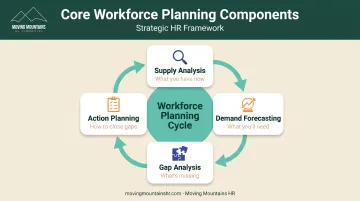
Supply Analysis
Start by understanding what you have today. Assess your current workforce including:
- Skills inventory and competencies
- Employee demographics, tenure, and performance levels
- Attrition patterns, turnover history, and intent to leave
- Organizational structure, reporting lines, and role overlap
This baseline shows your starting point and highlights existing strengths or vulnerabilities.
Demand Forecasting
Next, project what you'll need in the future. Base forecasts on:
- Business growth plans, revenue targets, and capacity assumptions
- Strategic objectives like new markets, products, or services
- Expected changes in productivity, processes, or technology
- External factors such as labor market conditions and industry trends
Use scenario planning to model different futures (growth, steady-state, or contraction) so you're prepared for multiple paths.
Gap Analysis
With supply and demand defined, compare the two to identify:
- Headcount gaps: Do you have enough people?
- Skills gaps: Do you have the right capabilities?
- Leadership gaps: Are successors ready for critical roles?
Prioritize gaps based on business impact, urgency, and risk. According to the U.S. Office of Personnel Management, mission-critical roles essential to your core business should be analyzed first.
Action Planning
Finally, close the gaps with targeted solutions:
- Recruiting: Hire external talent for new or hard-to-fill roles
- Training and development: Build capabilities internally through learning programs
- Internal mobility: Promote, transfer, or cross-train existing employees
- Outsourcing or contractors: Use flexible capacity for short-term or specialized needs
- Restructuring: Redesign roles, spans of control, or reporting lines for better efficiency
Assign ownership, set timelines, and establish metrics to track progress. Without owners, deadlines, and metrics, the plan stays a document instead of a workforce result.
The Workforce Planning Process: 4 Essential Steps
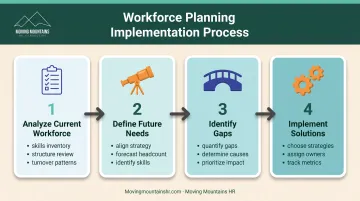
Step 1: Analyze Your Current Workforce
Begin with a clear picture of your starting point:
- Conduct a skills inventory: Document the capabilities, certifications, and competencies each employee brings
- Review organizational structure: Assess reporting lines, supervisory spans, and role overlap
- Evaluate performance and potential: Identify high performers, employees ready for advancement, and roles at risk
- Identify turnover patterns: Look at who's leaving, why, and which roles are hardest to retain or fill
Use existing data from payroll systems, performance reviews, and exit interviews. You don't need perfect data to start: just enough to understand your current state.
Step 2: Define Future Needs
Translate business goals into people requirements:
- Align with business strategy: What will your company need to achieve its goals over the next 1–3 years?
- Forecast headcount by department and role: How many people will each function require?
- Identify critical skills and competencies: What new capabilities must you build or acquire?
- Consider external factors: How tight is the labor market for your key roles? Are wages rising?
Use scenario planning (a base case, an optimistic growth case, and a conservative case) to build flexibility into your assumptions. Refresh forecasts quarterly rather than treating them as static annual plans.
Step 3: Identify and Prioritize Gaps
Compare your current workforce to future requirements:
- Quantify the gap: How many additional people or new skills do you need?
- Determine root causes: Are you losing people, growing too fast, or missing capabilities altogether?
- Prioritize by impact: Which gaps pose the greatest risk to business objectives?
Focus first on mission-critical roles: those that directly deliver your core product or service, require scarce skills, or have no ready successor.
Step 4: Develop and Implement Solutions
Create a detailed action plan:
- Choose strategies: Will you hire, train, promote, reorganize, or use contractors?
- Assign ownership and deadlines: Who is responsible for each action, and when will it be complete?
- Set success metrics: Track hiring progress, retention rates, critical-role coverage, and competency development
- Review and adjust regularly: Workforce planning is iterative—revisit assumptions and results at least quarterly
Implementation is where planning becomes results. Without clear accountability and measurement, even the best analysis stays on paper.
Common Workforce Planning Challenges (and Solutions)
Limited Data or Lack of HR Systems
Many small businesses don't have sophisticated HRIS (Human Resource Information System) platforms or historical workforce analytics.
Start simple. Use a spreadsheet to track basic metrics: headcount, turnover, open roles, and critical-skill coverage. Focus on your most important roles first, then expand as you build capability.
Difficulty Forecasting in Uncertain Environments
When market conditions or growth plans are unpredictable, creating a single forecast feels impossible.
Use scenario planning to model best-case, expected, and worst-case futures. Identify actions that make sense in all scenarios, and build quarterly review cycles so you can adjust quickly as conditions change.
Resistance From Leadership or Lack of Buy-In
Some leaders view workforce planning as HR paperwork, not a business priority.
Frame planning in business terms: cost savings, revenue capacity, and risk mitigation. Start with a pilot in one department, deliver quick wins, and demonstrate measurable impact. Success builds credibility.
Getting Started with Workforce Planning
Begin with Critical Roles
Don't try to plan for your entire organization at once. Identify 3–5 positions that have the greatest impact on business success—roles that are hard to fill, require scarce skills, or have no backup. Build your process around these roles, then expand over time.
Use Existing Data
Use information you already have: payroll records, performance reviews, turnover reports, and employee feedback. You don't need a perfect data set to start planning. Document what's missing, and fill gaps as you go.
Consider External HR Expertise
For small businesses without dedicated HR staff, workforce planning can feel overwhelming. Partnering with an HR consultant or fractional Chief Human Resources Officer (CHRO) provides strategic frameworks, accountability, and expertise without the cost of a full-time hire.
If you want that outside support, Moving Mountains HR offers tiered consulting packages that include workforce planning help for small and mid-size businesses. Options range from on-demand passive support to active participation in HR meetings and premium fractional CHRO guidance—so you can get help assessing staffing needs, forecasting demand, or building scalable HR systems without hiring full-time HR leadership.
Start with a complimentary 30-minute virtual consultation or 15-minute phone call to discuss your workforce planning priorities and identify gaps.
Frequently Asked Questions
What is workforce planning in simple terms?
Workforce planning means figuring out what people and skills your business will need in the future and making a plan to have them ready when you need them.
What are the 5 steps in HR planning?
Five commonly used steps are: (1) analyze your current workforce, (2) forecast future needs, (3) identify gaps, (4) develop action plans, and (5) implement and monitor solutions.
What is the difference between HR and workforce planning?
HR is the broader function managing all aspects of employees—recruiting, payroll, benefits, compliance, and employee relations. Workforce planning is a specific strategic process focused on aligning talent with business objectives over time.
What are the 5 key elements of workforce planning?
The five core elements are: supply analysis (current workforce assessment), demand forecasting (future needs projection), gap analysis (identifying shortfalls), solution implementation (closing gaps through hiring, training, or restructuring), and continuous monitoring and adjustment.
Can you give me some examples of workforce planning?
- A retail business preparing for holiday season hiring by forecasting staffing needs three months in advance and building a pipeline of seasonal candidates
- A professional services firm developing a succession plan for three retiring partners, identifying internal candidates, and creating development timelines
- A growing startup scaling from 15 to 50 employees over 18 months, mapping hiring priorities by quarter and defining new leadership roles before they're needed
What are the 5 R's of workforce planning?
The 5 R's are right people (qualified talent), right skills (needed competencies), right place (location and organizational fit), right time (available when needed), and right cost (within budget).