Introduction
Disengagement carries a steep price tag. Gallup's 2025 global workforce study puts lost productivity at about $10 trillion worldwide, with engagement at just 20% globally. In the U.S., 42% of employees who quit said their manager or organization could have prevented it. Turnover is still one of the costliest—and most preventable—expenses small businesses face.
Performance management and employee engagement work as one system. Done well, performance management sets clear expectations, steady feedback, and growth paths that raise engagement. Done poorly, it frustrates strong performers and pushes them out.
For small to mid-sized businesses without dedicated HR teams, that link is practical: you can build high-performing, committed teams with simple habits—not a bloated budget. This guide shows how the two fit together and which practices matter most.
Key Takeaways:
- Shape day-to-day experience with ongoing dialogue, not once-a-year reviews
- Drive engagement with clear goals, regular feedback, growth paths, strong managers, and real autonomy
- Weekly meaningful feedback ties to ~80% engagement—far above infrequent check-ins
- Favor simple, consistent habits over expensive software; train managers and protect time on the calendar
- Fit engagement-driven systems to your headcount, resources, and growth stage
Understanding the Connection: Why Performance Management and Employee Engagement Go Hand-in-Hand
Performance management isn't a once-a-year review form filed away in HR folders. It's the ongoing conversation that defines how employees experience their work. Every goal-setting session, feedback exchange, and development discussion contributes to whether someone feels valued, supported, and motivated—or frustrated, unclear, and ready to leave.
Engaged employees need three things performance management provides:
- Clear expectations that connect daily work to organizational priorities
- Regular feedback that confirms they're on track and valued
- Growth opportunities that show a future worth staying for
The relationship works in reverse, too. Well-managed performance builds psychological safety by removing the uncertainty and inconsistency that breed anxiety. Employees get recognition when it's earned and course correction before small issues turn into exit conversations. Purpose follows when people can see how their contributions matter.
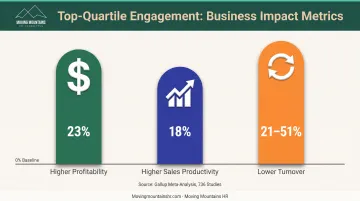
Employees who receive quarterly progress checks are 90% more likely to be engaged and 2.1 times as likely to see their performance management as fair and transparent. Gallup's analysis of 736 studies across 347 organizations found top-quartile engagement units delivered:
- 23% higher profitability
- 18% higher sales productivity
- 21–51% lower turnover than bottom-quartile units
For small to mid-sized businesses operating without full-time HR staff, this connection matters even more. You can't afford disengagement—whether measured in lost productivity, preventable turnover, or the time managers spend firefighting avoidable problems. Performance management becomes the practical framework that keeps small teams aligned, motivated, and performing without requiring a large HR department to maintain it.
The Top Drivers of Employee Engagement Through Performance Management
Clear Goals and Expectations
Goals do more than define tasks. They provide direction, meaning, and a sense of contribution. When employees understand what they're working toward and why it matters, engagement follows naturally. The problem is that most organizations either skip collaborative goal-setting entirely or treat it as a box-checking exercise disconnected from real work.
Effective goal-setting frameworks like SMART goals (specific, measurable, achievable, relevant, time-based) or OKRs (objectives and key results) give structure to this process.
The framework matters less than two practices: make goals specific enough to guide daily decisions, and connect individual goals to the organizational mission so people see how their work contributes to something larger.
Only 3 in 10 employees reported their manager involved them in goal setting, but those who were involved were four times as likely to be engaged. Participation creates ownership. When employees help shape their own targets, they execute a plan they believe in.
Regular Feedback and Recognition
Annual reviews have failed. 74% of employees reported receiving performance reviews once a year or less, and the results speak for themselves: only 14% strongly agreed reviews inspired improvement, just 29% called them fair, and only 26% found them accurate.
Continuous feedback works better. 80% of employees who received meaningful feedback in the prior week were fully engaged, a stark contrast to the disengagement that comes from waiting months to hear whether you're on track. Weekly feedback provides course correction when it's still useful, reinforces positive behaviors immediately, and builds trust through consistent communication.
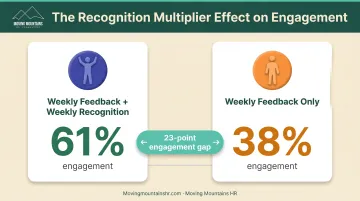
Recognition amplifies the effect. Weekly feedback plus weekly recognition corresponded to 61% engagement, compared to 38% with weekly feedback but less-frequent recognition. Balance constructive feedback with appreciation. Employees need to know what to improve and what they're doing well.
Growth and Development Opportunities
Career development is a retention strategy, not a nice-to-have perk. 25% of U.S. employees lack advancement opportunities, and those without development paths leave. Mentorship is linked to higher job satisfaction than going without it.
Effective development planning goes beyond generic training catalogs. It requires personalized paths that account for individual career goals, skill gaps, and the organization's future needs. The best performance management systems treat development as a regular conversation topic, not an annual afterthought.
Growth doesn't always mean promotion. Skill-building, lateral moves, project leadership, and expanded responsibilities all create development opportunities that increase engagement and retention without requiring a new title or salary band.
Manager-Employee Relationships
The direct manager is the single most influential factor in employee engagement. Gallup estimates managers account for at least 70% of variance in engagement scores across business units. That is why manager training matters more than any software platform or policy update.
Performance conversations are where that relationship gets built or broken. Effective discussions create trust by demonstrating that the manager cares about the employee's success, understands their challenges, and will advocate for their growth. Poor discussions (rushed, one-sided, or focused only on criticism) damage psychological safety and drive disengagement.
What makes performance discussions effective:
- Two-way dialogue, not monologue
- Focus on growth and support, not just accountability
- Frequency—monthly at minimum, not annually
- Preparation from both parties with specific examples
- Follow-through on commitments made during the conversation
Autonomy and Empowerment
Employees who feel like order-takers disengage. Those who own their work and influence how it gets done stay motivated. Performance management can either reinforce top-down control or create space for autonomy—and engagement depends on which path you choose.
Involving employees in goal-setting is the first step. Empowerment goes further by letting them shape how goals are achieved, solve problems without micromanagement, and contribute ideas that improve processes. This ownership taps into intrinsic motivation: the drive to do good work for its own sake, not only for external rewards.
Autonomy also drives innovation. When employees feel empowered to experiment, question assumptions, and propose improvements, they bring insights managers miss. Performance management becomes a tool for unlocking that creativity rather than enforcing rigid compliance.
Building an Engagement-Driven Performance Management System
An effective system holds people accountable and still supports their growth. Build it around these core components:
1. Goal-Setting Framework
Choose SMART goals, OKRs, or another structured approach. Train managers to set goals collaboratively with employees and tie targets to organizational priorities. Review and adjust goals quarterly, not annually, so they stay relevant as business needs shift.
2. Feedback Mechanisms
Schedule monthly one-on-ones as the baseline cadence. Encourage informal feedback after project milestones, client interactions, or team meetings. Build a recognition habit: managers should acknowledge contributions weekly, not just during formal reviews.
3. Development Planning
Make career development a standing agenda item in one-on-ones. Document individual development plans that outline skill-building goals, learning resources, mentorship opportunities, and stretch assignments. Revisit plans quarterly and tie them to performance goals.
4. Recognition Programs
Formal programs help, but consistency matters more than budget. Weekly shout-outs in team meetings, handwritten notes, or small spot bonuses all reinforce valued behaviors when delivered regularly.
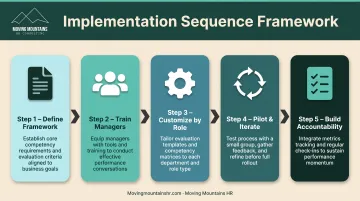
Step-by-Step Implementation:
- Define your framework - Select goal-setting and feedback practices that fit your organization's complexity and culture
- Train your managers - Invest time in teaching managers how to set collaborative goals, deliver constructive feedback, and conduct meaningful one-on-ones
- Customize by role - Use daily check-ins for frontline staff, structured video conversations for remote employees, and coaching for managers who juggle personal goals with team development
- Pilot and iterate - Start with one team or department, gather feedback, and refine before rolling out company-wide
- Build accountability - Use calendar reminders, manager dashboards, or simple tracking sheets to ensure conversations happen consistently
Moving Mountains HR helps small to mid-sized businesses design practical, engagement-focused performance systems. That support covers framework design, manager training, and compliance alignment without expensive software.
Common Pitfalls That Break the Performance-Engagement Connection
Even well-intentioned performance management systems fail when they fall into predictable traps:
Performance Management as Punishment
When the only time employees hear from managers is when something's wrong, performance management becomes a tool of fear rather than development. This creates defensiveness, erodes trust, and drives talented people to update their résumés. Balance accountability with recognition and support.
Infrequent or Inconsistent Feedback
Quarterly reviews scheduled but frequently postponed. Managers who deliver feedback to some employees but not others. Systems that exist on paper but not in practice. Inconsistency breeds cynicism. If employees can't count on regular, reliable conversations, they disengage from the process entirely.
Lack of Follow-Through on Development
Promising training, mentorship, or stretch assignments during performance conversations and then never delivering destroys credibility faster than skipping the conversation altogether. Document commitments and build follow-up into your next one-on-one agenda.
Overly Complex Systems
Software platforms with 47 required fields, competency matrices requiring PhD-level interpretation, or rating scales with vague distinctions between levels all create friction. Complexity discourages participation and shifts focus from meaningful conversation to form completion.
Misaligned Metrics
Measuring activity instead of outcomes, prioritizing easily quantifiable metrics over impact, or rewarding individual performance in roles requiring collaboration all send mixed signals. Employees disengage when the metrics don't reflect what actually matters.
Manager Bias and Favoritism
According to SHRM reporting on biased performance evaluations, field studies found ambiguous review language that disadvantaged women, and at one site only 15% of women managers and 24% of men managers trusted the evaluation process. Predetermined evidence checklists improved specificity, and consistent criteria reduced rating gaps. Without structured criteria and bias training, evaluations become popularity contests that destroy trust and engagement.
Measuring the Impact: Key Metrics to Track
Track engagement and performance metrics together so you can tell whether your system is actually working.
Engagement Metrics:
- Retention rates: voluntary turnover by department, tenure, and role
- Turnover costs: replacement cost estimates (~40% of salary for frontline roles, 80% for technical roles, 200% for managers)
- Employee satisfaction scores: pulse or annual engagement surveys that show sentiment trends
- Development participation: enrollment and completion rates for training, mentoring, and skill-building
- Manager effectiveness ratings: employee ratings of support, feedback quality, and development focus
Performance Metrics:
- Goal achievement rates: share of individual and team goals met or exceeded each quarter
- Productivity indicators: output per employee, project completion rates, or revenue per FTE
- Quality scores: error rates, rework, customer satisfaction, or other quality measures tied to your work
- One-on-one completion rates: whether managers hold scheduled check-ins as planned (a leading process signal)
Ongoing Health Monitoring:
Short pulse surveys keep the performance-engagement link visible in real time. Ask a few targeted questions monthly or quarterly:
- Do you have clear goals for the next 90 days?
- Have you received meaningful feedback in the past week?
- Does your manager support your career development?
- Do you feel recognized for your contributions?
Read trends, not one-off scores. A dip after a tough quarter can be normal; a steady three-month decline is a signal to act.
Frequently Asked Questions
How does performance management contribute to employee engagement?
Performance management creates the structure for clear expectations, regular feedback, recognition, and growth opportunities—the core drivers of engagement. Treated as ongoing dialogue rather than a once-a-year review, it builds trust, psychological safety, and purpose that keep people motivated and committed.
What are the top 5 drivers of employee engagement?
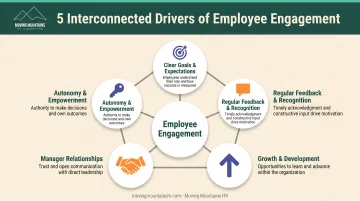
The primary drivers are clear goals and expectations, regular feedback and recognition, growth and development opportunities, strong manager-employee relationships, and autonomy or empowerment in how work gets done. Each requires deliberate performance management practices to sustain.
What are the 5 pillars of performance management?
The core pillars are goal setting, continuous feedback, performance evaluation, employee development, and recognition and rewards. They cover clear objectives, regular coaching, formal assessments, skill-building, and reinforcing the behaviors you want repeated.
What's the difference between performance management and employee engagement?
Performance management is the structured process organizations use to align work with business objectives through goals, feedback, evaluations, and development plans. Employee engagement is the outcome: how connected, motivated, and committed people feel. Performance management is a primary tool for driving that engagement.
How often should performance conversations happen to maintain engagement?
At minimum, conduct formal one-on-ones monthly, with informal feedback happening continuously as situations arise. More formal reviews should occur quarterly or semi-annually to assess progress and adjust goals. Weekly meaningful feedback corresponds to 80% engagement, making frequency a key driver of results.
Can small businesses implement effective performance management without expensive software?
Yes. Effective performance management runs on consistent practices and trained managers, not expensive software. Simple templates, shared documents, and calendar reminders work well; the real investment is teaching managers to set collaborative goals, give constructive feedback, and hold meaningful development conversations.