Introduction
Picture this: a 22-employee logistics company tracks performance through a shared spreadsheet nobody updates and a manager's memory of "who's been doing a good job lately." Come annual review time, everyone scrambles to remember what happened in March.
This isn't rare. Many small business owners either skip performance management entirely or dread the once-a-year review ritual that satisfies no one.
The data backs up the frustration. Only about 1 in 5 employees say their performance reviews are transparent, fair, or actually inspire better work, according to a Gallup survey of over 18,000 U.S. employees.
This guide breaks down what a performance management system actually is and walks through its five-stage cycle. You’ll see why it matters for small and mid-size businesses—and how to choose between software, DIY, or expert-guided support.
Key Takeaways
- Performance management aligns employee effort with business goals through ongoing feedback—not a once-a-year review
- The core cycle runs through five stages: Plan, Monitor, Develop, Review, and Reward
- Strong systems boost retention and productivity while creating a defensible record for HR decisions
- You don't need expensive software; a right-sized process or expert guidance works too
What Is a Performance Management System?
A performance management system (PMS) pairs a core process (goal-setting, ongoing feedback, and evaluation) with optional technology to support it. It's both a management philosophy and a practical way to run that philosophy consistently.
For decades, "performance management" meant one thing: an annual review form filled out under deadline pressure, filed away, and rarely referenced until next year. That model is fading fast. Modern performance management treats feedback as a year-round conversation between managers and employees, not paperwork due every December.
Core Elements of an Effective System
Every functional PMS, regardless of size or budget, includes these building blocks:
- Alignment — connecting individual roles to the company's broader mission
- Clear expectations — defining measurable outcomes for each position
- Development planning — mapping how employees grow their skills
- Regular check-ins — structured conversations that happen more than once a year
One distinction matters: performance management is the ongoing, year-round process. A performance appraisal is just one event inside it: the periodic look-back that summarizes what you've already discussed along the way.
Who's Involved
- Employees set goals, seek feedback, and track their own progress
- Managers coach, monitor, and document performance in real time
- HR professionals design the framework, train managers, and ensure consistency across teams
You can build this with a shared template and a recurring calendar invite, or with dedicated software. Company size and budget shouldn't be a barrier to getting started.
The Performance Management Cycle: How It Works
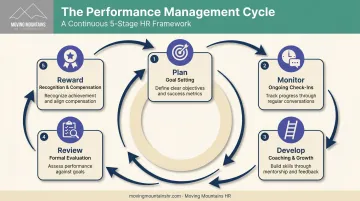
Every effective PMS moves through five connected stages. Skip one, and the whole system weakens.
1. Plan – Goal Setting and Alignment
Start with SMART goals: Specific, Measurable, Attainable, Relevant, and Time-bound. The U.S. Office of Personnel Management defines these as precise, objectively measurable targets tied directly to a real business need, with a deadline attached.
Each employee's goals should trace back to a team or company objective. If a goal doesn't connect to something the business actually needs, it's busywork.
2. Monitor – Ongoing Check-Ins
This is where most annual-only systems collapse. Waiting twelve months to discuss performance means small issues become big ones.
Regular one-on-ones, even 15 minutes every two weeks, catch problems early and give employees a chance to course-correct before a formal review ever happens.
3. Develop – Coaching and Growth Plans
Skipping this stage is expensive. Career development issues were the leading driver of employee turnover in 2024, accounting for 18.9% of departures. That figure comes from over 14,000 exit interviews analyzed in the Work Institute's 2025 Retention Report.
A growth plan doesn't need to be elaborate:
- Identify one skill gap per employee
- Assign a stretch project or training resource
- Revisit progress at the next check-in
4. Review – Formal Evaluation
Formal reviews still matter. They're where you document progress, calibrate ratings across similar roles, and sometimes incorporate 360-degree feedback from peers. Calibration matters most here: two managers rating the same performance level differently is how inconsistency (and legal risk) creeps in.
5. Reward – Recognition and Compensation
Recognition and pay decisions should trace directly back to documented performance data from stages 1-4. Employees stay motivated when they see a clear link between effort and reward. You also get a defensible paper trail if a compensation or promotion decision is ever questioned.
Why Performance Management Systems Matter for Your Business
A well-run PMS isn't a nice-to-have. It touches nearly every people-related risk and opportunity a small business faces.
Employee engagement and retention. Employees who know what's expected of them and receive regular feedback report higher engagement than those left guessing. Involving employees in setting their own goals builds more buy-in than goals handed down without discussion.
Productivity gains. Engaged teams deliver stronger production and sales results. Gallup's engagement research finds that highly engaged teams outperform disengaged ones on both metrics, which is why a working PMS shows up in output, not only in survey scores.
Legal and compliance protection. A documented, consistent performance process gives you a contemporaneous record if you ever need to explain a termination, demotion, or pay decision. The EEOC's guidance for small businesses specifically notes that managers conducting evaluations need to understand their responsibilities to help prevent discrimination claims. Documentation doesn't guarantee you avoid a lawsuit, but it strengthens your position considerably.
Talent development and succession planning. Performance data tells you who's ready for more responsibility long before a leadership seat opens up. Without it, succession decisions become guesswork.
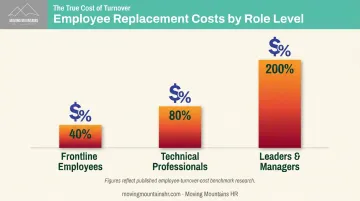
Reduced turnover costs. Turnover isn't cheap, and the cost scales with the role. Gallup estimates replacement costs at roughly 40% of salary for frontline employees, 80% for technical professionals, and 200% for leaders and managers (from their 2024 turnover research). Proactive performance management, especially ongoing development and coaching, directly addresses one of the biggest preventable drivers of that cost.
Software vs. DIY vs. HR Consultant: Choosing the Right Approach
There's no single right answer here. The best approach depends on your headcount, budget, and how much internal HR expertise you already have.
Software-Based Approach
Dedicated performance management software makes sense once manual tracking gets unwieldy. That usually means 30+ employees, or teams that need automated reminders, analytics dashboards, and 360-degree feedback.
Current market pricing runs:
| Platform Type | Typical Price | Notes |
|---|---|---|
| Mid-market PMS software | $5–$10 per employee/month | Annual contracts often $5,000–$15,000 minimum |
| 15Five Perform | $11/user/month | Billed annually; includes OKRs and check-ins |
| Lattice Performance | $10/seat/month | $4,000 annual minimum |
Watch for implementation fees and annual minimums — they can dominate costs for very small teams.
DIY/Manual Approach
A lightweight, template-based process works fine for very small teams (under 15 employees) who need structure without a platform.
The risk is consistency. Without expert guidance, documentation drifts, managers apply criteria differently, and gaps show up when you need records most: during a dispute.
HR Consultant or Fractional Support
Many SMBs don't need software at all. Partnering with an HR consulting firm to design and manage a right-sized performance process can be more cost-effective and more compliant than either DIY templates or a software subscription.
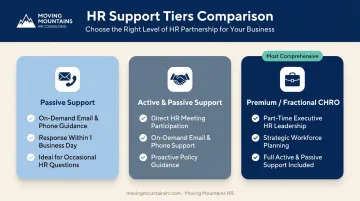
This is where Moving Mountains HR fits for California and U.S.-based small to mid-size businesses. Rather than selling a platform, the firm builds the performance management framework directly into its ongoing HR support:
- Passive Support: On-demand guidance by email or phone when performance questions come up
- Active & Passive Support: Direct participation in your company's HR meetings, plus on-demand help
- Premium (Fractional CHRO): Part-time executive HR leadership that designs performance frameworks and guides sensitive decisions
Cost Comparison
Rough ranges, depending on approach:
- DIY templates: Free to low-cost, but time-intensive and easy to apply inconsistently
- Software subscriptions: About $5–$11 per employee/month, plus setup fees and annual minimums
- Consultant engagements: Custom-quoted by company size and scope
Moving Mountains HR quotes per client rather than a flat rate. Final cost depends on headcount and support tier. A free consultation is the fastest way to get a real number.
Best Practices for Implementing an Effective Performance Management System
Getting the framework right matters less than executing it consistently. A few practices separate systems that work from ones that gather dust.
Consistency and calibration
Use the same criteria for employees in similar roles. Inconsistent standards are one of the fastest routes to a discrimination claim, even when no discrimination was intended.
Transparency and ongoing feedback
Replace the "surprise" annual review with frequent, informal check-ins. Nobody should hear about a performance problem for the first time in a formal review.
Manager training
This one carries outsized weight. Gallup research attributes 70% of the variance in team-level engagement to the manager — not company policy, not perks, the manager. Train managers to coach, not judge:
- Ask questions before delivering verdicts
- Document conversations as they happen, not months later
- Separate the person's potential from a single bad week
Document as you go
Write down goals, feedback, and outcomes when they happen. Clean records protect the business in disputes and make the next review faster and fairer.
Put these practices in writing, train every manager the same way, and revisit the process at least once a year so it stays useful—not ceremonial.
Frequently Asked Questions
What does performance management do?
It aligns employee effort with business goals through ongoing goal-setting, feedback, and evaluation, not a single annual event. It functions like the operating system under every performance conversation you have all year.
How much does a performance management system cost?
Costs range from free DIY templates to $5–$11 per employee/month for software, to custom-quoted consultant engagements. The right number depends on your company size and chosen approach.
What are the 5 C's of performance management?
Some practitioners use a mnemonic of Clarity, Communication, Collaboration, Consistency, and Coaching. This isn't a universal industry standard. Treat it as a helpful checklist, not an official framework.
What's the difference between performance management and a performance appraisal?
An appraisal is a periodic look-back event, usually annual or semi-annual. Performance management is the year-round process of goal-setting, check-ins, and coaching that appraisals summarize.
Does a small business really need performance management software?
No. Software helps at scale, but many SMBs succeed with structured templates or consultant-guided processes long before investing in a platform.
How often should performance check-ins happen?
Aim for monthly or quarterly informal check-ins, supplemented by a formal semi-annual or annual review. That cadence supports continuous performance management better than an annual-only cycle.