
Introduction: Aligning Your Workforce Strategy With Business Goals
Many small to mid-size businesses hit a familiar crossroads. Growth accelerates, markets shift, or customer demands evolve, but the team that got you here may not be ready for what's next. Without dedicated HR leadership, owners often find themselves reacting to urgent hiring needs rather than building a workforce strategy that drives long-term goals.
Strategic HR planning bridges that gap. It moves you from scrambling to fill positions to deliberately designing a talent roadmap aligned with where your business is heading.
This guide walks you through a clear framework for building an HR strategic plan—even without a full-time HR executive on staff.
Key Takeaways
- Align workforce capabilities with 1–5 year goals so the right talent is ready when you need it
- Cut turnover costs of 50–200% of salary per hire while gaining a competitive edge in hiring
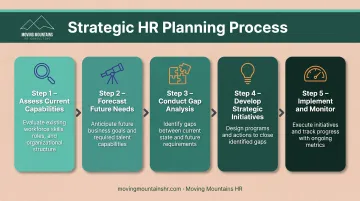
- Use five steps: assess capabilities, forecast needs, close gaps, launch initiatives, and monitor results
- Ease budget limits and change resistance with phased rollouts, clear communication, and fractional HR
What is Strategic HR Planning? Understanding the Foundation
Strategic HR planning (also called strategic human resource management, or SHRM) is the process of aligning workforce planning with organizational strategy over a 1-5 year timeframe. Unlike day-to-day HR tasks such as processing payroll or handling employee complaints, strategic HR looks ahead and builds the workforce the business will need.
Transactional vs. Strategic HR
Transactional HR is reactive and administrative. It handles tasks as they arise: onboarding new hires, updating handbooks, resolving conflicts. Strategic HR, by contrast, starts with business goals and asks critical questions:
- Will we have enough talent for our planned expansion?
- What skills will we need to enter new markets?
- How do we reduce turnover risk in revenue-critical positions?
- Which roles should we develop internally versus recruit externally?
A Concrete Example
Consider a growing consultancy planning to expand its service offerings. Strategic HR planning means forecasting the need for senior talent 12-18 months ahead. That includes building talent pipelines, upskilling current staff, and securing budget approvals so you are not scrambling when a major contract arrives.
Why Small Businesses Benefit Most
In small to mid-size companies, every hire has outsized impact on culture, budget, and operational capacity. Strategic planning helps you make those decisions deliberately, reducing costly mis-hires and enabling faster responses to new opportunities.
Why Strategic HR Planning Matters for Small Businesses
Small businesses with clear career paths, development opportunities, and visible growth plans compete effectively against larger employers. Strategic HR planning lets you offer stability and progression that ad-hoc hiring cannot match. That attracts candidates who value meaningful work and professional growth over corporate perks.
Cost Savings and Risk Reduction
According to Gallup's 2019 analysis, replacing one employee costs approximately 50-200% of annual salary. Strategic planning reduces those costs by:
- Minimizing emergency hiring and premium recruiting fees
- Decreasing turnover through proactive retention strategies
- Preventing compliance violations and related penalties
Repeat FLSA wage-and-hour infractions alone can trigger fines up to $2,515 under DOL's 2026 penalty schedule.
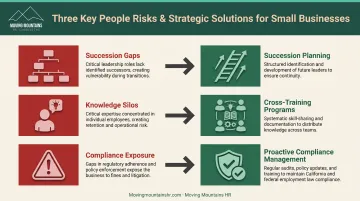
Cost is only part of the picture. Small businesses also carry concentrated people risks:
- Succession gaps: Key employees leave, and no one is ready to step in
- Knowledge silos: Critical expertise resides in one person
- Compliance exposure: Employment-law violations can threaten business viability
Succession planning, cross-training, and proactive compliance management close those gaps before they become crises.
Agility Without a Full HR Bench
Companies that understand their workforce capabilities can pivot faster when opportunities arise. When you know which skills you have, which you're developing, and which you can hire quickly, bigger bets get less risky—for example, covering a lead role with cross-trained staff instead of freezing a project until a new hire starts.
Concerned about lacking internal HR expertise? SHRM reported in 2024 that more than 80% of small-business HR decision-makers lacked formal HR training or experience. Fractional HR leadership or an external consultant like Moving Mountains HR can guide strategic planning without the overhead of a full-time HR executive.
5 Essential Steps to Develop Your HR Strategic Plan
Step 1: Assess Your Current Workforce Capabilities
Start with an inventory of your team:
- Roles and headcount: List current positions, employment status, and reporting structure
- Skills and proficiency: Use a simple matrix (spreadsheet or HRIS) mapping employees to role-critical skills and proficiency levels
- Performance and potential: Note performance ratings, productivity, engagement signals, and promotion readiness
- Compensation competitiveness: Compare pay against market benchmarks using BLS Occupational Employment and Wage Statistics
- Turnover and succession: Identify roles with no ready successor and positions vulnerable to regrettable turnover
External factors to evaluate:
- Local labor market conditions and unemployment trends
- Industry-specific talent shortages (check BLS Employment Projections for occupational supply forecasts)
- Competitor hiring practices
- Regulatory environment, especially in high-compliance states like California
Step 2: Forecast Future Workforce Needs
Align forecasting with your business strategy. Clarify your 1-5 year goals: expansion plans, new products or services, market entry, technology adoption, or operational changes.
Demand forecasting quantifies future labor requirements:
- How many employees will you need?
- What roles and skill levels?
- When will demand peak?
Base projections on business plans, historical growth patterns, and industry benchmarks. SHRM's framework recommends asking whether today's workforce will be adequate for your company in five years.
Supply forecasting predicts workforce availability:
- Start with current headcount and skills
- Subtract anticipated retirements and likely turnover
- Add expected promotions, transfers, and completed development programs
- Identify external labor market trends affecting talent availability
Scenario modeling: Build flexibility by modeling best-case, expected-case, and worst-case scenarios. Identify which actions remain valuable across multiple futures, and establish trigger indicators that signal when to adjust your plan. SHRM recommends quarterly scenario reviews rather than annual-only planning.
Step 3: Conduct a Thorough Gap Analysis
Compare current capabilities (Step 1) against future needs (Step 2) to identify specific gaps in headcount, skills, experience, or organizational structure.
Prioritize gaps using a simple table with these criteria:
| Gap | Business Impact | Urgency | External Scarcity | Internal Coverage | Cost to Close |
|---|---|---|---|---|---|
| Senior developer | Revenue-critical | 12 months | High | None | High |
| Compliance trainer | Risk mitigation | 6 months | Medium | Partial | Medium |
Focus on:
- Positions critical to revenue generation
- Gaps that create compliance or operational risks
- Skills shortages that could delay strategic initiatives
Internal vs. external solutions: Decide which gaps you can close through employee development and which need outside hires. Weigh time, cost, and candidate availability for each gap.
Step 4: Develop Strategic HR Initiatives to Close Gaps
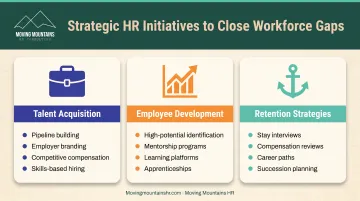
Match each prioritized gap to a concrete initiative in acquisition, development, or retention.
Talent acquisition strategies:
- Build pipelines through networking and partnerships with educational institutions
- Develop compelling employer branding for your niche (career paths, growth opportunities, meaningful work)
- Establish competitive compensation packages using market research
- Create skills-based role criteria and realistic job previews
Employee development programs:
- Identify high-potential employees for advancement
- Establish mentorship programs pairing junior staff with experienced employees
- Invest in online learning platforms or training partnerships
- Use DOL-registered apprenticeships for paid on-the-job training combined with classroom instruction
Retention strategies:
- Conduct stay interviews using SHRM's five-question framework to understand what keeps valuable employees engaged
- Address compensation gaps or workplace culture issues proactively
- Create visible career paths and development opportunities
- Establish succession plans for critical roles
Context-specific strategies: A California retail business planning expansion might prioritize manager training on state-specific labor laws, while a healthcare practice might focus on clinical credentialing and continuing education.
Step 5: Implement, Monitor, and Adjust Your Plan
Create an implementation roadmap with:
- Clear timelines and milestones
- Assigned responsibilities and decision rights
- Required resources and budget
- Dependencies and risk triggers
Establish KPIs to track progress:
- Time-to-fill for critical positions
- Employee retention rates (especially regrettable turnover)
- Internal promotion rates
- Training completion and time-to-productivity
- Employee engagement scores
Review cycles:
- Monthly: Action status and urgent hiring or retention risks
- Quarterly: Workforce assumptions, scenario triggers, KPI movement, and initiative continuation/change/stop decisions
- Annually: Refresh business outlook and rolling multi-year demand view
Communicate the plan so leaders and managers know HR's direction, how it supports business goals, and what they own in execution.
Key Components of an Effective HR Strategic Plan Document
A strong HR strategic plan is a working document leaders can act on—not a binder that sits on a shelf. Build yours around these nine components:
- Executive summary: HR's strategic objectives and how they support business goals
- Business context: Planning horizon, assumptions, and scenario triggers
- Current workforce analysis: Roles, headcount, skills, performance, engagement, pay position, and risks
- Future demand forecast: Required roles, skills, quantities, and timing
- Supply forecast: Expected exits, internal movement, and external availability
- Prioritized gaps: Impact and urgency scores for each gap
- Strategic initiatives: Acquisition, development, retention, and succession programs—each with owners, resources, milestones, and decision rights
- KPI framework: Definitions, baselines, targets, data owners, and review frequency
- Communication plan: Stakeholder messaging, feedback routes, and quarterly adjustment rules
How you package the plan matters as much as what you put in it:
Format best practices:
- Lead with a one-page strategy summary, then attach supporting data tables
- Show explicit links from each HR initiative to specific business objectives
- Write for non-HR stakeholders—skip jargon so leaders can reference it quickly
- Treat it as a living document: update quarterly instead of filing it away
Common Challenges and How to Overcome Them
Even a solid HR strategy runs into friction. Budget limits, resistance to change, and daily firefighting are the obstacles small and mid-size businesses hit most often. Here’s how to work through each one.
Limited Budget Constraints
Challenge: Small businesses often lack the budget for comprehensive HR systems or full-time expertise.
Solutions:
- Phased implementation: Prioritize highest-impact initiatives first; add others as budget allows
- Cost-effective tools: Use spreadsheets for skills matrices, free BLS data for market research, and online learning platforms for development
- Fractional HR expertise: Engage consultants for strategic guidance while your team handles routine tasks internally
- Focus on critical roles: Limit your first plan to revenue-critical positions and 3-5 priority initiatives
Resistance to Change
Challenge: Leadership or employees resist new HR processes or strategic initiatives.
Solutions:
- Secure executive buy-in first: Demonstrate ROI using turnover costs, compliance risks, and competitive hiring challenges
- Communicate the "why" consistently: Connect strategic changes to business goals and employee benefits
- Involve stakeholders in planning: Build ownership by including managers in gap analysis and initiative design
- Start small and show results: Implement one high-visibility initiative successfully before expanding
Maintaining Strategic Focus Amid Daily Demands
Challenge: Operational urgencies crowd out strategic HR work.
Solutions:
- Designate protected time: Block specific hours for strategic HR work; treat these as non-negotiable
- Assign clear accountability: Name an owner for each strategic initiative; track progress in regular meetings
- Consider external support: Bring in fractional HR leaders for strategic planning while internal staff run day-to-day operations
- Use simple tools: Lightweight scorecards and one-page plans require less maintenance than complex systems
Measuring Success: KPIs for Strategic HR Planning
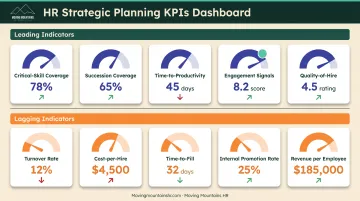
Pick a short KPI set tied to the gaps in your HR plan. Leading indicators help you course-correct early; lagging indicators confirm whether the strategy moved the business.
Leading Indicators (Predict Future Success)
- Critical-skill coverage: Percentage of required critical skills at target proficiency
- Succession coverage: Percentage of critical roles with a ready or developing successor
- Time-to-productivity: Days from start date to role-specific proficiency threshold
- Employee engagement signals: Consistent pulse items and closed action items, not just scores
- Quality-of-hire inputs: Early performance, retention, and structured post-hire feedback
Lagging Indicators (Confirm Strategic Impact)
- Voluntary/regrettable turnover: Separations divided by average headcount, segmented by critical role and reason
- Cost-per-hire: Recruiting costs per completed hire (document which cost categories you include so comparisons stay consistent)
- Time-to-fill: Calendar days from requisition opening to offer acceptance
- Internal promotion rate: Promotions or priority openings filled internally
- Revenue or productivity per employee: Role-relevant output, quality, or customer measures linked to original gaps
Baseline and measurement discipline:
Establish baseline metrics before implementing strategic initiatives, then measure improvement quarterly. ISO 30414 provides human-capital reporting guidelines applicable to organizations of any size, with specific SME recommendations.
Benchmark caution: SHRM reported 2025 average nonexecutive cost-per-hire of $5,475 and 2026 median time-to-fill of 39 days. These are reference points, not automatic targets—your optimal metrics depend on your industry, geography, and business model.
Frequently Asked Questions
What are the 5 steps of strategic HR management?
Strategic HR management follows five steps: assess current workforce capabilities, forecast future needs from business strategy, run a gap analysis prioritized by impact, develop initiatives to close those gaps, and implement with KPI monitoring and quarterly adjustments.
What are the 7 stages of the strategic planning process?
Some frameworks use seven stages: understand business objectives and the external environment, assess current HR capabilities, forecast workforce demand, analyze supply-demand gaps, formulate HR objectives, build implementation plans with owners and timelines, and monitor results through KPIs.
What are some examples of HR strategic planning?
Common examples include building a talent pipeline 12–18 months before market expansion, succession plans and cross-training for managers, retention programs in tight labor markets, and reskilling plans when automation changes roles.
What are the 5 P's of strategic human resource management?
The 5 P's are Philosophy (values that guide people management), Policies (rules that put those values into practice), Programs (training, performance, and recognition), Practices (day-to-day employee experiences), and Processes (systems that keep the other elements working together).
Ready to build a strategic HR plan tailored to your business? Moving Mountains HR provides fractional CHRO services, HR strategy consulting, and compliance support designed for small to mid-size businesses. Schedule a complimentary 30-minute virtual consultation or call 866-474-3575 to discuss your workforce planning needs.