Introduction
Workforce development strategies in 2026 focus on how organizations build, train, and retain teams while struggling with talent scarcity, fast-moving technology, and shifting employee expectations. As 34% of small business owners report job openings they cannot fill, the stakes for effective workforce planning have never been higher.
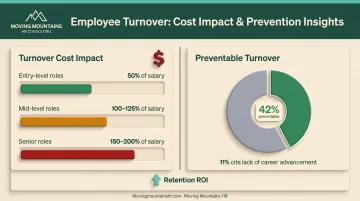
For small to mid-size businesses, emerging workforce development trends support competitiveness and cut turnover costs that average 50%–200% of annual salary. They also strengthen engagement and help teams adapt when conditions change.
Organizations without dedicated HR teams can no longer treat workforce development as optional. It directly affects productivity, retention, and long-term growth. This guide covers the 2026 strategies that matter most—skills planning, retention, and training models built for lean teams.
Key Takeaways
- Upskilling for AI-driven workflows and shifting roles defines workforce development in 2026
- Small businesses win talent with personalized development pathways and clear career advancement
- Align leadership, HR partners, and employees so workforce plans support real business goals
- Build California compliance—harassment prevention and safety training—into development strategies
- People investment pays measurable ROI through stronger retention, productivity, and agility
Building Skills for an AI-Augmented Workplace
In 2026, artificial intelligence has moved from experimental pilot projects to embedded daily workflows across industries. Census data shows 50% of workers at businesses with 2-499 employees now use AI, yet only about one in ten have received formal AI training. This gap creates both an urgent challenge and a competitive advantage for businesses that act decisively.
Workforce development now requires training employees to work alongside AI tools rather than compete with them. The goal is automation of repetitive tasks so teams can focus on higher-value strategic work: customer relationship building, creative problem-solving, and complex decisions technology cannot replicate.
Practical applications include:
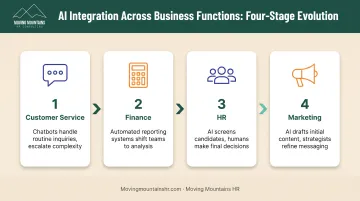
- Customer service teams learning to use AI chatbots for routine inquiries while handling escalations personally
- Finance staff using automated reporting tools to shift from data entry to analysis and forecasting
- HR teams using AI for candidate screening while maintaining human judgment for final hiring decisions
- Marketing professionals employing AI for content drafting while applying brand expertise to strategy and refinement
Businesses that upskill employees for AI collaboration see productivity gains and reduce resistance to technological change. Among AI users, 59% reported using time saved to produce more or higher-quality work. Employees whose leaders communicated a clear AI integration plan were three times as likely to feel prepared to use these tools effectively.
Small businesses can access affordable AI training through:
- Online learning platforms
- Industry webinars and workshops
- Partnerships with HR consultants who support workplace change
For California-based businesses, Moving Mountains HR offers customized training in leadership development, compliance, and performance management—help teams adapt as AI enters daily workflows, matched to industry, workforce size, and culture.
Creating Personalized Career Development Pathways
Personalized career development pathways are customized plans that align each employee's goals with what the business needs. They replace one-size-fits-all training that fails to engage or retain talent.
Businesses increasingly use Individual Development Plans (IDPs), mentorship programs, and skills assessments to create tailored growth opportunities. These tools help employees see a clear career path ahead—so they're less likely to look elsewhere for the next step.
Real-world implementation examples:
- Offering leadership training to high-potential employees identified during performance reviews
- Creating cross-functional project assignments that build new skills while delivering business value
- Providing tuition reimbursement for industry certifications that benefit both employee and employer
- Pairing junior staff with experienced mentors for knowledge transfer and career guidance
This approach matches what employees want, especially younger workers who weigh career growth heavily when choosing an employer. Research shows that among voluntary leavers, 42% believed their departure was preventable, and career advancement opportunities accounted for 11% of those preventable-turnover responses.
Replacement costs run 50%–200% of annual salary depending on the role. That makes personalized development a practical retention investment with a measurable payoff.
Small businesses can build these pathways without a large training budget:
- Hold career conversations in regular performance reviews and ask where people want to grow
- Tap internal mentors who can share expertise during normal work hours
- Use free or low-cost platforms such as LinkedIn Learning, Coursera for Business, or industry-specific resources
If you lack in-house HR, an outsourced consultant can design IDP frameworks, run skills-gap assessments, and build pathways that tie employee goals to business strategy. Moving Mountains HR helps small and mid-size businesses put performance management systems and customized development programs in place—aligned with organizational goals and California compliance requirements.
Embedding Continuous Learning Into Company Culture
Leading organizations in 2026 have moved from annual training events to continuous, on-demand learning built into daily work. Knowledge retention improves when learning happens in small, frequent doses—not infrequent marathon sessions.
Continuous learning shows up in practical ways:
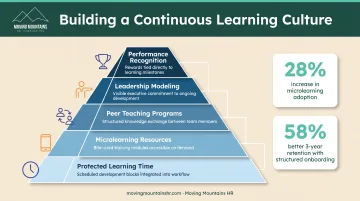
- Offer 5-10 minute microlearning videos or interactive lessons employees can finish at their desk
- Host weekly or monthly lunch-and-learns where teams share knowledge over a meal
- Run peer teaching programs so teammates pass on job-specific skills
- Build digital libraries of articles, videos, and courses matched to each role
- Protect learning time so skill development counts as real work, not an extra task
Research on microlearning shows its use has increased 28 percentage points since 2017, and only 7% of organizations surveyed say they don't use it. Common uses include technical training, performance support, interpersonal skills, and faster onboarding.
Healthcare practices might run weekly 15-minute compliance updates on regulation changes. Retail teams can use mobile apps for product knowledge and customer service techniques. Service companies often build internal video tutorials for common client scenarios.
Continuous learning cultures drive stronger engagement, faster new-hire ramp-up, fewer knowledge gaps, and quicker adaptation to market shifts. Structured onboarding programs are associated with employees being 58% more likely to remain for three years. Early investment in learning sets those retention patterns.
Building the culture takes leadership buy-in and real resources. Leaders need to free up work time for development, show that learning is valued, and model it themselves.
Small businesses can start simply:
- Set aside one protected hour each week for development
- Create a shared folder of role-relevant learning resources
- Recognize employees who apply new skills to improve processes
Prioritizing Compliance-Driven Workforce Development
Workforce development strategies in 2026 must address evolving employment regulations, especially in high-compliance states like California where labor laws are complex, frequently updated, and rigorously enforced.
Compliance-focused development includes mandatory training in harassment prevention, safety protocols, and wage-hour laws, paired with documented training completion and policy updates as regulations change.
Critical California requirements:
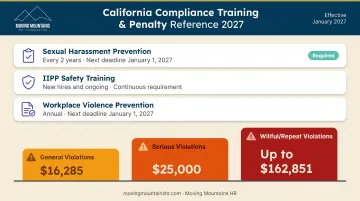
- Sexual harassment prevention: Employers with 5+ employees must train nonsupervisors (1 hour) and supervisors (2 hours) every two years, with the next deadline January 1, 2027
- IIPP / safety training: All California employers need a written Injury and Illness Prevention Program (IIPP), with training for new hires, new assignments, new hazards, and supervisors
- Workplace violence prevention: California’s SB 553 requires most employers to maintain a written workplace violence prevention plan and train employees on its procedures
Non-compliance exposes businesses to lawsuits, penalties, reputational damage, and operational disruptions that hit small organizations especially hard. Cal/OSHA's 2025 penalty schedule sets maximum fines at $16,285 for general violations, $25,000 for serious violations, and up to $162,851 for willful or repeat violations.
Beyond avoiding penalties, compliance training protects company culture and employee safety. It establishes clear behavioral expectations, creates documentation that defends against frivolous claims, and demonstrates good-faith efforts to maintain legal workplaces.
Small businesses often lack internal expertise to track changing requirements. Partnering with HR consultants who specialize in California employment law, such as Moving Mountains HR, helps keep training current, documentation audit-ready, and policies aligned as laws change.
The right partner can deliver compliance training virtually or on-site and run policy audits that catch gaps before they become violations.
Leveraging Fractional and Outsourced HR Expertise
Small to mid-size businesses increasingly rely on fractional HR professionals, consultants, or outsourced HR services to design and implement workforce development strategies without the cost of full-time HR staff.
About half of small businesses manage HR in-house, and more than 80% of those HR decision-makers lack HR training, experience, or confidence. Meanwhile, the median wage for HR managers reached $140,030 in May 2024, a significant expense for organizations with limited budgets and fluctuating HR needs.
Common approaches include:
- Hiring fractional Chief Human Resources Officers (CHROs) for quarterly strategic planning sessions
- Engaging HR consultants to conduct skills gap assessments and design training programs
- Outsourcing training administration, compliance tracking, and performance management systems to specialized firms
- Bringing in consultants for targeted work (investigations, leadership coaching, policy updates) without a full-time hire
Fractional and outsourced HR gives you executive-level expertise at a fraction of full-time cost. You pay for what you need, scale support as priorities shift, and tap skills your internal team may not have.
For workforce development, outside HR partners often bring ready frameworks you can put to work quickly:
- Career pathway design and competency assessments
- Training program structure and learning-culture practices
- Objective read on strengths, gaps, and where to invest first
- Systems and processes that stay in place after the engagement ends
Moving Mountains HR is built around this model. Founded by Michelle Schwanhauser, a seasoned HR executive with deep healthcare industry experience, the firm serves small and mid-size businesses across the U.S., with strong California employment-law expertise.
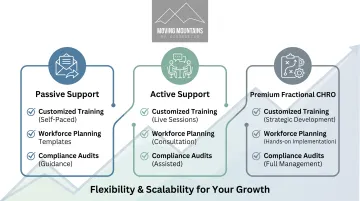
Support ranges from passive email guidance to active HR meeting participation to premium fractional CHRO services. Clients get customized training (leadership, compliance, performance management), strategic workforce planning, and compliance audits without hiring a full-time HR executive—a fit for shops that need periodic guidance and for mid-size teams tackling specific development gaps.
What's Driving These Workforce Development Strategies
Several forces are reshaping workforce development priorities in 2026. Organizations that do not adapt risk losing ground to competitors and watching top performers walk out the door.
Technology Acceleration and AI Integration
Rapid AI adoption and automation are changing job requirements, eliminating some tasks while creating demand for new skills. Businesses must continuously upskill their workforce to stay competitive as technology evolves.
Census data tracking 15 business functions found AI use ranged from 17%-20% overall, with larger firms (250+ employees) adopting at 37% and smaller firms lagging. Yet among workers at businesses with 2-499 employees, 50% already use AI, creating a disconnect between employer strategy and employee reality. The 41% of small-business workers who cite an AI skills gap demonstrate an urgent need for formal training.
Talent Scarcity and Competitive Labor Markets
Demographic shifts, skills gaps, and employee mobility create intense competition for qualified workers. Retaining talent through development programs is now a core business requirement.
In April 2025, 34% of small-business owners reported job openings they could not fill. That persistent gap pushes businesses to invest in existing employees rather than recruit endlessly. With replacement costs ranging from 50%-200% of annual salary depending on role level, retention through development delivers clear ROI.
Evolving Employee Expectations
Employees—especially Millennials and Gen Z—prioritize professional development, meaningful work, and career growth when choosing employers. Meeting those expectations is central to keeping people on the team.
Deloitte's 2025 global survey found mentorship important to 86% of Gen Z and 84% of millennials, with practical, on-the-job learning important to 88% and 89% respectively. Among voluntary leavers, 45% reported no manager or leader had discussed their satisfaction, performance, or future during the previous three months. That gap is a clear failure of career development and engagement.
Regulatory Complexity and Compliance Requirements
Expanding employment laws, industry regulations, and compliance mandates require ongoing workforce training to avoid legal risks that can cripple small businesses.
California shows how quickly the burden stacks up. State rules alone include:
- Harassment prevention training for employers with 5+ employees
- IIPP safety programs with role-specific training for all employers
- Frequent labor law updates that change what managers must know
Healthcare, finance, and other regulated industries add federal layers such as OSHA standards on top of state obligations. Businesses without dedicated compliance staff struggle to track requirements, schedule training, and keep documentation current, which is why outsourced compliance support is increasingly essential.
How These Strategies Are Impacting Businesses
Workforce development strategies create measurable impacts across operations, business performance, and culture—not only inside the training room.
Operational Impact
Structured development tightens day-to-day execution:
- Faster time-to-productivity for new hires through structured onboarding
- Better process efficiency from cross-training that removes single points of failure
- Fewer errors when continuous skill development reinforces best practices
Organizations with standardized onboarding report 50% higher new-hire productivity, and time-to-full-productivity often drops by months. Cross-trained teams also adapt faster during growth, market shifts, or staff transitions because versatile workers can cover more than one function.
Business Impact
Leaders are treating workforce development as strategy, not a side budget. That shows up as larger development investments, workforce planning tied to business goals, and partnerships with schools or HR consultancies for expertise and capacity.
Results show up in the numbers that matter to owners: stronger retention (fewer costly recruitment cycles), higher productivity and revenue per employee, better customer satisfaction from trained staff, and a clearer employer brand.
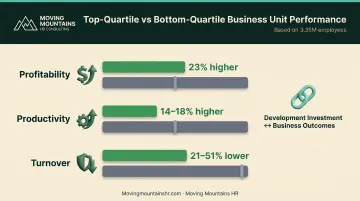
Gallup's engagement meta-analysis covering 3.35 million employees found top-quartile business units had 23% higher profitability, 14%–18% higher productivity, and 21%–51% lower turnover than bottom-quartile units. Development, engagement, and business-unit performance move together.
Workforce Impact
Skills demand is shifting. Employers want digital literacy, data analysis, critical thinking, emotional intelligence, and adaptability next to technical job skills. International research on SMEs using generative AI found 65% reported improved employee performance. The sample was outside the US, but the direction matches what many American small and mid-size employers already see on the ground.
How work is organized is changing too:
- Flatter hierarchies that value skills over titles
- More internal mobility and clearer career pathways
- Employees who own their development plans
- Cultures built around continuous learning
When people see real growth paths, they engage more deeply and become advocates for the organization.
Future Signals for Workforce Development Strategies
2026 priorities are clear, but a few early signals already show how workforce development will shift for small and mid-size US employers through 2027–2028.
Early indicators include:
- Skills-based hiring is gaining on degree-first screens. A Northeastern University study of 256 small-business managers found only 39% believed degree holders were better job-ready than microcredential holders; 49% hired candidates with both
- Micro-credentials and digital badges are spreading as portable, verifiable proof of skill employees can carry across jobs
- AI learning platforms adapt content and pacing to each person’s skill gaps and career goals
- Development programs are tying more tightly to DEI goals to close equity gaps and open advancement paths
Emerging technologies to watch:
- AI coaching tools that give on-demand guidance and feedback
- VR and AR for immersive training in high-risk or complex work
- Predictive analytics that flag skill gaps and flight risk before they turn urgent
- Blockchain-backed credentials and portable learning records that follow employees across roles
These signals are still early. Solid adoption benchmarks for small and mid-size US businesses are thin.
Monitor the trends, pilot tools selectively, and keep the fundamentals first: personalized development, a continuous learning culture, and compliance. Technology will mostly change how you deliver those basics, not whether they matter.
Conclusion
Workforce development strategies in 2026 are reshaping how small and mid-size businesses attract, develop, and retain talent. AI adoption, talent scarcity, shifting employee expectations, and regulatory complexity make strategic workforce investment a core priority for sustainable growth.
Organizations that invest early in development programs—through internal initiatives or partners like Moving Mountains HR—gain real advantages in retention, operational agility, and performance. Start with the gaps that matter most to your business, then build from there.
Frequently Asked Questions
What are the 5 R's of workforce planning?
The 5 R's framework covers the Right number of people, with the Right skills, in the Right place, at the Right time, for the Right cost. It helps businesses match workforce capacity to operational demand while keeping costs in check.
What are some effective employee development techniques?
Effective techniques include mentorship programs, job rotations, online learning platforms, stretch assignments, peer learning sessions, and formal training courses. Combining several methods tailored to employee needs and business goals works better than any single tactic.
How much should small businesses budget for workforce development?
Industry benchmarks recommend allocating 1–3% of payroll to training and development. Small businesses can start smaller with internal knowledge sharing, free online resources, and fractional HR support to stretch limited budgets.
What is the difference between workforce development and employee training?
Employee training teaches specific skills for current job performance, such as software proficiency or safety protocols. Workforce development is broader: it includes training plus career planning, succession planning, culture building, and aligning talent with long-term strategy.
How can small businesses with limited HR resources implement workforce development strategies?
Start with simple skills gap assessments during performance reviews, prioritize needs that align with business goals, and use free or low-cost learning resources. Partner with fractional HR consultants or firms like Moving Mountains HR to design programs without full-time HR staff.