
Key Takeaways
- Build communication, delegation, and decision-making skills through structured practice—not theory alone
- Pick from 10 exercises, from no-cost reflection to modest-budget challenges, that fit any team size
- Pair clear objectives, active participation, and guided debriefs so learning transfers on the job
- Run monthly or quarterly sessions with real-world application to lock in lasting skill growth
What Are Leadership Development Activities?
Leadership development activities are purposeful exercises that allow leaders and emerging leaders to practice essential skills in a low-stakes environment before applying them in real workplace situations. These activities differ from generic team-building by targeting specific leadership competencies:
- Strategic thinking
- Giving feedback
- Managing conflict
- Delegating effectively
- Building trust
The most effective activities connect directly to real challenges leaders face in their roles. A 2017 meta-analysis of 335 samples found substantial learning and transfer effects when training included structured practice and workplace application. The structured debrief matters most: participants reflect on what they learned and commit to applying it on the job.
10 Leadership Development Activities for Your Team
The following 10 activities move from simpler trust-building exercises to more complex strategic challenges, each with clear setup instructions and targeted skill development.
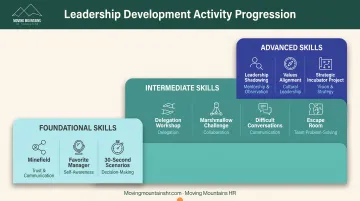
Activity 1: Minefield (Trust and Communication)
Setup: Pairs navigate a "minefield" of objects while one person is blindfolded and relies entirely on their partner's verbal directions. It needs only open space and common objects like water bottles, boxes, or soft toys.
Leadership skills developed: Trust-building, clear communication under pressure, active listening, and giving specific directional guidance. Research on blindfold training with 85 participants found teams using verbal-only communication demonstrated significantly more closed-loop communication (20.3 vs. 16.6 exchanges) and directed communication (4.3 vs. 1.5 instances) than control groups.
Practical tips:
- Use soft objects for safety
- Have pairs switch roles so everyone experiences both leading and following
- Debrief by asking what communication approaches worked best and why
- Connect lessons to workplace scenarios requiring clear remote direction or cross-functional collaboration
Activity 2: Your Favorite Manager Reflection (Self-Awareness)
Setup: Participants individually reflect on the best and worst managers they've worked for, then identify 3-4 specific behaviors from each. Small groups discuss common themes and commit to emulating positive behaviors while avoiding negative ones. Allow 10 minutes for individual reflection before group discussion.
Leadership skills developed: Self-awareness, understanding how leadership behaviors impact team members, and identifying concrete practices to adopt or avoid. Gallup's manager development research analyzed thousands of leaders and found managers account for 70% of variance in team engagement—making behavioral modeling critical.
Practical guidance:
- Encourage specificity: not "good communicator" but "held weekly one-on-ones and always asked how they could help"
- Have each participant commit to one behavior they'll start practicing this week
- Follow up in two weeks to discuss which behaviors participants implemented and what impact they noticed
Activity 3: 30-Second Leadership Scenarios (Decision-Making)
Setup: Present leaders with realistic workplace scenarios (underperforming team member, conflicting priorities, resource constraints) and give them only 30 seconds to decide on an action and explain their reasoning.
Leadership skills developed: Decisive thinking under time pressure, articulating rationale clearly, and practicing judgment calls that leaders face regularly.
Facilitation tips:
- Prepare 5-6 scenarios relevant to your industry and actual challenges your managers encounter
- Have observers note decision patterns and trade-offs each leader emphasized
- Debrief by discussing what information leaders wished they had and how they balanced competing considerations
- Connect to real decisions participants will face in the next month
Activity 4: Delegation Practice Workshop (Empowerment)
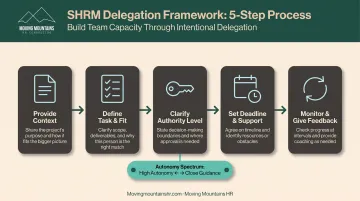
Setup: Give each participant a complex task written on a card, then have them practice delegating it to a partner using a structured framework: context, task, authority level, deadline, and check-in points. Partners provide feedback on clarity and whether they'd feel empowered to succeed.
Leadership skills developed: Effective delegation, one of the hardest transitions for new managers. DDI's 2025 Global Leadership Forecast assessed over 70,000 manager candidates and found only 19% demonstrated strong delegation skills. Research on autonomy-supportive leadership with 32,870 workers linked appropriate autonomy to higher team motivation and performance.
Implementation guidance:
- Use real work scenarios when possible to increase transfer
- Have participants practice delegating the same task multiple ways: high autonomy vs. close guidance
- Emphasize that good delegation saves leader time while developing team members
- SHRM's delegation framework covers outcome, fit, authority, deadline, support, and how you'll monitor and give feedback
Activity 5: Marshmallow Challenge (Collaboration and Innovation)
Setup: Teams of 3-4 people have 18 minutes to build the tallest free-standing structure using only spaghetti, tape, string, and a marshmallow that must sit on top. This classic exercise requires only inexpensive supplies—20 spaghetti sticks, one yard each of tape and string, and one marshmallow per team.
Leadership skills developed: Rapid prototyping vs. over-planning, collaborative problem-solving, handling failure productively, and testing assumptions early. Creator Tom Wujec reports that kindergarteners often outperform business school students because they test iteratively rather than planning extensively. The marshmallow's weight often collapses structures for teams that wait until the end to place it.
Facilitation notes:
- Measure final structures and celebrate both the tallest and most creative approaches
- Discuss why early prototyping matters and how it applies to project management
- Ask teams to identify their leadership approach: did one person direct, or did leadership emerge organically?
- Connect lessons to real projects where assumptions go untested until late stages
Activity 6: Difficult Conversation Role-Play (Feedback and Accountability)
Setup: Provide realistic scenarios requiring tough conversations: addressing poor performance, denying a promotion request, or delivering critical feedback. Then have participants role-play both leader and employee roles with observer feedback.
Leadership skills developed: Delivering difficult feedback with clarity and empathy, managing emotional reactions, maintaining accountability while preserving relationships, and listening to employee perspective. A 2019 poll of 540 people found half avoided the other party rather than hold a crucial workplace conversation—making practice essential.
Structure:
- Use a 3-round format: initial attempt, coaching/feedback, improved second attempt
- Provide CCL's SBI feedback framework: Situation, Behavior, Impact
- Emphasize that most managers avoid these conversations, but they're essential for team performance
- Have observers note specific language that worked and what made employees defensive
Activity 7: Escape Room Challenge (Problem-Solving and Pressure Management)
Setup: Physical or virtual escape rooms require teams to solve puzzles collaboratively under time pressure. Local facilities typically charge $20-40 per person for group bookings, or use online platforms for remote/hybrid teams at similar rates.
Leadership skills developed: Strategic thinking, resource allocation, leveraging diverse team strengths, staying calm under pressure, and recognizing when to shift approaches if something isn't working.
Practical tips:
- Debrief immediately after while energy is high
- Ask who naturally took leadership roles and why
- Discuss how the team divided tasks and whether that was effective
- Connect parallels to workplace deadline pressure and cross-functional collaboration
- Note: While emerging research on escape rooms shows promise for leadership development, this activity works best when the debrief explicitly targets coordination and information-sharing skills
Activity 8: Leadership Shadowing Program (Organizational Awareness)
Setup: Pair emerging leaders with senior leaders for a half-day shadowing experience where they observe meetings, decisions, and daily leadership challenges. This costs nothing but time and gives emerging leaders direct exposure to how senior roles actually run.
Leadership skills developed: Understanding the scope and complexity of senior leadership roles, observing how experienced leaders handle difficult situations, building cross-functional organizational knowledge, and strengthening mentorship relationships. A 2025 study of 64 adults in health, education, and technology found self-reported satisfaction rose from 3.2 to 4.5 and skill development from 3.5 to 4.7 over 12 months of structured shadowing.
Implementation guidance:
- Schedule shadowing during substantive work, not just routine admin days
- Have participants prepare 3-5 observation questions beforehand
- Require a brief reflection writeup afterward noting 2-3 leadership approaches they observed and want to emulate
- Follow up one month later to discuss what they've applied
Activity 9: Values Alignment Exercise (Purpose and Culture)
Setup: Individuals identify their top 3-5 personal values from a provided list, then small groups discuss how these align with organizational values and where tensions exist. Conclude with commitments on living values in daily decisions.
Leadership skills developed: Self-awareness about what drives decisions, understanding how personal values shape leadership style, recognizing organizational culture, and making explicit connections between stated values and daily behaviors.
Guidance:
- Provide a values list: integrity, innovation, collaboration, accountability, growth, service, transparency, excellence
- Create psychological safety by modeling vulnerability—share your own values and tensions
- Ask how values showed up in recent decisions
- Note that while research on values exercises focuses primarily on healthcare decision-making, the exercise surfaces behavioral trade-offs leaders face daily
Activity 10: Leadership Incubator Project (Strategic Execution)
Setup: Assign small teams a real organizational challenge (improving a process, solving a recurring problem, or proposing a new initiative) and give them 4-6 weeks to analyze, develop recommendations, and present to senior leadership.
Leadership skills developed: Strategic thinking, project management, stakeholder engagement, presenting to executives, handling questions and pushback, and experiencing ownership of meaningful business outcomes. CCL recommends action-learning projects tied to real work issues because workplace application is essential for skill consolidation. Without it, learners typically revert to prior behavior.
Structure:
- Provide executive sponsor support and access to needed information
- Require milestone check-ins at weeks 2 and 4
- Coach on presentation skills beforehand
- Ensure recommendations are genuinely considered, even if not all implemented
- Plan for the heavier time investment; the payoff is skill transfer on real business work
How to Choose the Right Activities for Your Team
Effective selection starts by identifying the specific leadership gaps you're trying to address. Is the issue unclear communication? Avoiding difficult conversations? Lack of strategic thinking? Match activities directly to those gaps rather than choosing based on what sounds fun.
Budget considerations for small businesses:
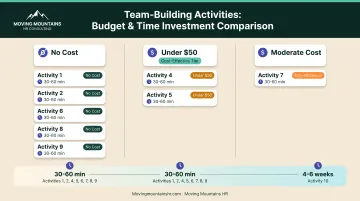
- No cost: Activities 1, 2, 6, 8, and 9 require only time
- Under $50 total: Activities 4 and 5 need minimal supplies
- Moderate per-person cost: Only Activity 7 requires budget ($20-40 per person)
Practical constraints:
- Team size: Activities 2, 6, and 9 work best for small teams (5-15 people), where psychological safety forms more easily
- Location: Most activities adapt to remote formats with breakout rooms and collaborative tools; hybrid sessions need intentional design so remote participants aren't left out
- Available time: Start with 30-60 minute activities before committing to half-day workshops
- Longer programs: Activity 10 spans 4-6 weeks; the rest fit in 30-90 minutes
Implementation recommendations:
- Start with 1-2 activities per quarter rather than overwhelming teams
- Rotate skill focus each quarter: communication one quarter, decision-making the next
- Build in structured debrief time; that's where learning sticks
- Solicit participant feedback to refine future activities
- Assign one workplace application per person and check in 2-4 weeks later
Measuring Effectiveness
Track both immediate and long-term impact:
Immediate feedback:
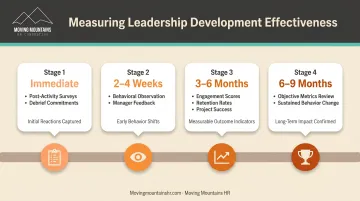
- Post-activity surveys asking what participants learned and will apply
- Debrief discussions capturing specific commitments
Behavioral observation:
- Managers and peers noting whether leaders actually use new skills in following weeks
- Self-reported application at 30-day check-ins
Outcome metrics tracked over 3-6 months:
- Team engagement scores
- Retention rates
- Project success rates
- Performance review improvements
The most important measure is whether leaders apply the skills—not whether they enjoyed the activity.
Research on leadership training effectiveness supports collecting data before, during, after, and again at 6–9 months, mixing objective metrics with subjective feedback when you can.
Conclusion
Leadership development activities pay for themselves. They build the pipeline every growing organization needs, cut costly leadership mistakes, and improve retention by showing employees you're invested in their growth.
Gallup's analysis of manager development programs found organizations saw up to 18% greater team engagement improvement and 21–28% less turnover than control groups.
These activities work best when embedded in a broader leadership development approach that includes coaching, regular feedback, and real opportunities to apply new skills. Small businesses can start small—one activity per quarter—and build momentum over time.
If you want activities tied to performance management and succession planning, an experienced HR partner can help you build a program that fits your size and constraints. Contact Moving Mountains HR to talk through your leadership development goals.
Frequently Asked Questions
What are some activities suggested to support leadership development?
Strong options include Minefield for communication, timed decision-making scenarios, Your Favorite Manager for self-awareness, and the Marshmallow Challenge for collaboration. Match each activity to a specific skill gap instead of running generic team-building.
How often should we conduct leadership development activities?
Most small to mid-size businesses do well with monthly or quarterly sessions, based on time and budget. Consistency beats frequency, so reliable quarterly work usually outperforms spotty monthly sessions. Follow up 2–4 weeks later to reinforce learning and track on-the-job use.
What leadership activities work best for small teams?
Teams of 5–15 people can involve everyone fully. Your Favorite Manager, Difficult Conversation role-plays, Values Alignment, and Delegation workshops work especially well in smaller groups, where people tend to share more openly.
How much do leadership development activities cost?
Many high-impact options cost little or nothing: Minefield, shadowing, and reflection exercises need only time. Supply-based activities like the Marshmallow Challenge usually stay under $50 total. Escape rooms and similar experiences typically run $20–40 per person.
Can leadership activities be done remotely or hybrid?
Most activities adapt to virtual formats with breakout rooms, video role-plays, shared screens, and online escape rooms. Keep interpersonal practice front and center so everyone participates equally. For hybrid sessions, assign a facilitator to remote attendees and use tools everyone can access the same way.
How do we measure the effectiveness of leadership development activities?
Combine post-activity surveys, manager and peer observation over the next 2–4 weeks, and outcome metrics over 3–6 months such as engagement, retention, and project success. What matters most is whether leaders apply the skills in real work situations.