
Organizations face new pressures: California's mandatory harassment training, OSHA compliance requirements, shrinking attention spans, and employees who expect flexible, personalized learning experiences. The delivery method you choose directly impacts retention, application, and ROI—making it one of the most critical decisions in your training strategy.
This guide explores the full spectrum of 2026 training delivery methods, emerging trends reshaping workplace learning, selection criteria for your organization, and implementation best practices that drive measurable results.
Key Takeaways
- Choose delivery methods that match your learning objectives, workforce distribution, and compliance mandates
- Blended learning (live instruction plus self-paced digital content) is becoming the default for many organizations
- AI-enhanced personalization, mobile-first design, and micro-credentialing are reshaping how employees learn in 2026
- Small to mid-size businesses can access cost-effective delivery through virtual training and Learning Management Systems
- California harassment training rules and federal OSHA standards limit which delivery methods employers can use
What is Training Delivery? Understanding the Fundamentals
Training delivery is how organizations communicate knowledge, skills, and competencies to learners. It covers the methods, technologies, resources, and environments that facilitate learning, from traditional classroom instruction to AI-powered adaptive platforms.
Training delivery differs from training design. Design answers what you teach: the learning objectives, content structure, and curriculum. Delivery answers how you teach: the format, technology, facilitation approach, and learning environment. Both must work together. Research shows that instructional methods (practice, feedback, and learner control) often matter more than the transmission medium itself.
Effective training delivery applies adult learning principles:
- Adults need to understand why they're learning something
- They prefer self-directed experiences
- They bring work experience into the learning process
- They learn best when content solves immediate problems
The delivery method you choose should support these principles while enabling measurable outcomes.
Why delivery matters: A meta-analysis of workplace training found that web-based instruction produced 6% better declarative knowledge outcomes than classroom instruction overall. That advantage disappeared when both formats used identical instructional methods. How you structure practice, feedback, and engagement drives retention more than whether training happens in a classroom or online.
The right delivery method directly impacts:
- Knowledge retention and skill application
- Training completion rates
- Cost per learner
- Speed to competency
- Compliance documentation
- Return on training investment
The Training Delivery Landscape in 2026
The post-pandemic workplace has permanently altered what employees expect from training. Remote and hybrid work patterns have stabilized, requiring delivery methods that accommodate distributed workforces and asynchronous schedules. Organizations can no longer default to classroom training when team members work across time zones, shift schedules, or field locations.
Compliance training now drives delivery choices, especially in healthcare, construction, and other regulated industries. OSHA explicitly requires employers to train workers on job-specific safety and health aspects, with requirements varying by standard.
California goes further: interactive harassment prevention training must run 1 hour for nonsupervisors and 2 hours for supervisors every two years, via classroom, webinar, or qualifying e-learning. Those rules remove pure convenience-based delivery decisions.
Attention spans are shrinking under information overload. Microsoft's 2023 Work Trend Index surveyed 31,000 workers globally and found that 68% lacked uninterrupted focus time and 62% spent too much time searching for information. Training must now compete with Slack notifications, email backlogs, and urgent project demands, so concise, relevant, just-in-time delivery matters more than ever.
Four forces now shape how organizations pick delivery methods:
- Distributed and hybrid teams that need asynchronous options
- Compliance rules that dictate format and interactivity
- Shorter attention windows that favor just-in-time content
- Affordable LMS, video, mobile, and AI tools once limited to large enterprises
Small businesses can already access those tools. The real barrier is choosing the right mix and designing learning that sticks.
Employee preferences are split. ATD's survey of 519 U.S. workers found that 54% preferred flexible training formats while one-third still favored traditional classroom learning. One-size-fits-all delivery will leave a large share of your workforce underserved.
Types of Training Delivery Methods: A Comprehensive Overview
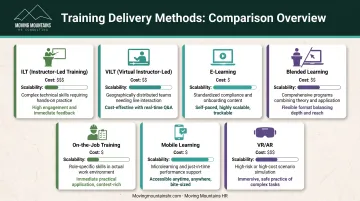
How you deliver training affects completion, skill transfer, and cost. Below are the main methods organizations use in 2026, with when each works best, what it does well, and where it falls short.
Instructor-Led Training (ILT)
Classroom training with a live instructor still fits 2026 programs that need demonstration, hands-on practice, and real-time feedback. It works best for complex topics where live interaction clearly improves outcomes.
When to use ILT:
- Technical skills requiring equipment operation or physical demonstration
- Leadership development programs emphasizing interpersonal dynamics
- Onboarding programs building organizational culture and team connections
- Compliance training with practical components (safety procedures, equipment handling)
Advantages:
- Immediate feedback and real-time assessment of understanding
- Human connection and relationship-building among participants
- Ability to adjust pace and content based on learner needs
- Effective for hands-on skills requiring physical practice
- Natural environment for role-plays and group exercises
Limitations:
- Scheduling constraints across distributed teams
- Travel costs and venue requirements
- Limited scalability: one instructor can only reach one group at a time
- Quality variation depending on instructor capability
- Time away from work for participants
Training magazine's 2025 survey found that classroom ILT accounted for 28% of training hours among U.S. organizations, with 49% using it for at least some programs. Organizations plan the largest increases in classroom delivery for management training (24%), interpersonal skills (21%), and executive development (20%), areas where live interaction provides clear value.
Virtual Instructor-Led Training (VILT)
VILT delivers live online training through video conferencing platforms like Zoom, Microsoft Teams, or WebEx. It maintains instructor interaction while eliminating geographic barriers and travel costs.
Best applications:
- Remote team training across multiple locations
- Regular skill-building sessions for distributed workforces
- Compliance training requiring interactive discussion
- Q&A sessions following self-paced content
- Expert-led workshops where travel isn't practical
Advantages:
- Reaches remote employees without travel costs
- Recordable sessions for later reference or makeup training
- Familiar technology most employees already use
- Easier scheduling with no venue requirements
- Can incorporate breakout rooms, polls, and digital whiteboards
Challenges:
- "Zoom fatigue" from prolonged video conferencing
- Technical issues and connectivity problems
- Harder to maintain engagement than in-person training
- Limited effectiveness for hands-on physical skills
- Requires deliberate design to prevent passive viewing
VILT represented 24% of training hours in 2025, used by 51% of organizations. Research from Stanford identifies excessive close-up eye contact, constant self-view, restricted movement, and high cognitive load as contributors to videoconference fatigue.
2026 best practices:
- Keep sessions to 45-60 minutes maximum
- Include interactive elements every 10 minutes
- Use breakout rooms for small-group discussion
- Build in stretch breaks during longer programs
- Send materials in advance so participants can preview content
E-Learning and Self-Paced Online Training
Digital courses accessed through Learning Management Systems allow learners to complete training independently, on their own schedule. Content can include slide-based courses, video tutorials, interactive quizzes, simulations, and microlearning modules.
Ideal use cases:
- Compliance training requiring documentation and tracking
- Product knowledge for distributed sales teams
- Software skills training with simulations
- Onboarding components covering policies and procedures
- Knowledge-based content that doesn't require live interaction
Advantages:
- Highly scalable: train unlimited learners with consistent messaging
- Learners control pace and can revisit difficult concepts
- Accessible 24/7 from any location
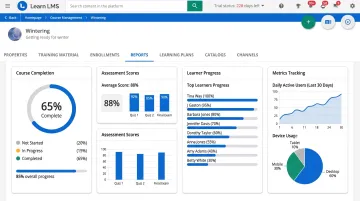
- Trackable metrics on completion, assessment scores, and time
- Cost-effective at scale once content is developed
Limitations:
- Requires self-motivation and time management
- Limited instructor interaction for questions
- Quality depends entirely on course design
- Technology barriers for less tech-savvy learners
- Higher upfront development costs
ATD research found that three-quarters of surveyed organizations used e-learning for at least half their programs, with compliance training as its most common application. Online/computer-based delivery accounted for 34% of training hours in 2025, making it the single largest delivery category.
Mobile-responsive design matters in 2026. Deskless workers in healthcare, construction, retail, and hospitality need training on smartphones and tablets, not just desktops. Mobile delivery accounted for 6% of training hours in 2025, doubling from 3% the year before.
Blended Learning
Blended learning strategically combines live instruction (ILT or VILT) with e-learning components to maximize effectiveness. Rather than choosing one method, blended programs draw on the strengths of multiple formats.
Common blended models:
- Flipped classroom: Learners complete online content first, then attend live sessions for practice, discussion, and application
- Core content plus Q&A: Self-paced modules deliver foundational knowledge; live sessions provide expert guidance and answer questions
- Sandbox practice: E-learning covers procedures; in-person labs provide hands-on equipment practice
Advantages:
- Flexibility for learners while maintaining structure
- Addresses different learning styles within one program
- Balances cost efficiency with learning effectiveness
- Scalable foundation with personalized live interaction
- Reduces live session time by moving foundational content online
Challenges:
- More complex to design and coordinate
- Requires multiple platforms and technologies
- Needs clear communication about expectations and deadlines
- Can confuse learners if components aren't well-integrated
Blended learning represented 22% of training hours in 2025, used by 46% of organizations. It's becoming the default approach for many organizations because it combines the cost efficiency of e-learning with the engagement and application benefits of live instruction.
On-the-Job Training (OJT) and Mentoring
Experiential learning where employees develop skills by performing actual job tasks with guidance from experienced colleagues. Formats include job shadowing, mentorship programs, buddy systems, and formal apprenticeships.
When OJT works best:
- Role-specific technical skills unique to your organization
- Equipment operation requiring hands-on practice
- Organizational culture and informal procedures
- New hire onboarding and team integration
- Skill transfer from experienced to newer employees
Advantages:
- Immediately applicable to actual job tasks
- Context-specific learning in the real work environment
- Builds relationships and strengthens team cohesion
- Cost-effective with no external vendor fees
- Identifies skill gaps and knowledge needs quickly
Limitations:
- Inconsistent quality across mentors and departments
- Depends heavily on mentor capability and teaching skill
- Difficult to track, measure, and document
- Can perpetuate bad habits or outdated procedures
- Takes experienced employees away from productive work
The U.S. Department of Labor defines Registered Apprenticeship as combining paid OJT with classroom instruction and mentorship. Structured programs with clear objectives, documentation, regular check-ins, and feedback mechanisms produce better results than informal "shadow and learn" approaches.
How to structure OJT in 2026:
- Define specific skills and competencies to be learned
- Assign trained mentors who understand how to teach
- Create documentation checklists for consistency
- Schedule regular check-ins to assess progress
- Gather feedback from both learner and mentor
Mobile Learning (mLearning)
Training delivered through smartphones and tablets, optimized for mobile consumption. Ideal formats include microlearning modules (3-5 minutes), quick reference guides, just-in-time resources, and short video snippets.
Best applications:
- Deskless workers in field, retail, or healthcare settings
- Just-in-time support accessed at point of need
- Quick refreshers on procedures or policies
- Pre-shift safety reminders
- Bite-sized compliance training
Advantages:
- Accessible anywhere, anytime from devices employees already carry
- Perfect for workers without regular computer access
- Supports just-in-time learning when employees need immediate answers
- Higher engagement with short, focused content
- Fits naturally into workflow breaks
Limitations:
- Small screen size limits complex content and detailed graphics
- Requires mobile-optimized design and development
- Potential for workplace distractions
- Not suitable for complex topics requiring deep concentration
- May require data plans or Wi-Fi access
Mobile learning is essential in 2026 for field-heavy industries such as construction, healthcare, retail, and hospitality. Adoption is still early as a share of total hours, but the recent jump in mobile delivery shows demand is rising fast among deskless teams.
Emerging Trends and Technologies Shaping Training Delivery in 2026
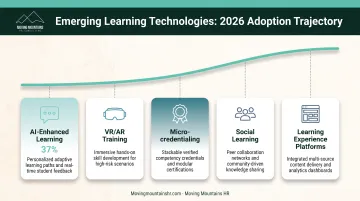
AI-enhanced learning is moving from experimental to operational. Training magazine reports that 37% of organizations now use AI technology in learning and development, up from 25% the previous year. Common applications include:
- Adaptive learning paths that adjust difficulty based on performance
- AI-powered chatbots for instant learner support
- Automated content recommendations and personalization at scale
Fosway's 2025 research identifies learning-system intelligence, automated media generation, translation, content creation, enhanced search, and personalized recommendations as the leading L&D AI use cases.
Immersive formats are advancing just as quickly. Virtual reality (VR) and augmented reality (AR) provide safe environments for high-risk training scenarios. A PwC study comparing classroom, e-learning, and VR inclusive-leadership training found that VR learners finished three times faster than classroom learners. PwC calculated cost parity with classroom delivery at 375 learners and with e-learning at 1,950 learners.
Typical applications include:
- Safety training and emergency response
- Equipment operation practice
- Customer service and leadership soft-skills scenarios
Falling hardware costs are making VR realistic for mid-size organizations, not only large enterprises.
Credential design is shifting in parallel. Micro-credentialing and skills-based learning focus on proving specific competencies rather than completing seat-time requirements. Digital badges, stackable credentials, and competency-based certifications let learners build recognized credentials incrementally. SHRM's 2022 research found that 45% of U.S. workers held alternative credentials including microcredentials, certifications, apprenticeships, or skill badges.
Social and collaborative learning tools leverage peer-to-peer knowledge sharing through internal knowledge bases, community forums, Slack or Teams integration, and user-generated content. Social learning accounted for 6% of training hours in 2025 and was used by 30% of organizations.
Learning Experience Platforms (LXP) curate content from multiple sources and use AI to recommend personalized learning journeys. Unlike traditional LMS platforms that track assigned training, LXPs emphasize learner-driven discovery, Netflix-style content recommendations, and integration of internal and external resources.
How to Choose the Right Training Delivery Method for Your Organization
Start with learning objectives: What specific skills or knowledge must employees gain? What does success look like? A compliance training objective ("employees must understand harassment policy") suggests a different delivery method than a skill objective ("employees can operate the forklift safely").
Define measurable outcomes:
- Knowledge objectives (can explain, can identify) → E-learning, VILT, or ILT
- Skill objectives (can perform, can demonstrate) → ILT, OJT, or VR simulation
- Behavior objectives (consistently applies on the job) → Blended learning with practice and reinforcement
Evaluate your audience:
- Work environment: Office workers can access computer-based training; field workers need mobile delivery
- Tech literacy: Less tech-savvy audiences may struggle with complex e-learning platforms
- Learning preferences: Some employees thrive with self-paced content; others need structure and interaction
- Geographic distribution: Dispersed teams favor virtual or self-paced methods; co-located teams can use ILT
- Time availability: Frontline workers with limited downtime need microlearning; salaried professionals can attend longer sessions
Assess practical constraints:
- Budget: Training magazine's 2025 benchmarks: $1,091/learner (small), $782 (midsize), $468 (large)
- Technology infrastructure: Do you have an LMS? Video conferencing licenses? Mobile-responsive platforms?
- Internal expertise: Can your team design e-learning courses, or do you need external support?
- Timeline: ILT and custom e-learning require longer development; VILT and purchased courses deploy faster
Compliance requirements also constrain delivery choices. Federal OSHA standards specify training requirements standard-by-standard.
California's harassment training regulations require interactive formats—classroom, webinar, or qualifying e-learning with questions, feedback, and scenarios. Passive video alone doesn't meet the legal standard.
Most organizations benefit from using multiple methods rather than selecting one universal approach. Compliance training might use e-learning for scalability and documentation, while leadership development uses blended learning with self-paced prework and live practice sessions.
Organizations can partner with HR consultants like Moving Mountains HR to assess training needs and design delivery strategies tailored to workforce characteristics, compliance requirements, and budget realities. Programs can be delivered virtually or in person through workshops, leadership series, coaching, or custom learning resources.

Best Practices for Implementing Effective Training Delivery
Start with clear, measurable learning objectives aligned to business outcomes before selecting delivery methods. "Complete harassment training" is a compliance task, not a learning objective. "Employees can recognize, report, and respond appropriately to harassment complaints" defines success and guides delivery decisions.
Pilot test new delivery methods with a small group before full rollout. Identify technical issues, confusing instructions, pacing problems, and content gaps while the stakes are low. Collect feedback through post-training surveys and informal debriefs, then refine before expanding to the full workforce.
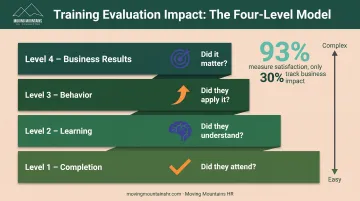
Gather continuous learner feedback through post-training surveys, assessment results, and follow-up interviews. ATD research found that 93% of organizations collect participant satisfaction data, but only 30% effectively use learning data for business decisions. Move beyond satisfaction scores to measure learning gains, behavior change, and business impact.
Track meaningful metrics:
- Completion rates: Are learners finishing the training?
- Assessment scores: Are learners mastering the content?
- Time to completion: How long does training take?
- On-the-job application: Are employees using new skills?
- Business results: Did training impact productivity, quality, safety, or retention?
That same research pressure shows up in goal alignment: only 43% of organizations report aligned learning and business goals, and just 45% have dedicated evaluation staff. Separate four levels of impact:
- Completion: Did they attend?
- Learning: Did they understand?
- Behavior: Did they apply it?
- Business results: Did it matter?
Method-specific ROI claims still require isolating training's contribution from other factors—a measurement challenge most organizations struggle with.
Putting these practices in place is easier when training is designed around business outcomes from the start. Moving Mountains HR partners with organizations on training program design, delivery strategy, and compliance guidance, including leadership development and California employment compliance, using practical tools and real-world scenarios tailored to each client's industry and culture.
Frequently Asked Questions
What is training delivery?
Training delivery is how organizations transfer knowledge and skills to learners. It covers the formats, tools, and facilitation approaches used—from classroom and virtual sessions to e-learning, coaching, and blended programs.
What are the most common delivery methods for training?
The five most common methods are instructor-led classroom training, virtual instructor-led training (live online), self-paced e-learning, blended learning, and on-the-job training with coaching or mentorship.
What is the best way to deliver training?
No single method is universally best. Fit depends on objectives, audience, content complexity, budget, and constraints. Instructional design (practice, feedback, learner control) usually matters more than the medium, and blended learning often balances flexibility with live practice well.
What are the five steps of the training process?
The five steps are: (1) assess needs and skill gaps, (2) design objectives and content, (3) develop materials and choose delivery methods, (4) deliver the training, and (5) evaluate results through assessments, behavior change, and business outcomes.
What is the 70-20-10 rule for learning?
The 70-20-10 model suggests roughly 70% of learning comes from on-the-job experience, 20% from social learning (coaching and peers), and 10% from formal courses. It is widely cited in business, but research does not support the exact ratio as a proven formula.