That complexity is exactly why outsourcing has become mainstream. Among businesses with 10-100 employees, PEOs alone now serve 17% of employers, according to a 2024 NAPEO industry report. That figure doesn't even count businesses using ASOs or fractional HR consultants.
The right outsourcing partner does three things well: it keeps you compliant, takes administrative tasks off your plate, and gives leadership room to focus on growth instead of paperwork. This guide breaks down the top HR outsourcing services of 2026 — from national PEOs to boutique consultancies like Moving Mountains HR — and shows you how to pick the one that actually fits your business.
Key Takeaways
- HR outsourcing spans full-service PEOs, ASOs, and fractional HR consulting, each built for different business sizes
- Strong providers combine compliance depth, transparent pricing, and reachable support
- National PEOs like ADP and TriNet fit scale needs; specialized firms like Moving Mountains HR suit targeted HR support
- Your best fit depends on company size, industry regulation, and how much control you want to retain
- Use the comparison tables and methodology below to shortlist the right provider fast
Overview of HR Outsourcing in 2026
HR outsourcing means handing off payroll, compliance, benefits, or strategic HR work to a third-party provider instead of building an internal department. But not all outsourcing looks the same:
- PEOs (Professional Employer Organizations): Co-employ your team and take on payroll taxes, workers' comp, and compliance while you keep day-to-day supervision and business decisions.
- ASOs (Administrative Services Organizations): Deliver specific HR services without co-employment—you stay the sole employer of record with no shared employment liability.
- Boutique/fractional HR consulting: Provides executive-level guidance and hands-on compliance support with no co-employment relationship.
The PEO segment alone represents more than $358 billion in industry revenue and employs over 4.5 million worksite employees across the U.S., per NAPEO's 2024 data. That scale reflects real demand, but bigger isn't automatically better for every business.
The providers below span different service models, price points, and specializations—so you can match the option to your actual needs rather than picking the biggest name on the list.
Top HR Outsourcing Services of 2026
We evaluated each provider on five criteria: compliance expertise, service model flexibility, pricing transparency, verified client feedback, and industry specialization. Here's how they stack up.
ADP
ADP has decades of infrastructure behind its payroll and tax processing, making it one of the most established names in HR outsourcing. It offers both ADP TotalSource (its PEO) and ADP Comprehensive Services (its non-co-employment ASO option), giving businesses flexibility in how much liability-sharing they want.
Where ADP really separates itself is workforce analytics. Its Workforce Now platform includes AI-powered dashboards, benchmarking tools, and customizable reporting built for multi-state compliance tracking. That said, the sheer scale of ADP's operation can mean less of a personal touch for very small teams that want a single point of contact.
| Best For | Reporting, analytics, and large-scale payroll compliance |
| Pricing Model | Custom quoted, per-employee-per-month |
| Key Features | Workforce analytics, PEO and ASO options, multi-state compliance tools |
TriNet
TriNet built its reputation automating compliance work for small-to-mid-size businesses, and it shows in the details. Its HR Platform includes a Compliance Assistant that tracks federal deadlines, flags I-9 filing status, and sends custom reminders before something slips through the cracks.
TriNet also leans into industry specialization. Its teams cover verticals like life sciences, financial services, technology, and nonprofits, with specialists tracking sector-specific regulatory and talent issues. On benefits compliance, TriNet documents support for ACA reporting, large-employer penalty notices, and COBRA election tracking.
Pricing isn't published as a flat rate; TriNet's own pricing page notes that quotes vary by headcount, industry, and service complexity, so get a specific number before assuming a range.
| Best For | Automated HR compliance tracking |
| Pricing Model | Custom PEO quote, varies by headcount and industry |
| Key Features | Compliance Assistant, ACA/COBRA tracking, industry-specific plans |
Insperity
Insperity's calling card is high-touch support. Every client gets an assigned specialist team with direct phone and email access covering HR management, payroll, benefits, performance, and safety — plus a dedicated client liaison to coordinate it all.
That level of service comes at a price. Independent estimates put Insperity's PEO costs around $150-$210 per employee per month, depending on services and headcount, according to a 2026 Business.com review. It's a premium option, and it's priced like one.
| Best For | Personalized ongoing HR support |
| Pricing Model | Custom quote; independent estimates suggest $150-$210 PEPM |
| Key Features | Dedicated specialist team, payroll, benefits, risk management |
Justworks
If ADP and Insperity feel like overkill, Justworks offers a lighter, software-based alternative popular with startups. Unlike most PEOs on this list, Justworks publishes its actual pricing:
- Payroll only: $8/employee/month plus a $50/month base fee
- PEO Basic: $79/employee/month (payroll, compliance, HR tools, 401(k) access)
- PEO Plus: $124/employee/month (adds medical, dental, vision, HSA/FSA, mental health benefits)
- Contractor payments: $8/month for U.S. contractors, $39/month for international
That kind of upfront transparency is rare in this industry, and it's a big reason small businesses gravitate toward Justworks or comparable platforms like Gusto for basic payroll and HR needs.
| Best For | Small businesses wanting affordable, self-service payroll and basic HR |
| Pricing Model | Published per-employee pricing with tiered plans |
| Key Features | Payroll automation, benefits access, contractor payments |
Moving Mountains HR
For businesses that want senior-level HR guidance without co-employment, Moving Mountains HR takes a different path. Founded in 2023 by Michelle Schwanhauser, a seasoned HR executive with healthcare-industry depth, the California-based firm serves small to mid-size businesses with fractional CHRO support, compliance audits, and workplace investigations.
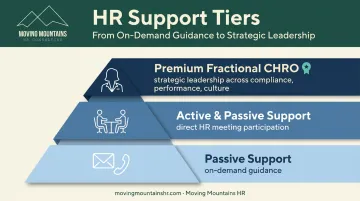
Support is tiered rather than one-size-fits-all:
- Passive Support: on-demand email or phone guidance after a compliance package purchase
- Active & Passive Support: adds direct participation in your company's HR meetings
- Premium (Fractional CHRO): executive-level leadership across strategy, compliance, performance, and culture
Compliance work is packaged as an HR Document Audit, Fresh Compliance Docs, or a combined Audit & Update. The firm also runs neutral third-party workplace investigations (harassment, discrimination, hostile work environment, retaliation, and code of conduct), which most PEOs do not offer.
Clients keep full workforce control because there is no co-employment relationship, while still getting executive-level strategic input. That model fits regulated industries like healthcare especially well.
| Best For | Fractional CHRO strategy and hands-on compliance guidance without a national PEO relationship |
| Pricing Model | Custom quoted based on service tier and company size |
| Key Features | Compliance audits, fractional CHRO, workplace investigations, HR strategy support |
Bambee
Bambee targets the smallest end of the market — businesses that need HR policy help but can't justify a full PEO contract. Pricing is publicly listed and scales with headcount:
- 1-4 employees: $299/month
- 5-19 employees: $399/month
- 20-49 employees: $499/month
- 50-70 employees: $1,299/month
- 71+ employees: custom quote
Each plan includes a dedicated HR manager who builds policies and assists with onboarding, terminations, and disciplinary actions. Bambee focuses squarely on policy development and compliance guidance rather than full-service payroll or benefits administration, making it a budget-conscious option for reducing liability without a big spend.
| Best For | HR policy creation and liability reduction on a budget |
| Pricing Model | Flat monthly fee, publicly listed, scales with headcount |
| Key Features | Policy templates, dedicated HR manager, compliance guidance |
How We Chose the Best HR Outsourcing Services
We weighed each provider on service model fit (PEO, ASO, or consulting) alongside compliance depth, pricing transparency, and verified client feedback rather than marketing claims.
The most common mistake businesses make? Choosing a provider on price or brand recognition alone, without confirming the service model matches how much control they want to keep.
A company that needs strategic HR leadership shouldn't default to a payroll-first platform just because it's cheaper. A startup that only needs basic payroll shouldn't overpay for a premium PEO it doesn't need yet.
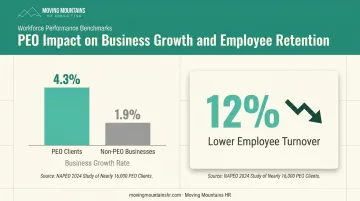
NAPEO's 2024 study of nearly 16,000 clients found that businesses using PEOs grew 4.3%, compared to 1.9% for similar businesses that didn't, and saw 12% lower employee turnover, according to the NAPEO 2024 white paper. That is a client-outcomes study, not a guarantee. Still, it shows why the right fit matters more than the biggest name.
We tied every evaluation factor to concrete outcomes:
- Reduced compliance risk and fewer costly violations
- Lower turnover costs through better HR practices
- Time saved on administrative tasks that don't require your attention
How to Choose the Right HR Outsourcing Partner
Your ideal provider depends heavily on where your business stands today.
Startups and very small businesses should cover payroll and core compliance first. Self-service platforms like Justworks or Gusto usually handle the basics; add a consultant when you need handbooks, policies, or state-specific guidance.
Regulated industries like healthcare need specialized compliance expertise and hands-on guidance, not generic templates. A partner with healthcare HR depth—such as Moving Mountains HR—helps you manage industry-specific employment rules on top of standard labor law.
Established or scaling companies face a real tradeoff:
- Full PEO co-employment: More built-in support, less direct control, because you share employer responsibilities
- Fractional CHRO or consulting: You stay sole employer and get tailored strategic guidance, with more control and more retained responsibility
Pick the model that matches how much control you want to keep versus how much day-to-day HR you want handled for you.
Conclusion
The best HR outsourcing partner is the one that matches your operational goals, industry, and growth stage—not the biggest brand name. A national PEO might be perfect for a 200-employee logistics company and completely wrong for a 15-person healthcare startup.
Before committing, evaluate providers through a trial period or reference checks. Ask about scalability, real response times, and total cost, not just the advertised rate.
If your business wants executive-level HR strategy and compliance support without giving up control through co-employment, Moving Mountains HR offers a free consultation to walk through fractional CHRO and compliance options built around your specific situation.
Frequently Asked Questions
What is an HR outsourcing company?
An HR outsourcing company is a third-party provider that manages HR functions like payroll, compliance, benefits administration, or strategic HR guidance on a business's behalf. Models range from full-service PEOs to boutique consultancies.
How much does outsourced HR cost per hour?
Most providers bill per-employee-per-month or as a flat consulting fee rather than hourly. PEO costs typically run $40-$160 per employee per month, or 3%-12% of payroll, according to Business News Daily.
What is the difference between a PEO and an HR outsourcing company?
A PEO enters a co-employment arrangement, sharing certain employer responsibilities and liabilities with your business. Standard HRO/ASO providers and boutique consultancies like Moving Mountains HR deliver services without sharing employment liability.
What HR functions can be outsourced?
Commonly outsourced functions include compliance tracking, performance management, workplace investigations, recruiting, and fractional or strategic HR support. Many providers also handle payroll and benefits administration, though coverage varies by service model.
Is HR outsourcing worth it for small businesses?
Yes—once HR complexity outpaces internal bandwidth, typically around 10-15+ employees. Below that, basic self-service tools may still be enough.
How do I choose the best HR outsourcing service for my business?
Match the provider to your size, industry regulation level, and whether you want co-employment (PEO) or advisory support without shared liability. Confirm pricing transparency and which functions are included before you sign.