The owner tried a trust-fall exercise. It didn't help. The real problem wasn't a lack of icebreakers—it was missing structure, unclear roles, and no safe way to surface problems before they festered.
Improving teamwork isn't about forced bonding activities. It's about creating the right conditions for collaboration: clear expectations, open communication channels, and leadership that models accountability. This article covers what teamwork actually means in daily work, why it matters for small businesses, warning signs that coordination is breaking down, eight practical strategies to strengthen collaboration, and how HR support helps sustain high-performing teams over time.
Key Takeaways
- Effective teamwork requires shared goals, defined roles, mutual accountability, and trust, not just physical proximity
- Strong team environments deliver 14% to 18% higher productivity and 21% to 51% lower turnover than low-engagement units
- Warning signs include frequent miscommunication, duplicated work, unresolved conflicts, and employees working in silos
- Evidence-based fixes center on role clarity, communication norms, psychological safety, and constructive conflict resolution
- HR frameworks provide the structure (job descriptions, performance processes, conflict protocols) that sustain teamwork long-term
What Is Teamwork in the Workplace?
Teamwork means coordinated effort toward shared goals. It involves clear communication, defined roles, mutual accountability, and trust. A true work team requires real interaction, reliance on each other's work, varied expertise, and clear responsibilities—not just people who happen to sit near each other.
Working in proximity is different from working as a team. Effective teamwork means employees understand how their work connects to others' tasks and actively support each other's success. Research from INSEAD and IESE found that strong social ties can offset physical distance. Collaboration depends more on relationships and shared understanding than on where people sit.
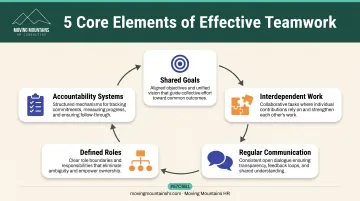
True teamwork includes:
- Shared, clearly defined goals that everyone understands
- Interdependent work where one person's output affects another's
- Regular communication that shares information, surfaces problems, and coordinates action
- Defined roles so everyone knows who does what
- Accountability systems that track progress and address gaps
When these elements align, teams move faster, solve problems more effectively, and adapt to change without finger-pointing or confusion.
Why Teamwork Matters for Small Businesses
Strong teamwork directly impacts productivity. Gallup's 2024 meta-analysis of 183,806 business units and 3.35 million employees found that top-engagement teams delivered 14%-18% higher productivity, 32% fewer defects, and 23% higher profitability than bottom-quartile units.
Engagement measures more than teamwork alone, but the pattern holds: environments where people work well together perform better.
Retention improves when employees feel connected to their team. The same Gallup study found top-engagement units experienced 21% lower turnover in high-turnover organizations and 51% lower turnover in low-turnover organizations.
Separate research showed 42% of 717 recent voluntary leavers said their employer could have prevented the exit, yet 45% reported no proactive manager discussion in the three months before they quit. Feeling unsupported by a team or manager is a common driver behind those preventable exits.
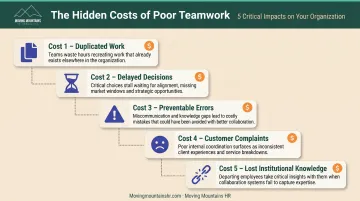
Teamwork also shapes innovation, problem-solving, and customer service. When collaboration breaks down, hidden costs pile up:
- Duplicated work when employees don't coordinate efforts
- Delayed decisions when no one knows who owns final approval
- Preventable errors when information doesn't flow between team members
- Customer complaints when miscommunication leads to inconsistent service
- Lost institutional knowledge when high turnover creates constant onboarding cycles
Small businesses feel these costs acutely because every employee's contribution matters. One communication breakdown can derail an entire project.
Signs Your Team Needs Improvement
If coordination is slipping, these warning signs usually show up first:
Communication and coordination symptoms:
- Frequent miscommunication, or people learning about decisions after the fact
- Duplicated work because no one knew someone else was already handling it
- Unclear responsibilities, with several people assuming the same task belongs to someone else
- Missed deadlines due to poor handoffs or unclear ownership
- Decisions and updates trapped in side chats instead of shared channels
Behavioral indicators:
- People defaulting to solo work and rarely asking for input
- Little documentation, so processes live only in a few people's heads
- Conflicts that linger unresolved, creating tension that affects collaboration
- Low morale, disengagement, or visible frustration during team interactions
- Rising turnover, especially when exit feedback cites weak support or unclear expectations
These issues usually trace back to unclear expectations, weak communication norms, or low psychological safety—not individual talent gaps.
Before blaming specific employees, check whether the team has clear roles, shared communication channels, and safe ways to raise concerns. Without that structure, even strong performers struggle to collaborate.
8 Practical Ways to Improve Teamwork
Set Clear Roles and Expectations
Confusion about who does what kills collaboration. When three people think someone else is handling the client follow-up, nothing gets done. When two people both email the vendor with conflicting requests, trust erodes.
How to clarify roles:
- Document each position's core responsibilities and decision rights
- Specify who owns final decisions versus who provides input
- Map out handoff points where work transfers from one person to another
- Ensure everyone understands not just their own role but how it connects to team goals
- Review role clarity quarterly as responsibilities evolve
SHRM's performance-management cycle starts with clarifying job responsibilities and specific goals before any monitoring or feedback begins. Clarity up front prevents confusion later.
Build Open Communication Channels
Teams that communicate well share information clearly, make decisions efficiently, and surface problems early. A 2018 meta-analysis found communication quality was more strongly related to performance than communication frequency. Better information flow beats more meetings.
Create effective communication norms:
- Establish regular touchpoints: weekly team meetings, one-on-ones, daily check-ins for fast-moving projects
- Define how the team communicates: email for documentation, chat for quick questions, meetings for decisions
- Set response-time expectations so people know when to expect answers
- Designate decision owners for recurring choices; frameworks like RAPID (Recommend, Agree, Perform, Input, Decide) clarify who plays each role
- Document decisions and share them with the full team
Gallup research found that one meaningful manager conversation weekly was associated with employees being 4x as likely to be highly engaged. Consistent, quality communication builds trust and keeps work moving forward.
Create Psychological Safety
Psychological safety means team members feel safe speaking up, asking questions, admitting mistakes, and offering ideas without fear of embarrassment or punishment. Google's research into team effectiveness found psychological safety mattered more than team composition. How the team worked together outweighed who sat on it.
How managers build psychological safety:
- Frame work as a learning problem, not just execution: "We're figuring this out together"
- Acknowledge your own fallibility: "I don't have all the answers; I need your input"
- Model curiosity: Ask questions, probe assumptions, invite dissenting views
- Respond constructively to mistakes: Focus on what the team learned, not who to blame
- Never punish someone for raising a concern or admitting an error
A 2017 meta-analysis covering 136 samples, 22,000+ people, and nearly 5,000 groups confirmed the link between psychological safety and team performance. When people trust they won't be penalized for honesty, they share problems early, collaborate more openly, and take smart risks.
Align on Shared Goals
Team members need to understand not just what they're doing but why it matters and how their work supports the bigger picture. A study of 105 Dutch public-sector teams found goal clarity positively related to team performance.
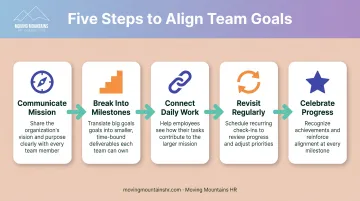
Clarify and align goals:
- Communicate the team's mission and how it ties to organizational objectives
- Break larger goals into specific, measurable milestones
- Ensure every team member can explain how their daily work contributes to team success
- Revisit goals regularly—quarterly or when priorities shift
- Celebrate progress toward shared goals, not just individual achievements
When everyone rows in the same direction, coordination improves and duplicate efforts decrease.
Address Conflicts Early and Constructively
Conflict is normal. Disagreement itself rarely damages a team. Unresolved tension that festers into resentment or avoidance does. Research separates task disagreement (healthy debate about the work) from relationship conflict (personal attacks). MIT Sloan warns performance suffers when task conflict becomes personal.
Handle conflict constructively:
- Recognize disagreement as an opportunity to clarify expectations and improve processes
- Address issues directly and privately before they escalate
- Keep conflict focused on the problem, not the person
- Summarize the decision once debate concludes so everyone knows the path forward
- Assign clear ownership of next steps
- Follow up to ensure the issue is resolved, not just papered over
Managers who intervene early and model respectful disagreement prevent small misunderstandings from becoming major team rifts.
Recognize and Celebrate Contributions
Recognition reinforces positive behaviors and strengthens team cohesion. Gallup found only 1 in 3 U.S. workers strongly agreed they received recent praise; inadequately recognized employees were 2x as likely to say they would quit within a year.
Make recognition effective:
- Offer honest, authentic, individualized feedback. Generic praise rings hollow
- Recognize both individual contributions and team achievements to promote cohesion
- Acknowledge effort in real time, not just at annual reviews
- Celebrate milestones publicly when appropriate, privately when the employee prefers it
- Tie recognition to specific behaviors you want to see repeated
Recognition doesn't require elaborate programs. A sincere "thank you" with specific detail ("Your analysis helped us avoid a costly mistake") builds goodwill and motivates continued collaboration.
Encourage Cross-Training and Knowledge Sharing
When only one person knows how to process invoices or access the client database, the team is vulnerable. Cross-training builds interpositional knowledge, improves coordination, and reduces single points of failure.
Implement cross-training:
- Rotate responsibilities so multiple people understand each function
- Pair experienced employees with newer team members for hands-on learning
- Document processes so knowledge isn't locked in one person's head
- Schedule regular knowledge-sharing sessions where team members teach each other
- Encourage employees to shadow colleagues in different roles
Research shows cross-training improved shared mental models, coordination, and backup behavior. When team members understand each other's work, they coordinate more smoothly, offer better support, and solve problems faster.
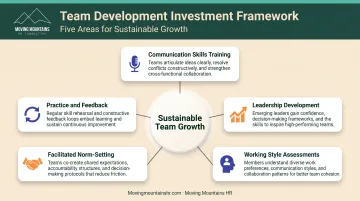
Invest in Team Development
Training, workshops, and facilitated sessions help teams build communication skills, understand working styles, and establish norms. A 2017 meta-analysis of 72 controlled interventions involving 8,439 participants found teamwork interventions improved both teamwork and performance. Interactive simulations, team reviews, and workshops outperformed passive instruction.
Effective team development includes:
- Communication and conflict-resolution skills training
- Leadership development for supervisors and emerging leaders
- Working-style assessments so team members understand different approaches
- Facilitated sessions to establish team norms and decision processes
- Practice and feedback, not just lectures—teams learn by doing
One-off events fade quickly. Sustainable improvement requires practice, reinforcement, and follow-up over time.
Common Teamwork Challenges and Solutions
Challenge: Lack of Trust Among Team Members
Trust breaks down when people don't follow through, communication is inconsistent, or past conflicts remain unresolved. A 2016 meta-analysis of 112 studies and 7,763 teams found intrateam trust positively related to performance.
Rebuild trust through:
- Share information openly and explain the “why” behind decisions
- Do what you say you’ll do, every time
- Have leaders admit mistakes and ask for help first
- Meet commitments—or flag changes early when plans shift
- Treat mistakes as learning moments, not blame sessions
Trust grows slowly through repeated positive interactions. Leaders set the tone by modeling the behaviors they want to see.
Challenge: Unclear Decision-Making Processes
Teams get stuck when no one knows who makes which decisions. Work stalls while people wait for approval or multiple people make conflicting calls.
Clarify decision rights:
- Use a framework like RAPID from Bain & Company: Recommend, Agree, Perform, Input, Decide
- Assign one explicit decision owner for each recurring decision type
- Define who provides input versus who has final authority
- Set deadlines for input so decisions don't drag on indefinitely
- Communicate the decision and rationale to everyone affected
Named owners and input deadlines cut the “I thought you were handling it” loop and keep work moving.
Challenge: Misaligned Priorities or Competing Goals
When team members receive conflicting direction or departments have competing objectives, collaboration suffers. Research on organizational silos shows structures, incentives, decision processes, and cultural barriers can block shared goals and resources.
Align priorities:
- Ensure team goals align with organizational objectives
- Resolve conflicts between departmental priorities at the leadership level
- Design performance measures that reward collaboration, not just individual output
- Help teams navigate trade-offs when multiple goals compete
- Communicate why certain priorities take precedence
Many organizations still run team-based work on top of individual-only performance systems. When incentives reward one function while blocking another, teamwork stalls.
Challenge: Difficult Team Members or Personality Conflicts
Not all teamwork issues are systemic—some involve individuals who struggle with collaboration. Before concluding the problem is personal, verify role expectations, resources, goals, handoffs, and whether peers show the same pattern.
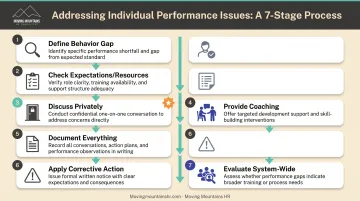
Address individual performance issues:
- Define the observable behavior gap and its impact on the team
- Check whether expectations, training, workload, and support are clear and adequate
- Discuss specific examples privately; restate required behavior and measurable expectations
- Provide coaching, training, resources, and a follow-up date
- Document facts, support offered, commitments, and next steps
- If the pattern continues after support, apply consistent performance-management and corrective action
- If the same gaps show up across the team, fix the system—not only individuals
SHRM’s performance-management guidance backs this order: set expectations, monitor, give feedback, coach, evaluate, then correct when needed.
Repeated shortfalls after real support call for documented intervention. Widespread shortfalls usually point to a process or team design problem. Small businesses without in-house HR often bring in outside help to structure coaching plans, document expectations, and keep the process consistent and fair.
The Role of HR in Building Strong Teams
HR provides the frameworks, policies, and support systems that enable teamwork: clear job descriptions, performance expectations, conflict-resolution processes, and compliance with employment laws. Without these foundations, even well-intentioned teams struggle.
HR supports teamwork by:
- Translates organizational goals into team and individual objectives
- Clear role descriptions that cut overlap and clarify ownership
- Check-in, feedback, recognition, and development processes
- Facilitates difficult conversations when conflicts escalate
- Training in communication, leadership, conflict resolution, and performance management
- Team norms aligned with company values and legal requirements
Those foundations matter even more when a company is too small for a full-time HR seat. Fractional or outsourced HR brings executive-level expertise without the overhead, so owners can stay focused on operations while teams still get structure and guidance.
Moving Mountains HR offers tiered support packages that include participation in company HR meetings, on-demand assistance, and fractional CHRO services. Small businesses get the same caliber of HR support larger companies keep in-house—without a full-time hire.
Frequently Asked Questions
How can I build strong teamwork in the workplace?
Focus on five areas: clear roles, open communication that favors quality over volume, psychological safety to speak up, shared goals everyone understands, and steady leadership support through coaching and recognition. Teamwork is built over time, not in a single kickoff.
What are the 5 C's of effective teamwork?
Gallup's 2020 framework names five elements: Common Purpose, Connection, Communication, Collaboration, and Celebration. They cover shared mission, trust, clear information flow, mutual support, and recognition—Gallup's practical blueprint, not a universal standard.
How do I deal with difficult team members?
Address the behavior directly and privately. Name the performance gap and its impact, confirm expectations and resources are clear, then coach with documented commitments and a follow-up date. If it continues, escalate to formal performance management; involve HR when multiple people, legal risk, or a neutral investigation is involved.
Ready to strengthen your team's collaboration and performance? Moving Mountains HR helps small businesses build the HR structure, communication norms, and performance systems that sustain strong teamwork—fractional CHRO support, compliance, and training without a full-time hire. Schedule a 30-minute consultation to discuss your team's needs.