The math backs this up. The National Safety Council estimates the average medically consulted work injury costs $48,000 once you factor in wages, medical care, and administrative expenses, according to the National Safety Council's 2024 Injury Facts data. That figure doesn't include the cost of a citation, legal exposure, or the productivity hit from an investigation.
A structured audit process catches these gaps before they become expensive. This guide walks through what you need before starting, three proven audit methods, how to read your results without over- or under-reacting, and the mistakes that quietly sabotage even well-intentioned audits.
Key Takeaways
- A safety audit evaluates program effectiveness and documentation, not just physical hazards like a routine inspection
- Three audit approaches: internal self-audits, third-party professional audits, and OSHA-aligned compliance audits
- Results fall into three buckets—compliant, minor gaps, or critical violations—each with its own response timeline
- Most audit failures stem from bias, outdated checklists, or weak follow-through, not the audit process itself
What You Need for a Workplace Safety Audit
The accuracy of your audit depends heavily on what you gather before you start. Show up unprepared and you'll get a surface-level review that misses the details that actually matter.
Tools and Documentation Required
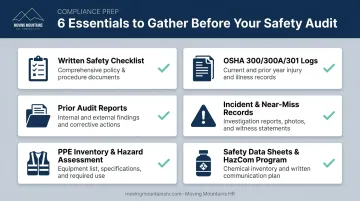
Pull together these materials before scheduling your walkthrough:
- Written safety checklist or template aligned to your industry and applicable regulations
- OSHA 300, 300A, and 301 logs, or your state equivalent (Cal/OSHA requires the same forms, retained for five years)
- Prior inspection and audit reports to track whether previous findings were actually resolved
- Incident and near-miss records, including any injuries reported in the past 12 months
- PPE inventory and the written hazard-assessment certification required under 29 CFR 1910.132
- Safety Data Sheets (SDS) for every hazardous chemical used on-site, along with your written Hazard Communication program
Tablets, audit apps, and phone cameras let your team capture photo evidence on the spot and log corrective actions in real time—instead of reconstructing notes later. That timestamped trail also helps if a finding is ever challenged.
Preconditions and Setup
Getting the setup right prevents wasted time and skewed results:
- Build a cross-functional audit team. No one should audit their own department. That's the fastest way to introduce bias into your findings.
- Notify department heads in advance and arrange access to every area, including restricted or high-risk zones. Surprise lockouts during an audit waste everyone's time.
- Confirm your regulatory framework before scoping the audit. Federal OSHA standards apply nationwide, but states like California add requirements on top. One example: the written Injury and Illness Prevention Program under Cal/OSHA Title 8, Section 3203.
Skip this prep and you spend the walkthrough catching up on paperwork instead of finding real hazards.
Methods to Conduct a Workplace Safety Audit
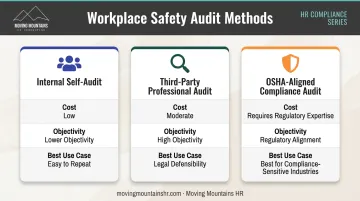
Which method you choose depends on how much objectivity you need, your budget, and how exposed you are to regulatory risk. None of these approaches is universally best. Each solves a different problem.
Method 1: Internal Self-Audit
An internal team or designated safety committee reviews conditions proactively, before an external party ever sees them.
What you'll need: Standard checklist template, camera or phone, incident logs.
How it works:
- Assign a cross-departmental team and divide up audit areas
- Walk each area, comparing conditions against your checklist and documenting findings with photos
- Compile results into a summary report with recommended fixes
Trade-off: Low-cost and easy to run frequently, but objectivity suffers if the same people audit the same areas every time.
Method 2: Third-Party/External Professional Audit
A neutral outside expert reviews your programs and practices, removing internal bias and benchmarking against industry standards.
What you'll need: Company policy documents, training records, OSHA logs, a structured audit questionnaire.
How it works:
- Review existing documentation and incident history remotely
- Conduct an on-site walkthrough with management interviews to test real-world practice against written policy
- Deliver a formal report with prioritized recommendations
This is where a firm like Moving Mountains HR fits for many small and mid-size businesses. Its HR Document Audit reviews policies, procedures, and the employee handbook against how work actually gets done, then closes with a gap analysis and a formal compliance report presented by an HR expert.
For teams without a full-time HR lead, that outside review is a practical way to get a defensible read on safety-related policies and records without adding permanent headcount.
Trade-off: Highly objective and useful if you ever need to defend your practices legally, but it comes at a cost.
Method 3: OSHA-Aligned Compliance Audit
This method mirrors OSHA's own Safety and Health Program Audit Tool. It tests your programs against regulatory expectations across seven areas: management leadership, worker participation, hazard identification, hazard prevention, training, program evaluation, and contractor coordination.
What you'll need: OSHA audit tool or checklist, current regulatory references, training and certification records.
How it works:
- Map each OSHA program requirement (hazard communication, PPE, emergency plans) to current company practice
- Score each area as not implemented, partially implemented, or fully implemented
- Prioritize corrective actions based on regulatory risk and citation severity
Trade-off: Best suited to compliance-sensitive industries preparing for a possible inspection, but it requires someone who genuinely knows current OSHA standards. Get the scoring wrong and you'll misallocate your corrective effort.
How to Interpret Workplace Safety Audit Results
Misreading your findings cuts both ways. Miss a serious hazard and you're exposed to a citation or worse. Overreact to a minor documentation gap and you'll burn resources that should go toward real risks.
Audit findings generally sort into three categories:
| Result Category | What It Looks Like | Required Action |
|---|---|---|
| Compliant/Normal | Programs fully implemented, documented proof, consistent training records | Maintain current monitoring cadence |
| Minor Issues | Partial implementation, small documentation gaps, no immediate danger | Build a corrective action plan with a reasonable timeline |
| Critical/Out-of-Spec | Missing programs, unaddressed hazards, repeated violations | Immediate correction, possible reporting obligations, reassign responsible personnel |
OSHA's 2025 penalty adjustments set serious violations at $1,221 to $16,550 per violation, while willful or repeated violations range from $11,823 up to $165,514, according to OSHA's 2025 civil penalty memo.
Those are proposed ranges, not guaranteed outcomes. They still show why a "minor issue" left unaddressed can escalate into a "critical" one during an actual inspection.
Hold onto these interpretation principles:
- Don't average across categories. One critical finding in an otherwise clean audit still requires immediate action; it doesn't get diluted by everything else being fine.
- Documentation gaps aren't automatically minor. A missing written IIPP or Hazard Communication program is a compliance failure even if no injury has occurred yet.
- Track patterns across audit cycles. A finding that reappears year after year signals a systemic issue, not a one-off oversight.
Common Errors and Best Practices in Workplace Safety Audits
Even a well-designed audit process fails if the execution is sloppy. Here's what tends to go wrong, and what actually works instead.
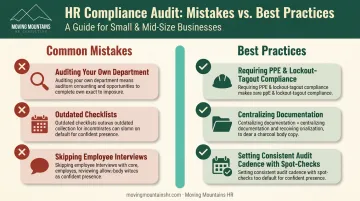
Common Mistakes to Avoid
- Letting employees audit their own department. It seems efficient, but bias undermines the entire exercise.
- Using an outdated checklist. New equipment, revised processes, and updated regulations make last year's template unreliable.
- Skipping employee interviews. Paperwork alone won't show what actually happens on the floor.
Best Practices for a Reliable Audit
- Require PPE and lockout/tagout compliance for auditors on every physical walkthrough. An audit that causes an injury defeats its purpose.
- Centralize all documentation so you can compare findings year over year instead of starting from scratch each cycle.
- Set a consistent cadence with unannounced spot-checks between formal audits to catch drift early.
OSHA recommends an initial evaluation, then reviews at least annually, plus extra checks after equipment changes, injuries, or a rise in complaints (OSHA's Recommended Practices for Safety and Health Programs).
Conclusion
A checklist alone won't keep a workplace safe. What matters is the process behind it: choosing the right audit method, reading results honestly, and following through on corrective actions. That discipline separates businesses that catch problems early from those facing a citation after the fact.
If your audit surfaces HR or compliance policy gaps, closing them usually takes more than good intentions. Moving Mountains HR works with small and mid-size businesses across California and the broader U.S. to close those gaps—updating outdated policies, building compliance documentation from scratch, or providing ongoing HR support so problems don't resurface.
You get expert guidance without the cost of a full-time hire.
Frequently Asked Questions
How do you conduct a workplace safety audit?
Assemble a cross-functional team, gather your documentation, walk the site against a written checklist, and issue a report with findings prioritized by severity. Follow up with a corrective action plan and deadlines.
How often should a workplace safety audit be conducted?
Most organizations benefit from annual or semiannual audits. High-risk industries, or any business following a recent incident, should audit more frequently.
What's the difference between a safety audit and a safety inspection?
An inspection checks physical conditions, equipment, and hazards on the ground. An audit evaluates whether your entire safety program, including policies and documentation, is actually effective.
Who should conduct a workplace safety audit?
An internal safety committee can run one, but objectivity improves significantly when an outside consultant or third party is involved, especially for legally sensitive findings.
What happens if a workplace safety audit finds violations?
Findings should be prioritized by severity and addressed through a documented corrective action plan with clear deadlines. Critical violations need immediate attention, not a "next quarter" fix.
Does OSHA require workplace safety audits?
OSHA doesn't mandate audits directly, but it treats them as a core part of a strong safety program and may reference audit practices during compliance reviews.