

Introduction: Can Employers Regulate Workplace Romance?
Workplace romances are common. In SHRM's 2025 survey, 52% of U.S. workers reported a current or past workplace relationship, and 16% had dated a colleague within the prior year.
While office relationships may seem harmless, they create real management challenges. In the post-#MeToo era, scrutiny of power dynamics, consent, and workplace conduct has intensified.
The core tension for employers is balancing legitimate business interests against employee privacy rights. Organizations must guard against harassment claims, conflicts of interest, perceived favoritism, and liability—without overstepping into employees' personal lives.
Clear policies, legal awareness, and consistent enforcement make that balance possible. That is especially true in California, where FEHA sets specific harassment-prevention duties and off-duty privacy protections run stronger. This guide covers what employers can regulate, where the law draws the line, and how to build a workable romance policy.
Key Takeaways
- Employers can legally regulate workplace romance through clear policies but cannot ban all coworker relationships outright
- Harassment claims, favoritism, conflicts of interest, retaliation, and poor decision-making are the biggest romance-related risks
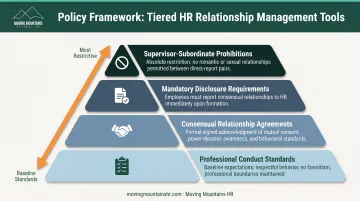
- Supervisor-subordinate bans, mandatory disclosure rules, and consensual relationship agreements ("love contracts") are the strongest policy tools
- California FEHA requires reasonable steps to prevent harassment—including risks that stem from workplace relationships
Legal Boundaries: Can Employers Regulate Workplace Romance?
What Employers Can Legally Regulate
U.S. law does not generally prohibit consensual workplace romances. However, employers have broad authority to regulate workplace conduct, including romantic relationships, when they create conflicts of interest, compromise reporting relationships, or affect business operations.
The California case Barbee v. Household Automotive Finance Corp. (2003) illustrates this principle. The court upheld the termination of a national sales manager who dated a subordinate, finding that the employer's disclosure-and-reassignment policy was reasonable and legally defensible.
The manager's privacy claim failed because the relationship created real business risks: favoritism, workplace disruption, harassment liability, and compromised decision-making.
Legal Limits on Employer Authority
While employers can regulate workplace romance, they cannot act without limits:
- Title VII bars disparate treatment based on sex, including enforcement driven by sex stereotypes—apply romance policies equally regardless of gender, sexual orientation, or whether someone accepted or rejected an advance
- California Labor Code sections 96(k) and 98.6 protect lawful off-duty conduct; policies must target work-related conflicts, not private moral judgments
- California courts expect reasonableness and business necessity: focus on reporting lines, conflicts of interest, and workplace behavior—not private conduct alone
Why Total Bans Don't Work
Blanket prohibitions on all coworker dating are difficult to enforce, legally risky, and generally unrealistic. Employees will likely resist policies perceived as overly intrusive, and enforcement becomes nearly impossible without invasive monitoring of employees' personal lives.
More effective approaches:
- Ban only supervisor-subordinate relationships or relationships in the same reporting chain
- Require disclosure when a relationship creates a conflict of interest
- Use reassignment, third-party decision-making, or reporting-line changes when conflicts arise
Real-world examples:
- BlackRock requires employees to disclose relationships with coworkers and certain firm-linked third parties, then uses alternative work arrangements to address conflicts. In 2019, the firm dismissed two executives for failing to disclose relationships.
- Intel enforces a manager non-fraternization policy. When CEO Brian Krzanich's past consensual employee relationship came to light in 2018, he resigned for violating the policy.
- Financial services firms typically require manager-subordinate disclosure due to heightened conflict-of-interest and favoritism risks, rather than imposing blanket bans.

The Risks Employers Face from Workplace Romance
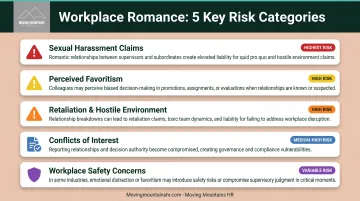
Workplace romance creates legal and operational exposure that reaches well beyond the couple involved. Employers should watch several distinct risk categories.
Sexual Harassment and Quid Pro Quo Claims
Even when a relationship begins consensually, employees or courts may later treat it as unwelcome or coercive. The legal question is whether conduct is unwelcome when it occurs, not whether it was once consensual. That risk rises sharply when power imbalances exist between supervisors and subordinates.
What matters most:
- A prior consensual relationship does not prove that later advances remain welcome
- Supervisor-subordinate relationships carry the highest risk; subordinates may feel unable to decline or end the relationship without career consequences
- Federal law focuses on whether sexual conduct is unwelcome, regardless of past consent
Perceived Favoritism and Morale Issues
When romantic relationships exist in the workplace, other employees may perceive preferential treatment, whether or not it actually occurs. In SHRM's 2025 survey, 68% of HR professionals cited perceived favoritism or unfair treatment as a leading concern, and 61% cited conflicts of interest.
Perceived favoritism can lead to:
- Resentment and decreased team morale
- Reduced productivity and engagement
- Potential discrimination claims from employees who believe they were passed over for promotions, raises, or favorable assignments
The California Supreme Court case Miller v. Department of Corrections (2005) held that widespread sexual favoritism may create a hostile work environment if it communicates that advancement depends on sexual access. While isolated favoritism ordinarily isn't harassment, systemic patterns can cross the line into actionable discrimination.
Retaliation and Hostile Work Environment
Workplace romances that end badly create ongoing legal and operational risks. When relationships sour, employers may face:
- Retaliation claims: One party may allege adverse employment actions (negative reviews, assignment changes, termination) in response to ending the relationship
- Continued unwanted advances: Post-breakup pursuit can constitute harassment if it becomes pervasive or severe
- Hostile atmosphere for colleagues: Tension between former partners can create uncomfortable working conditions for the entire team
Forrest v. Brinker (1st Cir. 2007) shows how post-breakup conduct can become sex-based harassment. After the relationship ended, the former partner used sexually degrading, gender-specific slurs. The court found this could support a harassment claim. The employer still prevailed because it investigated promptly, disciplined progressively, and ultimately terminated the offender.
Conflicts of Interest in Decision-Making
Romantic relationships compromise objectivity when one party has authority over the other's:
- Performance reviews and evaluations
- Promotions and compensation decisions
- Work assignments and project selections
- Disciplinary actions
Even when the supervising party believes they remain objective, the appearance of bias undermines trust, morale, and the integrity of employment decisions.
Workplace Violence and Safety Concerns
In extreme cases, breakups or unrequited feelings escalate to threats or violence. National data isolating romance-related workplace violence is limited, but employers still must act on warning signs and keep the workplace safe. Ignoring credible threats or escalating behavior can create liability for negligent retention or failure to protect employees.
Effective Policy Tools and Solutions
Consensual Relationship Agreements (Love Contracts)
What they are:
Written acknowledgments signed by both employees confirming that their relationship is voluntary, consensual, and understood to comply with company anti-harassment policies.
Key elements:
- Confirmation of mutual consent
- Acknowledgment of the company's anti-harassment policy
- Agreement to maintain professionalism and avoid favoritism
- Understanding that the relationship is not a condition of employment
- Commitment to report if the relationship ends or becomes unwelcome
Benefits and limitations:
Love contracts provide contemporaneous evidence of consent and policy awareness. They clarify expectations and document the voluntary nature of the relationship at the time of signing.
They are not bulletproof protection against future claims. Consent can change, and employees cannot waive their statutory rights to file harassment or retaliation complaints. Employers must still investigate complaints promptly and take corrective action when needed.
Supervisor-Subordinate Relationship Prohibitions
Why these relationships are highest risk:
Direct reporting relationships create the strongest potential for quid pro quo harassment, perceived favoritism, and compromised decision-making. Subordinates may feel unable to say no or end the relationship without career consequences.
Typical policy approaches:
- Outright bans: Prohibit all romantic relationships between managers and anyone in their reporting chain
- Mandatory disclosure with reassignment: Require immediate reporting and transfer to eliminate the supervisory relationship
- Reporting-line changes: Assign a neutral third party to make employment decisions affecting the subordinate
Common practice:
When a disclosed supervisor-subordinate relationship occurs, companies often transfer one party to a different department or shift decision-making authority to another manager. This protects both parties and preserves the integrity of performance evaluations, promotions, and assignments.
Mandatory Disclosure Requirements
When disclosure is required:
Most policies require employees to report relationships when they involve:
- Supervisory or direct reporting relationships
- Employees in the same department or team
- Situations creating conflicts of interest (such as vendor relationships or client interactions)
Employer obligations:
After disclosure, focus on managing conflicts rather than punishing employees. Employers should:
- Maintain confidentiality to the extent possible
- Assess whether a genuine conflict of interest exists
- Determine whether reassignment or reporting-line changes are necessary
- Document the disclosure and any actions taken
Professional Conduct Standards
Clear behavioral expectations help prevent workplace disruptions and harassment claims:
- No public displays of affection on company property
- Maintain professional boundaries during work hours
- Avoid favoritism in assignments, reviews, or promotions
- Keep emails, messaging, and social media professional
These standards apply to in-person and digital interactions alike. Inappropriate messages can create a hostile work environment as easily as face-to-face conduct.
Training and Communication
Training priorities:
- Harassment prevention: Required under California law (AB 1825, AB 2053, SB 1343) and essential for compliance
- Romance policy awareness: Ensure employees understand disclosure requirements, prohibited relationships, and consequences for violations
- Manager responsibilities: Train supervisors to recognize warning signs, handle disclosures properly, and enforce policies consistently
Communication methods:
- Employee handbooks and onboarding materials
- Annual policy refreshers
- Accessible reporting channels for disclosures and complaints
- Clear, written guidance on what to do when conflicts arise
The EEOC notes that effective training can reduce harassment, while poor training can be counterproductive. Pair training with leadership accountability, accessible reporting, and prompt corrective action.
In SHRM's 2025 study, 77% of managers felt prepared to handle disclosed romances, but only 60% considered training sufficient for voluntary disclosures and just 54% for third-party reports. This gap highlights the need for targeted manager training.
Implementing and Enforcing Workplace Romance Policies
Step-by-Step Guidance
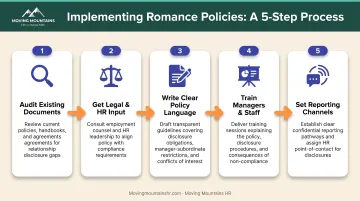
A workable romance policy is only as strong as the process behind it. Use this sequence to build one that holds up in practice:
- Audit existing documents. Review your handbook, code of conduct, and harassment-prevention policies for gaps on workplace romance, conflicts of interest, and supervisor-subordinate relationships.
- Get legal and HR input. Work with employment counsel or an experienced HR consultant so the policy meets federal, state, and local rules—especially California FEHA harassment and discrimination standards and employee privacy limits.
- Write plain, specific language. Define prohibited relationships, disclosure rules, conduct expectations, and consequences. Add short examples so managers and employees interpret the policy the same way.
- Train managers and staff. Cover the policy itself, reporting duties, confidentiality, and anti-retaliation protections.
- Set clear reporting channels. Give employees confidential ways to disclose relationships or raise concerns, and say who to contact and what to share.
Consistent Enforcement
Inconsistent enforcement weakens the policy and invites discrimination claims. Employees need to see the same rules applied at every level—not bent for executives, rainmakers, or personal favorites.
Build consistency into daily practice:
- Document every disclosure, violation, and corrective action
- Apply rules uniformly across jobs, departments, and performance tiers
- Investigate complaints promptly, thoroughly, and without bias
- Protect confidentiality as much as you can while still resolving conflicts
Consequences for Non-Compliance
Romance policy violations can trigger progressive discipline, up to termination. Calibrate the response to:
- Severity — for example, a hidden supervisor-subordinate relationship versus a late update to a disclosed relationship
- Workplace impact — favoritism, harassment complaints, or team disruption
- Prior history — whether the employee has related discipline on file
Skipping enforcement, or enforcing unevenly, raises exposure to harassment, discrimination, retaliation, and wrongful termination claims—the same risk inconsistent treatment creates in the section above.
If you do not have in-house HR bandwidth to draft the policy, run training, or handle a sensitive investigation, bring in outside HR support so the rules are clear on paper and applied the same way in practice.
California-Specific Considerations for Employers
FEHA Prevention Duty
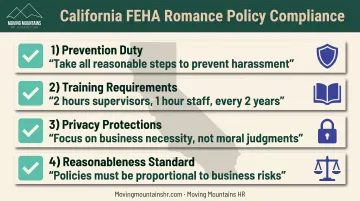
California Government Code section 12940(k) makes it unlawful for employers to fail to take all reasonable steps necessary to prevent discrimination and harassment. Romance policies must integrate with harassment-prevention programs, including:
- Written anti-harassment policies
- Accessible complaint procedures
- Prompt, thorough, impartial investigations
- Confidentiality protections
- Anti-retaliation safeguards
- Corrective action when violations occur
California Code of Regulations Title 2, section 11023 reinforces this duty, requiring employers to prevent and promptly correct harassment and discrimination.
Harassment-Prevention Training Requirements
California employers with five or more employees must provide:
- Two hours of sexual harassment prevention training to supervisory employees
- One hour of training to nonsupervisory employees
- Training repeated every two years
Training must cover harassment prevention, supervisor responsibilities, complaint procedures, and legal protections. Integrate romance policies into this training framework.
Stronger Employee Privacy Protections
California law protects lawful off-duty conduct more strongly than many other states. Labor Code sections 96(k) and 98.6 limit employer intrusion into employees' personal lives. Romance policies must focus on legitimate business concerns (reporting relationships, conflicts of interest, and workplace behavior) rather than moral judgments about employees' private relationships.
Barbee supports this balance. The court upheld discipline where a supervisor-subordinate relationship created genuine business risks (favoritism, harassment liability, compromised decision-making), but it rejected the manager's claim to absolute privacy in the relationship.
Reasonableness and Business Necessity
California courts scrutinize workplace policies for reasonableness and business necessity. Well-drafted policies that target specific business risks—such as supervisor-subordinate relationships or conflicts of interest—are more defensible than broad, intrusive bans on all coworker dating.
How Moving Mountains HR Can Help
Moving Mountains HR brings California employment law expertise to small and mid-size businesses. We help you regulate workplace romance without creating new compliance or privacy risk.
Services include:
- HR Document Audit: Review handbooks and practices for gaps on workplace romance, harassment prevention, conflicts of interest, and conduct expectations
- Policy Development: Draft or update romance policies, consensual relationship agreements, and conduct standards aligned with California FEHA
- Workplace Investigations: Run impartial, confidential investigations into harassment, conflicts of interest, retaliation, and relationship-related conduct issues
- Training & Development: Custom harassment-prevention training, manager coaching on disclosures, and California compliance education
- Fractional CHRO Services: Ongoing strategic HR support—policy enforcement guidance, manager coaching, and compliance monitoring
Based in Newbury Park, California, Moving Mountains HR helps organizations maintain compliant, respectful workplaces while protecting employee privacy and minimizing legal exposure. Contact staff@movingmountainshr.com or call 866-474-3575 to schedule a consultation.
Frequently Asked Questions
What should a workplace romance policy cover?
Policies should live in the employee handbook and be covered at onboarding. Strong policies address disclosure, supervisor-subordinate limits, conflicts of interest, conduct expectations, and consequences for violations.
Is it legal to have a romantic relationship with an employee?
Yes. Consensual relationships are generally legal under U.S. law. Employers may still regulate them through policy—especially supervisor-subordinate pairs, conflicts of interest, or conduct that disrupts the workplace.
Can you be fired for dating a coworker?
Yes, if the relationship violates company policy. Common grounds include failing to disclose, dating a direct report, or causing workplace disruption. Outcomes depend on the written policy, past enforcement, and the facts.
What should I do if I'm in a workplace relationship?
Read the romance policy right away and disclose the relationship if required. Stay professional, avoid favoritism, and follow HR’s process—noncompliance can mean reassignment or termination.
Can managers date employees they supervise?
Most employers ban or tightly limit manager-subordinate dating because of harassment, conflict-of-interest, and favoritism risk. Many require disclosure and a reporting-line change. Violations can bring discipline or termination even when the relationship is consensual.
What happens if a workplace romance creates problems?
Employers should promptly and impartially investigate complaints of harassment, favoritism, or retaliation. Remedies can include transfers, reporting-line changes, discipline, or termination, chosen to protect employees and restore a respectful workplace.