Introduction
U.S. businesses will pour an estimated $102.8 billion into corporate training in 2025, a 4.9% jump from the year before, according to Training Magazine's 2025 Training Industry Report. That's a massive investment.
Yet plenty of business owners still watch new hires struggle, managers repeat the same mistakes, and compliance issues resurface months after a workshop supposedly fixed them.
The problem usually isn't the money. It's a mismatch between what a business actually needs and what gets purchased under the umbrella term "training."
"Business training experts" is a broad label. It covers everything from a two-hour harassment prevention course to a year-long leadership coaching engagement. Confuse these categories, and you'll likely buy the wrong solution.
This guide breaks down:
- What business training really means
- The four core types every organization needs
- Why the 70-20-10 leadership model matters
- How to vet the right expert for your company
Key Takeaways
- A complete training program covers four pillars: onboarding, technical/job-specific skills, compliance, and leadership development.
- Formal coursework drives only about 10% of leadership growth; experience and mentorship do the rest.
- Gaps in manager communication, delegation, and accountability drive avoidable turnover.
- The strongest training partners pair expertise with ongoing coaching—not one-off workshops.
What Is Business Training?
Business training is any structured process built to grow the knowledge, skills, and behaviors employees and managers need to hit organizational goals. Notice the word "structured." A single onboarding email doesn't count, and neither does a vague verbal pep talk on someone's first day.
Training also isn't a one-time event. It's ongoing, reinforced through practice, feedback, and follow-up long after the initial session wraps.
So what actually makes someone a business training expert? Two things matter:
- Subject-matter depth: real experience in HR, leadership, compliance, or a specific industry, not just a certificate.
- Diagnostic skill: the ability to pinpoint where an organization's skill gaps actually live, then design a program that changes behavior instead of just checking a box.
Michelle Schwanhauser, founder of Moving Mountains HR, built her career in healthcare HR, one of the most heavily regulated industries in the country. That background shapes how her firm approaches training: fewer generic slideshows, more practical tools tied to real compliance risk and everyday workplace scenarios.
Training isn't limited to a classroom, either. It shows up as:
- One-on-one coaching sessions
- Compliance audits that double as teaching moments
- On-the-job mentoring
- Strategic HR guidance woven into daily operations
Why It Matters for Small and Mid-Size Businesses
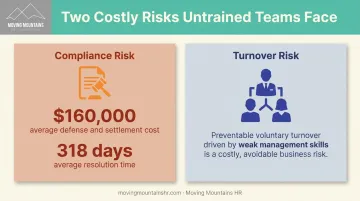
Compliance training is risk management, not optional paperwork. Hiscox claims data found that U.S. small and mid-size businesses without employment practices liability coverage face an average of $160,000 in defense and settlement costs per employment claim, with cases taking an average of 318 days to resolve.
That's nearly a year of disruption—and a cost curve training and clear policies are built to reduce.
Leadership training carries a different but equally costly risk: turnover. Gallup research finds that many employees who quit voluntarily believe their manager or organization could have prevented it. When managers lack basic people skills, strong employees leave—and replacing them almost always costs more than the training would have.
The 4 Types of Business Training Explained
Most training programs fall into four broad buckets. Each serves a different need, and most businesses accidentally over-invest in one category while neglecting another (usually leadership, which gets treated as a "nice to have" instead of a necessity).
Orientation and Onboarding Training
This is a new hire's first real impression of how your company actually operates. Good onboarding covers culture, policies, and role expectations in the first days and weeks. It's also directly tied to early retention: structured onboarding is one of the strongest levers you have for keeping new hires past the first year.
Technical and Job-Specific Training
This covers the practical tools, systems, and processes an employee needs to do their job well—software platforms, safety procedures, or role-specific processes. It looks completely different for a warehouse supervisor than it does for a billing coordinator, which is why it can't be one-size-fits-all.
Compliance and Regulatory Training
This keeps your business on the right side of the law. Harassment prevention, workplace safety, and industry-specific rules (California employment law, healthcare regulations) fall here. Of the four types, this one carries the most direct legal risk if skipped or handled with generic content.
Leadership and Skills Development Training
This prepares high performers and current managers with the soft skills and strategic thinking needed to lead people, not just manage tasks. It's also the category businesses get wrong most often—and the next two sections unpack why.
The 70-20-10 Rule for Leadership Development
Ask any manager how they really learned to lead, and you'll rarely hear "a training class." The Center for Creative Leadership's 70-20-10 framework explains why.
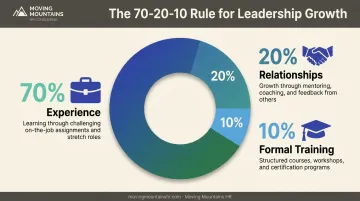
The model breaks leadership growth into three sources:
- 70% comes from experience: challenging assignments, stretch projects, and the messy work of leading a team through a real problem.
- 20% comes from relationships: mentoring, coaching, and honest feedback from people who've done it before.
- 10% comes from formal training: workshops, courses, and certification programs.
Researchers have questioned whether the exact percentages hold in every organization, and CCL itself treats the model as a guideline, not a rigid formula. What matters is the message: formal training alone is nowhere near enough.
For business owners: send a promising manager to a two-day seminar and call it done, and you've covered maybe a tenth of what builds a leader. Pair that seminar with a stretch assignment and a mentor who checks in regularly, and you've got something that actually sticks.
Experience, relationships, and formal learning aren't separate boxes to check. They reinforce each other: a challenging assignment without any mentor support breeds frustration, while a mentor without real experience to draw on has little to teach.
This is why Moving Mountains HR structures its leadership programs as multi-session series paired with one-on-one coaching rather than standalone workshops. Spreading a program over several months gives managers time to apply what they learn, then return with real scenarios to work through.
Top Leadership Skills Every Manager Needs
Poor management is one of the most common reasons employees quit. Gallup has found that roughly half of employees have left a job specifically to get away from a manager at some point in their career. The root cause is usually a skills gap, not a personality flaw.
Most effective leadership programs are built around a consistent core skill set. These ten show up again and again:
- Communication: Explain the why behind decisions, not just the what
- Decision-making: Make timely calls even with incomplete information
- Delegation: Assign ownership without abandoning oversight
- Conflict resolution: Address friction early, before it escalates
- Accountability: Hold the team—and yourself—to clear standards
- Adaptability to change: Adjust plans when conditions shift
- Coaching and mentoring: Develop people, not just direct tasks
- Emotional intelligence: Read the room and manage your own reactions
- Strategic thinking: Connect daily work to larger business goals
- Customer focus: Keep internal and external customers in view
Communication, accountability, and conflict resolution most often separate high-performing managers from those who struggle. Managers who explain context build trust faster and see fewer misunderstandings turn into conflict. Accountability cuts both ways: hold the team to clear standards, and own your own mistakes openly—teams notice fast when a manager deflects blame. On conflict, untrained managers avoid friction entirely or let it explode; skilled managers step in early, before it becomes a formal HR complaint.
Why These Skills Are Often Missing in New Managers
Most new managers get promoted because they were strong individual contributors, not because anyone taught them how to lead. A CareerBuilder survey found that 58% of managers received no management training at all, and roughly a quarter said they weren't ready to lead when they started managing people.
That gap doesn't close with a single onboarding session. It closes through structured training paired with ongoing HR support: coaching, performance management systems, and regular feedback that reinforces what was taught long after the course ends.
Choosing the Right Business Training Partner for Your Organization
Not every training partner fits every business. The best fit starts with industry alignment, not generic content pulled off a shelf.
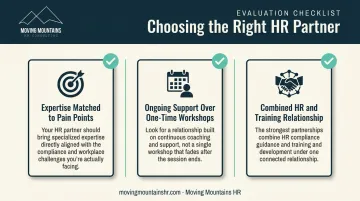
When you evaluate partners, weigh three factors:
- Expertise matched to your pain points. A healthcare practice navigating regulated HR issues needs different training than a team rebuilding leadership accountability. Generic workshops rarely serve either well.
- Ongoing support over one-time workshops. Under the 70-20-10 rule, classroom time is only a small slice of real development. Stronger partners add coaching, HR strategy guidance, and follow-up—not just a session and a certificate.
- A combined HR and training relationship. Small and mid-size businesses without a dedicated HR department often get more from one firm that bundles compliance, leadership guidance, and fractional CHRO support. A standalone training vendor usually covers only one piece of that puzzle.
This is the model Moving Mountains HR built its practice around. Rather than treating training as a separate line item, the firm folds leadership development, California compliance training, and workplace-risk topics into the same relationship as its HR compliance audits and fractional CHRO services.
Programs run through virtual and in-person workshops, multi-session leadership series, and one-on-one coaching, whichever format actually fits how your team works.
If you're not sure where your organization stands, start with something concrete. Moving Mountains HR offers a complimentary California HR Compliance Checklist that helps business owners spot compliance gaps before they turn into costly claims.
Frequently Asked Questions
What is business training?
Business training is a structured program that builds employee and manager skills so teams perform consistently and stay compliant. It covers day-one onboarding through ongoing leadership development.
What are the 4 types of training?
The four core types are orientation/onboarding, technical/job-specific, compliance/regulatory, and leadership/skills development training. Most businesses need all four, though the emphasis shifts based on size and industry.
What is the 70-20-10 rule for leaders?
The 70-20-10 rule is a leadership development model: about 70% of growth comes from on-the-job experience, 20% from mentoring and relationships, and 10% from formal coursework. Training matters, but it works best alongside real work and coaching.
What are the top 10 leadership skills for managers?
Communication, decision-making, delegation, conflict resolution, accountability, adaptability, coaching, emotional intelligence, strategic thinking, and customer focus. Gaps in these areas link directly to turnover and disengagement.
How much does business training typically cost for a small business?
Cost depends on format (virtual vs. in person), group size, topics, and whether training is standalone or bundled with broader HR support. Many small businesses use custom-quoted programs; in-house sessions cost less upfront, while consultant-led training often improves follow-through.
How do I know if my business needs a training consultant or HR partner?
Recurring compliance issues, high turnover, or inconsistent management practices are strong signs you need outside help. A training consultant or HR partner can find root causes across skills gaps, policies, and manager habits instead of fixing symptoms one at a time.