Introduction: Why Organizational Development Matters in Healthcare
Healthcare organizations across the United States face mounting pressure on workforce stability. Physician burnout, while declining from 48.2% in 2023 to 41.9% in 2025, remains dangerously high among nearly 19,000 physicians surveyed. HRSA projects an 8% national RN shortage by 2028, and one in five healthcare workers left their organizations in 2023.
Labor costs compound the strain: $839 billion in 2023, nearly 60% of average hospital expenses, with contract staffing alone accounting for $51.1 billion.
Most healthcare leaders focus on clinical excellence, but the systems and culture that enable that excellence often get overlooked. Staffing shortages, burnout, and high turnover are symptoms of deeper issues: operational bottlenecks, weak staffing models, poor communication, and toxic leadership cultures. Organizational development (OD) gives leaders a structured way to fix those root causes instead of treating each symptom in isolation.
Key Takeaways:
- OD targets root causes, improving employee experience and patient outcomes together
- Strong interventions diagnose structures and processes, not only individual training gaps
- Healthcare’s mix of roles and specialties makes coordinated organizational change essential
- Systematic culture work over 12–24 months shows measurable clinical impact
What Is Organizational Development in Healthcare?
Organizational development (OD) is a collaborative, system-wide approach to building lasting organizational effectiveness. In healthcare, OD is a systematic, data-driven practice that aligns structure, culture, processes, and people with high-quality patient care.
How OD Differs from Traditional HR
HR focuses on individual employee needs—recruitment, benefits, payroll, and compliance. OD addresses systemic organizational issues: leadership effectiveness, culture, change management, and team collaboration. While HR manages the employee lifecycle, OD transforms the systems and environment in which employees work.
This distinction matters in healthcare. When a hospital struggles with turnover, HR posts job openings and processes exit interviews.
OD asks harder questions: Why are people leaving? Are staffing models sustainable? Do employees have a voice in decisions? Is leadership creating psychological safety? Those answers drive system-level interventions HR alone cannot deliver.
Evolution of OD in Healthcare
Modern OD traces back to Kurt Lewin's 1947 group-dynamics work and the "unfreeze-change-refreeze" model that followed. Early OD emphasized human relations and participative management. In healthcare, practitioners adapted that foundation for industry-specific challenges: quality improvement, patient safety, interdisciplinary coordination, and organizational learning.
Today's healthcare OD must balance clinical priorities with operational efficiency. It has to serve the mission of patient care and the business realities of sustainable operations at the same time.
Core components of healthcare OD include:
- Organizational culture and climate assessment
- Leadership and coalition development
- Team effectiveness and communication design
- Change management and process redesign
- Strategic planning and continuous improvement
- Evaluation using workforce, operational, and clinical measures
Why Healthcare Organizations Need Organizational Development
Healthcare's complexity has grown exponentially. The Bureau of Labor Statistics counted 5.7 million jobs in general medical and surgical hospitals across 22 major occupational groups in May 2023, spanning clinical, technical, managerial, and support roles.
No single leader or profession can control quality outcomes in that environment.
The Systemic Nature of Healthcare Challenges
W. Edwards Deming observed that "something like" 94% of workplace troubles and improvement opportunities belong to the system, not individuals. It was a management heuristic, not a universal statistical law, but the principle still holds: most healthcare challenges need organizational-level solutions.
Burnout exemplifies systemic failure. Research links burnout to high workload, long shifts, and strained working relationships. A meta-analysis found high burnout correlates with worse patient safety outcomes. Burnout is not an individual resilience problem. It results from:
- Operational bottlenecks that create unnecessary workload
- Inadequate staffing models that stretch resources beyond capacity
- Poor communication systems that waste time and create frustration
- Toxic leadership cultures that erode trust and psychological safety
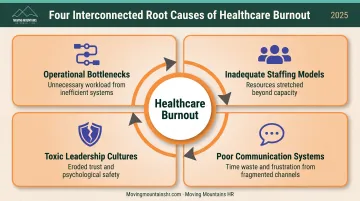
Only OD interventions targeting these root causes can reduce burnout sustainably.
Organizational Culture and Patient Outcomes
A 2017 systematic review of 62 healthcare studies found culture associated with patient outcomes in more than 90% of studies examined. Favorable cultures correlated with lower mortality, fewer falls, reduced infections, and higher patient satisfaction.
The evidence is primarily observational, but the pattern is clear. Engaged, supported employees create better patient experiences. Toxic cultures drive higher error rates and weaker safety performance.
The I-PASS handoff program shows what coordinated OD looks like in practice. Across 10,740 admissions at nine pediatric residency programs, teams paired a standardized handoff mnemonic with workshops, simulation, faculty development, direct observation, and a culture-change campaign.
Medical errors fell 23%, from 24.5 to 18.8 per 100 admissions, and preventable adverse events dropped 30%, from 4.7 to 3.3 per 100 admissions.
Strategic Advantage and Adaptability
Healthcare organizations face constant external pressure: mergers and acquisitions, value-based care models, telehealth expansion, regulatory changes, and public health emergencies. Organizations with strong OD capabilities respond more effectively because they've built adaptive cultures and collaborative decision-making processes.
Consider staffing adaptation. AHA reports that Providence's virtual-team model produced a 40% turnover reduction, near-zero ancillary vacancies, and projected $500,000 in annual cost avoidance after 16 weeks. That result was not just a staffing fix. It required workflow redesign, role clarity, technology adoption, and cultural acceptance of virtual collaboration.
Value-based care presents similar challenges. A 2025 scoping review of 145 studies found leadership and multidisciplinary collaboration were common facilitators. Funding limits, fee-for-service structures, provider resistance, and poorly aligned structures were common barriers.
OD gives organizations the means to assess culture, build coalitions, redesign roles, and adapt in stages as those transitions unfold.
Key Components of Organizational Development in Healthcare
Effective healthcare OD requires attention to several interconnected system elements. Each component influences the others, so strength in one area reinforces the rest—and weakness in one drags the system down.
Organizational culture is the deep-seated norms, values, and behaviors that define "how we do things here." Leadership behaviors, reward systems, communication patterns, and past experiences all shape it.
Organizational climate is the day-to-day mood of the workplace: how employees experience trust, psychological safety, openness of communication, and fairness.
These constructs are related but not interchangeable. Climate surveys capture employee perceptions; culture work requires changing the underlying assumptions and values that drive behavior.
Leadership Development and Effectiveness
Healthcare is shifting from traditional hierarchical leadership to adaptive leadership that empowers teams, manages change processes, and creates cultures of continuous learning. The American College of Healthcare Executives identifies five core competency domains:
- Communication and relationship management
- Leadership
- Professionalism
- Knowledge of the healthcare environment
- Business skills and knowledge
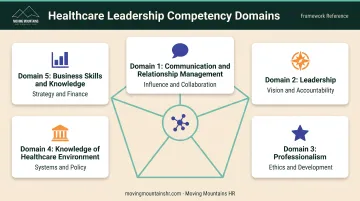
For OD work specifically, those domains show up in a few practical competencies:
- Emotional intelligence to navigate high-stakes clinical environments
- Change management skill to guide complex transitions
- Ability to balance clinical and business priorities
- Cultural competence to serve diverse patient populations
- Transparent communication that builds trust across professional silos
Team Development and Collaboration
Effective teamwork is particularly challenging in healthcare. Breaking down silos between physicians, nurses, administrators, and support staff takes intentional design and ongoing support. Hackman's model of group effectiveness points to four conditions for strong teams:
- Clear goals
- Appropriate team composition
- An enabling organizational context
- Ongoing coaching
AHRQ's TeamSTEPPS framework adds evidence-based tools around team structure, communication, leadership, situation monitoring, and mutual support. Training alone is not enough. TeamSTEPPS sticks only when leaders reinforce it and teams build it into daily workflow.
Creating psychological safety is essential. Teams must feel safe speaking up about errors, concerns, or improvement ideas without fear of punishment or embarrassment. That shift rarely happens without sustained OD work.
Change Management and Process Improvement
OD provides structured approaches to implementing change: assessing readiness, engaging stakeholders, addressing resistance, communicating transparently, and evaluating impact. The IHI Psychology of Change framework emphasizes intrinsic motivation, co-design, authentic relationships, distributed power, and adaptation in action.
Continuous improvement methods such as Lean, Six Sigma, and Total Quality Management are common in healthcare. Process tools alone do not change culture. Effective OD pairs those tools with leadership behavior, real participation, learning loops, and reinforcement so improvements last.
The Organizational Development Process for Healthcare Organizations
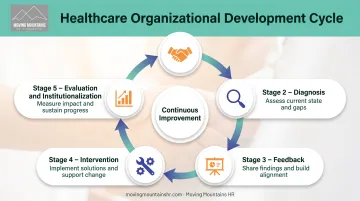
Healthcare OD typically follows a cycle adapted from action research:
1. Entry and contracting - Define the problem, identify sponsors, and set the system boundary. Clarify roles, decision rights, confidentiality parameters, and success criteria before work begins.
2. Diagnosis - Combine workforce or culture surveys, stakeholder interviews, focus groups, workflow observation, and operational or clinical data to identify root causes rather than symptoms. Engage diverse stakeholders: frontline staff, mid-level managers, executives, and physicians, to surface cultural realities.
3. Feedback - Validate findings with executive and frontline groups. Identify patterns rather than assigning individual blame. Build readiness for change by making the case for action based on shared data.
4. Intervention - Select and implement appropriate solutions:
- Leadership coaching and development programs
- Team-building retreats and workshops
- Culture change initiatives
- Strategic planning facilitation
- Conflict resolution and mediation
- Process redesign and succession planning
5. Evaluation and institutionalization - Compare leading behaviors with lagging outcomes across workforce, operations, safety, quality, and patient experience. Adapt based on results and build new practices into routine operations.
The Leadership Saves Lives hospital study demonstrates this cycle in action. Ten US hospitals received coalition-based workshops and support over two years, with validated surveys at baseline, 12, and 24 months, plus 393 interviews and CMS mortality data.
Six hospitals with substantial culture shifts reduced AMI risk-standardized mortality by 1.07 percentage points, versus 0.23 points in the other four.
Effective OD is iterative. Organizations need to keep assessing results and refining their approach as internal and external conditions change.
Common Challenges and How to Overcome Them
Healthcare OD faces predictable barriers. A 2023 integrative nursing review tied most resistance to fear, mistrust, and low readiness—often worsened by weak sponsorship, top-down management, structural constraints, and thin resources.
Where clinical staff push back
- Skepticism of "corporate initiatives" disconnected from patient care
- Fear that OD will add administrative burden without reducing workload
- Concerns about loss of professional autonomy
- Past negative experiences with failed change efforts that eroded trust
Strategies that reduce resistance
- Name an executive sponsor and a multidisciplinary guiding coalition with protected time and real authority
- Bring clinicians in early to set goals, success measures, and workable actions
- Frame every initiative around patient outcomes, safety, or experience—not corporate jargon
- Pilot small with IHI's "adapt in action" approach: test, publish shared measures, then scale on evidence
- Give people training, coaching, and protected time while the change lands
- Read resistance as diagnostic data on trust, workload, autonomy, resources, or design—not as obstruction
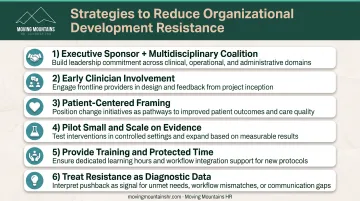
Leaders who treat pushback as information, and who pair clear patient-care framing with real frontline ownership, clear the most common OD barriers faster.
How to Get Started with Organizational Development
Healthcare leaders should begin with an honest organizational assessment. Ask:
- What are our most pressing challenges?
- Where do symptoms suggest deeper systemic issues?
- What does employee feedback reveal about culture and leadership?
Review engagement surveys, exit interviews, turnover data, patient satisfaction scores, safety metrics, and operational efficiency measures. Look for patterns that point to organizational rather than individual problems.
Build Internal OD Capability or Bring in a Partner
Larger health systems may benefit from dedicated internal OD staff who know the organization's history and can sustain multi-year initiatives. Small to mid-size practices usually get farther with external consultants who bring cross-organizational experience and objectivity.
What to Look for in an OD Partner
- Healthcare industry experience and a real grasp of clinical culture
- Data-driven diagnosis instead of off-the-shelf programs
- Collaborative stakeholder engagement from start to finish
- Focus on building lasting capability, not one-off fixes
- Proof of measurable results from past engagements
If you need that external bench strength, Moving Mountains HR brings executive-level HR support shaped by deep healthcare industry experience. Founder Michelle Schwanhauser works with organizations on leadership development, performance management, workplace culture, and fractional CHRO support when senior HR leadership is needed without a full-time hire.
Start Where Impact Is Clearest
- Leadership gaps → begin with leadership development
- Silos blocking coordination → start with team development
- Toxic culture → open with culture assessment and change management
- Process bottlenecks → start with workflow redesign
Don't try to fix everything at once. Put resources on the changes that deliver the highest return with the least implementation resistance.
Frequently Asked Questions
What are the 5 stages of organizational development (OD)?
The five stages are Entry (contact and contracting), Diagnosis (data collection and analysis), Feedback (sharing findings), Intervention (implementing change), and Evaluation (measuring impact). These stages often cycle as organizations pursue continuous improvement rather than one-time projects.
What are the 5 key performance indicators for healthcare organizations?
OD work in healthcare often targets five KPI areas: patient satisfaction (HCAHPS), employee engagement and retention, clinical quality (readmissions, infections, mortality), operational efficiency (length of stay, cost per case), and safety (sentinel events and preventable harm).
What are the four leadership styles in healthcare organizations?
Four common approaches are transformational (inspiring change), transactional (rewards and accountability), servant (team development and support), and participative (collaborative decisions). Effective healthcare leaders usually blend styles based on context and need.
What are the 5 C's of healthcare organizations?
One useful framing uses five C's: Care (patient-centered quality), Cost (sustainability and efficiency), Convenience (access and experience), Communication (transparency), and Culture (values and environment). OD work often touches all five, though this is not a formal OD model.
How long does organizational development take in healthcare?
OD is ongoing, not a one-time project. Early results can appear in 3–6 months, but meaningful culture change usually takes 12–24 months or more, depending on size and scope. The Leadership Saves Lives study, for example, tracked substantial culture shifts over two years.
What's the difference between HR and organizational development in healthcare?
HR focuses on the employee lifecycle: recruiting, onboarding, benefits, compliance, and performance management. OD targets system-level issues—culture, leadership effectiveness, change management, and team development. The two often partner closely, but they differ in focus and methods.