
Now what?
This is the exact moment many business owners realize their internal team can't handle the situation fairly — or can't be seen as handling it fairly, which matters just as much. That's where the term "independent investigator" comes in.
You'll hear this phrase used across legal, corporate, and even municipal settings, each with slightly different rules attached. This article focuses on what it means in the workplace context: who these investigators are, what qualities separate a good one from a bad one, how the investigation process actually unfolds, and when your business should bring in outside help instead of managing it internally.
Key Takeaways
- An independent investigator is a neutral third party with no stake in the complaint’s outcome.
- Credibility hinges on independence, employment law knowledge, and thorough documentation.
- Harassment, discrimination, or executive misconduct usually warrants an outside investigator when HR has a conflict.
- A well-run investigation limits legal exposure and treats every party fairly.
What Is an Independent Investigator?
An independent investigator is a neutral third party (often an employment attorney, HR consultant, or licensed professional) brought in to objectively gather facts about an alleged incident of misconduct, discrimination, or policy violation.
Here's the part people often misunderstand: the investigator's job is to figure out what happened, not to decide guilt or hand down discipline. Those decisions stay with the employer. The investigator delivers findings; leadership decides what to do with them.
The formality of this role varies by setting. Some cities have written it directly into law.
Los Angeles Administrative Code Section 4.407, for example, requires investigations into discrimination or sexual harassment complaints against elected officials to be handled by someone from a Council-approved list of non-city employees, chosen by lot before any complaint is filed.
That investigator gets access to the complainant, the accused, witnesses, and city records, and must submit a full report with findings and recommendations. It is one of the clearest examples of how formal the role can be.
Private businesses rarely need that level of formality, but the underlying principle is the same: no conflicts of interest, no personal or professional ties to either party, and no vested interest in the outcome.
Independent Investigator vs. Internal HR Investigator
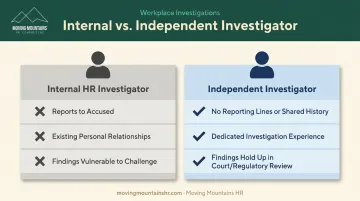
Internal HR staff can absolutely conduct fair investigations. But bias (real or perceived) creeps in more easily than most owners expect, especially at smaller companies where the HR person knows the accused, reports to them, or has worked alongside the complainant for years.
That's not a knock on internal HR. It's just human nature. And if a case later escalates to litigation, the other side's attorney will look for exactly this kind of relationship to challenge your findings.
An outside investigator addresses these risks directly:
- No reporting lines, friendships, or shared history with either party
- Findings that hold up better if challenged in court or before a regulatory agency
- Dedicated investigation experience most internal HR teams do not practice day to day
When Should a Business Use an Independent Investigator?
Not every complaint needs outside help. A minor scheduling dispute or a one-off policy misunderstanding can usually stay in-house. But certain situations tip the scale toward bringing in a neutral third party:
- Allegations of harassment, discrimination, or retaliation
- Complaints against a senior executive, owner, or someone HR reports to
- Financial misconduct or fraud allegations
- Cases where internal HR lacks the training or objectivity to investigate properly
High-stakes complaints deserve extra caution. If an allegation carries real legal exposure or reputational risk, an internal investigation that later gets picked apart in court can cost far more than the fee for an outside investigator would have.
California regulations reinforce this. Under California Code of Regulations, Title 2, Section 11023, employers must provide "impartial and timely investigations by qualified personnel" for harassment and discrimination complaints, plus documentation showing reasonable progress.
The rule doesn't explicitly mandate an outside investigator — but "impartial" is doing a lot of work in that sentence. It's hard to argue impartiality when the investigator reports to the accused.
Healthcare employers face additional pressure. The industry already deals with heightened scrutiny around workplace safety and incident response, and complaints involving patient-facing staff or clinical hierarchies often carry extra sensitivity.
When licensing boards or accreditation bodies may get involved, a defensible, independently documented process matters even more.
Key Qualities of an Effective Independent Investigator
Not every attorney or HR consultant is equipped to run a workplace investigation well. Look for these five qualities before hiring one.
Independence and impartiality. No conflicts of interest, no personal stake in the outcome. This is the foundation everything else builds on. Without it, nothing the investigator produces will hold up to scrutiny.
Employment law and industry expertise. The investigator needs working knowledge of harassment, discrimination, and workplace regulations relevant to your industry. California's Harassment Prevention Guide from the Civil Rights Department specifically notes that complex or serious allegations call for investigators with prior investigative experience, not just general HR background.
Professional empathy. Witnesses are often distressed, guarded, or afraid of retaliation. A skilled investigator asks open-ended questions, avoids leading witnesses toward a particular answer, and makes people feel heard without compromising objectivity.
Confidentiality and data protection. Investigators share information on a need-to-know basis only. Anyone handling sensitive complaints should clearly explain how they protect records and witness statements throughout the process.
Strong documentation and reporting skills. The investigation lives or dies on the paper trail. A clear, objective, legally defensible written report is essential—if the documentation is sloppy, the investigation itself becomes vulnerable to challenge.
The Independent Investigation Process: What to Expect
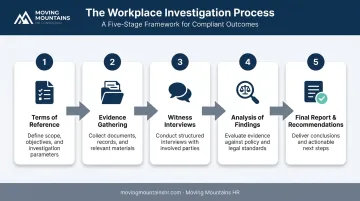
Every credible workplace investigation follows a similar arc, even when the details differ case to case.
- Terms of Reference. The investigator and employer agree on scope, allegations, process, timeline, and how witnesses will be identified, interviewed, and whether they may bring a representative.
- Evidence gathering. The investigator collects and organizes documents, emails, texts, HR files, and other relevant records.
- Witness interviews. Structured but flexible conversations built on open-ended questions. The investigator avoids leading or compound questions, which can taint the reliability of answers.
- Analysis of findings. The investigator weighs evidence under the preponderance of the evidence standard—more likely than not that the conduct occurred—and follows the facts wherever they lead. That is the standard California's Civil Rights Department uses in its harassment prevention guidance.
- Final report and recommendations. A clear, jargon-free document outlining what evidence was reviewed, what the investigator found, and, where appropriate, recommendations for next steps.
Moving Mountains HR follows this same structure in its workplace investigation work: intake and complaint assessment, investigation planning, neutral interviews, evidence collection, and a summary report with findings. Confidentiality and anti-retaliation protections stay in place at every stage.
Benefits of Hiring an Independent Investigator for Your Business
Bringing in outside help produces measurable business value.
- Reduces legal risk by creating a thorough, neutral record you can defend if a complaint becomes litigation or a regulatory inquiry
- Protects workplace trust and morale, because employees accept outcomes more readily when they believe the process was fair
- Saves internal resources by freeing owners and HR teams from the hours a sensitive investigation would otherwise consume
For California businesses without an in-house investigator, Moving Mountains HR provides neutral, third-party workplace investigations. That includes harassment, discrimination, hostile work environment, retaliation, and code-of-conduct complaints—so you get seasoned HR support for a serious matter without building that capability in-house.
Frequently Asked Questions
What is an independent investigator?
An independent investigator is an unbiased third party retained to objectively establish facts in a workplace complaint or dispute. Unlike an internal HR employee, they have no reporting relationship or personal stake in either party involved.
Do private investigators have any powers?
Generally, no. Private investigators lack law enforcement authority such as arrest or subpoena power unless specifically granted by a government body or contract. Their role is limited to fact-gathering permitted under the law.
Can you be under investigation at work without knowing?
A preliminary review can begin quietly, but a fair process generally requires notifying the accused once the investigation formally proceeds. They should receive a clear statement of the allegations and a chance to respond.
Who can serve as an independent investigator for a workplace complaint?
Outside employment attorneys, HR consultants, or licensed investigators with relevant training and no ties to either party typically fill this role. The key requirement is complete independence from the people and outcome involved.
How much does an independent workplace investigation typically cost?
Cost depends on the complexity and scope of the investigation. Most providers, including Moving Mountains HR, offer a custom quote after an initial consultation rather than a flat rate.
How long does an independent workplace investigation usually take?
Timelines vary based on case complexity, the number of witnesses, and evidence involved. Investigators aim to move quickly without sacrificing thoroughness. Rushing a case often creates more legal risk than it solves.