
This gap creates real business consequences. Leadership development training addresses these challenges by equipping managers with the skills they need to lead effectively. This article covers the essential leadership training topics that help small to mid-size organizations build capable leaders at every level, from frontline supervisors to senior executives.
Key Takeaways
- Leadership training reduces turnover, strengthens succession planning, and improves team engagement for growing businesses
- Strong programs build three pillars: team leadership, strategic skills, and personal development (EQ and resilience)
- Highest-impact topics: performance management, communication, delegation, emotional intelligence, and strategic thinking
- Assess leadership gaps, prioritize 3–5 topics, and pair formal training with coaching and on-the-job practice
Why Leadership Development Training Matters for Small to Mid-Size Businesses
Leadership gaps slow operations, create compliance risks, drive turnover, and leave organizations unprepared when key leaders leave. A 2016 survey of 400 US middle-market executives found that fewer than half used critical talent-planning processes, and only half were prepared for an unexpected senior-leader departure.
Small to mid-size businesses often skip formal leadership development, relying instead on "learning by doing." While experience matters, this approach produces inconsistent results. Some managers figure it out; others struggle for years or leave.
Research shows that managers account for 70% of the variance in team engagement. That makes manager capability one of the highest-leverage investments an organization can make.
Companies that invest in leadership training see measurable returns:
- Better-trained managers build engaged teams that stay productive and stick around
- Stronger day-to-day leadership cuts turnover costs tied to poor management
- Leadership pipelines reduce disruption when key people move on
- Trained managers handle conflicts, performance problems, and documentation with fewer compliance gaps
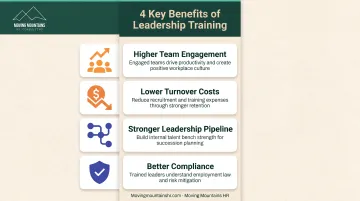
For small and mid-size businesses, that investment shows up in higher engagement, lower turnover, and steadier operations when leadership changes.
15 Essential Leadership Development Training Topics
Effective leadership development spans three core categories: team leadership and management, strategic and operational capabilities, and personal development. The topics below represent the foundational skills that separate struggling managers from high-performing leaders.
Team Leadership & Management Skills
Communication & Active Listening
Strong leaders listen fully, adapt their message, and confirm understanding before they respond. Effective active listening includes paying full attention, withholding judgment, reflecting what you hear, clarifying ambiguity, summarizing key points, and sharing your perspective only after understanding theirs.
Training should cover:
- Tailoring communication style to different personalities and situations
- Delivering clear expectations and constructive feedback
- Listening for underlying concerns, not just surface statements
- Using open-ended questions to uncover team challenges
Conflict Resolution
Workplace conflict is inevitable; effectiveness shows up in the response. The five conflict-management modes (competing, avoiding, accommodating, compromising, and collaborating) each have appropriate use cases. Training should cover when to step in, when to mediate, and how to turn disagreements into stronger team alignment.
Performance Management & Coaching
Performance management works best as an ongoing process, not a once-a-year review. Effective feedback is frequent, focused, future-oriented, and delivered through two-way conversation. Leaders need training in:
- Setting clear, measurable expectations
- Providing real-time feedback that improves performance
- Coaching employees toward skill development and career goals
- Conducting performance conversations that motivate rather than demoralize
Team Building & Motivation
The Direction, Alignment, Commitment (DAC) framework defines what teams need: agreement on goals (Direction), coordinated work (Alignment), and mutual responsibility (Commitment).
Leaders also need to understand what motivates each person, recognize contributions authentically, and build psychological safety so people can take smart risks.
Delegation & Accountability
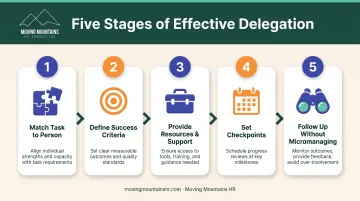
New managers often swing between micromanaging and handing work off with no support. Effective delegation transfers authority along with resources, direction, and support. Training should address:
- Matching tasks to team members' skills and development needs
- Defining success criteria and checkpoints upfront
- Following up without micromanaging
- Holding people accountable while maintaining trust
Strategic & Operational Skills
Strategic Thinking & Planning
Strategic thinking connects daily work to long-term organizational goals. The 3A model (Acumen: context, insight, innovation; Allocation: resource choices; Action: collaboration and execution) provides a practical framework. Training helps leaders anticipate challenges, decide with future impact in mind, and align team priorities with company strategy.
Decision-Making & Problem-Solving
Leaders face decisions under uncertainty every day. Case-method training helps managers analyze real dilemmas, weigh options, involve stakeholders appropriately, and defend their choices. The aim is building judgment, learning from outcomes, and raising decision quality over time—not chasing a single "right" answer every time.
Change Management
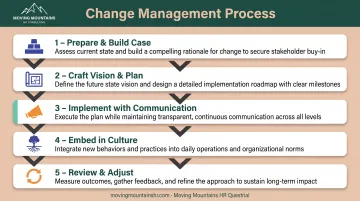
Change is constant, and leaders must guide teams through transitions while maintaining productivity. The five-stage change-management process includes:
- Preparing the organization and building the case for change
- Crafting a clear vision and detailed plan
- Implementing the change with ongoing communication
- Embedding new practices into culture and systems
- Reviewing progress and adjusting as needed
Training should also address how to communicate reasons for change, address resistance, and maintain morale during uncertainty.
Time & Priority Management
Managers juggle competing demands constantly. Effective time management requires three skill areas: awareness (realistic understanding of time), arrangement (goal-setting and scheduling), and adaptation (adjusting under changing conditions). Leaders should model sustainable work practices, manage meetings effectively, and set boundaries that protect team focus.
Succession Planning & Talent Development
Building leadership pipelines ensures organizational continuity. SHRM's succession-planning framework includes identifying critical roles, assessing current leaders, pinpointing skill gaps, creating development plans, and measuring readiness. Programs should teach how to spot high-potential employees, assign stretch work, and prepare successors for future roles.
Personal Development & Soft Skills
Emotional Intelligence & Self-Awareness
Emotional intelligence (EI) includes four competencies: self-awareness (recognizing your emotions and triggers), self-management (controlling reactions), social awareness (understanding others' emotions), and relationship management (building strong connections). Leaders with high EI navigate workplace dynamics more effectively, manage stress, and demonstrate empathy that builds trust.
Adaptability & Resilience
Resilience means responding adaptively to stress and recovering effectively. Research-backed resilience practices include reframing setbacks as learning opportunities, staying composed under pressure, and modeling persistence for teams. Leaders who practice this create cultures where people can take risks and learn from failure.
Ethical Leadership & Integrity
Ethical conduct is how leaders earn and keep trust. Ethical leadership practice includes modeling character and values, creating community, encouraging ethical conduct, exercising role discipline, clarifying culture, and designing systems that reinforce ethical behavior. That means values-based decisions, visible accountability, and transparency even when it is difficult.
Influence & Persuasion
Formal authority rarely covers everyone a leader needs to move. Training should cover how to build credibility, present ideas clearly, and win buy-in across the organization. Ethical influence builds durable relationships without manipulation: clear messages, honest framing, and respect for others' autonomy.
Continuous Learning & Growth Mindset
A growth mindset treats ability as developable rather than fixed. Leaders with a growth mindset seek feedback actively, reflect on experiences, stay current on industry trends, and encourage team learning. They reframe failure as a learning opportunity and use "not yet" language to focus on improvement rather than limitations.
How to Implement Leadership Training in Your Organization
Building an effective leadership development program requires more than picking topics off a list. Follow these steps to create training that drives measurable business impact.
1. Conduct a leadership skills assessment
Start by identifying current gaps. Survey employees about their managers' effectiveness, review recurring performance issues, and pinpoint where leadership breakdowns occur.
A thorough needs analysis examines organizational strategy, HR metrics, job requirements, and individual performance data. Consider adding confidential 360-degree feedback to surface blind spots.
2. Prioritize topics based on business needs
Don't try to train everything at once. Identify the 3-5 topics that will have the most immediate impact on your specific challenges:
- High turnover? Prioritize team motivation, performance management, and communication
- Compliance concerns? Focus on conflict resolution, documentation, and ethical leadership
- Succession gaps? Emphasize delegation, talent development, and strategic thinking
- Growth stage? Invest in change management, decision-making, and adaptability
3. Choose appropriate training methods
Different skills require different development approaches:
- Formal workshops: Frameworks and shared language for groups learning together
- Online courses: Foundational knowledge leaders can complete at their own pace
- Mentoring programs: Ongoing guidance pairing experienced leaders with emerging managers
- Executive coaching: One-on-one support for senior leaders facing complex challenges
- Peer learning groups: Facilitated circles where managers work through real challenges
- Stretch assignments: On-the-job experiences that build judgment and capability
4. Create a blended learning approach
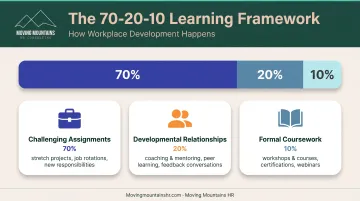
The 70-20-10 framework suggests that 70% of development comes from challenging assignments, 20% from developmental relationships, and 10% from formal coursework. Those percentages aren't rigid, but the principle holds: combine formal training with experiential learning and ongoing support.
Role-playing exercises, case discussions, and on-the-job application reinforce classroom concepts.
5. Measure impact and adjust
Track both leading and lagging indicators:
- Leading indicators: Training completion rates, skill assessments, 360-degree feedback scores
- Lagging indicators: Employee engagement scores, turnover rates, promotion readiness, manager effectiveness ratings
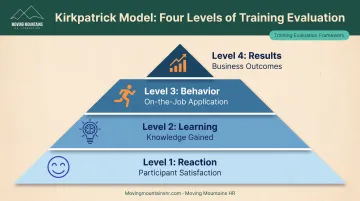
The Kirkpatrick model evaluates training at four levels:
- Reaction: Participant satisfaction
- Learning: Knowledge gained
- Behavior: On-the-job application
- Results: Business outcomes
Define the desired business result first, then work backward so your program is built to deliver it.
Choosing the Right Leadership Development Approach
Small to mid-size businesses have several options for delivering leadership training, each with different resource requirements and benefits.
Internal training programs offer maximum customization. You can tailor content around specific organizational challenges, culture, and strategic priorities. However, this approach requires dedicated learning and development staff, curriculum design expertise, and budget for materials and facilitation.
External training providers bring specialized expertise through workshops, seminars, and online courses. Many organizations use a hybrid approach: 43% combined internal and external programs in 2025, up from 35% the year before.
External providers can fill gaps when internal capacity is limited, though content may be less tailored to your specific context.
Fractional HR leadership support is an option when you need executive-level guidance on leadership development without hiring a full-time Chief Human Resources Officer.
This model pairs strategic planning with hands-on implementation. You get help assessing gaps, prioritizing topics, selecting methods, and measuring results.
The best approach aligns your training investment with organizational priorities, available resources, and the urgency of leadership gaps. Consider:
- Budget constraints: What can you invest in leadership development this year?
- Internal capacity: Do you have staff who can design and deliver training?
- Leadership gap urgency: How quickly do you need to close capability gaps?
- Organizational size: How many managers need development, and at what levels?
The most effective programs blend methods. Use formal training for foundational skills, coaching for personalized development, and stretch assignments for real-world application.
Frequently Asked Questions
What are some good topics for leadership development training?
High-impact topics include communication, conflict resolution, coaching and performance management, delegation, emotional intelligence, strategic thinking, decision-making, change management, and team building. Prioritize based on your organization's gaps and business challenges.
What are some effective training activities for leadership development?
Effective activities include role-playing (feedback, delegation, tough conversations), case studies, 360-degree feedback, and peer coaching circles. Stretch assignments paired with coaching deliver the strongest learning when combined with formal training.
What are some good leadership trainings?
Choose programs that blend frameworks with real-world practice, offer support beyond one-off workshops, and fit your organization's challenges. The best ones include feedback and coaching, and measure behavior change and business results, not just satisfaction scores.
What are the 4 C's of leadership?
One informal framework describes the 4 C's as Competence (technical and professional skills), Character (integrity and values), Commitment (dedication to the organization and team), and Communication (clarity and transparency). This is not a standardized research framework but serves as a useful organizing mnemonic for core leadership attributes.
What are the five P's of leadership?
An editorial framework describes the five P's as Purpose (clear vision), People (building and developing teams), Process (systems and efficiency), Performance (results and accountability), and Perseverance (resilience through challenges). While not an authoritative research model, these categories capture key leadership responsibilities.
Investing in Leadership Development Drives Long-Term Success
Leadership development works best as an ongoing investment, not a single workshop. Done well, it builds organizational capability, cuts turnover, and supports succession planning over time.
A 2017 meta-analysis of 335 studies found positive effects on learning, skill transfer, and organizational results. The strongest outcomes came from programs that included:
- Needs analysis before training starts
- Practice opportunities with real work
- Multiple methods plus regular feedback
- Spaced learning instead of one-and-done sessions
Start by assessing leadership gaps through employee surveys, performance reviews, and turnover data. Then build a plan that fits your budget:
- Prioritize 3–5 topics with the most immediate business impact
- Mix formal training with coaching and mentoring
- Require on-the-job application so skills stick
- Measure progress and adjust as you go
For small to mid-size businesses without dedicated HR staff, fractional HR leadership support can supply the executive-level guidance to design, implement, and measure these programs. You get stronger managers and more engaged teams without hiring a full-time HR executive.
Moving Mountains HR works with small and mid-size organizations to design customized leadership training that addresses real business challenges. Our programs combine practical tools and real-world scenarios with ongoing support, so your managers lead more effectively. Contact us at 866-474-3575 or staff@movingmountainshr.com to discuss your leadership development needs.