
High-performing teams don't happen by accident. They're built deliberately through specific leadership practices, clear communication systems, and intentional HR strategies. This guide provides actionable steps for building and improving team performance, regardless of your company size or resources.
Key Takeaways
- Strong performance rests on clear goals, defined roles, psychological safety, and steady communication rhythms
- Leaders raise results through consistent accountability, coaching, and clearing blockers
- Resolve conflicts and performance gaps early with a simple, repeatable process
- Track both hard outcomes (output, quality, deadlines) and team-health signals (trust, engagement)
- Build trust through reliable follow-through over time—not one-off events
What is Team Performance and Why Does It Matter?
Team performance is the collective ability of a group to achieve goals efficiently while maintaining positive working relationships and individual engagement. It covers more than individual output: how people collaborate, share accountability, and deliver results no one person could produce alone.
Individual vs. Team Performance
Individual performance measures what one person accomplishes. Team performance measures how people coordinate work, share knowledge, solve problems together, and own shared outcomes.
Business Impact of High-Performing Teams
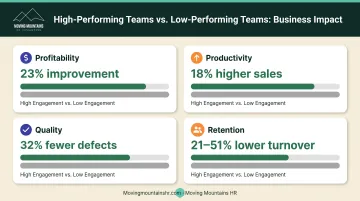
Gallup’s engagement research shows a clear gap between strong and weak teams:
- Profitability: High-engagement teams outperform low-engagement units by 23%
- Productivity: 18% higher sales productivity and 14% higher production output
- Quality: 32% fewer defects in work products
- Retention: 21–51% lower turnover, depending on industry baseline
For small businesses, those gaps show up fast. Every contribution counts, and poor collaboration hits operations immediately.
Why This Matters for Small to Mid-Size Businesses
Limited resources mean you can't afford weak links or inefficient collaboration. When a team of eight loses one member, capacity drops 12.5%. When two people stop communicating, entire workflows stall.
In smaller organizations, team performance problems are more visible, more costly, and more urgent to fix.
Foundation Elements of High-Performing Teams
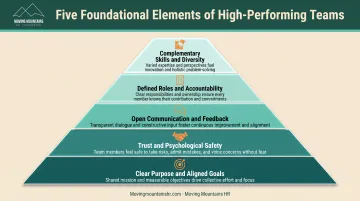
High-performing teams rest on a few non-negotiable foundations. Get these right, and every other performance effort has something solid to stand on.
Clear Purpose and Aligned Goals
Teams need a shared understanding of why they exist and what they're trying to achieve together. Without this, people work in different directions, duplicate effort, and waste time.
How to create clear team goals:
- Connect team objectives directly to broader business goals
- Use the SMART framework: Specific, Measurable, Assignable, Realistic, Time-related
- Assign an owner, measure, deadline, and success criteria to each goal
- Document dependencies between team members' work
- Review and adjust goals quarterly based on business priorities
Strong alignment means coordinated roles and expertise. Weak alignment produces duplication, rework, and gaps where critical work falls through.
Trust and Psychological Safety
Psychological safety is a shared belief that the team is safe for interpersonal risk-taking. Team members feel comfortable admitting mistakes, asking questions, sharing half-formed ideas, and challenging the status quo without fear of punishment or embarrassment.
Research on 51 manufacturing teams found psychological safety was associated with learning behavior. A 2020 meta-analysis of 3,671 business teams found trust correlated with performance at 0.48, with stronger effects in smaller teams.
Practical ways leaders build trust:
- Follow through on commitments consistently
- Demonstrate vulnerability by admitting your own mistakes
- Address conflicts transparently instead of avoiding them
- Solicit input and respond supportively
- Create a positive climate before adding challenge or stretch goals
Trust builds through repeated leader behavior that proves the environment is safe, not through one-time team-building events.
Open Communication and Feedback
Research shows communication quality matters more than frequency. Clear, timely, accurate, and useful exchanges drive performance better than high message volume alone.
Establish communication norms:
- Define which channels to use for what purposes (email vs. chat vs. meetings)
- Set expectations for response times
- Document decisions and action items in a shared log
- Create escalation paths for urgent issues
- Schedule regular check-ins at a predictable cadence
Pair those norms with a feedback culture where constructive input flows in all directions, not only top-down during annual reviews. Gallup reports that employees who receive daily manager feedback are three times as likely to be engaged as those who hear from their manager once a year.
Defined Roles and Accountability
Team members need clarity about their individual responsibilities and how they contribute to team success. Role ambiguity creates confusion, frustration, inefficiency, and gaps in coverage.
Accountability structures that support performance:
- Use a RACI matrix to map Responsible, Accountable, Consulted, and Informed roles for each deliverable
- Assign one accountable owner per deliverable
- Track progress visibly through scorecards or dashboards
- Hold regular progress check-ins
- Create peer accountability, not just top-down oversight
Accountability should support and motivate, not punish. The goal is shared ownership and transparent progress tracking.
Complementary Skills and Diversity
High-performing teams intentionally combine different skill sets, perspectives, and working styles. A 2024 meta-analysis of 615 studies found that demographic, job-related, and cognitive diversity had positive relationships with performance, especially for complex or creative work.
Build a balanced team:
- Identify skill gaps through honest assessment
- Leverage individual strengths and assign work accordingly
- Combine technical expertise with relationship-building skills
- Mix analytical thinkers with creative problem-solvers
- Create inclusive processes that draw on different perspectives
Select for complementary task skills and build processes that make diverse contributions visible and valued.
Step-by-Step Process for Building and Improving Team Performance
Step 1: Assess Your Current Team State
Start by diagnosing team health before implementing changes. The Team Diagnostic Survey, developed across 321 organizational teams, checks whether the conditions for strong teamwork are in place—not only whether the team hits output metrics.
Assessment methods:
- Conduct one-on-one conversations with each team member
- Use anonymous surveys to surface candid feedback
- Observe team dynamics during meetings and collaborative work
- Review performance data: deadlines met, quality metrics, customer feedback
- Track engagement indicators: participation, initiative, voluntary collaboration
What to look for:
- Communication patterns: Who talks to whom? What gets discussed openly vs. avoided?
- Conflict resolution: Do people address disagreements directly or let them fester?
- Goal clarity: Can everyone articulate the team's top three priorities?
- Trust levels: Do people admit mistakes and ask for help?
- Engagement: Are members invested in the team's success or just completing tasks?
Establish a baseline before changing meetings, roles, or accountability systems.
Step 2: Establish Clear Team Goals and Expectations
Involve the whole team in defining shared objectives. Participation builds buy-in and brings out different views of what success looks like.
Facilitate a goal-setting session:
- Present business objectives and constraints
- Ask team members what they believe the team should achieve
- Discuss trade-offs and prioritize together
- Define 3–5 measurable goals with specific success criteria
- Document expectations for both results and behaviors
Create a team charter:
- Mission: Why does this team exist?
- Goals: What will we achieve in the next 6–12 months?
- Roles: Who is responsible for what?
- Ground rules: How will we work together?
- Decision method: How will we make decisions when we disagree?
- Communication norms: How will we stay aligned?
- Accountability: How will we track progress and address issues?
Review and update the charter quarterly as work evolves.
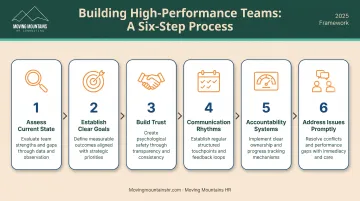
Step 3: Build Trust Through Structured Team Activities
Build trust continuously, not as a one-time event. While team-building activities can help, daily leadership behaviors matter more.
Trust-building activities for different environments:
Match the format to how your team works.
In-person teams:
- Start meetings with personal check-ins
- Run problem-solving workshops where everyone contributes
- Conduct retrospectives where the team reviews what worked and what didn't
- Create cross-functional collaboration opportunities
Remote teams:
- Schedule virtual coffee chats or informal video calls
- Use collaborative tools where everyone can see and contribute to shared work
- Rotate meeting facilitation so everyone leads
- Celebrate wins publicly in team channels
Continuous trust-building practices:
- Model vulnerability by sharing your own mistakes and lessons learned
- Ask for input before making decisions that affect the team
- Follow through on commitments consistently
- Address broken commitments directly and make repairs
- Recognize contributions publicly and specifically
Step 4: Implement Regular Communication Rhythms
Establish a cadence of team meetings with specific purposes. Match frequency to work interdependence and decision urgency.
Recommended meeting structure:
| Meeting Type | Frequency | Duration | Purpose |
|---|---|---|---|
| Daily huddle | Every workday | 10–15 min | Share priorities, flag blockers, maintain alignment |
| Weekly check-in | Weekly | 30–60 min | Review progress, solve problems, coordinate work |
| Monthly review | Monthly | 60–90 min | Assess goal progress, celebrate wins, adjust plans |
| Quarterly planning | Quarterly | 2–4 hours | Set goals, review team health, address systemic issues |
Structure productive meetings:
- Publish an agenda in advance
- Start on time and end on time
- Rotate facilitation or note-taking
- Capture decisions and action items with owners and deadlines
- End with next steps and accountability
- Periodically question whether each meeting is still needed
Step 5: Create Accountability Systems That Support Performance
Make progress visible and track it consistently. Use tools appropriate for small businesses: simple scorecards, shared dashboards, or project management systems.
Visible tracking tools:
- Scorecards with 3–5 key metrics reviewed weekly
- Kanban boards showing work in progress
- Shared spreadsheets tracking milestones and deadlines
- Project management platforms (Asana, Trello, Monday.com)
- Regular status updates in team channels
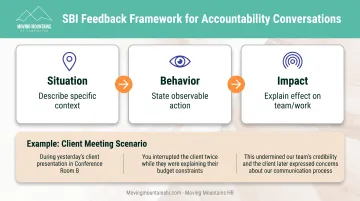
Conduct accountability conversations using the SBI framework:
- Situation: Describe the specific context
- Behavior: State the observable action (not judgment)
- Impact: Explain the effect on the team or work
Example: "During yesterday's client call (situation), you interrupted Sarah twice when she was explaining the timeline (behavior). The client looked confused and we didn't get clarity on their decision deadline (impact). Can we talk about how we coordinate in client meetings?"
This keeps feedback on facts and outcomes, not character, so it stays constructive.
Step 6: Address Performance Issues and Conflicts Promptly
Avoiding difficult conversations lets issues fester and damage team morale. CIPD's 2019 UK survey found that only 47% of employees said managers resolved conflict quickly and just 49% said managers resolved it effectively.
Framework for addressing performance problems:
- State the observable issue: "You've missed the last three project deadlines."
- Explain the impact: "This delayed the client launch and required two team members to work overtime."
- Ask for their perspective: "Help me understand what's happening."
- Agree on the goal: "We need all deliverables submitted on time."
- Discuss solutions together: "What support do you need? What will you commit to?"
- Document the agreement: Owner, actions, timeline, follow-up date
- Schedule a follow-up: Review progress in two weeks
When conflicts involve harassment, discrimination, a hostile work environment, or policy violations, bring in neutral third-party support.
Moving Mountains HR conducts workplace investigations through confidential interviews, evidence collection, and written findings so you can resolve sensitive matters fairly.
The Leader's Role in Driving Team Performance
Leaders set the tone for team culture through their own behaviors, not just their words. A 2018 meta-analysis of 2,448 teams found leadership explained 18% of variance in team learning. Person-focused behaviors support learning broadly, while task-focused behaviors help most on adaptive work.
Key leadership practices:
- Model accountability: do what you say you'll do, and own it when you don't
- Coach people to build skills and solve problems, not only assign tasks
- Celebrate wins publicly, including results and positive team behaviors
- Clear obstacles that block progress before they stall the team
- Build a positive climate first, then raise expectations
Task focus and relationship focus both matter. Task focus means clarifying goals, structuring work, setting deadlines, and monitoring progress. Relationship focus means building trust, showing empathy, supporting development, and creating psychological safety.
McKinsey research found supportive and consultative behaviors promote psychological safety, while authoritative behavior undermines it. A positive climate has to come first. Challenge only adds value once that foundation is in place.
Overcoming Common Team Performance Challenges
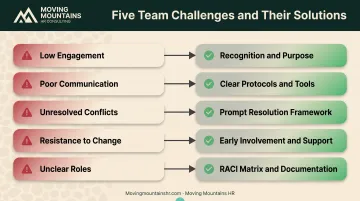
Even capable teams stall when the same friction points keep showing up. Low engagement, siloed communication, unresolved conflict, resistance to change, and unclear roles are the patterns leaders hit most often—and each one has a practical fix.
Challenge 1: Low Engagement and Motivation
Gallup reported that US employee engagement dropped to 31% in 2024, a 10-year low.
Symptoms and root causes:
- Unclear purpose or connection between work and business goals
- Lack of recognition or feeling undervalued
- Burnout from unsustainable workload
- No input into decisions affecting their work
Strategies to improve engagement:
- Reconnect individual work to team purpose and business impact
- Implement regular recognition practices (public acknowledgment, peer shout-outs)
- Address workload issues by redistributing work or reprioritizing goals
- Involve team members in planning and problem-solving decisions
- Provide growth opportunities through new projects or skill development
Challenge 2: Poor Communication and Information Silos
Communication usually breaks down for predictable reasons. Assumptions, missing systems, remote-work friction, personality differences, and unclear expectations all create gaps—and silos form fast when information lives in one person’s head or inbox.
Solutions:
- Establish explicit communication protocols: which channel for what, expected response times
- Use collaborative tools where information is visible to everyone who needs it
- Train on communication styles and how to adapt across different preferences
- Create redundancy for critical information (don't rely on one channel)
- Schedule regular cross-team updates to break down silos
- Record decisions and share them in a central location
Challenge 3: Unresolved Conflicts and Interpersonal Tensions
Conflict avoidance damages team performance. Productive conflict, focused on ideas and tasks, is healthy. Unresolved interpersonal conflict is destructive. Use a simple framework before tension hardens into lasting damage.
Conflict resolution framework:
- Address conflicts before they escalate
- Separate the problem from the people involved
- State each person's interests and concerns
- Generate options together
- Agree on a solution and owner
- Set a follow-up date to review progress
When conflicts involve harassment, discrimination, a hostile work environment, or policy violations, escalate to HR or a neutral third-party investigation. That path protects fairness and compliance.
Challenge 4: Resistance to Change or New Processes
A 2022 systematic review found resistance stems from workload concerns, uncertainty, fatigue, low participation in decisions, poor communication, and low trust.
Change management strategies:
- Involve the team early in discussing why change is needed
- Communicate the purpose and expected impact clearly
- Surface workload risks and adjust timelines or resources
- Provide training and support during the transition
- Maintain two-way updates: share progress and ask for feedback
- Recognize early adopters and quick wins
Challenge 5: Unclear Roles and Duplicated Efforts
Symptoms:
- Confusion about who is responsible for what
- Multiple people doing the same work
- Critical tasks falling through the gaps
- Frustration and inefficiency
Solutions:
- Create a RACI matrix for key deliverables and review it when work changes
- Document decision rights: who decides, who has input, who is informed
- Clarify handoffs between team members
- Define backup coverage for critical roles
- Conduct regular role-clarity exercises, especially after reorganizations
Measuring and Tracking Team Performance Success
Track both quantitative metrics and qualitative indicators. Numbers alone miss the team dynamics that produce results.
Quantitative metrics:
- Throughput per period (units completed, tickets resolved, projects delivered)
- Cycle time from start to completion
- On-time completion rate
- Error or rework rate
- Customer satisfaction scores
- Budget variance
These output measures show what the team delivers. Pair them with qualitative signals that explain how the work gets done.
Qualitative indicators:
- Goal clarity: Can everyone articulate team priorities?
- Role clarity: Does everyone know their responsibilities?
- Communication quality: Are exchanges clear, timely, and useful?
- Psychological safety: Do people feel safe taking risks and admitting mistakes?
- Trust: Do team members rely on each other and follow through on commitments?
- Engagement: Are people invested in team success?
Once you know what to measure, set a simple tracking rhythm.
Establish baselines and track progress:
- Define each metric, owner, data source, and review frequency
- Record starting values before making changes
- Review progress monthly or quarterly
- Compare the team with its own baseline before using external benchmarks
- Celebrate milestones when metrics improve
- Use data to identify areas needing continued focus
Pair lagging outcomes (results) with leading indicators (team processes) so you can spot problems before they hit final results.
Frequently Asked Questions
What is the best way to develop my team?
Start with an honest assessment of where the team stands, then build trust, set clear communication norms, and coach people against individual and team goals. Treat development as an ongoing practice, not a one-off workshop.
What are the 5 stages of team development?
Tuckman's model describes Forming (initial coming together), Storming (conflict and competition), Norming (establishing patterns and agreements), Performing (high productivity and collaboration), and Adjourning (completion and transition when the team disbands).
What are 5 characteristics of an effective team?
Clear shared goals, strong communication, mutual trust and respect, complementary skills with defined roles, and commitment to accountability.
How can I enhance team performance?
Performance improves through regular feedback and coaching, removing obstacles that block progress, recognizing and celebrating achievements, addressing conflicts promptly, and continuously developing team members' skills.
What three things would you do to improve your team?
Establish clear goals and expectations everyone understands, create regular communication rhythms for alignment and feedback, and build trust through consistent leadership behaviors and team engagement.
What are 5 qualities of a good team member?
Reliability and accountability, strong communication skills, willingness to collaborate and help others, openness to feedback and learning, and commitment to shared team goals over individual agendas.