Here's the problem: managers account for 70% of the variance in team engagement, according to Gallup's research on frontline managers. If you can't see how your managers lead day to day, you're flying blind on the single biggest driver of retention and performance.
This is why virtual leadership coaching has shifted from a perk to a necessity. Below, we'll define what it actually is, why it matters for your bottom line, the skills it builds, and what to look for when choosing a provider.
Key Takeaways
- Virtual leadership coaching drives behavior change through personalized remote sessions—not one-way training
- Managers shape up to 70% of team engagement, so their development is a financial priority—not an HR checkbox
- Strong virtual coaching hinges on accountability, digital active listening, and a 70/30 listen-to-talk ratio
- SMBs can get this support through fractional HR partnerships instead of a full-time executive
What Is Virtual Leadership Coaching?
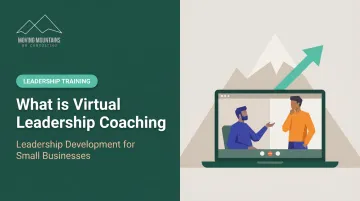
Virtual leadership coaching is structured, personalized leadership development delivered through video calls, messaging platforms, and digital assessments. It focuses on applying skills in real time rather than passively absorbing information.
Sessions typically happen one-on-one or in small groups. Instead of following a fixed curriculum, they're built around:
- Goal-setting specific to the leader's actual challenges
- Reflection on recent decisions and interactions
- Accountability for follow-through between sessions
When a manager is struggling with a remote direct report, pointed questions about that specific relationship—and accountability for trying a new approach—beat a generic communication course every time.
How Virtual Coaching Differs From Virtual Leadership Training
Training and coaching get lumped together, but they solve different problems.
According to SHRM, training transfers knowledge through standardized courses or workshops. Coaching enhances a person's ability to apply that knowledge, tailored to their specific situation.
| Training | Coaching |
|---|---|
| Standardized curriculum | Personalized to the leader |
| Knowledge transfer | Behavior application |
| Group workshops | One-on-one or small group dialogue |
| Fixed content | Goal-driven, evolving sessions |
Neither replaces the other. A manager might take a training course on giving feedback, then work with a coach to actually apply it to a specific underperforming employee.
What Effective Virtual Coaching Requires
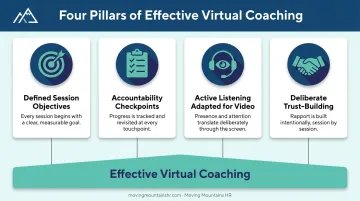
Effective virtual coaching depends on a few non-negotiables:
- Defined session objectives so meetings drive behavior change, not vague check-ins
- Accountability checkpoints between sessions to confirm follow-through
- Active listening adapted for video, where tone and body language are harder to read
- Deliberate trust-building, since in-person rapport does not transfer automatically to a screen
Most programs run on video conferencing, digital assessment tools, and goal-tracking software. The technology matters far less than the structure and confidentiality behind it. A polished platform with no follow-through plan will not change how leaders actually behave.
Why Virtual Leadership Coaching Matters for Your Business
That 70% engagement statistic isn't abstract. It's the difference between a team that sticks around and one that quietly starts job hunting.
Remote and hybrid work strips away the informal feedback loops that used to catch problems early. No hallway chats. No visible frustration in a team meeting. A manager who's micromanaging or communicating poorly can go unnoticed for months until it surfaces as turnover, complaints, or a formal HR issue.
The data backs up the urgency. Global employee engagement fell from 23% in 2023 to 21% in 2024, and manager engagement specifically dropped from 30% to 27%, according to Gallup's 2025 report on global engagement.
Why this hits your bottom line:
- Disengaged managers create disengaged teams
- Disengaged teams have higher turnover
- Turnover drives real cost through recruiting, hiring, and training replacements
- Virtual leadership coaching improves manager engagement and interrupts that cycle
For regulated industries like healthcare, the stakes climb higher. The Joint Commission has documented that disruptive workplace behavior contributes to medical errors, poor patient satisfaction, and staff turnover among qualified clinicians.
Strong frontline leadership isn't optional there. It shapes compliance culture and whether workplace issues get handled early—or escalate into formal HR complaints.
Essential Skills Virtual Leaders Need to Succeed
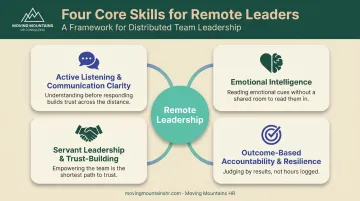
Leading a distributed team requires a different skill set than leading a room. Here's what separates managers who thrive remotely from those who struggle.
Active Listening and Communication Clarity
Remote managers can't rely on a quick verbal clarification in the hallway. They need to:
- Put expectations in writing, not just say them out loud
- Summarize decisions clearly after every meeting
- Choose the right channel: video for sensitive topics, async messages for routine updates
Ambiguity that would get resolved in five seconds in person can fester for days over Slack.
Emotional Intelligence
Tone is genuinely harder to read across a screen. A short reply that reads as terse might just be someone typing fast between meetings.
Leaders with strong emotional intelligence compensate by checking in on people, not just tasks. A University of Toledo study of over 200 managers found that higher EQ meant far less concern about leading remotely during disruption. Self-awareness and stress management mattered most.
Servant Leadership and Trust-Building
Distributed teams don't respond well to control-based management. Leaders who prioritize their team's growth over constant oversight build higher trust, which means less need to monitor every move. That dynamic matters more remotely, where micromanagement is both harder to hide and more damaging to morale.
Outcome-Based Accountability and Resilience
The best remote leaders shift from watching activity to measuring results:
- Define success upfront so everyone knows what "done well" looks like
- Set milestones that break large goals into checkpoints
- Model a growth mindset by treating setbacks as data, not failure
- Protect psychological safety so teams feel safe raising problems during change
How Virtual Leadership Coaching Works: Methods and the 70/30 Rule
Virtual leadership coaching starts with a clear picture of how a manager is actually performing. Coaches typically combine several assessment methods:
- Open-door policies that signal availability without requiring physical presence
- Anonymous pulse surveys to surface concerns employees won't say out loud
- 360-degree assessments gathering feedback from peers, direct reports, and supervisors
- Skip-level meetings where leadership hears directly from employees a level below the manager being coached
Used together, these methods catch blind spots any single channel would miss.
The 70/30 Listening Rule
The International Coaching Federation describes great coaches as spending roughly 70% of a session listening and 30% talking, asking reflective questions instead of handing down conclusions.
This gets harder on video. Silence feels more awkward when you're staring at a screen instead of sitting across a table, so coaches have to resist the urge to fill every pause.
A Realistic Timeline for Change
Behavior change doesn't happen after one session. A 30-60-90 day framework gives structure:
- Day 30: Confirm the manager has attempted the new behavior at least once
- Day 60: Assess consistency; is it becoming a habit or a one-off?
- Day 90: Measure actual change against the original baseline
Cost of Virtual Leadership Coaching and Choosing the Right Partner
What Affects the Cost
Coaching fees vary widely, and the 2023 ICF Global Coaching Study found the global average sits around $244 per one-hour session, ranging from roughly $114 to $277 depending on region.
What actually drives your quote:
- Coach experience and specialization — executive-focused coaches command higher rates
- Session frequency and length — weekly hour-long sessions cost more than monthly check-ins
- Format — one-on-one coaching typically costs more per person than group sessions
- Bundling — coaching folded into a broader HR or leadership development package often costs less than buying it standalone
There's no universal price tag. A custom quote based on your team size and goals is the only reliable way to budget.
What to Look for in a Provider
Before signing on with a coaching partner, check for:
- A proven methodology, not just a rotating cast of generic exercises
- Experience with remote or distributed teams specifically, not just in-person leadership backgrounds
- Industry-specific expertise — healthcare compliance requires different context than retail management
- Clear accountability structures, including how progress gets measured between sessions
If you need that mix of methodology, remote-team experience, and accountability without hiring a full-time HR executive, fractional support can fill the gap.
Moving Mountains HR's Fractional CHRO services (Premium tier of ongoing HR support) give small and mid-size businesses executive-level strategic guidance, performance management support, and culture development. Engagements are scoped to your company size and budget rather than a fixed, one-size-fits-all package.

Frequently Asked Questions
How much does virtual leadership coaching cost?
Cost depends on coach experience, session format, and how often you meet. Most organizations get a customized quote tied to their goals and engagement length.
What is the 70/30 rule in virtual leadership coaching?
Coaches should listen roughly 70% of the time and speak only 30%. Reflective questions help leaders reach their own conclusions instead of being told what to do.
What are the 7 C's of leadership coaching?
The seven C's are Clarity, Climate, Capability, Confidence, Commitment, Creativity, and Communication. Together they map a leader's readiness and ability to sustain real change.
What is the difference between virtual leadership coaching and virtual leadership training?
Training builds knowledge through standardized courses. Coaching applies that knowledge to a leader's specific, real-world challenges through personalized dialogue and ongoing accountability.
How long does it take to see results from virtual leadership coaching?
Meaningful behavior change usually takes several months. Use 30-60-90 day checkpoints instead of waiting for one final evaluation.
Can virtual leadership coaching be as effective as in-person coaching?
Yes. A 2023 meta-analysis published in Frontiers in Psychology found no statistically significant difference in effectiveness between virtual and in-person coaching when sessions are structured with consistency and clear accountability.