None of this shows up in a compliance checklist. A process can be procedurally "fair" by every legal standard and still leave people shaken, guarded, and less likely to ever report something again.
This guide breaks down what trauma-informed investigations actually are, the six principles behind them, a step-by-step process you can use, the mistakes that quietly sabotage good intentions, and when it's time to call in a neutral outside investigator.
Key Takeaways
- Trauma-informed investigations apply SAMHSA's six-principle framework to reduce harm and produce more reliable, defensible findings
- Fragmented memory, inconsistent statements, or flat affect are common trauma responses, not proof of dishonesty
- A structured interview approach (safety, transparency, open-ended questions, aftercare) improves both wellbeing and evidence quality
- Small businesses without dedicated HR or legal teams face outsized risk when investigations go wrong
- Complex or high-risk complaints often call for a neutral, trained third-party investigator
What Is a Trauma-Informed Workplace Investigation—And Why It Matters
A trauma-informed investigation recognizes that trauma changes how people remember, behave, and participate. It doesn't lower the evidentiary bar. It changes how information gets collected in the first place.
Traditional workplace investigations often borrow from a courtroom model: prove guilt or innocence, poke holes in the story, catch inconsistencies. That approach assumes memory works like a video recording. It doesn't.
During a traumatic event, the amygdala prioritizes sensory and emotional information over sequential detail. That's why a survivor might vividly recall a smell or a tone of voice but struggle to say what happened "first" versus "second." It's not evasiveness—it's how the brain encodes threat.
This isn't a fringe concern. A peer-reviewed study of nearly 3,000 U.S. adults found that 89.7% reported experiencing at least one significant traumatic event in their lifetime, according to Kilpatrick et al.'s 2013 research in the Journal of Traumatic Stress.
The sample wasn't a perfect national probability panel, but the takeaway holds: trauma history is common among the workforce walking into your interview room, not an outlier.
The Business Case
Handled poorly, investigations create three costly outcomes:
- Increased legal exposure from claims of retaliation or bad-faith process
- Higher turnover as employees lose trust in leadership
- Underreporting, which lets problems fester
Employees already hesitate to come forward. A process that feels like cross-examination gives them one more reason to stay silent.
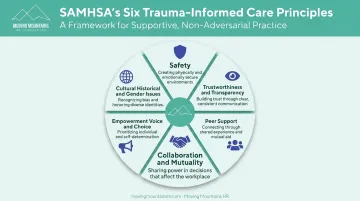
The 6 Core Principles of Trauma-Informed Investigations
These principles come from SAMHSA's trauma-informed care framework, originally built for healthcare and social services. HR has adapted them because they work just as well in a conference room as they do in a clinic.
Safety
Physical setup matters. Choose a private, low-noise room, or a stable virtual setting where the participant won't be interrupted.
Psychological safety matters just as much. Use a calm tone, open body language, and a clear statement that this is a safe space to speak honestly.
Trustworthiness and Transparency
Be clear from the start about:
- Your role in the process
- Investigation scope
- Confidentiality limits
- Next steps after the interview
Then follow through exactly as promised. Broken promises here destroy credibility fast.
Peer Support
Proactively tell every participant they can bring a support person and that resources like an Employee Assistance Program are available. Don't wait for them to ask. Most won't know it's an option unless you say so.
Collaboration and Mutuality
Frame the interview as joint fact-finding, not an interrogation. Questions like "Is there anything I should know?" or "Who else should I talk to?" shift the dynamic from adversarial to cooperative.
Empowerment, Voice, and Choice
Trauma often strips away a person's sense of control. Restore it through:
- Open-ended prompts that let them tell the story their way
- Comfort with silence instead of rushing to fill pauses
- Small choices such as interview timing, format, or whether to take a break
Cultural, Historical, and Gender Issues
Account for intersectionality and cultural communication norms. In some cultures, avoiding eye contact signals respect, not dishonesty. Use interpreters where needed, and question your own assumptions before you question the participant's honesty.
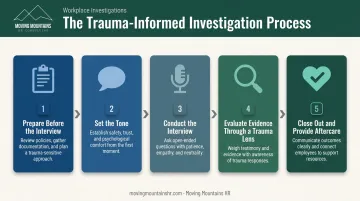
How to Conduct a Trauma-Informed Investigation: A Step-by-Step Guide
Step 1: Prepare Before the Interview
Review the complaint in full before you schedule anything. Choose a private location or a secure virtual setup, and draft open-ended questions in advance instead of a rigid interrogation script.
- Confirm exactly where confidentiality boundaries begin and end
- Notify the participant of their right to a support person
- Share available wellbeing resources before, not after, the interview
Step 2: Set the Tone at the Start
Explain your neutral role, the scope of the inquiry, confidentiality limits, and what happens to the information gathered. Don't rush this part.
Build rapport with an unhurried introduction. Let the participant choose small details, like where to sit. It sounds minor. It signals that they still have agency in a situation where they may feel like they have none.
Step 3: Conduct the Interview Using Trauma-Informed Techniques
Use broad prompts: "Tell me what happened" or "What else happened?" instead of forcing a strict chronological order. Trauma memory often surfaces in fragments, not a timeline.
- Allow silence without jumping in to fill it
- Avoid interrupting, even when the account jumps around
- Offer breaks proactively, not just when asked
- Watch for signs of fatigue or distress that signal it's time to pause
Step 4: Evaluate Evidence and Assess Credibility Through a Trauma Lens
Memory gaps, non-linear recall, and flat affect are common trauma responses. They are not automatic evidence of dishonesty, and treating them that way is one of the fastest ways to reach the wrong conclusion.
California's official workplace harassment guide is blunt on this point: most people cannot reliably judge truthfulness from demeanor alone. Weigh testimony against corroborating evidence, documents, and witness accounts instead of relying on how someone "seemed" while talking.
Step 5: Close Out and Provide Aftercare
Communicate findings and next steps within the timeframe you promised. Delays without explanation erode trust even when the eventual outcome is fair.
Check in on participant wellbeing after the interview concludes. Reconnect them with support resources if they need it. This step gets skipped constantly, and it's often the one participants remember most.
Common Mistakes That Undermine a Trauma-Informed Approach
Even well-intentioned investigators fall into these traps:
- Misreading trauma responses as deception. Inconsistent statements, avoided eye contact, or emotional flatness are read as red flags when they're often normal reactions to stress.
- Defaulting to rigid, chronological questioning. An interrogation-style script forces participants to fit their story into an order that doesn't match how they experienced it.
- Failing to follow through on promises. Skipping support person offers, missing stated timelines, or breaking confidentiality assurances does more damage than almost anything else in the process.
Each of these mistakes is fixable with training and structure. None require a legal background to fix—only awareness and consistency.
When to Bring in a Neutral Third-Party Investigator
Internal HR staff, especially at smaller organizations, often lack specialized trauma-informed interview training. Even skilled HR generalists can be perceived, fairly or not, as biased toward leadership. That perception alone can undermine an otherwise solid investigation.
Certain situations call for an outside investigator almost automatically:
- Complaints against senior leadership, owners, or the person who oversees HR
- Allegations of sexual harassment or discrimination with real litigation exposure
- Cases involving multiple complainants or conflicting witness accounts
- Situations where internal staff lack the time or specialized experience to conduct the inquiry properly
SHRM's investigation framework points to the same factors: the accused person's rank, the complexity of the complaint, and the internal team's actual investigation experience all affect whether an outside investigator is warranted.
When those factors line up, a neutral third party protects both the process and the people in it. Moving Mountains HR provides trauma-informed workplace investigations for small to mid-size businesses that need objective, legally defensible outcomes without a full internal HR or legal team.
The work centers on confidentiality, anti-retaliation education, and treating every participant with dignity from the first interview through the final report.
Frequently Asked Questions
What does "trauma-informed" actually mean in a workplace investigation?
It means recognizing how trauma affects memory, behavior, and participation—and adjusting interview techniques to match. It does not change the impartiality of the findings.
Does a trauma-informed approach compromise the neutrality of an investigation?
No. Trauma-informed practice changes how information is gathered, not the conclusions drawn. Investigators remain objective while minimizing unnecessary harm to participants.
How does trauma affect a witness's memory and credibility?
Trauma can cause fragmented or non-chronological recall and unusual demeanor during interviews. Neither should be automatically treated as a sign of dishonesty.
Do small businesses really need trauma-informed investigation practices?
Yes. Any business handling harassment, bullying, or discrimination complaints benefits from them. Even a legally "fair" process can retraumatize participants and create legal exposure.
Should both the complainant and the respondent be treated with a trauma-informed approach?
Yes. Dignity, safety, and fair process apply to everyone involved, including witnesses and the person accused, not just the complainant.
When should a company hire an outside investigator instead of handling it internally?
Bring in a neutral, trained third-party investigator for complex, sensitive, or high-risk complaints. That usually includes matters involving senior leadership, harassment allegations, or clear litigation risk.