The business case is compelling. While vendor claims about emotional intelligence have been overstated, research shows a moderate association between emotional intelligence and job performance, with a meta-analysis of 78,159 participants finding a correlation of .29. More importantly, these capabilities are learnable: a 2024 workplace meta-analysis found that emotional intelligence training produced moderate, measurable improvements that persisted beyond three months.
Key Takeaways
- Emotional intelligence and soft skills are learnable competencies that raise workplace performance and help leaders keep strong people longer
- Self-awareness is the foundation: know your emotions and how they affect others, and every other interpersonal skill gets easier
- High emotional intelligence cuts conflict and supports clearer decisions and stronger workplace relationships
- Small businesses can assess and build these skills with practical, budget-conscious strategies
What Are Emotional Intelligence and Soft Skills?
Emotional intelligence (EI) is the learned ability to identify, understand, and manage emotions in yourself and others in healthy, productive ways. First defined by researchers Mayer and Salovey in 1990, EI covers four key abilities:
- Perceiving emotions
- Using emotions to facilitate thinking
- Understanding emotions
- Managing emotions
Soft skills are interpersonal competencies including communication, teamwork, adaptability, problem-solving, and leadership that enable effective collaboration. The US Department of Labor identifies professionalism, communication, teamwork, and critical thinking as foundational workplace soft skills.
The Relationship Between EI and Soft Skills
Emotional intelligence serves as the foundation upon which all soft skills are built. Effective communication depends on understanding how your words land with others. Conflict resolution falls apart if you can't manage your own reactions. And authentic leadership simply doesn't work without empathy.
The Learnability Myth
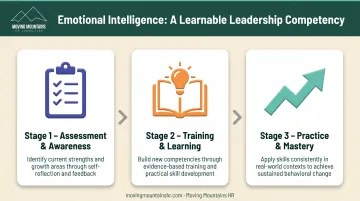
A common misconception holds that these are innate traits you either have or don't. That isn't the case. Emotional intelligence and soft skills are competency-based capabilities that can be systematically taught and developed through guided practice, feedback, and real-world application.
Hard Skills vs. Soft Skills
Hard skills are technical, measurable abilities: accounting proficiency, software development, equipment operation. Soft skills are interpersonal, relationship-oriented abilities that determine how effectively you apply those technical capabilities in a team environment.
Both are essential, but soft skills increasingly differentiate candidates for career advancement. When technical qualifications are similar, employers consistently choose candidates with stronger interpersonal capabilities.
Why Emotional Intelligence and Soft Skills Matter in the Workplace
Productivity and Performance Impact
The 2022 meta-analysis of 78,159 participants found that emotional intelligence correlates with several key workplace outcomes:
- Job performance (correlation of .29)
- Organizational citizenship behavior (.36)
- Job satisfaction (.29)
- Reduced job stress (-.43)
- Organizational commitment (.26)
These figures are associations, not guaranteed returns. Still, they show that emotionally intelligent employees tend to perform better, stay more committed, and handle stress more effectively.
Retention and Engagement Advantage
Organizations with emotionally intelligent leaders experience lower turnover because employees feel valued, respected, and understood. When Catalyst surveyed nearly 900 US employees, they found clear gaps under highly empathic senior leaders:
- 76% engagement versus 32% under less empathic leaders
- 61% innovation versus 13%
- Lower intent to leave, including among women of color
Leadership Effectiveness
Emotionally intelligent leaders inspire discretionary effort: team members go above and beyond because they respect and trust their leader.
A 2026 review of 101 leader-EI studies found that 23 of 27 performance studies showed positive associations. Most of those studies were cross-sectional, so causation is still unresolved.
The Cost of Low Emotional Intelligence
Lack of emotional intelligence leads to:
- Workplace conflict that consumes management time and damages team dynamics
- Poor communication that creates costly errors and delays
- Increased stress and burnout that drive turnover
- Emotional "hijacking" that impairs decision-making during critical moments
- Damaged workplace relationships that reduce collaboration
The Small Business Multiplier Effect
For small and mid-size businesses, emotional intelligence and soft skills become especially critical. Every team member's impact is magnified when you have 15 employees instead of 1,500. Toxic dynamics spread quickly in close-knit environments. One manager's lack of emotional regulation can poison an entire department.
Moving Mountains HR works with small and mid-size businesses across California and the United States on these challenges. Customized training in leadership, communication, employee relations, and conflict resolution builds the emotional intelligence foundation those skills require.
The 5 Elements of Emotional Intelligence
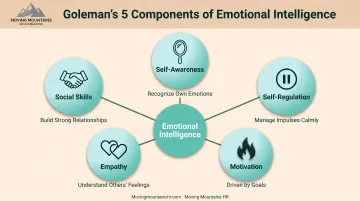
Daniel Goleman's 1998 framework identified five components of workplace emotional intelligence. His current model reorganizes these into four domains with 12 competencies, but the original five-element framework remains widely recognized.
Self-Awareness
Self-awareness means understanding your emotions, strengths, weaknesses, values, and how your behavior affects others. It's the foundation of all other EI capabilities. You can't manage what you don't recognize.
Practical self-awareness practices:
- Morning reflection – Spend five minutes identifying your emotional state and potential triggers for the day ahead
- Journaling – Write about situations that provoked strong reactions to identify patterns
- Seeking honest feedback – Ask trusted colleagues how you come across during meetings or stressful situations
- Recognizing emotional patterns – Notice which situations consistently trigger frustration, defensiveness, or withdrawal
Self-Regulation
Self-regulation is managing your emotional reactions, controlling impulses, and responding thoughtfully rather than reactively. It's the pause between stimulus and response.
Consider receiving a frustrating late-night email from a colleague. Self-regulation means recognizing your anger, choosing not to fire off an immediate response, and waiting until morning to reply with a clear head. You still address the issue. You simply do so more effectively.
Motivation
Intrinsic motivation means being driven by internal fulfillment and passion rather than external rewards like praise or bonuses. Intrinsically motivated employees take initiative, embrace challenges, persist through setbacks, and inspire colleagues through their commitment.
In small and mid-size teams, that drive often shows up as people who improve processes without being asked and stay with hard problems longer than external incentives alone would explain.
Empathy
Empathy is the ability to understand and share the feelings of others, recognizing their perspectives and responding with compassion. Empathy is not the same as agreement. You can understand someone's frustration without accepting their position.
A Catalyst survey found that employees under highly empathic leaders reported higher engagement, innovation, and retention intentions. Empathy delivers measurable business results, not just a warmer culture.
Social Skills
Social skills encompass the ability to build and maintain relationships, communicate effectively, resolve conflicts, and work collaboratively toward common goals. Strong social skills include:
- Active listening without interrupting or planning your response
- Giving and receiving feedback constructively
- Networking authentically rather than transactionally
- Reading verbal and nonverbal cues in conversations
- Adapting your communication style to different audiences
Essential Soft Skills for Today's Workplace
The World Economic Forum's 2025 Future of Jobs Report surveyed 1,043 employers representing 14.1 million workers across 55 economies. Employers ranked the skills they consider most essential—a mix of technical and human capabilities:
- Analytical thinking (69%)
- Resilience and flexibility (67%)
- Leadership and social influence (61%)
- Creative thinking (57%)
- Motivation and self-awareness (52%)
- Technological literacy (51%)
- Empathy and active listening (50%)
Alongside emotional intelligence, these soft skills show up most often in strong workplaces:
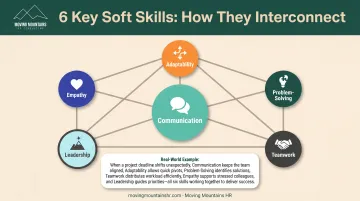
- Communication – Written, verbal, and nonverbal expression
- Teamwork and collaboration – Working effectively toward shared goals
- Adaptability and flexibility – Navigating change and ambiguity
- Problem-solving and critical thinking – Analyzing situations and generating solutions
- Conflict resolution – Addressing disagreements constructively
- Time management – Prioritizing tasks and meeting deadlines
- Leadership – Influencing others and driving positive change
How Soft Skills Work Together
These capabilities reinforce each other. Effective communication combined with empathy enables better conflict resolution. Adaptability paired with problem-solving helps teams navigate unexpected change. Leadership draws on all of them.
Real scenario: A key project deadline shifts forward by two weeks due to a client emergency. The team lead communicates the change clearly, acknowledges frustration with empathy, and figures out what can be deprioritized.
They reorganize workflows and use teamwork to spread the extra burden fairly. Without these soft skills, the same situation turns into panic, resentment, and finger-pointing.
How to Develop Emotional Intelligence and Soft Skills in Your Organization
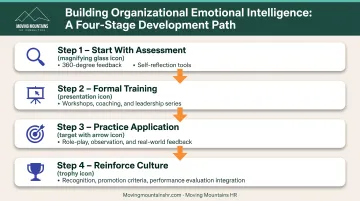
Start With Assessment
Help employees understand their current baseline through:
- Structured self-reflection on emotional patterns and interpersonal strengths
- 360-degree feedback from peers, direct reports, and supervisors
- Professional tools such as the MSCEIT (ability-based) or ESCI (competency-based multi-rater)
Use multiple methods and reassess targeted behaviors over time. Don't treat one score as hiring truth—assessments provide starting points for development, not permanent labels.
Formal Training and Coaching
The 2024 meta-analysis of workplace EI training found moderate effects that persisted beyond three months. A separate 2023 meta-analysis of workplace coaching showed an overall effect size of .44, with skill outcomes reaching .72.
Effective development methods:
- Workshops on active listening, feedback delivery, or emotion management
- One-on-one coaching for leaders building specific competencies
- Peer mentoring that pairs strong communicators with colleagues still building those skills
- Leadership series that stack skills across multiple sessions
Moving Mountains HR designs these programs around each client's industry, workforce, and culture—through workshops, leadership series, or coaching on communication, performance management, and conflict resolution.
Practice and Real-World Application
Knowledge without practice doesn't change behavior. Create opportunities for employees to:
- Role-play difficult conversations and conflict scenarios in low-stakes settings
- Watch skilled colleagues handle tough interpersonal moments
- Get regular feedback on real interpersonal interactions
- Apply new skills to current workplace situations right away
Reinforce the habit in how you run the business:
- Recognize collaborative, emotionally intelligent behavior in public and private feedback
- Weight soft skills in promotion criteria, not only technical output
- Include interpersonal competencies in performance evaluations
Frequently Asked Questions
Can you give me some examples of how to manage my emotions?
Pause, take three deep breaths, and label the feeling out loud ("I'm frustrated because...") to lower intensity. Step away briefly if needed, ask whether it will matter in six months, and gather facts before reacting—most conflicts come from misunderstanding, not malice.
What are the 5 C's of emotional intelligence?
Goleman's 1998 framework names five elements: self-awareness, self-regulation, motivation, empathy, and social skills. Some sources use a nonstandard "Five Cs" list; for clarity, stick with Goleman, Mayer-Salovey, or NACE.
What are the 7 major soft skills?
No universal seven-skill list exists. NACE defines eight career-readiness competencies, including communication, critical thinking, leadership, professionalism, and teamwork. A practical set is communication, teamwork, problem-solving, adaptability, leadership, time management, and conflict resolution—all grounded in emotional intelligence.
How can emotional intelligence improve workplace productivity?
High EI cuts time lost to conflict and miscommunication, supports clearer decisions under pressure, and improves engagement and collaboration. Meta-analyses in 2022 and 2024 found moderate links between EI, job performance, and training gains—useful effects, not guaranteed productivity percentages.
Can soft skills be taught to employees?
Yes. Soft skills are learnable competencies, not fixed traits. Workplace EI training shows moderate effects that last beyond three months, and one randomized trial reported a 13.5% productivity gain from a bundled soft-skills program. Gains still depend on practice, feedback, and a supportive culture.
How do you assess emotional intelligence in the workplace?
Use more than one method: 360-degree feedback, observation in real team and conflict situations, and self-assessment tools. HR partners can run structured evaluations and tie results to development plans. Moving Mountains HR helps small and mid-size businesses build performance systems and training that strengthen leadership and communication.
Emotional intelligence and soft skills matter in collaborative, change-driven workplaces. The evidence shows they can be learned, measured, and improved with deliberate practice and organizational support.
Moving Mountains HR helps California and US small businesses with customized training, performance management, and strategic HR guidance. Contact us to build the leadership and soft skills that drive results.