Introduction: What Is Employee Development and Training?
Many small to mid-size business owners want to retain top talent and stay competitive, yet they're unsure how to invest in their workforce strategically. The pressure intensifies when 75% of organizations struggled to fill full-time positions in 2024, making building skills in-house essential.
Employee development and training work together to build a stronger workforce. Training covers the job-specific skills people need to perform in their current roles. Development focuses on long-term career growth and skills for future roles.
Together, they help small businesses compete for talent without the overhead of a large HR department.
This article explores the distinction between development and training, why both matter, practical implementation steps, and how to overcome common challenges—especially for businesses without dedicated HR teams.
Key Takeaways
- Training targets immediate job skills; development builds long-term career and leadership capability
- 76% of workers are more likely to stay with employers that offer continuous training
- On-the-job learning, mentoring, and cross-training deliver results without massive budgets
- Start with one business-linked skills gap and a measurable goal not a large course catalog
- Manager buy-in and protected learning time drive better skill transfer to daily work
Why Employee Development and Training Matters for Your Business
Retention and engagement remain hard problems for most employers. Among 717 U.S. employees who voluntarily left their jobs, 42% said something could have been done to prevent the departure.
Nearly half (45%) said no manager had discussed their satisfaction, performance, or future in the prior three months. Development plans and career conversations close that gap.
When employees get training, they feel valued and ready to succeed. In a 2022 study of 1,001 U.S. workers:
- 55% wanted more training to do their jobs well
- 38% wanted training more relevant to their current roles
Employers who meet that demand see real results. Teams led by managers who completed strengths-based development had 21%–28% less turnover than comparison teams.
A workforce that keeps learning adapts faster to market shifts, regulatory changes, and new technology. When hiring stays difficult, building skills inside the company is a business priority—not an optional perk.
Employee Development vs. Employee Training: Understanding the Difference
Employee Training: Building Skills for Today
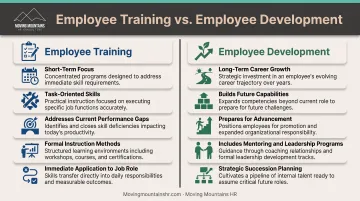
Training is a formal process for improving workplace performance through short-term, task-oriented learning. It fills immediate knowledge or skill gaps that affect current job performance.
Common training scenarios include:
- Onboarding new hires on company software and internal systems
- Compliance training for regulatory requirements such as workplace safety or anti-harassment policies
- Technical skills training for specific tools, equipment, or processes
- Role-specific instruction before launching new products or implementing system changes
Use training when you need to:
- Address an identified performance gap that affects current output
- Ensure compliance with regulations or industry standards
- Prepare teams for specific projects or system implementations
- Standardize processes across departments or locations
Moving Mountains HR builds short, practical training—virtual or in person—on topics like California employment compliance, supervisor skills, and conflict resolution so employees can apply what they learn on the job right away.
Employee Development: Preparing for Tomorrow
Development takes a holistic, long-term approach to growing employees' careers beyond their current positions. It builds capability, adaptability, and leadership readiness over time.
Development activities include:
- Leadership programs that prepare employees for management roles
- Cross-functional projects that broaden understanding of the business
- Mentorship relationships that facilitate knowledge transfer
- Professional certifications that enhance credentials and expertise
- Soft-skills training in communication, decision-making, and strategic thinking
Use development when you're focused on:
- Succession planning and building internal promotion pipelines
- Increasing employee engagement and retention through career growth
- Creating future leaders who understand your organization's culture
- Supporting advancement opportunities that keep high performers motivated
Why Both Matter for Small Businesses
Training ensures day-to-day operations run smoothly by equipping employees with the specific skills their roles require. Development builds long-term organizational capacity and loyalty by showing employees a future within your company.
Small businesses often assume comprehensive development programs require large budgets or dedicated HR teams. That's not true.
Effective programs start with one business-linked skills gap, protected practice time, manager follow-up, and a simple evaluation plan. Even modest learning investments pay off when they tie directly to real business needs.
Types of Employee Development and Training Methods
Formal Training Methods
Formal training includes structured workshops, courses, certifications, and degree programs delivered by external providers or internal subject-matter experts.
When formal training works best:
- Knowledge gaps require expert instruction not available internally
- Certifications or credentials provide competitive advantage
- Regulatory compliance mandates specific training content
- Multiple employees need the same foundational skills
In 2024, organizations spent an average of $1,283 per employee on direct learning expenditures. Select programs that align clearly with business goals and skill gaps identified through your needs assessment.
On-the-Job Training and Experiential Learning
Hands-on learning through job shadowing, stretch assignments, cross-training, and real-world project work represents the most cost-effective method for small businesses. A 2019 study found 55% of organizations emphasized on-the-job learning to a high or very high extent, with another 33% doing so moderately.
Effective on-the-job approaches:
- Pairing new hires with experienced colleagues for guided practice
- Rotating employees through different departments to build cross-functional knowledge
- Assigning progressively challenging tasks that stretch capability
- Documenting processes while employees learn them, creating training materials for future hires
This method reduces purchased instruction costs but requires manager time for supervision, feedback, and coaching.
Coaching and Mentorship Programs
Pairing employees with experienced colleagues facilitates knowledge transfer and professional growth. A 2023 meta-analysis of 11 workplace studies found coaching has a moderate positive effect on workplace outcomes, with virtual and face-to-face coaching producing similar results.
Structuring mentorship without extensive resources:
- Match employees based on complementary skills and career interests rather than formal hierarchies
- Set clear expectations for meeting frequency and discussion topics
- Focus on specific goals such as leadership readiness or technical skill development
- Provide basic guidelines but allow relationships to develop naturally
Moving Mountains HR can help structure coaching support through ongoing HR packages that include participation in company HR meetings and fractional CHRO guidance.
Digital and Self-Paced Learning
Online courses, webinars, e-learning platforms, and microlearning offer flexibility for busy teams and remote workers. A 2024 survey found 71% of organizations reported at least half of their learning was blended (combining digital and other methods).
Advantages for small businesses:
- Employees learn at their own pace without disrupting operations
- Content can be accessed repeatedly for reinforcement
- Lower cost per participant than in-person instruction
- Scalable across distributed or growing teams
A 2025 review of microlearning reported gains in knowledge, on-the-job behavior, and engagement, making it a strong fit for narrow, just-in-time learning goals. For small teams, digital learning works best as a flexible delivery option paired with hands-on practice.
Leadership Development Programs
Investing in leadership development prepares employees for management roles and builds internal succession pipelines. Topics include strategic thinking, delegation, feedback delivery, conflict management, and team motivation.
Leadership development for small organizations:
- Start with frontline supervisors who directly affect team performance
- Use action learning that solves real business problems while teaching leadership concepts
- Rotate leadership of cross-functional projects to build experience
- Provide coaching and feedback from senior leaders or external consultants
Gallup's research shows manager development reduces turnover by 21%-28% in teams led by those managers.

How to Create an Effective Employee Development Program
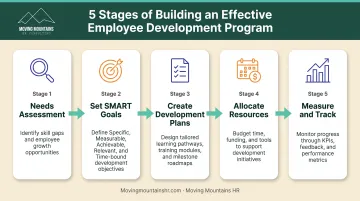
Start with a needs assessment. Identify skills gaps, business goals, and career aspirations through surveys, performance reviews, and direct conversations. The U.S. Office of Personnel Management framework starts with business-linked performance requirements, then organization, task, and person analysis—before you choose methods or budgets.
Set clear, measurable goals. Use SMART goals (Specific, Measurable, Achievable, Relevant, Time-bound) that tie each objective to a required competency. Prefer "By Q3, customer service representatives will resolve 90% of tier-one inquiries without escalation" over "improve customer service skills."
Create personalized development plans. One-size-fits-all programs waste resources. A strong individual contributor may want technical depth; another may want a path into management. Match learning paths to strengths, interests, and career goals.
Allocate resources strategically. Map budget, time, and available learning tools. Protected learning time, manager follow-up, and real chances to apply new skills often matter more than expensive courses.
Establish metrics and tracking systems. Measure progress with the Kirkpatrick levels:
- Reaction: Did participants find it useful?
- Learning: Did they gain knowledge or skill?
- Behavior: Did they apply it on the job?
- Results: Did it move business outcomes?
Also track cost, completion, demonstrated learning, workplace application, and the original business KPI.
Build manager buy-in. Train managers on their role in development and give them tools and time to coach their teams. Skill transfer hinges on supervisor and peer support, coaching, feedback, practice, and reflection.
Best Practices for Implementing Employee Development Programs
A few operating habits separate programs that change how people work from ones that fade after the session ends.
Make development a regular part of performance conversations. Integrate it into one-on-ones and reviews rather than treating it as a separate initiative. Among employees who left voluntarily, 45% said no manager had discussed their satisfaction, performance, or future in the prior three months. Career conversations close that gap before people disengage.
Encourage a culture of continuous learning. Give employees room to try new things, make mistakes, and ask questions without fear of punishment. When leaders model learning and share their own development experiences, growth reads as expected at every level.
Provide time and space for learning. Build development into work schedules instead of pushing it to nights and weekends. In a 2022 study, 25% of workers cited too little work time as a training barrier. Protected learning time shows real commitment and improves completion rates.
Design training so skills show up on the job. Include realistic practice, feedback, reflection, manager follow-up, peer support, and chances to apply new skills right away. A 2022 review found these design and work-environment factors strongly affect whether training improves daily performance.
Common Challenges and How to Overcome Them
Budget, time, and engagement stop many development programs before they pay off. Each barrier is common—and each has a practical fix.
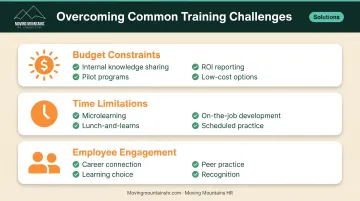
Budget constraints topped a 2022 survey, with 54% of HR managers saying leadership doesn't treat learning and development as an investment. Overcome this by:
- Highlighting low-cost options like internal knowledge sharing, cross-training, job rotation, and free online resources
- Starting with one small pilot tied to an operational KPI
- Reporting learning, application, and results separately to demonstrate value
- Calculating ROI only when benefits can be credibly monetized
Time limitations hit both administrators and employees. In the same survey, 33% cited too little time to run programs, and 25% of workers said they lacked time during the workday. Address this through:
- Microlearning modules that take 5-15 minutes
- Lunch-and-learn sessions that combine learning with breaks
- On-the-job development built into daily work
- Manager-scheduled practice time written into project plans
Lack of employee engagement undercuts results. Another 33% of workers cited motivation issues, and 25% said they quickly forgot what they learned. Improve engagement by:
- Connecting development opportunities directly to career aspirations
- Providing choice in learning paths and methods
- Using peer practice, mentoring, feedback, and retrieval exercises
- Recognizing participation and progress publicly
For small businesses without internal HR teams, fractional HR consultants like Moving Mountains HR can design programs, source materials, track progress, and support managers—without the cost of a full-time hire.
Frequently Asked Questions
What are the benefits of training and development for employees?
Employees gain career advancement opportunities, increased job satisfaction, improved performance and confidence, and enhanced marketability. Continuous learning keeps skills current and opens pathways to higher-responsibility roles.
What types of training methods are used in employee development?
The main methods include formal instruction (workshops, courses, certifications), on-the-job learning (job shadowing, stretch assignments), coaching and mentorship, digital learning (online courses, webinars, microlearning), and leadership programs.
How do training programs impact employee performance?
Training fills skills gaps, increases productivity and efficiency, reduces errors, and builds confidence in tackling new challenges. Measure the targeted work behavior or KPI before and after training to quantify impact.
What are the best practices for employee development and training?
Align programs with business goals, personalize learning paths, and fold development into regular manager conversations. Measure what changed on the job, and design for transfer with practice, feedback, and manager support.
What is the role of HR in training and development?
HR identifies needs, designs programs, coordinates resources, tracks progress, and supports managers. For businesses without internal HR teams, fractional HR consultants can fulfill this role by providing design expertise and ongoing guidance.
What are the stages of employee development?
The typical progression includes needs assessment, goal setting, creating a development plan, implementing learning activities, providing ongoing feedback and coaching, and evaluating and adjusting based on results.
Ready to build a strategic employee development program? Moving Mountains HR helps small and mid-size businesses design practical training and development initiatives tailored to your workforce, culture, and goals—no full-time HR executive required.
Contact us at 866-474-3575 or questions@movingmountainshr.com to discuss how we can support your team's growth.