Introduction
Picture a five-person search committee reviewing resumes for a director role. Everyone agrees the strongest candidate "just felt right" — she went to the same university as two panel members, and her communication style mirrored their own. Nobody flagged race, gender, or age. Yet the committee just filtered out several equally qualified candidates without realizing it.
This happens constantly, even in organizations that genuinely value diversity. Women hold 49% of entry-level roles but just 29% of C-suite positions, and for women of color that number drops from 21% to a mere 7%, according to McKinsey's 2025 Women in the Workplace report. The pipeline isn't broken at entry — it's broken at every decision point in between, including hiring.
This guide covers:
- What implicit bias actually is
- The five types most likely to show up on a search committee
- Where bias enters the hiring process
- How structured training builds fairer, more defensible hiring decisions
Key Takeaways
- Implicit bias works below conscious awareness—even among committee members who genuinely value diversity
- Any of five search phases—from writing criteria to the final vote—can introduce bias
- Facilitated conversation-based training beats one-off lectures for building lasting awareness
- Knowing which interview questions are legally off-limits is as important as recognizing bias itself
- Formal criteria, rubrics, and documentation turn good intentions into defensible hiring decisions
What Is Implicit Bias & Why It Matters for Search Committees
Implicit bias refers to automatic mental associations (positive or negative) that shape judgment without a person's deliberate intent or awareness. It's distinct from explicit prejudice, which is conscious and stated. That distinction matters: implicit bias often doesn't match what someone believes about themselves.
A committee member who champions diversity in every all-hands meeting can still unconsciously rate a resume lower because the applicant's name sounds unfamiliar. That gap is automatic cognition at work, not hypocrisy.
The Data Behind the Problem
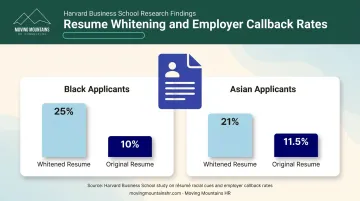
Real-world hiring experiments confirm this isn't theoretical. Research covered by Harvard Business School's Working Knowledge tracked 1,600 entry-level applications across 16 U.S. metro areas:
- Black applicants who removed racial cues ("whitening") received callbacks at 25%, vs. 10% when cues stayed
- Asian applicants saw a similar gap: 21% versus 11.5%
- In a 2012 PNAS study (Moss-Racusin et al.), identical science-faculty applications differed only by name—male-named applicants were rated more competent and hirable and offered a higher average starting salary
The organizational cost compounds over time. Narrower talent pools lead to weaker leadership pipelines, higher turnover among employees who don't see advancement paths, and greater exposure to discrimination litigation. The damage rarely stops at one weak hire; it shapes who advances, who stays, and what the culture rewards for years.
The 5 Common Types of Implicit Bias in Hiring
Search committees don't need a psychology degree to spot bias. They need to recognize five specific patterns.
Affinity Bias
This is the pull toward candidates who feel familiar: same alma mater, same hobbies, same communication style as the evaluator. It feels like "good chemistry" in an interview, but it narrows who advances. Left unchecked, affinity bias reproduces the existing team's demographics, hire after hire.
Confirmation Bias
Once a committee member forms an early impression (good or bad) they unconsciously hunt for evidence that confirms it and dismiss anything that contradicts it. A single confident answer in minute one can color how every later answer gets interpreted.
Halo/Horn Effect
One standout trait bleeds into the overall evaluation. A candidate with an impressive employer on their resume gets the benefit of the doubt everywhere else (halo). A candidate with an awkward opening answer gets marked down across unrelated competencies (horn).
Attribution/Perception Bias
Identical behavior gets read differently depending on who's exhibiting it. Assertiveness from one candidate reads as leadership potential; the same trait in a different candidate reads as aggression. A career gap gets attributed to poor commitment for one applicant and understandable circumstance for another.
Status Quo / Groupthink Bias
Committees gravitate toward candidates who resemble the existing team makeup.
The numbers here are stark: research analyzing 598 finalists and 174 job offers found that when a woman or minority candidate was the sole underrepresented finalist in a pool, their odds of being hired were statistically negligible. Once two or more underrepresented finalists made the shortlist, hiring odds shifted dramatically.
The composition of your finalist slate matters as much as the individuals on it.
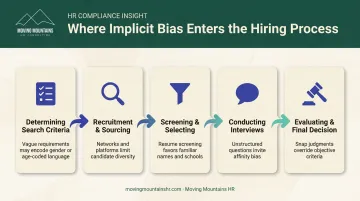
Where Bias Creeps Into the Search Process: 5 Critical Phases
Bias doesn't wait for the interview. It can enter and compound at every stage of a search.
Phase 1: Determining Search Criteria
Vague qualifications ("strong communicator," "culture fit") give evaluators room to substitute personal preference for job-relevant judgment.
Before anyone reviews an application, the committee should agree in writing on:
- Concrete, measurable, job-related criteria
- How each criterion will be scored
- What evidence counts (and what does not)
Phase 2: Recruitment & Sourcing
Relying on employee referrals, one industry conference, or a founder's personal network limits the applicant pool before evaluation even starts.
Broaden outreach from day one:
- Professional associations and affinity networks
- Targeted job boards beyond the usual defaults
- Community and campus partnerships
Phase 3: Screening & Selecting Candidates
Group review sessions amplify halo and affinity effects, since one loud opinion can sway the room. Better practice:
- Score applications individually against a pre-set rubric before any group discussion
- Require at least two independent reviewers per candidate
- Reconcile score differences by referencing specific evidence, not gut feeling
Phase 4: Conducting Interviews
Behavioral questions ("Tell me about a time you managed conflicting deadlines") produce more comparable, bias-resistant data than hypotheticals ("How would you handle...?"). They anchor evaluation in demonstrated past behavior, not imagined future performance.
Committees also need clear guardrails on what's off-limits. Questions about family status, age, national origin, marital status, or disability are often flatly prohibited under EEOC guidance.
Members should know what not to ask and what not to write in their notes.
Phase 5: Evaluating Candidates & Final Decision
Informal consensus-building, where the room just "talks it out," is where late-stage bias does the most damage.
Use formalized, criteria-based feedback forms that require every rating to tie back to the original job criteria. That structure keeps personality and affinity from deciding the hire at the finish line.
Building an Effective, Bias-Aware Search Committee Training Program
Effective bias training works best as a hands-on working session.
Run it as a facilitated conversation. When committee members talk through real scenarios together, you get more engagement and buy-in than a top-down slide deck. People retain what they work through as a group.
A solid training session should include:
- A shared working definition of bias the whole committee agrees on before the search starts
- Mock resume or CV review exercises that surface how the group's own instincts diverge from the agreed criteria
- A reference workbook the committee can pull out mid-search when questions arise
Timing matters as much as content. Training works best before criteria are finalized, ideally before the committee is even fully formed, so bias awareness shapes the process from day one.
Standing committees that hire repeatedly need refreshers, not a one-time session from years ago that nobody remembers.
Documentation needs the same rigor. Train committees to keep every note and evaluation form tied to job-related, criteria-based reasoning:
- Record only evidence linked to the posted criteria
- Skip vague labels like "not a fit" or "seemed disengaged"
- Treat casual phrasing as a liability if a hiring decision is later challenged
How Moving Mountains HR Supports Fair, Compliant Hiring Practices
Building bias-aware hiring processes takes ongoing discipline. Most small and mid-size organizations don't have the in-house bandwidth to maintain it. That's where Moving Mountains HR comes in.
Founded by Michelle Schwanhauser, the firm brings healthcare industry HR expertise to small and mid-size businesses and healthcare organizations. It helps clients design customized training programs and structured hiring criteria as part of broader HR consulting and compliance work. Programs use practical tools and real-world scenarios, not generic slide decks, and are tailored to each client's workforce and industry.
Support for fair, defensible hiring includes:
- Customized search-committee training built around real scenarios, not off-the-shelf decks
- Compliance packages (HR Document Audits, Fresh Compliance Docs, or combined Audit & Update) that turn vague practices into criteria-based processes
- Neutral third-party workplace investigations when bias or discrimination concerns surface after a hire
Because the firm operates outside internal reporting lines, it can conduct interviews, gather evidence, and deliver findings without the conflicts of interest that come with an internal review.

Ready to build a defensible, equitable search process? Book a free consultation with Moving Mountains HR to discuss a compliance audit or fractional CHRO support for your organization.
Frequently Asked Questions
What is implicit bias training?
It's structured education that helps individuals recognize unconscious attitudes affecting their decisions. Effective programs typically combine discussion, mock exercises, and practical tools rather than a one-time awareness lecture.
What are the 5 types of implicit bias?
The five most relevant to hiring are affinity bias, confirmation bias, the halo/horn effect, attribution/perception bias, and status quo or groupthink bias. Each one distorts evaluation in a different, predictable way.
How do you run a search committee?
Start by defining concrete, job-related criteria before reviewing applications. Assemble a diverse committee, use standardized interview questions for every candidate, and document decisions consistently against the original criteria.
How long should implicit bias training take?
Most effective sessions run 90 minutes to three hours and happen before the search begins, not after. Refresher sessions for standing committees improve long-term retention.
Is implicit bias training legally required?
It's not federally mandated for most private employers, but several states require it in regulated sectors like healthcare, and it's increasingly considered a best practice for reducing litigation risk everywhere else.
How often should search committees receive bias training?
Ideally before each major search cycle. Standing or recurring committees should get refresher sessions at least annually to keep awareness current.